

In today’s fast-paced digital world, businesses are constantly looking for the most effective way to reach their target audience online. With so many marketing channels available, choosing the right strategy can feel overwhelming. Two of the most powerful approaches are Search Engine Marketing and Social Media Marketing, but many people struggle to understand how they differ and which one delivers better results. Making the wrong choice can lead to wasted budget and missed opportunities.
In this blog on SEM Vs SMM, we will break down the key differences between these two marketing strategies in a simple and practical way. You will learn how each method works, its benefits, and when to use them based on your business goals. By the end, you will have a clear understanding of which strategy suits your needs and how to use both effectively for maximum growth.
What is Search Engine Marketing (SEM)?
Search Engine Marketing (SEM) is a digital marketing strategy that uses paid advertisements to increase a website’s visibility on search engines. It helps businesses appear at the top of search results when users search for specific keywords, commonly explained as what is sem in simple terms. SEM is commonly done through platforms like Google Ads, where advertisers bid on keywords to display their ads. This method delivers quick results and drives targeted traffic to websites. It is widely used for generating leads and increasing conversions.
1. How SEM Works?
SEM works by allowing businesses to create ads based on specific keywords that users search for online. When someone enters a query, search engines display paid ads at the top or bottom of the results page. Advertisers bid on keywords, and the highest-quality and most relevant ads get better placement. The system usually follows a pay-per-click model, meaning you only pay when someone clicks on your ad. Ad performance depends on factors like keyword relevance, ad quality, and landing page experience. Continuous optimization helps improve visibility and return on investment. You can better understand its benefits by exploring the advantages of search engine marketing.
2. Benefits of SEM for Businesses
- Provides instant visibility on search engines
- Drives highly targeted traffic to your website
- Works on a cost-per-click model, making it budget flexible
- Delivers measurable and trackable results in real time
- Helps generate leads and increase conversions quickly
- Allows businesses to compete effectively in competitive markets
What is Social Media Marketing (SMM)?
Social Media Marketing (SMM) is a digital marketing strategy that uses social media platforms to promote products, services, and brands, commonly understood as what is smm in simple terms. It helps businesses connect with their audience, build relationships, and increase brand awareness through engaging content and paid advertisements. Platforms like Facebook and Instagram are commonly used for SMM campaigns. This approach focuses on interaction, engagement, and long-term brand growth. It is widely used to attract and retain customers online.
1. How SMM Works?
SMM works by creating and sharing content such as posts, images, videos, and ads on social media platforms. Businesses target specific audiences based on interests, demographics, and behavior. Both organic content and paid ads are used to reach users effectively. Engagement through likes, comments, and shares helps increase visibility and brand recognition, which also highlights the benefits of social media marketing. Social media algorithms play a key role in determining content reach. Consistent posting and strategy optimization improve overall performance and audience engagement.
2. Benefits of SMM for Businesses
- Helps build strong brand awareness and online presence
- Increases customer engagement through likes, shares, and comments
- Allows precise audience targeting based on user interests
- Cost-effective compared to traditional marketing methods
- Supports long-term relationship building with customers
- Improves brand loyalty and trust among the audience
What is the Main Difference Between SEM and SMM?
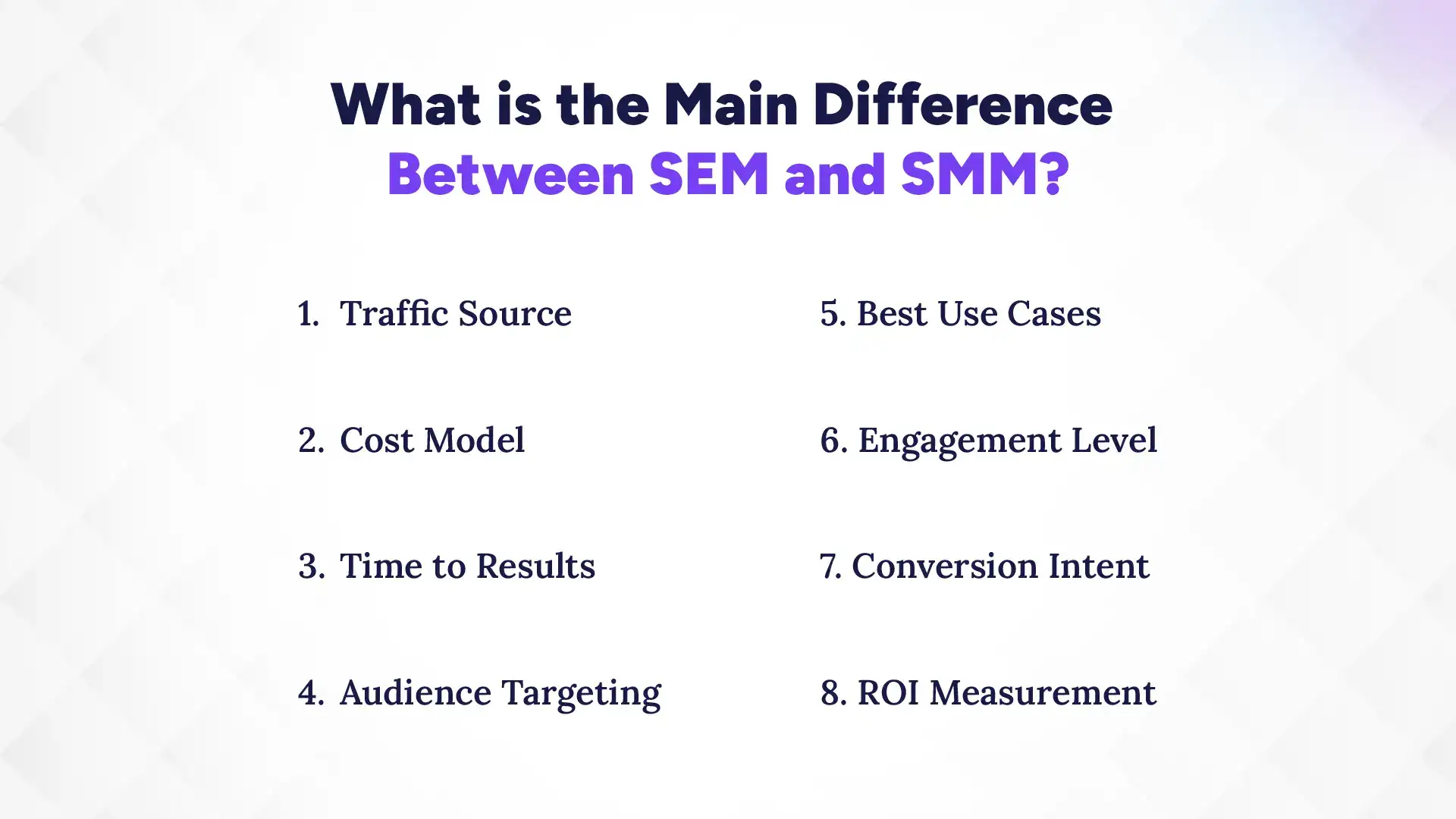
The main difference between SEM and SMM lies in traffic source, cost model, time to results, targeting, engagement, and conversion intent. SEM focuses on search engine-based paid ads to capture high-intent users, while SMM uses social media platforms to build awareness and engage audiences. SEM delivers faster results with direct conversions, whereas SMM focuses more on long-term brand building and interaction. Both strategies differ in how they attract, convert, and measure users. Choosing the right one depends on your business goals and marketing strategy.
1. Traffic Source
SEM drives traffic from search engines like Google, where users actively search for products or services. This means the audience already has the intent to take action. On the other hand, SMM brings traffic from social media platforms where users are browsing content. This makes SMM more discovery-based rather than intent-driven. SEM captures demand, while SMM creates demand. Both sources serve different stages of the customer journey.
2. Cost Model
SEM mainly works on a pay-per-click model where advertisers pay only when users click on ads. This allows better control over the budget and spending. SMM can be both organic and paid, depending on strategy. Paid social ads also use CPC or CPM models. Organic social media does not require direct cost but needs time and effort. Cost structure varies significantly between the two.
3. Time to Results
SEM delivers instant visibility and quick results once campaigns are live. Businesses can start generating traffic and leads immediately. SMM usually takes more time to build an audience and engagement. Organic growth on social platforms requires consistency and patience. Paid SMM can speed up results, but still focuses on engagement. SEM is faster, while SMM is gradual.
4. Audience Targeting
SEM targets users based on search intent and keywords. This ensures ads reach people actively looking for solutions. SMM targets audiences based on demographics, interests, and behavior. It allows businesses to reach users even before they search for a product. Social media targeting is more detailed and personalized. SEM focuses on intent, while SMM focuses on audience behavior.
5. Best Use Cases
SEM is best for lead generation, sales, and high-intent conversions. It works well for businesses that want quick results. SMM is ideal for brand awareness, engagement, and community building. It helps businesses connect with audiences emotionally. Both strategies serve different marketing objectives. Choosing depends on your business needs.
6. Engagement Level
SMM offers higher engagement through likes, comments, shares, and interactions. It helps build relationships with customers over time. SEM has limited engagement as users mainly click and visit websites. Social platforms encourage conversations and feedback. Engagement is a key strength of SMM. SEM focuses more on action than interaction.
7. Conversion Intent
SEM targets users with high purchase intent since they are actively searching. This leads to higher conversion rates. SMM targets users in the awareness and consideration stage. Conversions may take longer, but they build stronger relationships. SEM is conversion-focused, while SMM is awareness-driven. Both play different roles in the funnel.
8. ROI Measurement
SEM provides clear and measurable ROI through clicks, conversions, and cost tracking. It is easy to analyze campaign performance. SMM also offers analytics but focuses more on engagement metrics. Measuring direct ROI in SMM can be more complex. Both require tracking tools for optimization. SEM is more performance-driven, while SMM balances performance and branding.
| Factor | SEM (Search Engine Marketing) | SMM (Social Media Marketing) |
|---|---|---|
| Traffic Source | Traffic comes from search engines like Google, where users actively search for products or services | Traffic comes from social media platforms where users browse content and discover brands |
| Cost Model | Primarily a pay-per-click model, where you pay only when users click on ads | Can be both organic and paid, using CPC, CPM, or free content strategies |
| Time to Results | Delivers instant results and immediate visibility once campaigns go live | Takes time to build an audience and engagement, especially for organic growth |
| Audience Targeting | Targets users based on keywords and search intent | Targets users based on demographics, interests, behavior, and engagement patterns |
| Best Use Cases | Best for lead generation, direct sales, and high-intent conversions | Best for brand awareness, engagement, and building customer relationships |
| Engagement Level | Limited engagement, mainly focused on clicks and conversions | High engagement through likes, comments, shares, and interactions |
| Conversion Intent | High-intent users are ready to take action or make a purchase | Lower intent users in the discovery or awareness stage |
| ROI Measurement | Easy to measure with clear metrics like clicks, conversions, and cost per result | More complex, focuses on engagement, reach, and long-term brand impact |
When to Choose SEM and SMM: How to Decide?
You should choose SEM and SMM based on your business goals, budget, audience behavior, and whether you need quick results or long-term brand growth. SEM is ideal when you want immediate visibility and conversions, while SMM works best for building awareness and engagement over time. The right choice depends on how your target audience interacts online and what stage of the marketing funnel you are focusing on. In many cases, using both together delivers the strongest results. Understanding your objectives helps you select the most effective strategy.
1. Choose SEM When You Need Immediate Results
SEM is the best choice when your business needs fast traffic and quick conversions. It works well for product launches, promotions, or urgent campaigns. Since it targets high-intent users, results come quickly. Businesses can start generating leads almost immediately. It is ideal for competitive industries where speed matters. SEM helps you achieve short-term marketing goals effectively. It is useful when time is a critical factor.
2. Choose SMM for Brand Awareness and Engagement
SMM is perfect when your goal is to build brand awareness and connect with your audience. It focuses on long-term engagement rather than instant sales. Social media helps create strong relationships with users, and learning how to do social media marketing is important for using these platforms effectively. It increases visibility through content sharing and interaction. This approach builds trust over time. SMM is ideal for growing brand identity. It also helps in building a loyal audience base.
3. Choose Based on Your Target Audience Behavior
Your audience behavior plays a key role in deciding between SEM and SMM. If users actively search for your product, SEM is more effective. If they spend more time on social platforms, SMM works better. Understanding where your audience is active is important. This helps in choosing the right channel. Matching strategy with behavior improves results. It ensures better engagement and conversions.
4. Consider Your Marketing Budget and Resources
SEM usually requires a dedicated ad budget for consistent performance. Costs depend on keyword competition and bidding. SMM can be more flexible with both paid and organic options. Small businesses can start with organic social media. Budget planning helps avoid overspending. Choosing based on resources ensures better ROI. It helps businesses allocate funds efficiently.
5. Evaluate Your Business Goals and Objectives
Your business goals determine which strategy is more suitable. SEM is best for sales and lead generation. SMM is ideal for branding and audience engagement. Clear objectives help in selecting the right approach. Each strategy serves different marketing purposes. Aligning goals ensures better campaign success. It helps in achieving measurable results.
6. Use SEM and SMM Together for Best Results
Using SEM and SMM together creates a powerful marketing strategy. SEM drives immediate traffic while SMM builds long-term brand value. Combining both improves visibility and engagement. It covers all stages of the customer journey. This approach maximizes marketing performance. Integrated strategies deliver the highest ROI. It creates a balanced and sustainable growth system.
How SEM and SMM Work Together in a Strong Digital Marketing Strategy?
SEM and SMM work together by combining immediate conversions with long-term brand building to create a complete and balanced digital marketing strategy. SEM focuses on driving high-intent traffic through search ads, while SMM builds awareness and engagement through social platforms. When used together, they help businesses attract, engage, and convert customers more effectively across different stages of the marketing funnel through digital marketing services. This integration improves overall performance, reduces dependency on a single channel, and maximizes return on investment. A combined approach ensures both short-term and long-term growth. It creates a more stable and scalable marketing system.
1. SEM for High-Intent Traffic and Conversions
SEM targets users who are actively searching for products or services, making them highly likely to convert. It brings fast and measurable results through paid search ads. This helps businesses generate leads and sales quickly. It is especially useful for competitive industries. SEM ensures your brand appears at the top of search results. This drives strong conversion-focused traffic. It helps capture ready-to-buy customers instantly.
2. SMM for Audience Engagement and Brand Building
SMM focuses on building relationships with audiences through social media platforms. It increases engagement through posts, videos, and interactive content. This helps create brand awareness and trust over time. Users connect with brands in a more personal way. It is ideal for long-term customer loyalty. SMM strengthens brand identity in the digital space. It also improves audience retention and recall.
3. Using SEM Data to Improve SMM Campaigns
SEM provides valuable keyword and performance data that can be used to improve social media strategies. Businesses can identify high-performing keywords and audience behavior. This helps in creating more targeted social media content. It improves ad relevance and engagement rates. Data-driven decisions enhance overall marketing efficiency. Both channels support each other through shared insights. It leads to smarter and more effective campaigns.
4. Creating a Balanced Marketing Funnel Strategy
Combining SEM and SMM helps build a complete marketing funnel from awareness to conversion. SMM attracts and engages users at the top of the funnel. SEM captures users at the decision-making stage. Together, they guide customers smoothly through the buying journey. This balance increases conversions and brand visibility. It creates a strong and sustainable digital marketing system. It ensures consistent growth at every stage.
Advantages of SEM and SMM in Digital Marketing
Advantages of SEM and SMM in digital marketing include improved visibility, better customer engagement, cost control, and scalable growth opportunities for businesses. SEM helps brands achieve instant exposure on search engines, while SMM builds long-term relationships through social platforms. Together, they create a balanced strategy that supports both short-term performance and long-term branding. This combination helps businesses maximize reach, engagement, and conversions effectively. It is one of the most powerful approaches in modern digital marketing.
1. Advantages of SEM for Quick Visibility
SEM provides instant visibility on search engines by placing ads at the top of search results. This helps businesses reach users immediately who are actively searching for products or services. It is highly effective for driving fast traffic and generating leads. SEM ensures your brand appears before organic results, increasing chances of clicks. It is especially useful for new businesses or product launches. This speed gives a strong competitive advantage in the market.
2. Advantages of SMM for Customer Interaction
SMM allows businesses to interact directly with their audience through posts, comments, and messages. It helps build strong relationships and trust with customers. Engagement through likes, shares, and comments increases brand visibility. Social media platforms also allow real-time communication with users. This improves customer satisfaction and loyalty. SMM creates a more personal connection between brands and audiences.
3. Cost Efficiency and Budget Control
SEM and SMM both offer flexible budgeting options for businesses of all sizes. SEM works on a pay-per-click model, so you only pay for actual clicks. SMM can be run organically or through paid ads, depending on the budget. This allows businesses to control spending effectively. Proper optimization helps reduce unnecessary costs. Both strategies provide measurable returns on investment.
4. Scalability and Flexibility in Campaigns
Both SEM and SMM campaigns can be easily scaled based on business needs. SEM allows quick adjustment of bids, keywords, and budgets for better performance. SMM campaigns can be expanded by increasing content reach and ad spending. This flexibility helps businesses adapt to market changes. Campaigns can be optimized in real time for better results. Scalability ensures long-term marketing growth and success.
Common Mistakes Businesses Make with SEM and SMM
Many businesses fail to get the best results from SEM and SMM because they do not follow a proper strategy or optimization process. Instead of focusing on targeting, analytics, and content quality, they often run campaigns without clear planning. This leads to wasted budget, low engagement, and poor conversion rates. Understanding common mistakes helps businesses improve performance and avoid costly errors. A well-planned approach ensures better ROI and stronger digital marketing results.
1. Running Ads Without Clear Target Audience
Many businesses launch SEM and SMM campaigns without defining their target audience properly. This results in showing ads to irrelevant users who are unlikely to convert. Without clear audience segmentation, marketing efforts become ineffective. It increases cost and reduces return on investment. Proper targeting ensures ads reach the right people. This improves engagement and conversion rates significantly.
2. Ignoring Analytics and Performance Tracking
Failing to track performance is a major mistake in digital marketing campaigns. Without analytics, businesses cannot understand what is working and what is not. Tools like Google Analytics help measure traffic, conversions, and user behavior. Ignoring data leads to poor decision-making. Regular monitoring helps optimize campaigns effectively. It improves overall marketing performance.
3. Poor Ad Creatives and Messaging
Weak ad creatives and unclear messaging reduce the effectiveness of both SEM and SMM campaigns. If ads are not visually appealing or persuasive, users ignore them. Good content should be simple, engaging, and relevant to the audience. Strong messaging builds interest and trust. It directly impacts click-through and conversion rates. Quality creatives are essential for success.
4. Not Aligning SEM Vs SMM with Business Goals
Many businesses use SEM and SMM without aligning them with clear objectives. This results in scattered efforts and inconsistent results. SEM should focus on conversions, while SMM should focus on engagement and branding. Misalignment leads to wasted resources. Clear goals help in choosing the right strategy. Alignment ensures better and measurable outcomes.
Who Provides the Best SEM and SMM Services?
The Pace Infosys provides the best SEM and SMM services because it delivers result-driven digital marketing strategies focused on performance, growth, and ROI. It combines advanced advertising techniques with data-driven optimization to ensure maximum visibility and engagement for businesses. With a strong understanding of both search and social platforms, it helps brands achieve consistent online growth. The approach is tailored to meet specific business goals effectively and efficiently.
Why The Pace Infosys is the Best Choice
- Provides data-driven SEM campaigns for high-quality leads
- Creates engaging SMM strategies for strong brand awareness
- Focuses on maximizing ROI through continuous optimization
- Uses advanced targeting to reach the right audience
- Delivers customized marketing solutions for different industries
- Ensures measurable results with detailed performance tracking
Conclusion
Understanding the difference between SEM and SMM is essential for building a strong and effective digital marketing strategy. SEM helps businesses achieve quick visibility and immediate conversions through search engines, while SMM focuses on building brand awareness and long-term customer engagement through social media platforms. Both strategies play a unique role in attracting, engaging, and converting audiences at different stages of the customer journey.
For the best results, businesses should not rely on only one approach. Instead, combining SEM and SMM creates a balanced marketing strategy that delivers both short-term performance and long-term growth. With the right planning, targeting, and optimization, these two powerful tools can significantly improve brand visibility, customer engagement, and overall return on investment.