Many businesses struggle to get seen online. You put time into your website, but it still feels invisible on search engines. Your competitors show up, yet your brand stays buried. It can be stressful, especially when you know customers are searching but not finding you.
That is where search engine marketing comes in. It gives your business a way to appear right when people are looking for your products or services.
In this guide, you will learn what SEM really is, how it works, and why it can help your business grow faster. The steps are simple, the language is easy, and you will understand exactly how to use SEM to get real results.
What is Search Engine Marketing?
Search engine marketing, or SEM, is a way to promote your business on search engines using paid ads. When someone searches for something related to your product or service, SEM helps your ad appear right away. It’s a fast and direct method to get in front of people who are already interested. You only pay when someone clicks your ad, which makes it easy to control your budget through digital marketing services.
SEM is a part of digital marketing and works through platforms like Google Ads. You pick your keywords, set a budget, write your ads, and choose where you want them to show. The more your ad matches what a person is searching for, the better your chances of getting clicks and conversions.
Here are a few simple things SEM helps you do:
Reach people at the exact moment they are searching
Control your daily or monthly budget easily
Test different ads to see what works best
Get quick data so you can improve your results fast
How Does Search Engine Marketing Work?
SEM works by showing your paid ads to people when they search for something you offer. In simple terms, SEM is all about using paid ads to appear on search engines like Google. You choose the words people might type when looking for your products or services. Then you create ads and set a budget so your ads show to the right people at the right time. It’s fast, targeted, and measurable, which makes it very useful for businesses using search engine marketing services.
Here’s how it works step by step:
Paid Search Ads: You create ads that show on search engine results pages. You pay only when someone clicks your ad. This helps you get immediate visibility.
Keywords, Bidding, and Ad Auctions: You pick the keywords you want to target. Then you set a bid for how much you are willing to pay per click. Google runs an auction to decide which ads show for each search.
Quality Score, Ad Rank, and Cost Per Click: Google gives each ad a Quality Score based on relevance, click rate, and landing page experience. Higher scores help your ad rank better and cost less per click.
Landing Page Relevance and Conversions: Your ad should lead to a page that matches what people are looking for. A relevant landing page improves the chance of people taking action, like buying or signing up.
Google Ads and Search Networks: Google Ads is the main platform for SEM. It lets you show ads on Google search, partner sites, and other search networks to reach more people.
This system allows you to reach potential customers exactly when they are searching, making your marketing more effective and focused.
Why Use Search Engine Marketing?
You should use Search Engine Marketing (SEM) as it helps your business get noticed online quickly, reach the right audience, and track results effectively. Many businesses struggle to get seen on search engines, especially when competition is high. SEM solves this by placing your ads in front of people who are already searching for your products or services. It is fast, measurable, and helps you get more traffic, leads, and sales without waiting months.
Here are the main benefits:
1. Instant Visibility on Search Engines
SEM allows your ads to appear at the very top of search results almost immediately. You don’t have to wait for your website to rank naturally. This means more people see your business the moment they search for related products or services. It’s perfect for promotions, new launches, or seasonal campaigns. You can start generating clicks and leads as soon as your campaign goes live. The instant visibility gives your business a head start over competitors who rely only on organic search.
2. Highly Targeted Audience Reach
With SEM, you can show your ads to very specific audiences. You can target people based on location, device, age, interests, and even the words they type in search engines. This ensures that your ads reach people who are most likely to buy or take action. It reduces wasted ad spend and improves the chances of conversions. You can also refine your targeting over time to focus on your best-performing audience. Highly targeted reach makes your marketing more efficient and effective.
3. Faster Results Compared to SEO
SEO can take weeks or months to improve your website’s ranking. SEM delivers traffic almost immediately after your campaign starts. This speed is ideal for businesses that want quick results, like launching a new product or running a promotion. You can start seeing clicks, leads, and sales in days instead of months. SEM gives instant feedback so you can test and improve campaigns fast. It helps businesses react quickly to market trends.
4. Measurable Performance and ROI Tracking
Every click, impression, and conversion is tracked in SEM platforms like Google Ads. You can see exactly which ads, keywords, or campaigns are working. This helps you calculate your return on investment and adjust your strategy. You can increase budgets on high-performing campaigns and pause the ones that don’t work. The data-driven approach ensures your marketing spend is optimized. SEM makes it easy to improve results over time.
5. Competitive Advantage for All Business Sizes
SEM lets small and medium businesses compete with larger companies online. Even if competitors have bigger budgets, smart targeting and compelling ads can help you stand out. You can reach customers who are ready to buy and grow your business faster. SEM allows businesses of any size to be visible, attract leads, and increase sales. By combining speed, targeting, and measurability, SEM creates a strong advantage in competitive markets.
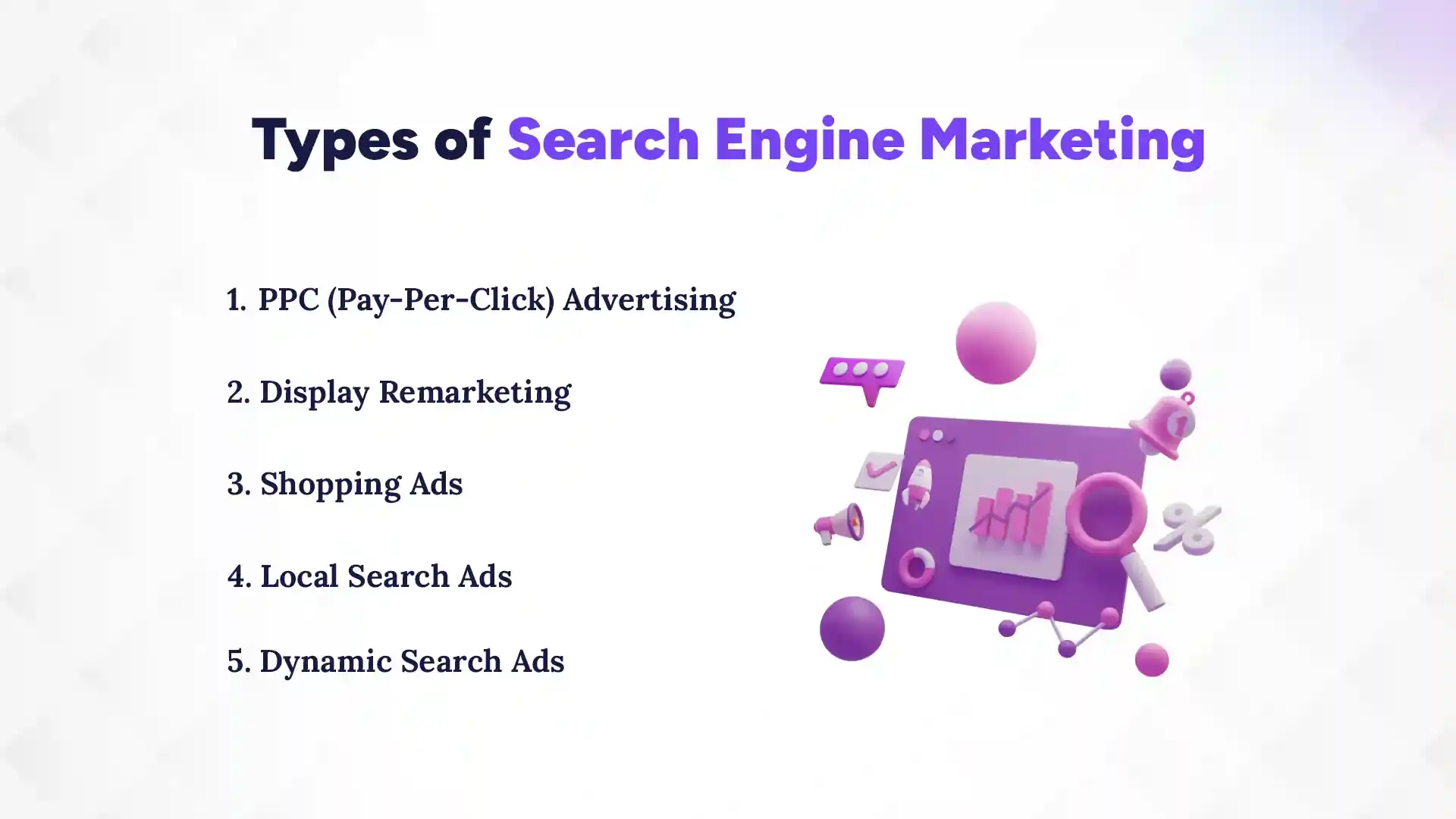
Types of Search Engine Marketing
Search engine marketing isn’t just one type of ad. There are several ways to reach people online, depending on your goals and audience. Each type has its own purpose and works a little differently. Understanding these types helps you choose the right strategy for your business. Here are some of the major types of SEM:
1. PPC (Pay-Per-Click) Advertising
PPC is the most common type of SEM. You create ads and pay only when someone clicks on them. Ads appear on search engines when people type specific keywords. You can control your daily or monthly budget easily. PPC is fast and gives instant visibility. You can also test different ad copies to see what works best. Over time, you can refine your keywords and targeting to get better results.
2. Display Remarketing
Remarketing helps you reach people who have already visited your website. You show ads to them while they browse other sites on the internet. This reminds them of your business and encourages them to come back. Display ads can be images, banners, or videos. It helps improve brand awareness and conversions. Remarketing is cost-effective because it targets people already interested in your products. You can customize ads for different audience segments.
3. Shopping Ads
Shopping ads are perfect for e-commerce businesses. They show product images, prices, and your store name directly in search results. People can see what you sell before clicking your ad. This makes it easier for users to compare products and decide quickly. Shopping ads drive high-quality traffic because users are already looking to buy. You can manage inventory and campaigns through Google Merchant Center. They are very visual and help your products stand out.
4. Local Search Ads
Local search ads show your business to people searching nearby. They appear in maps or local search results with your address, phone number, and directions. This is great for shops, restaurants, or service-based businesses. You reach people who are likely to visit or call you. Local ads help increase foot traffic and local sales. You can target by city, zip code, or a specific area. It’s an effective way to grow your business in your community.
5. Dynamic Search Ads
Dynamic search ads automatically create ads based on your website content. You don’t need to choose keywords manually. Google matches your ad to relevant searches. This saves time and helps cover more search queries. It is helpful for large websites with many pages or products. You can reach people searching for terms you may not have thought of. Dynamic ads adapt over time to improve performance.
Search Engine Marketing vs. Search Engine Optimization
Search Engine Marketing (SEM) and Search Engine Optimization (SEO) are both ways to get your business noticed online, but they work differently. SEM uses paid ads to show up quickly, while SEO improves your website to rank naturally in search results. Each has its own advantages, costs, and timelines. Understanding the differences between SEO and SEM can help you decide when to use each or combine them for the best results.
Aspect
Search Engine Marketing (SEM)
Search Engine Optimization (SEO)
Paid vs. Organic
Uses paid ads that appear at the top of search results.
Focuses on unpaid, organic rankings on search engines.
Short-term vs. Long-term Results
Gives instant traffic and leads as soon as the campaign starts.
Takes weeks or months to build authority and rank higher naturally.
Cost Differences
You pay per click or impression; costs depend on competition.
No direct payment for clicks; cost is mainly for content creation and website optimization.
When to Prioritize Each
Use SEM for quick visibility, product launches, or urgent campaigns.
Use SEO to build consistent traffic, brand authority, and long-term presence.
Combining Both Strategies
SEM provides fast traffic while SEO works on organic growth in the background.
SEO complements SEM by lowering long-term ad costs and improving Quality Score.
How to Develop an SEM Strategy?
To develop an SEM strategy, you can plan your campaigns step by step, choose the right keywords, create effective ads, and continuously optimize for better results. Creating a strong SEM strategy helps your business appear in front of the right people at the right time. Without a plan, your ads may waste money or fail to bring in leads. A clear strategy ensures every campaign is focused, effective, and easy to track.
Here’s how to develop an SEM strategy step by step:
1. Define Clear SEM Goals
First, decide what you want to achieve with your ads. It could be website visits, leads, sales, or brand awareness. Clear goals help you choose the right keywords, ad types, and budget. Knowing your goal also makes it easier to measure success. Without clear goals, it’s hard to know if your campaign is working. Take time to write down exactly what success looks like for your business.
2. Conduct Keyword Research
Keywords are the words people type in search engines when looking for your products or services. Use tools like Google Keyword Planner to find the right ones. Focus on keywords with high intent, meaning people are ready to buy or take action. Don’t pick too broad or too competitive keywords at first. Organize keywords by theme or product to make your ads more relevant. Good keyword research increases clicks and conversions.
3. Analyze Competitor Strategies
Look at what your competitors are doing online. Check which keywords they target and what kind of ads they run. This gives you ideas and shows gaps you can use to stand out. You can also see what works well in your industry. Competitor research helps you avoid mistakes and improve your campaigns faster. Keep an eye on competitors regularly, as strategies change over time.
4. Set Up Campaign Structure and Targeting
Organize your campaigns by products, services, or themes. Choose the audience carefully based on location, device, and demographics. Well-structured campaigns make management and optimization easier. It also ensures ads are relevant to the audience. Proper targeting reduces wasted spending. Think about how different ad groups can focus on different customer needs.
5. Create High-Quality Ads
Write ads that grab attention and match what people are searching for. Include keywords in headlines and descriptions, and add a clear call-to-action. Make ads relevant to the landing page. Test different versions to see which performs better. High-quality ads get more clicks and lower costs per click. Keep your messaging simple and persuasive.
6. Optimize Landing Pages
The page people reach after clicking your ad should be clear and easy to use. It must match the ad and provide what the user is looking for. Fast loading, mobile-friendly design, and clear calls-to-action improve conversions. Test different headlines, images, and buttons to see what works. A good landing page increases your Quality Score in Google Ads, lowering your costs. Keep improving the page based on results.
7. Monitor Performance And Continuously Optimize
Track clicks, conversions, and costs regularly. Check which ads and keywords are performing best. Pause low-performing ads and invest more in the ones that work. Small adjustments in bidding, targeting, or ad copy can make a big difference. Learning from the data helps you improve results over time. SEM is not set-and-forget; continuous optimization is key to success.
Common Mistakes to Avoid in SEM
Running SEM campaigns can bring great results, but small mistakes can waste money and lower your performance. Many businesses spend on ads without seeing the expected clicks or conversions. Understanding common pitfalls helps you plan smarter campaigns and get better results. Avoiding these mistakes saves time, money, and effort.
1. Targeting Too Many Broad Keywords
Choosing too many broad keywords can waste your budget. Your ads may show for irrelevant searches. This leads to clicks from people who are not interested, which lowers your return on investment. Instead, focus on high-intent keywords that match what your customers are searching for. Use a mix of short-tail and long-tail keywords. Broad keywords can be used carefully, but only with proper monitoring. Narrow targeting gives better results and more qualified leads.
2. Poor Landing Page Experience
A bad landing page can ruin your SEM campaign, even if your ads get clicks. Slow loading pages, confusing layouts, or missing information frustrate visitors. If the page doesn’t match the ad, people leave quickly, wasting your ad spend. A good landing page is simple, clear, and mobile-friendly. Make sure it has strong headlines, clear calls-to-action, and relevant content. Test your pages regularly to find what converts best. A smooth landing page increases clicks, conversions, and Quality Score.
3. Ignoring Negative Keywords
Negative keywords prevent your ads from showing on irrelevant searches. Without them, your ads may appear for terms that don’t match your products. This wastes money and lowers performance. Add negative keywords to block unrelated searches. Review your search terms regularly to catch new irrelevant words. Using negatives ensures your ads reach only the right audience. This simple step improves targeting and saves your budget.
4. Not Optimizing Ad Copy
Poor ad copy can reduce clicks and lower your ad performance. Ads need clear headlines, relevant keywords, and a strong call-to-action. Testing different versions of ad copy helps find what works best. Small changes like wording or formatting can make a big difference. Keep your ads simple and focused on the user’s needs. Well-optimized ads attract more clicks and better results. Always review and update your ad copy based on performance data.
5. Lack of Conversion Tracking
If you don’t track conversions, you won’t know which ads or keywords are working. Without this data, you may waste money on campaigns that don’t bring results. Conversion tracking lets you measure leads, sales, or other goals. Set up tracking for all important actions on your website. Use the data to improve your campaigns over time. Knowing what works allows you to invest in the best-performing ads. Tracking is essential for smart, cost-effective SEM campaigns.
Conclusion
Search engine marketing is a powerful way to grow your business online. It helps your ads appear exactly when people are searching for what you offer. SEM gives fast results, precise targeting, and measurable performance, which makes your marketing more efficient. At the same time, combining SEM with SEO can give both short-term traffic and long-term growth. While SEM needs careful planning, good ads, and continuous optimization, it can bring instant visibility and more customers. Avoiding common mistakes like targeting broad keywords or ignoring landing page quality is key to success. Overall, SEM is a practical, cost-effective strategy for businesses of all sizes that want to reach the right audience and achieve real results online through the top 10 search engine marketing companies in Austin.
FAQs
What is Search Engine Marketing (SEM)?
+
Search Engine Marketing (SEM) is a digital marketing strategy that uses paid ads to promote a business on search engines. It helps your website appear at the top of search results when people search for related products or services.
How does SEM work?
+
SEM works by allowing businesses to bid on keywords so their ads appear in search engine results. You pay only when someone clicks on your ad, which is called pay-per-click advertising.
What is the difference between SEM and SEO?
+
The difference between SEM and SEO is that SEM uses paid ads while SEO focuses on organic search rankings. SEM delivers faster results, while SEO takes more time but provides long-term traffic.
How much does Search Engine Marketing cost?
+
The cost of Search Engine Marketing depends on your industry, competition, and chosen keywords. You can control your budget by setting daily or monthly spending limits.
Is SEM good for small businesses?
+
SEM is good for small businesses because it provides instant visibility and targeted reach. It allows small businesses to compete with larger companies by focusing on specific audiences.
How long does it take to see results from SEM?
+
The time it takes to see results from SEM is usually very short, often within a few days of launching a campaign. Traffic and leads can start coming in as soon as your ads go live.
What are keywords in SEM?
+
Keywords in SEM are the words or phrases people type into search engines when looking for something. Businesses choose relevant keywords so their ads appear for those searches.
How do you measure success in SEM?
+
Success in SEM is measured using metrics like clicks, conversions, cost per click, and return on investment. These metrics show how well your ads are performing and whether they are generating results.
Ready to get started?
Book a 30-minute consultation call, and let's talk about your goals.