In 2026, every business wants that top spot on search results. But, getting noticed on search engines isn’t easy anymore.
Along the way, you’ve probably heard the terms SEO vs SEM. Sometimes used interchangeably, sometimes together. But, actually, they’re not the same.
SEO focuses on building organic visibility over time, while SEM delivers immediate exposure through paid ads. Choosing the wrong approach can cost both time and marketing budget.
Understanding digital marketing, including SEM vs SEO, is key to making smarter decisions for your business. Both strategies help your website appear in search results, but they differ in speed, cost, and impact.
In this guide to SEO vs SEM marketing, we’ll break down what each strategy means, the main differences, and when to use SEO, SEM, or both for growth that actually works.
What Is SEO? (Search Engine Optimization)
Search Engine Optimization, or SEO, is the process of improving your website so it appears higher in organic search results on search engines like Google. In simple terms, SEO helps your website show up when people search for products, services, or information related to your business.
Unlike paid ads, SEO focuses on earning visibility naturally. This means creating useful content, improving your website structure, and making sure search engines understand what your pages are about. Over time, strong SEO services helps your website attract visitors who are already looking for what you offer.
1. How SEO Works
SEO works through a combination of improvements across your website and its online presence. On-page SEO focuses on the content within your website. This includes using the right keywords, writing helpful content, optimizing headings, and adding proper meta titles and descriptions so search engines understand each page.
Technical SEO deals with how well your website functions behind the scenes. A fast-loading site, mobile-friendly design, proper indexing, and secure connections help search engines crawl and rank your pages more effectively.
Off-page SEO focuses on building credibility. When other trusted websites link to your content, search engines see your site as more reliable and authoritative, which is also an important factor in local SEO.
Together, these elements help search engines recognize your website as a valuable result for users.
Wondering how SEO works in real world? Explore our case study of Kumari Job's organic SEO growth. This is the story drawing our entire journey of partnering with Kumari Job, decoding their core requirements, engineering their growth, and positioning them as one of the leading job portals, recruitment service, and training providers in Nepal.
2. Benefits of SEO for Businesses
For many businesses, SEO becomes one of the most valuable long-term marketing strategies. Instead of paying for every visitor, SEO helps your website attract people who are already searching for what you offer. Over time, this builds a steady flow of potential customers while strengthening your brand’s online presence.
Some key benefits include:
Long-term organic website traffic
Strong brand credibility in search results
Lower long-term customer acquisition cost
Consistent and sustainable online growth
Builds website authority over time
That said, SEO takes time to show results. While it builds strong visibility in the long run, some businesses also look for faster ways to drive traffic and leads. That’s where search engine marketing comes in.
What Is SEM? (Search Engine Marketing)
Search Engine Marketing, or SEM, is a broader approach to search visibility that uses paid advertising to place your business at the top of search results. Unlike SEO, which focuses on organic traffic, SEM delivers immediate exposure and helps businesses reach their target audience quickly. In discussions about SEO vs SEM marketing, SEM is the go-to strategy for campaigns that need fast, measurable results, especially for new product launches, promotions, or time-sensitive offers.
How SEM Works
SEM works by placing paid ads on search engines like Google, giving your business a chance to appear at the very top of search results. At its core, SEM relies on a few key tactics, namely PPC, bidding, ad placement, and reaching the targeted audience.
With pay-per-click (PPC) ads, you only pay when someone actually clicks on your ad, making every dollar count. Keyword bidding allows you to compete for the search terms that matter most to your audience. Ad placement ensures your business gets noticed immediately, while targeted audience reach directs your ads to the people most likely to convert. Together, these elements give businesses instant visibility, precise control, and measurable results, making SEM a powerful tool for fast, actionable marketing.
Benefits of SEM for Businesses
SEM is ideal for companies that want quick results without waiting for organic growth. Its benefits include:
Instant search visibility
Highly targeted audience reach
Measurable campaign performance
Faster lead generation
Flexible budget control
While SEM delivers immediate results, it’s best used alongside SEO for a balanced, long-term digital strategy. Up next, let’s dive into how SEO and SEM services differ and why understanding these differences matters for your business.
What Is the Main Difference Between SEO and SEM?
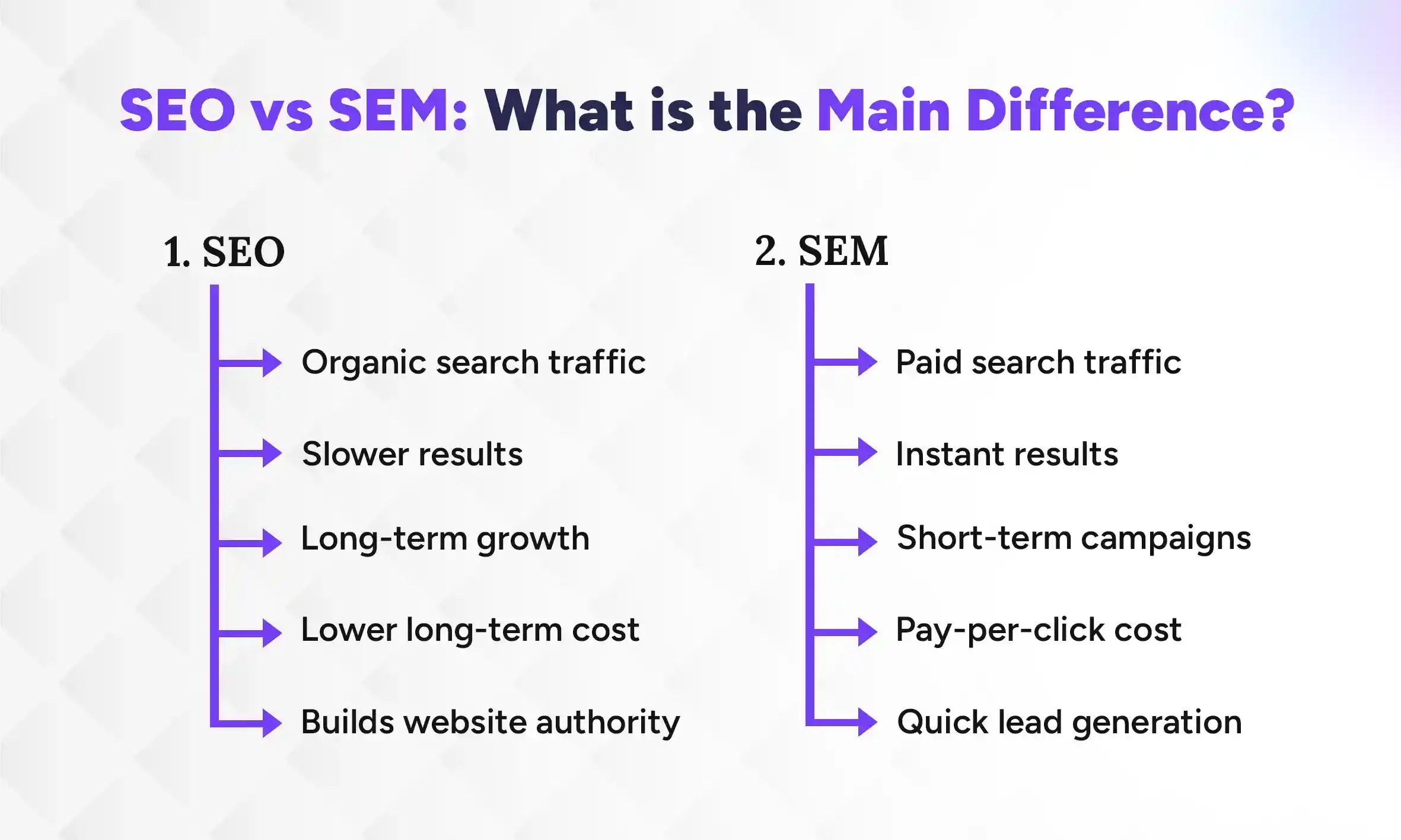
The main difference between SEO and SEM lies in organic versus paid visibility. SEO helps your website rank naturally in search results over time, while SEM uses paid ads to appear instantly at the top. Both can drive traffic, but the way they work, cost, and deliver results is very different. Understanding these differences is key to choosing the right strategy between SEO or SEM for your business.
Here, we have highlighted the major differences between SEO and SEM, comparing both of them based on the following key factors:
1. Traffic Source
The first major difference between SEM and SEO is where your traffic comes from. SEO generates organic traffic, meaning visitors find your site naturally by searching for topics or products related to your business. SEM, on the other hand, brings traffic through paid search ads, which appear at the top or bottom of search results as sponsored links. In short, SEO earns attention over time, while SEM buys it immediately.
2. Cost Model
Next, let’s talk about costs. With SEO, your investment is mainly in time and optimization. You will create content, build backlinks, and improve website structure. It doesn’t charge you for every visitor, which makes it more cost-effective in the long run. On the other hand, SEM works differently. You pay for each click your ad receives, known as pay-per-click advertising. This means traffic stops the moment your ad budget ends, but it also gives instant results.
3. Time to Results
Another key factor is how quickly you see results. SEO is a long-term strategy. It takes weeks or months to climb search rankings, but once you get there, the results can last. SEM provides immediate visibility. As soon as your campaign goes live, your ads appear at the top of search results, driving traffic and leads right away.
4. Sustainability
Sustainability is also different between the two. SEO builds long-lasting traffic because high-quality content and strong website authority keep attracting visitors over time. SEM traffic, however, stops when ads stop, so it’s great for short-term campaigns but doesn’t build organic authority.
5. Best For
Finally, each strategy has its ideal use. SEO is best for long-term growth, building trust, and steadily increasing your website’s organic reach. SEM is better for quick traffic and campaigns, such as product launches, promotions, or time-sensitive offers. Many successful businesses combine both strategies to maximize reach and performance.
6. Targeting Precision
SEM allows highly precise targeting. You can show ads to users by location, device, time of day, and even interests. SEO is less targeted in this sense; it attracts anyone searching for your keywords, which is great for broad visibility but less precise for specific campaigns.
7. Flexibility
SEM campaigns are very flexible. You can pause, adjust, or change ads instantly based on performance. SEO changes, like optimizing content or building backlinks, take longer to impact results, so it’s less flexible for rapid pivots.
8. Risk Level
SEM has a financial risk because paid ads stop delivering results if your budget ends. SEO has a time risk. It may take months to see meaningful results but once you rank, your traffic is more stable and less dependent on ongoing spend.
When to Choose SEM vs SEO: How to Decide?
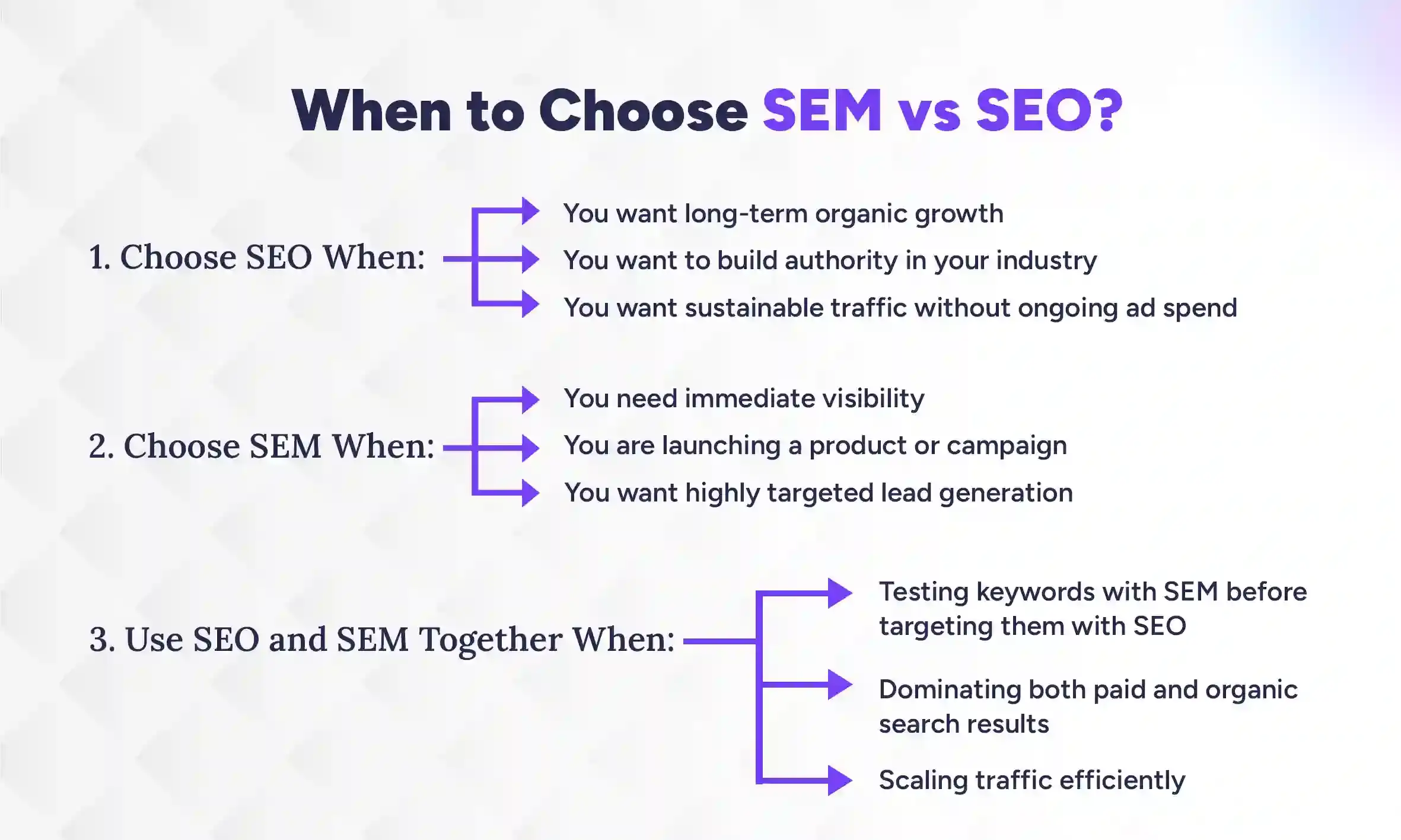
In the simplest terms, you should choose SEO for long-term organic growth and authority, SEM for immediate visibility and targeted leads, or combine both for maximum impact. The right choice, howsoever, depends on your business goals, timeline, and the type of results you’re aiming for. Understanding when to prioritize one strategy or how to combine both can save time, reduce unnecessary spend, and ensure your marketing efforts drive meaningful growth. By exploring the different types of digital marketing, you can better align your search strategy with what truly matters for your business.
1. Choose SEO When
SEO is best for businesses focused on long-term growth rather than instant results. If your goal is to steadily attract visitors over months and years, SEO builds a foundation that keeps paying off. For example, a consulting firm, educational platform, or B2B service provider benefits from consistent organic traffic that establishes credibility and authority in their industry.
Beyond traffic, SEO helps improve user experience, site structure, and content quality, which strengthens your brand’s online presence. This approach works best when you want to build trust, reduce long-term costs, and grow sustainably without relying on constant paid campaigns.
2. Choose SEM When
SEM is ideal for businesses that need quick, measurable results. Whether you’re launching a new product, running a limited-time promotion, or targeting a highly specific audience, SEM can put your business at the top of search results immediately. Paid campaigns offer precise control over audience, timing, and budget, making it easier to generate leads fast and track ROI.
In the context of SEO vs SEM marketing, SEM shines when speed and accuracy matter most, giving businesses the ability to test messaging, adjust campaigns on the fly, and gain insights that can even inform future SEO strategies.
3. Use SEO and SEM Together
For many businesses, the strongest results come from a combined approach. Using SEO and SEM together allows you to capture both short-term wins and long-term growth. For example, you can run SEM campaigns to test high-performing keywords, then optimize your website content and SEO strategy around those findings. Likewise, dominating both paid and organic search results increases visibility and builds authority simultaneously.
This integrated strategy not only helps you scale traffic efficiently, but also provides valuable data for decision-making, ensures your brand remains consistently visible, and creates a more sustainable online presence that doesn’t rely solely on ads or organic rankings.
How SEO and SEM Work Together in a Strong Search Marketing Strategy
Modern digital marketing works best when SEO and SEM are used together, creating a balanced approach that captures both immediate opportunities and long-term growth. Here’s how the two strategies complement each other:
1. SEM for Short-Term Traffic
SEM drives immediate visibility, putting your business at the top of search results right away. This is ideal for product launches, promotions, or campaigns that need quick leads and measurable impact. Paid campaigns allow precise targeting, giving businesses control over who sees their ads and when.
2. SEO for Long-Term Authority
While SEM brings quick results, SEO focuses on building lasting authority. Optimizing content, improving site structure, and earning backlinks ensures that your website attracts consistent organic traffic over time. This helps businesses establish credibility and sustainable growth, complementing the short-term wins from paid campaigns.
3. Using SEM Data to Improve SEO
One of the most powerful advantages of combining strategies is that data from SEM campaigns can guide SEO efforts. High-performing keywords in paid ads can inform content creation, meta optimization, and on-page targeting. This feedback loop lets businesses refine their strategy faster and improve organic rankings more efficiently.
4. Strategic Integration with Expert Guidance
By integrating SEO and SEM, companies can maximize reach, scale traffic efficiently, and capture more qualified leads without relying on just one channel. Strategic digital marketing partners like The Pace Infosys help businesses align paid and organic strategies to achieve measurable, long-term results.
Common Mistakes Businesses Make With SEO and SEM
Even the best marketing plans can stumble when businesses expect instant SEO results, ignore keyword research, skip proper landing pages for SEM, or fail to track ROI. These common pitfalls when overlooked can discard your investment. Understanding these mistakes helps you avoid wasted time, money, and effort, while improving the impact of both SEO and SEM campaigns.
1. Expecting SEO Results Instantly
One of the most frequent mistakes is assuming SEO delivers immediate traffic. SEO is a long-term strategy. Ranking higher organically takes time as search engines evaluate your content and authority. Businesses that expect overnight results often get frustrated and give up too soon. Patience and consistency are key: think of SEO as building a strong foundation that pays off steadily over months, not days.
2. Running SEM Ads Without Proper Landing Pages
Another common error is launching SEM campaigns without optimized landing pages. Even if your ads attract clicks, a poorly designed or irrelevant page can prevent conversions. Ensuring that your landing pages align with ad messaging, are fast-loading, and guide visitors to take action is essential for maximizing ROI.
3. Ignoring Keyword Research
Skipping keyword research is a mistake that affects both SEO and SEM. Without understanding which terms your target audience is searching for, your content and ads may reach the wrong people, or get lost in competition. Conducting thorough keyword research ensures that your marketing efforts are focused, relevant, and effective.
4. Not Measuring ROI
Finally, many businesses fail to track the performance of their SEO and SEM campaigns. Without measuring results, it’s impossible to know what’s working, what needs adjustment, or how to allocate budget efficiently. Regular monitoring and analytics help businesses optimize strategies, reduce wasted spend, and achieve better outcomes over time.
Who Provides the Best SEO and SEM Services?
The Pace Infosys stands out as a trusted provider of SEO and SEM services tailored for businesses that want measurable growth and sustained online visibility. With over 11+ years of experience and a global client base, they bring both technical expertise and practical marketing insights to help companies perform at every stage of their search journey.
At The Pace Infosys, SEO and SEM aren’t treated as separate silos. Instead, they’re part of an integrated digital strategy that adapts to your business goals, whether you’re trying to boost organic traffic, increase paid search performance, or both.
What Makes The Pace Infosys’ Search Services Stand Out?
The Pace Infosys delivers comprehensive SEO and SEM solutions that help businesses grow visibility and attract the right audience. Their approach combines strategy, execution, and measurable results. Key highlights include:
Uses targeted SEO to grow organic traffic up to 40%.
Runs optimized SEM campaigns generating hundreds of leads monthly.
Continuously optimizes ads and content to boost CTR 25%.
Integrates SEO and SEM strategies to increase conversions consistently.
Conclusion
When it comes to growing your business online, there’s no debate. SEO builds lasting authority and sustainable traffic, while SEM delivers immediate visibility and targeted results. Choosing one over the other can work in certain situations, but the most successful businesses often combine both, creating a balanced search marketing strategy that captures opportunities today while securing growth for tomorrow.
Acquiring more visitors, bringing qualified leads, and creating a measurable impact is about working smarter, using insights from paid campaigns to guide organic growth, and ensuring every marketing effort contributes to your bigger goals.
If you’re ready to grow your business with search markets, partnering with experts like The Pace Infosys today to simplify your process. The company provides a complete service package as well as professional digital marketing consultations to guide your business. Make your choice wisely and watch your business grow.
FAQs
Is SEO better than SEM for businesses?
+
SEO builds long-term organic traffic, while SEM delivers quick results. Most successful businesses use both strategies together for maximum impact.
Does SEM include SEO?
+
SEM usually refers to paid search marketing, while SEO focuses on improving organic search visibility. They complement but are not the same.
Which is more cost-effective: SEO or SEM?
+
SEO becomes more cost-effective over time. SEM requires ongoing ad spend but delivers faster traffic and immediate leads.
Can small businesses use SEO and SEM together?
+
Yes. Many small businesses use SEM for immediate leads while investing in SEO for sustainable, long-term traffic growth.
How long does it take to see SEO results?
+
SEO typically shows results in 3–6 months, depending on competition, website quality, and consistency of content and optimization efforts.
Can SEM campaigns target specific customer groups?
+
Yes. SEM allows precise targeting by location, demographics, and search intent, ensuring ads reach the most relevant audience quickly.
Ready to get started?
Book a 30-minute consultation call, and let's talk about your goals.