A customer is standing at your counter, ready to pay, and asks for a bill. You grab a pad, then freeze. Does it need a PAN? A bill number? Should you add VAT?
Searching answers online rarely settles it, because each PAN bill sample you find looks different and few say which one fits your business. That is the gap this guide fills.
Here you will find a clear PAN bill format in Nepal with a sample you can copy, the details every bill should carry, simple steps to make one, and the rules that matter, checked against Nepal's tax laws and IRD material. No jargon, no guesswork. Just a bill you can issue with confidence.
What Is a PAN Bill in Nepal and Who Needs to Issue One?
In everyday use, a PAN bill means a sales bill issued by a seller who has a Permanent Account Number (PAN) but is not registered for VAT. It records the sale of goods or services, so both the seller and the buyer have proof of the transaction. This section explains what PAN means, who needs to keep bills, and how PAN registration differs from VAT registration.
PAN stands for Permanent Account Number. It is a unique 9-digit taxpayer number issued by Nepal's Inland Revenue Department (IRD). Shopkeepers, freelancers, service providers, and companies all use it to identify themselves for income tax.
A bill is the seller's record of what was sold, to whom, when, and for how much. Anyone who sells goods or services as a business should issue bills and keep copies, because those copies support the income and sales they report.
Insights
Did You Know?
PAN registration and VAT registration are two separate things. A PAN identifies you as a taxpayer. VAT registration gives you the right and the duty to charge and collect VAT. Getting a PAN does not make you eligible to charge VAT.
What Does a PAN Bill Format in Nepal Look Like? (With Sample)
A PAN bill format in Nepal is an invoice layout that shows the seller's name, address, and PAN, a bill number and date, the items sold, and the total payable. The sample below is illustrative and is not an official IRD template, because the format that applies to you depends on your registration status and billing obligations. The sections below show a sample bill with explanation of each field:
1. Sample PAN Bill Format You Can Follow
This sample uses a fictional seller who is registered for PAN but not for VAT. Because the seller is not VAT-registered, the bill shows no VAT line.
Illustrative sample only. Not an official template.
Field
Fill in
Field
Fill in
Bill number (बीजक नम्बर)
Transaction date (कारोबार मिति)
Seller's PAN (बिक्रेताको करदाता दर्ता नम्बर)
Bill issue date (बीजक जारी भएको मिति)
Seller's name (बिक्रेताको नाम)
Phone number (फोन नम्बर)
Address (ठेगाना)
Payment method (भुक्तानीको तरिका)
Cash / Cheque / Credit / Other
Buyer's name (क्रेताको नाम)
Buyer's address (ठेगाना)
S.N. (सि.नं.)
Description (विवरण)
Qty (परिमाण)
Unit
Rate (दर)
Amount (जम्मा रकम रु.)
1
2
3
4
5
Summary
NPR
Subtotal
Discount (छुट रकम रु.)
Total payable (जम्मा रकम रु.)
Amount in words: Three thousand rupees only.
Seller's signature and seal: ____________
A VAT-registered seller would not use this layout. It would issue a VAT invoice in the format prescribed under the VAT law.
2. What Information Should a PAN Bill Include?
Most bills carry the same core details, and each one has a job. Which of these are legally compulsory depends on your registration status and the applicable rules, so check them with your IRO before you finalize a template.
Commonly used details in a PAN bill:
Business name and address: tells the buyer exactly who sold the goods or services.
Seller's PAN: identifies the taxpayer and lets the buyer verify the seller with the IRD.
Bill number: keeps bills in order and makes it easy to find a record later.
Date: fixes when the sale happened, which matters for your records.
Customer details: useful for business customers and for returns or disputes. Many retail sales to walk-in customers do not need them.
Description, quantity, and unit: removes doubt about what was sold. "Notebook, A4, 200 pages" is better than "stationery."
Rate and amount: shows how each line total was reached.
Discount: shows the actual discounted amount.
Total payable: the final amount the buyer owes.
Signature or seal: a common way to show the bill is genuine.
Details that depend on the rules: VAT invoices must follow the prescribed format and carry VAT details. Electronic billing systems may add further fields. Treat the list above as a practical baseline, not as a legal checklist.
Clear descriptions, correct totals, a traceable seller, and consistent numbering all matter for one reason. If your bill is questioned later, it should explain the sale on its own.
Losing Track of Customer Enquiries & Follow-Ups?
Keep customer details, sales conversations, and follow-up reminders in one place so fewer potential sales slip through the cracks with Pace CRM.
Government-Prescribed PAN Bill Formats in Nepal: IRD Invoice Formats
The Inland Revenue Department (IRD) has mandated invoice formats in Nepal. This includes PAN bill format for luxury fee, the sip promotion fee, the education equity fee, and the health equity fee. They come from an IRD notice dated 2083/03/26 BS and apply to sellers of specific goods and services, not to ordinary PAN bills, so ask your IRO if you are unsure which one covers you. The sections below show each format, what it is used for, and what you can learn from it when you design your own bill.
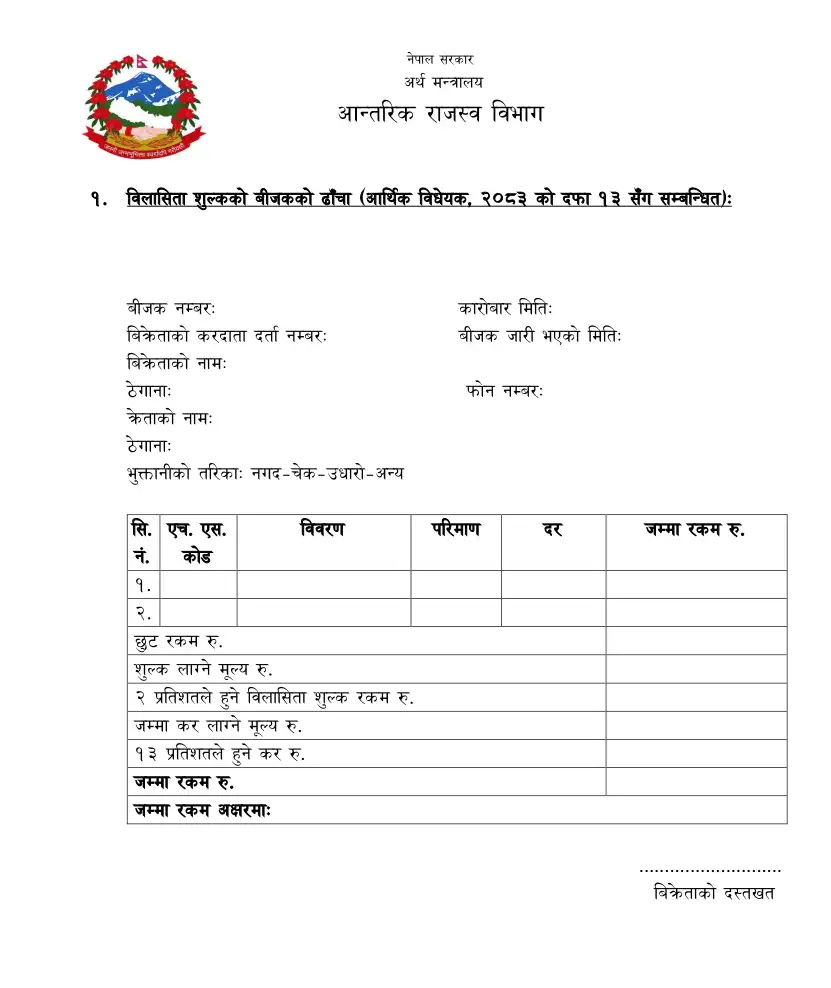
1. Luxury Fee Invoice Format (Section 13)
This format is for the 2% luxury fee on the sale price of services from five-star and higher hotels and luxury resorts. It also covers imported ready-made liquor, where the fee applies to the value that includes customs duty and excise. It is the most general of the four, with the seller’s registration number, buyer details, payment method, an items table with HS code, discount, 13% VAT, total, amount in words, and the seller’s signature.
Caption: IRD-prescribed invoice format for the luxury fee (IRD notice dated 2083/03/26 BS). This is not a PAN bill format.
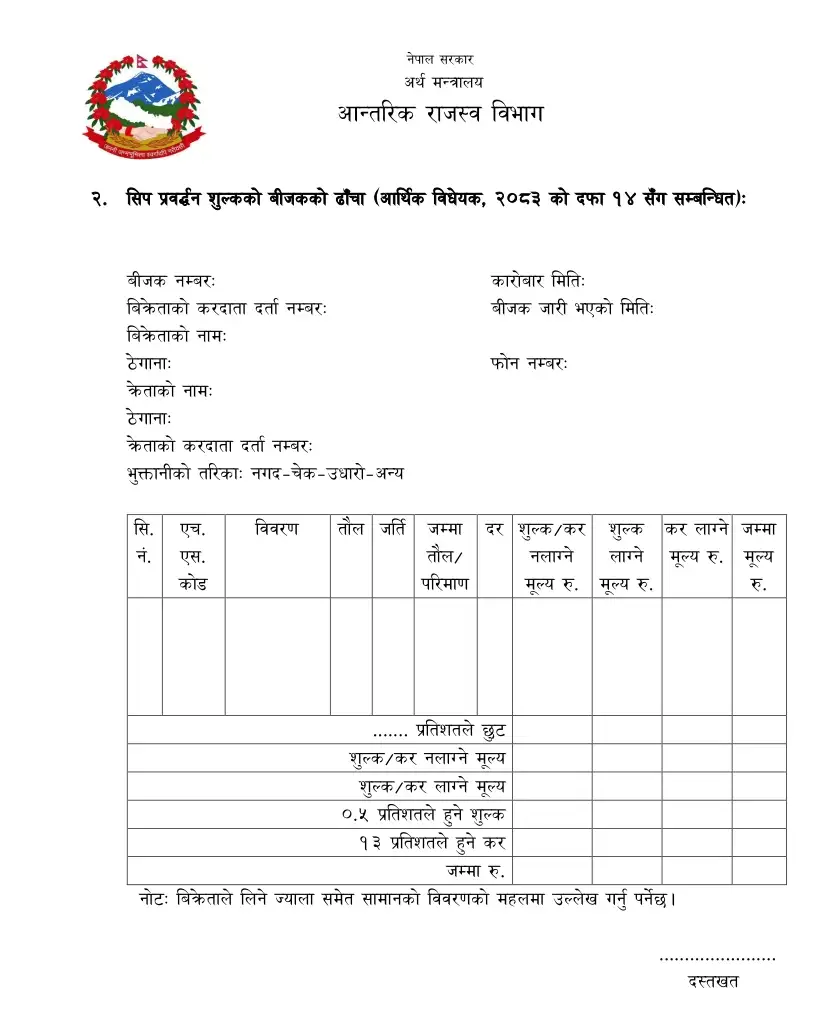
2. Sip (Skill) Promotion Fee Invoice Format (Section 14)
This format is for the 0.5% skill (sip) promotion fee when gold, silver, and their ornaments and goods are sold to consumers in Nepal. It adds columns for weight and quantity, and it splits the value into amounts with and without duty or tax. The form also notes that the seller must write any labour charge in the item description column.
Caption: IRD-prescribed invoice format for the sip promotion fee (IRD notice dated 2083/03/26 BS). The columns change with the type of sale.
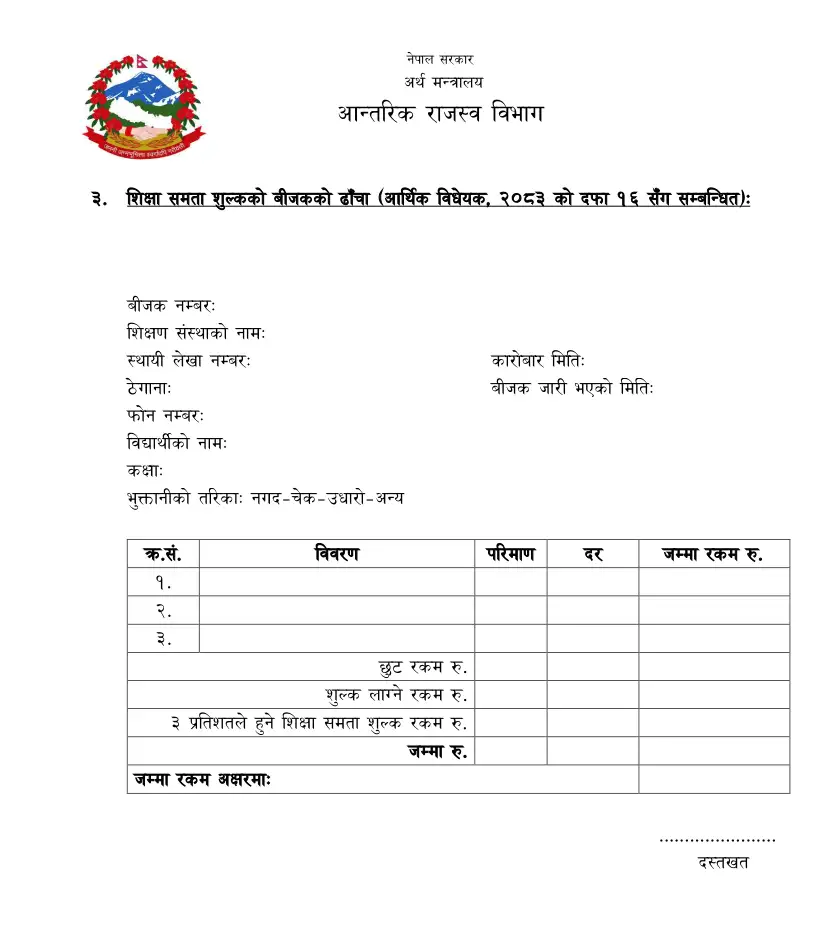
3. Education Equity Fee Invoice Format (Section 16)
This format is for the 3% education equity fee on all fees that private educational institutions collect from students. Instead of a buyer and seller, it records the institution’s name and permanent account number (PAN), the student’s name, and the class. The table lists each fee item with its quantity, rate, and amount.
Caption: IRD-prescribed invoice format for the education equity fee (IRD notice dated 2083/03/26 BS).
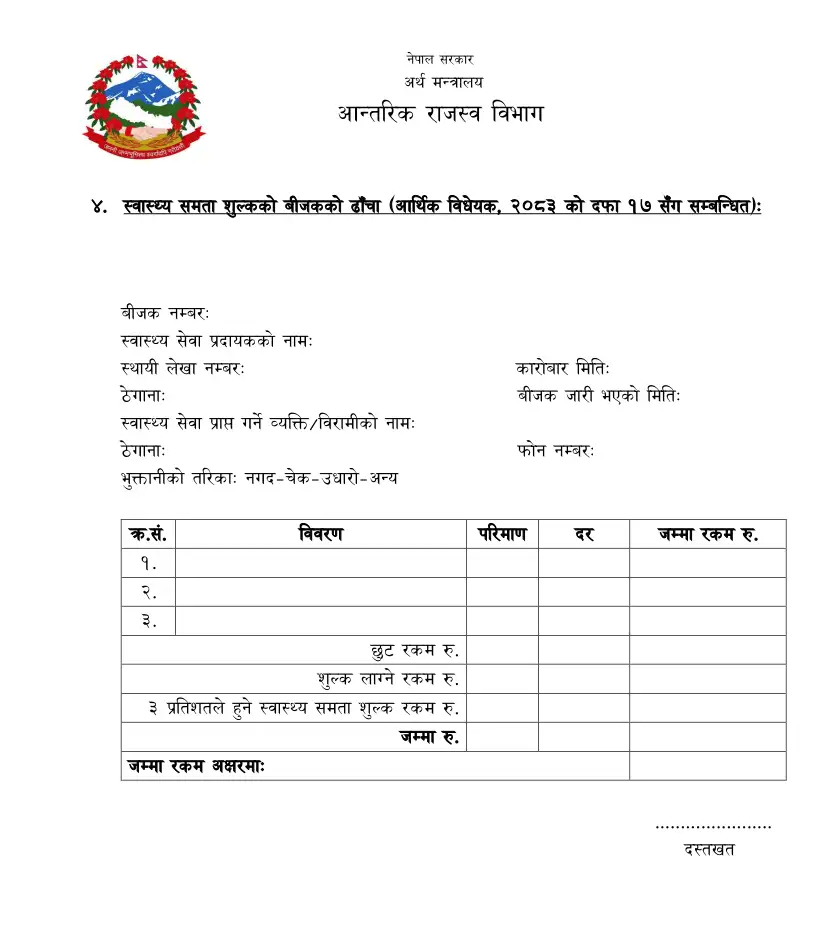
4. Health Equity Fee Invoice Format (Section 17)
This format is for the 3% health equity fee on all service fees that private health service providers collect from patients. It records the provider’s name and permanent account number (PAN), and the name and address of the person or patient receiving the service. The table lists each service with its quantity, rate, and amount.
Caption: IRD-prescribed PAN invoice format for the health equity fee (IRD notice dated 2083/03/26 BS).
How Do You Make a PAN Bill in Nepal, Step by Step?
To make a PAN bill in Nepal, enter your business details and PAN, add a bill number and date, list the goods or services with their amounts, calculate the total, and issue a copy to the buyer. The exact fields and the way you issue the bill depend on your registration status and any billing rules that apply to your business. The steps below take you from a blank bill to a filed copy, and then look at Excel and online generators.
1. Step-by-Step Process for Preparing a PAN Bill
Enter the seller's business details and PAN. Use the name and address registered with the IRD, and copy the PAN carefully.
Assign a bill number and enter the transaction date. Use the next number in your series. Never reuse a number.
Enter customer details where required. Add the buyer's name and PAN for business customers, or when the buyer asks.
Describe the goods or services supplied. Be specific enough that a stranger could tell what was sold.
Enter quantities, rates, discounts, and amounts. Multiply quantity by rate for each line, then apply any discount.
Calculate the total and any legally applicable taxes. A seller who is not VAT-registered does not add VAT. A VAT-registered seller should use the VAT invoice format instead.
Check all required particulars. Compare the bill with your template and with the rules that apply to you.
Issue the bill and maintain the required records. Give the buyer the original, keep a copy, and file it where you can find it.
2. Can You Make a PAN Bill in Excel?
Yes, you can create a PAN bill in Excel by entering the seller's details, bill number, items, quantities, and prices. Excel formulas can calculate the total automatically, but you must manage bill numbers and records yourself. If your business is required to use an IRD-compliant electronic billing system, a basic Excel sheet may not meet those requirements.
3. How to Generate a PAN Bill Online?
You can use an online bill generator to enter your business details, add products or services, calculate the total, and download or print the bill. However, generating a bill online does not automatically make it IRD-compliant. Before using a tool, check whether it meets the billing requirements that apply to your business.
4. Can a System Automatically Generate an Invoice After a Sale?
Yes, billing software or a CRM connected to a billing system can generate an invoice using the details recorded when a sale is completed. It can pull customer information, products, and prices directly from the sales record, reducing manual data entry and keeping invoices organized. If your business must follow specific IRD electronic billing requirements, confirm that the system supports them before using it.
What Are the PAN Bill Rules in Nepal Every Seller Should Know?
PAN bill rules in Nepal depend on the seller’s tax registration status and the type of transaction. A PAN-registered seller cannot charge VAT unless registered to do so, while VAT-registered sellers must follow the applicable invoice rules. Here are the key rules on bill issuance, turnover limits, recordkeeping, and IRD requirements.
1. PAN Registration Determines Who Can Issue a PAN Bill
A business registered for PAN but not VAT can issue bills for eligible transactions without charging VAT. However, businesses required to register for VAT must follow the applicable VAT invoicing rules.
Under Nepal’s VAT Act, 2052, registered sellers must issue invoices as prescribed by law, and unregistered sellers cannot collect VAT. Having a PAN alone does not authorize a business to charge VAT.
2. Annual Turnover Determines Whether VAT Registration Is Required
Nepal does not have a universal maximum amount for an individual PAN bill. The commonly discussed limits refer to annual turnover thresholds that may trigger mandatory VAT registration.
Goods: The commonly cited threshold is NPR 50 lakh.
Services and mixed transactions: The commonly cited threshold is NPR 30 lakh.
Exceptions: Some businesses must register regardless of turnover, while voluntary registration may also be possible.
Verify these figures against the latest applicable law and IRD guidance before publication, as thresholds and exemptions can change.
3. Sellers Must Follow Tax Recordkeeping and Bill Numbering Requirements
Businesses must maintain the records required by applicable tax laws and keep them for the prescribed period. Under the Income Tax Act, 2058, the general retention period is five years from the end of the relevant income year, subject to applicable provisions.
VAT invoices: Must follow the prescribed format.
Record checks: Tax authorities may inspect business records during audits.
Electronic billing: Applicable systems must follow the relevant IRD procedures.
Sequential bill numbers and copies of issued bills also help businesses maintain organized records. Check with your Inland Revenue Office (IRO) for requirements specific to your business.
4. PAN Bills Do Not Require Individual Registration With the IRD
Individual PAN bills are not generally registered with the IRD one by one. Businesses register for PAN and, where required, VAT, while electronic billing may involve separate compliance requirements.
Certain businesses may be required to use IRD-compliant electronic billing systems connected to the Central Billing Monitoring System (CBMS). Check the latest IRD notices to confirm whether these requirements apply to your business.
Still Struggling to Prepare Bills and Track Sales?
Keep customer details organized, track sales transactions, and simplify billing-related workflows with Pace CRM.
Should You Use Manual PAN Bills or Billing Software in Nepal?
Manual or spreadsheet billing is usually enough for a small seller with few bills a day, while billing software helps once volume, staff, or reporting needs grow. Software can organize and automate your work, but compliance depends on what the system actually does and on the rules that apply to you. The table compares both approaches.
Manual billing works well for businesses with a low number of daily transactions, while billing software is more practical for growing businesses that need faster calculations, organized records, and easier reporting. If electronic billing is required for your business, you need software that meets the IRD's procedure. A well-organized spreadsheet beats a messy system, so choose based on your volume and obligations, not on features alone.
The right choice depends on your transaction volume, team size, and compliance requirements.
If your business also needs to manage customer details, track sales opportunities, and follow up on payments, a CRM system can be another option to consider. CRM software also helps you manage customer details, track sales, plan follow-ups, and keep all customer conversations in one place. This can be useful for businesses that want better visibility across both customer relationships and sales activities as they grow.
Conclusion
A good PAN bill is simple: your name and PAN, a clear bill number, honest items and totals, and no VAT unless you are registered. Your registration status, not the size of the bill, decides which format you use, and using the right one keeps your records clean at tax time. That is the whole story, minus the confusion.
We know the feeling. A customer is waiting, a pad is in your hand, and a small voice asks, "Is this right?" You work hard for every sale, and a clumsy bill should never put that effort at risk. Getting it right once makes every bill after it easy.
So check your status, pick a clean template, and issue your next bill with confidence. Better still, give your sales a CRM that keeps every customer and bill in one place.
FAQs
What Is the Format of a PAN Bill in Nepal?
+
A PAN bill shows the seller's name, address, and PAN, a bill number, the date, the items with quantity and rate, and the total. The exact fields depend on the billing rules that apply to you.
Can I Make a PAN Bill in Excel or PDF?
+
Yes, for many small sellers, but not if your business must use IRD-compliant electronic billing software.
Is There a PAN Bill Limit in Nepal?
+
No, there is no maximum value for one bill. The figures people call a limit are turnover thresholds for VAT registration: NPR 50 lakh for goods and NPR 30 lakh for services and mixed businesses.
Is a PAN Bill Valid Without VAT?
+
Yes, if the seller is not VAT-registered, because such a seller must not collect VAT. A VAT-registered seller must issue a VAT invoice instead.
Can an Individual Issue a PAN Bill in Nepal?
+
Yes, a freelancer or sole trader with a PAN can generally issue bills for their sales. Confirm with your IRO whether VAT registration also applies to you.
Is a Handwritten PAN Bill Valid in Nepal?
+
It can be, as long as your business is not required to use electronic billing. If it is, handwritten bills cannot replace it.
How Can I Check Whether a PAN Bill Is Genuine?
+
Search the PAN on the IRD's PAN search page and compare the name and address with the bill. A valid PAN alone does not prove the bill is genuine, so check the date, number, and totals, and ask the seller if anything looks off.
Ready to get started?
Book a 30-minute consultation call, and let's talk about your goals.