


HRMS handles leave requests fairly across teams by applying the same policy rules, eligibility checks, and approval logic to every request, removing the inconsistency that comes from leaving decisions to individual manager discretion. What feels like favoritism on one team and strictness on another is usually just two managers applying unwritten rules differently, not a difference in policy itself.
This guide covers what fair leave management actually means, why leave requests often feel unfair, how Leave Management HR Software standardizes approval across teams, what data keeps decisions consistent, what happens when fairness breaks down, the features worth prioritizing, and how this applies specifically to Nepali businesses closing with which HRMS handles multi-team leave management best.
What Does Fair Leave Management Mean Across Teams?
Fair leave management across teams means applying the same policy rules, eligibility checks, and approval standards to every employee, regardless of which manager or department they belong to.
It doesn't mean every employee gets the same number of leave days. It means the same eligibility rules and approval logic apply to every request, no matter who submits it or who reviews it. When one manager approves a request in minutes and another sits on a similar one for days, that's not a policy difference; it's an inconsistency in how the policy is applied. Fairness comes from that consistency, not from the specific leave entitlements themselves.
Why Do Leave Requests Often Feel Unfair to Employees?
Leave requests often feel unfair to employees because approval depends heavily on individual manager discretion, team leave balances aren't visible, and different managers end up applying different unwritten rules. Employees notice these inconsistencies quickly, even when no one intends to be unfair.
1. Inconsistent Manager Discretion
One manager might approve a last-minute request without hesitation while another denies a similar one, and reducing this inconsistent manager discretion is what makes approval feel predictable. Over time, employees start basing their expectations on which manager they report to rather than on the actual policy.
2. Lack of Visibility Into Team Leave Balances
When employees can't see how much leave their teammates have used, improving visibility into team leave balances is what removes the guesswork that fuels suspicion of favoritism. Without that visibility, even accurate decisions can look unfair simply because there's no way to verify them.
3. Different Rules Applied by Different Managers
Without a centralized system, individual managers often develop their own informal standards, so standardizing rules instead of allowing different rules applied by different managers closes this fairness gap. These informal standards are rarely written down, which makes them hard to challenge or even notice until an employee compares experiences with a coworker.
How Does HRMS Standardize Leave Approval Across Teams?
HRMS standardizes leave approval across teams by centralizing policy configuration, running automated eligibility checks, and applying the same approval workflow regardless of which manager is reviewing the request. This removes the room for personal interpretation that manual approval leaves open.
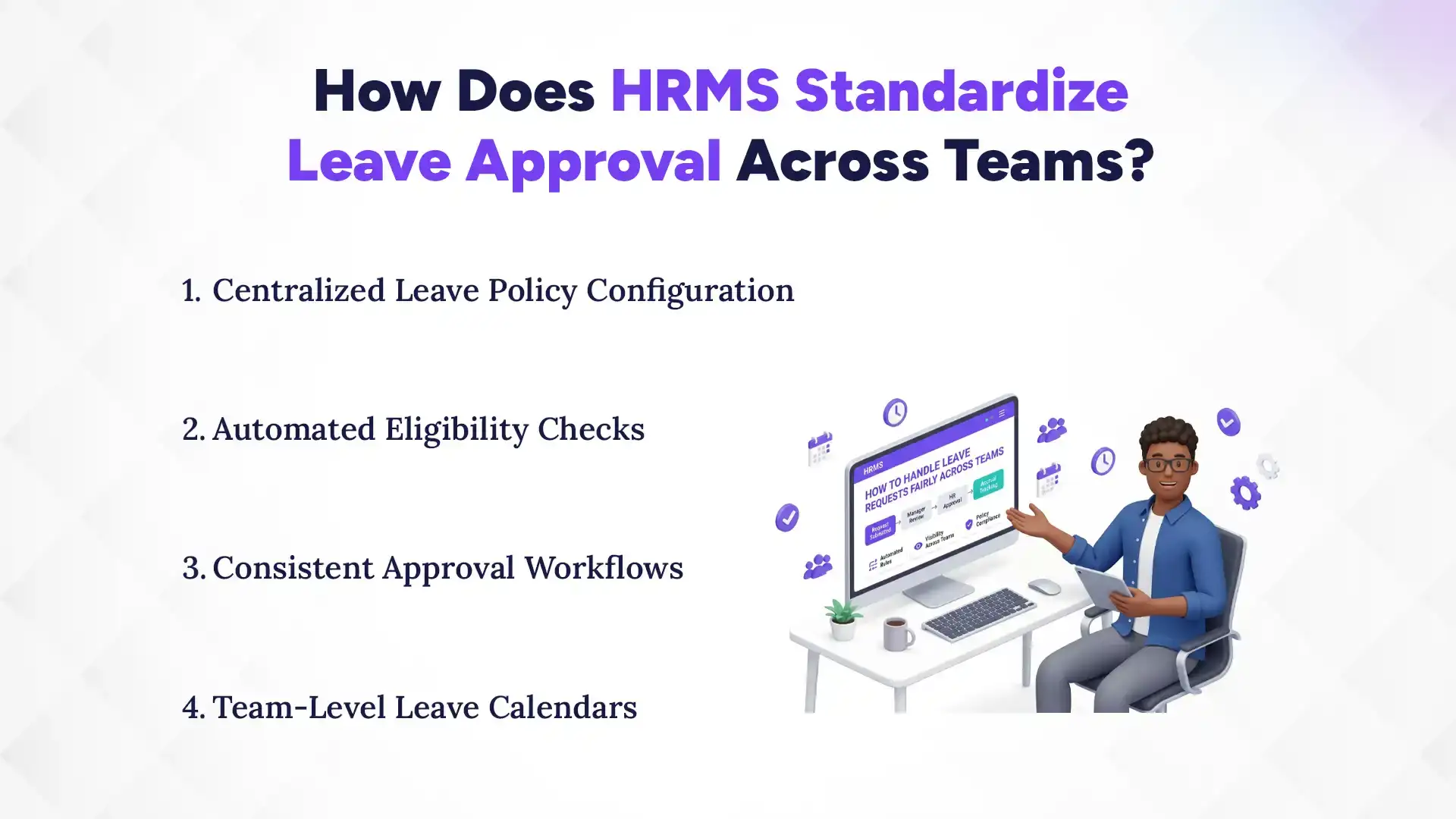
1. Centralized Leave Policy Configuration
Leave policies are configured once at the system level, so relying on centralized leave policy configuration keeps every team operating from the same rulebook. This removes the need for each department to interpret or recreate policy on its own.
2. Automated Eligibility Checks
Running automated eligibility checks means the system verifies balance and notice period requirements before a request even reaches an approver. This catches ineligible requests early instead of leaving that judgment call to whoever happens to be reviewing it.
3. Consistent Approval Workflows
Applying consistent approval workflows across the business means every request follows the same review sequence, regardless of department. Employees know exactly what to expect at each stage, which reduces confusion and follow-up questions.
4. Team-Level Leave Calendars
Using team-level leave calendars lets managers and employees see who's already on leave, supporting decisions based on actual coverage rather than guesswork. This visibility also helps employees plan their own requests around teammates who are already off.
What Data Does HRMS Use to Keep Leave Decisions Consistent?
HRMS keeps leave decisions consistent using leave balance and accrual records, team coverage and overlap data, and historical approval patterns that flag when a request deviates from normal practice. This data-driven basis replaces decisions made purely on manager instinct.
1. Leave Balance and Accrual Records
Maintaining precise leave balance and accrual records, often synced with an attendance management system, ensures approvals are based on what an employee has actually earned, not an outdated estimate. Inaccurate balances are one of the fastest ways to trigger a dispute, even when the underlying decision was reasonable.
2. Team Coverage and Overlap Data
Using team coverage and overlap data helps flag when too many people on the same team are requesting leave at once. This turns a coverage decision into something based on actual numbers rather than a manager's rough sense of who's already off.
3. Historical Approval Patterns
Reviewing historical approval patterns helps HRMS flag when a new decision looks inconsistent with how similar requests were handled before. This gives managers a useful check before approving or denying something that breaks from established precedent.
What Happens When Leave Requests Are Handled Inconsistently?
When leave requests are handled inconsistently, employees perceive favoritism, teams end up understaffed from overlapping approvals, disputes arise between managers and employees, and trust in HR processes erodes over time. These effects tend to build quietly until they surface as broader dissatisfaction.
1. Perceived Favoritism Among Employees
Even well-intentioned managers can create perceived favoritism among employees simply because their decisions aren't consistent with how other requests are handled. Once that perception takes hold, it's difficult to undo even if every individual decision was reasonable on its own.
2. Understaffing From Overlapping Approvals
Without shared visibility, a manager might approve overlapping requests on the same team, leading directly to understaffing from overlapping approvals. The gap often isn't discovered until the team is already short-handed during a busy period.
3. Disputes Between Managers and Employees
When a decision looks unfair compared to a similar request elsewhere, it often escalates into disputes between managers and employees. These disputes take up time and energy that a clearer, documented process could have avoided entirely.
4. Reduced Trust in HR Processes
Once employees stop trusting leave decisions, that skepticism tends to spread into reduced trust in HR processes more broadly, compounding the challenges of HR management in Nepal. This makes even unrelated HR initiatives harder to get genuine buy-in on.
What Features Should You Look for in HRMS Leave Management?
The HR software features to look for in HRMS leave management include automated policy enforcement, real-time leave balance visibility, and manager override controls that still keep an audit log of exceptions. These features balance consistency with the flexibility managers occasionally need.
1. Automated Policy Enforcement
Prioritizing automated policy enforcement removes the single biggest source of inconsistency found in manual leave management. It also frees managers from having to memorize and apply every rule correctly on their own.
2. Real-Time Leave Balance Visibility
Offering real-time leave balance visibility to both employees and managers prevents disputes rooted in outdated balance information. It also cuts down on the back-and-forth of employees asking HR to confirm how much leave they have left.
3. Manager Override Controls With Audit Logs
Combining manager override controls with audit logs preserves flexibility for exceptions without sacrificing transparency. Every override stays visible and explainable later, rather than becoming an untraceable one-off decision.
How Can Nepali Businesses Apply Fair Leave Policies With HRMS?
Nepali businesses can apply fair leave policies with HRMS by aligning leave rules with Nepal's labor law, standardizing festival and public holiday leave, and giving every team the same visibility and approval standards regardless of location. This keeps fairness consistent even across businesses with multiple branches.
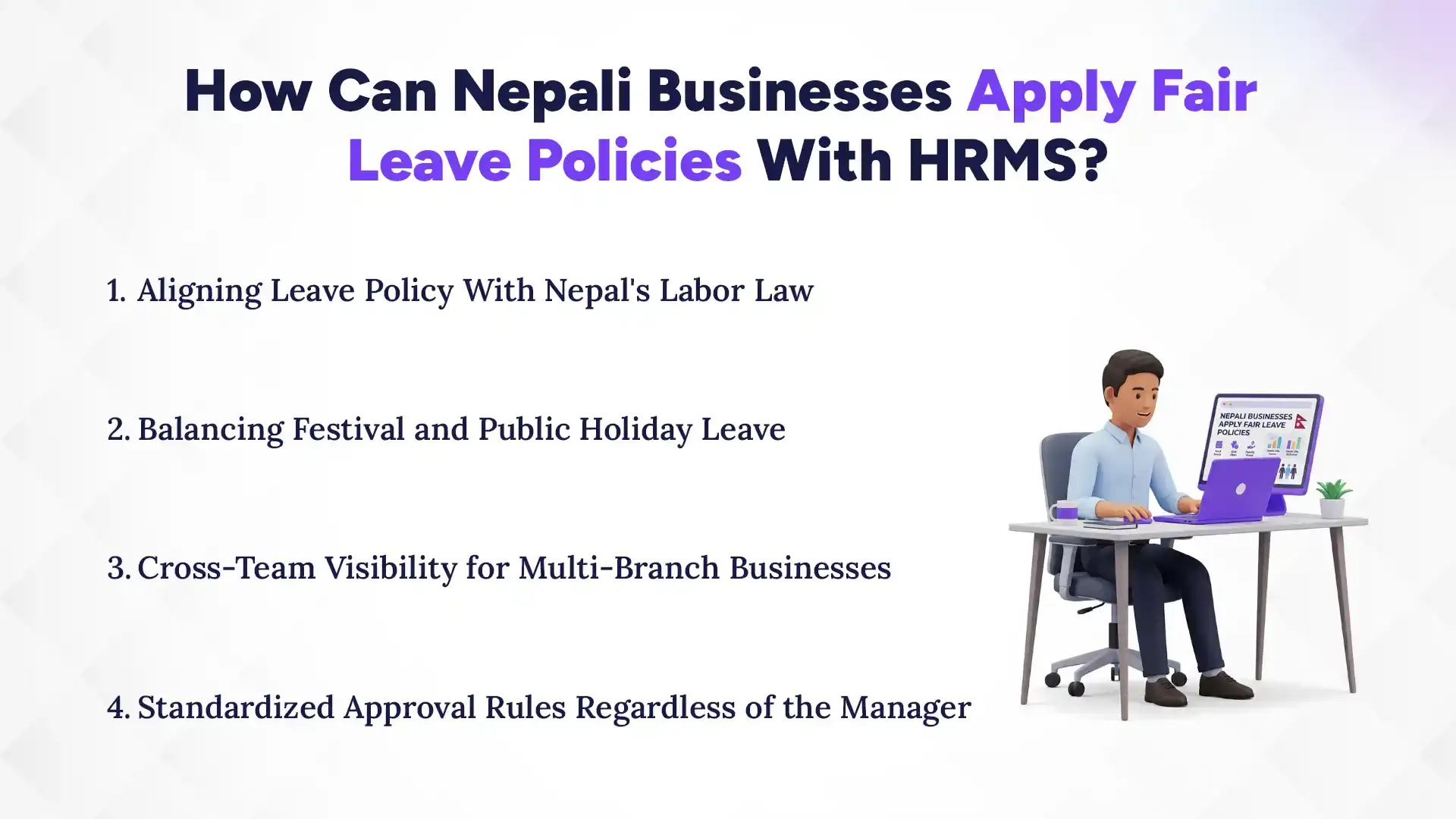
1. Aligning Leave Policy With Nepal's Labor Law
Aligning leave policy with Nepal's labor law from the start keeps every team compliant without requiring manual interpretation branch by branch. It also protects the business from inconsistencies that could raise concerns during a labor compliance review.
2. Balancing Festival and Public Holiday Leave
Standardizing how festival and public holiday leave is balanced ensures every employee is treated the same regardless of which office they work from. This matters especially for businesses with staff spread across different regions with slightly different local observances.
3. Cross-Team Visibility for Multi-Branch Businesses
When exploring how to choose HR software in Nepal, building cross-team visibility for multi-branch businesses keeps fairness consistent even when teams are spread across different locations. Without it, each branch risks developing its own informal culture around leave that drifts further from head office policy over time.
4. Standardized Approval Rules Regardless of the Manager
Enforcing standardized approval rules regardless of the manager is what actually delivers on the promise of fairness across the whole organization. It ensures an employee's experience requesting leave doesn't depend on which branch or team they happen to belong to.
Which HRMS Offers the Best Leave Management for Multi-Team Businesses in Nepal?
Pace HRMS offers the best leave management for multi-team businesses in Nepal, with centralized policy configuration, automated eligibility checks, and consistent approval workflows across every department. It's built to apply the same standard everywhere, not just at the head office.
For Nepali businesses managing leave across multiple teams or branches, Pace HRMS centralizes policy configuration so every location operates from the same rulebook, with automated checks removing the guesswork from approval. It gives both managers and employees real-time visibility into balances and team calendars. As one of the top 5 HR software solutions in Nepal, Pace HRMS combines centralized policy management, audit-logged overrides, and Nepal-specific holiday handling to ensure every team is treated fairly and consistently, regardless of location or department.
Conclusion
Leave-related resentment usually comes from inconsistency rather than the policy itself, and HRMS removes that inconsistency by applying the same rules and visibility to every team, not just the ones with attentive managers. When approval is based on documented policy instead of individual discretion, fairness stops being a matter of luck.
If your business is dealing with leave-related friction across teams, explore Pace HRMS's leave management features with a demo or contact Pace Infosys to see how it fits your organization.