If you're an HR manager or business owner in Nepal, chances are you've had to navigate the SSF vs EPF question at least once. And probably, more times than you'd like.
Between staying compliant, managing payroll, and answering confused employees asking "where is my money going?", it can get overwhelming fast. And with Nepal's labor laws evolving, getting this wrong isn't just inconvenient, it can cost your business real money.
Both SSF and EPF exist to protect your workforce. But they work very differently, and choosing or managing the wrong one can create compliance headaches down the line. So this guide breaks down the differences between SSF and PF for you straightforwardly, practically, and without the legal fluff.
Understanding SSF (Social Security Fund)
SSF or Samajik Suraksha Kosh is a government-mandated social security system that protects employees beyond just retirement. Every month, a portion of the employee's salary goes into five benefit schemes, covering health, accidents, maternity, family protection, and old-age pension.
Nepal introduced SSF through the Social Security Act of 2017 to bring private and informal sector workers under one formal protection system. Before this, most private employees had no structured safety net outside of EPF. SSF changed that by making social security mandatory, organized, and legally enforceable for all employers.
The fund is managed by the Social Security Fund Board under direct government supervision, which means stronger accountability and stricter compliance requirements for businesses.
Understanding EPF (Employees Provident Fund)
EPF or Karmachari Sanchaya Kosh is a long-term savings fund where both the employer and employee contribute a fixed percentage of the salary every month. At retirement, the employee receives the entire accumulated amount as a lump sum payout. It is straightforward, predictable, and has been the default retirement savings tool for Nepal's workforce for decades.
EPF has been around since 1962 and is deeply familiar to both employers and employees. Many businesses still prefer it because it is simpler to manage, easier to understand, and has fewer compliance layers compared to SSF. For employees, the appeal is clear too since you can see your savings grow and even access them partially when needed.
EPF is managed by the Employees Provident Fund Board and follows a straightforward contribution model. Both employer and employee contribute 10% of the basic salary each month, and the fund earns interest over time. Members can also take loans against their balance and make partial withdrawals under specific conditions like medical emergencies or home purchases.
At the core, SSF and EPF serve two very different purposes. EPF is a savings model where contributions accumulate over time and are returned as a lump sum at retirement. SSF on the other hand is a social protection model where contributions are distributed across multiple benefit schemes that activate when employees need them most.
Think of EPF as a fixed deposit for your employees and SSF as an insurance policy plus pension plan combined. EPF grows quietly in the background while SSF actively works whenever there is a medical emergency, workplace accident, maternity leave, or retirement.
For employers, this distinction matters because the two systems have different contribution structures, compliance requirements, and employee expectations attached to them. Understanding this difference is what makes managing either system a whole lot easier.
Eligibility and Enrollment Criteria for SSF vs EPF
SSF and EPF don't apply to everyone the same way. Who you must enroll, and which fund applies to your business, depends on your company type and employment structure.
1. Who Must Join SSF (And Why It's Mandatory)
Any private sector company in Nepal with one or more employees is legally required to register under SSF. This includes employees on permanent, temporary, and even contract basis. The government made SSF mandatory to ensure no private sector worker is left without social protection. As an employer, failing to register or contribute on time can result in penalties and legal action under the Social Security Act.
2. Who Can Opt for EPF
EPF is primarily designed for government and semi-government employees, though some private organizations also operate under it. Unlike SSF, EPF enrollment for private sector employers is not universally mandatory, making it more of a legacy system for organizations that adopted it before SSF was introduced. Private companies already registered under SSF are generally not required to separately enroll in EPF.
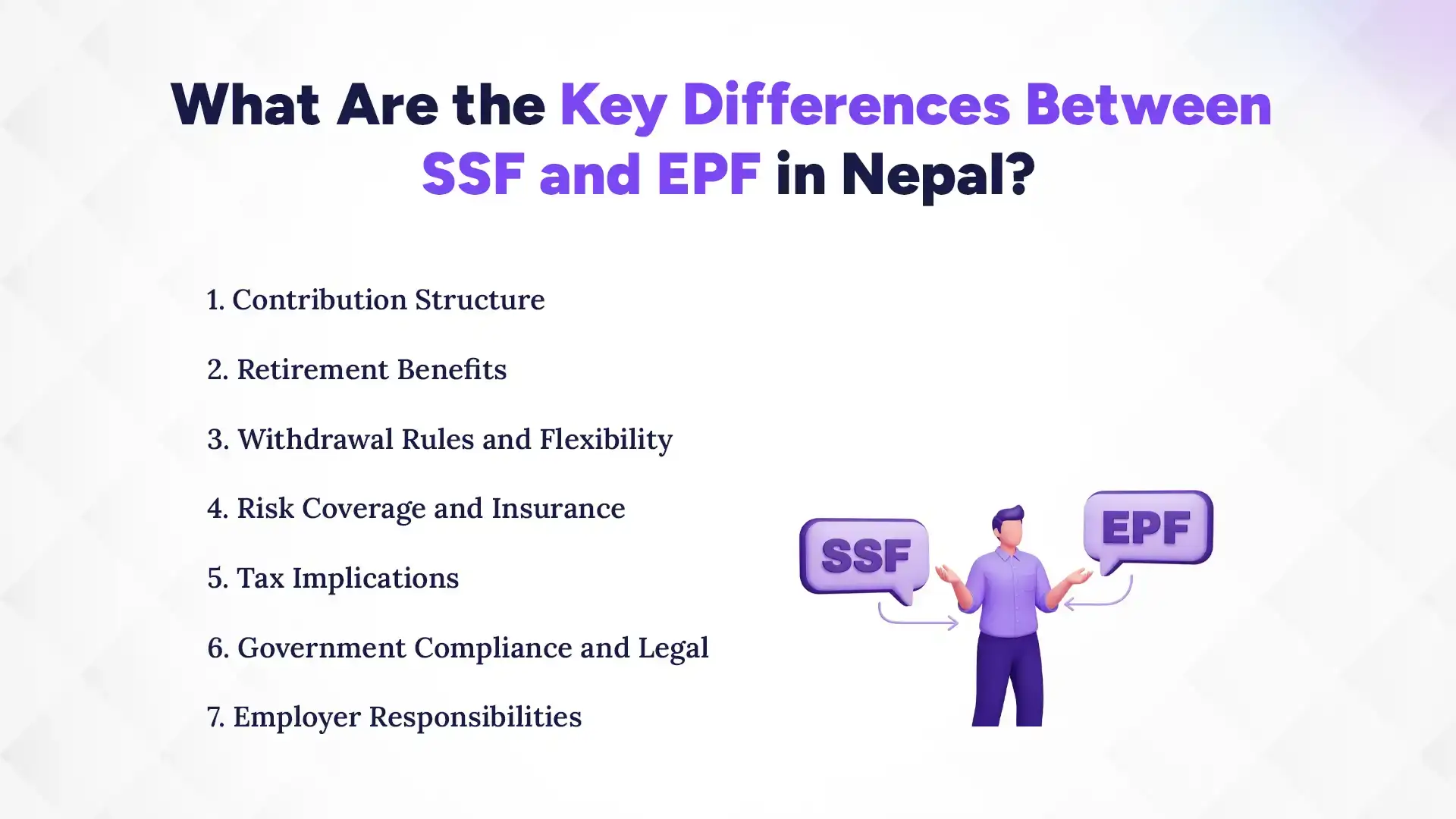
What Are the Key Differences Between SSF and EPF in Nepal?
SSF and EPF differ in contribution rates, benefit coverage, withdrawal rules, tax treatment, and compliance requirements. EPF is a straightforward savings fund while SSF is a comprehensive social protection system covering health, accidents, maternity, and retirement. Here is a breakdown of every major difference you need to know as an employer or HR manager:
1. Contribution Structure
Under EPF, both the employer and employee each contribute 10% of the basic salary every month, making it a simple 10+10 model. SSF works differently. The employer contributes 20% of the gross salary while the employee contributes 11%, bringing the total to 31% per month. That 31% is then split across five benefit schemes, each serving a different purpose. So while EPF contributions go into one savings pool, SSF contributions are actively distributed across multiple protections simultaneously.
2. Retirement Benefits
EPF pays out everything in a single lump sum when the employee retires or exits the fund. The amount depends entirely on how long they contributed and how much interest accumulated over the years. SSF, on the other hand, provides a monthly pension for life once the employee completes a minimum of 180 months (15 years) of contribution. For employees with long careers, SSF's pension model offers far more financial stability than a one-time payout.
3. Withdrawal Rules and Flexibility
The EPF follows a Savings-First model, operating like a flexible personal bank account. With EPF, you can take Special Loans of up to 90–95% of your total balance after just six months of contributing. Its greatest strength is liquidity. This makes it ideal for those who want immediate access to their money for short-term needs or personal emergencies.
In contrast, the SSF follows an Insurance-First model, where your money is locked into a collective safety net to guarantee lifelong benefits like medical coverage and a monthly pension. While it is less flexible for quick withdrawals, it is not completely inaccessible. After three years, you can take substantial loans for housing, education, or social ceremonies.
Ultimately, the EPF shines for its personal financial freedom, while the SSF provides long-term security that stays invested in your future rather than being spent early.
4. Risk Coverage and Insurance
This is where SSF clearly pulls ahead. SSF covers employees across five risk areas including medical treatment, workplace accidents, maternity, dependent family protection, and old-age pension. EPF covers none of these risks directly. If an EPF member gets injured at work or needs emergency medical care, their provident fund offers no immediate support. SSF essentially replaces the need for separate insurance policies by bundling all major employment risks into one system.
5. Tax Implications
Both SSF and EPF contributions are tax-deductible under Nepal's Income Tax Act, which is good news for both employers and employees. EPF withdrawals are also tax-exempt if the employee has contributed for at least three years. SSF contributions enjoy similar tax benefits, and the pension received at retirement is treated favorably under current tax rules. For employers, both systems reduce taxable payroll costs, but SSF's higher contribution rate means a larger deduction overall.
6. Government Compliance and Legal Obligations
SSF registration is legally mandatory for all private sector employers under the Social Security Act 2074. Non-compliance can result in fines, back-payment of contributions with interest, and in serious cases, legal prosecution. EPF compliance, while important for enrolled organizations, does not carry the same universal mandate for private companies. Simply put, if you run a private business in Nepal and haven't registered for SSF yet, you are already non-compliant regardless of whether you contribute to EPF.
7. Employer Responsibilities
Under EPF, employers are responsible for deducting the employee's 10% contribution, adding their own 10%, and depositing the combined amount to the EPF Board monthly. SSF requires more. Employers must register their business on the SSF portal, enroll every employee individually, and deposit the full 31% contribution by the 28th of each month. Any delay attracts a 1.5% monthly penalty on the outstanding amount. So while both systems require discipline, SSF demands tighter payroll management and stronger HR processes.
Need Better SSF Compliance Management?
Manage employee deductions, SSID records, and monthly reporting from one secure platform.
Both funds offer real value but protect employees in very different ways. SSF covers employees across multiple life events while EPF focuses on building retirement savings. Here is exactly what each fund offers.
1. SSF (Social Security Fund) Benefits
SSF goes beyond retirement. It actively protects employees through five dedicated benefit schemes covering health, accidents, maternity, family, and pension. For employers, this means fewer out-of-pocket obligations when employees face emergencies.
Old-Age Pension
Employees who contribute for a minimum of 15 years receive a guaranteed monthly pension for life after retirement, giving them a steady income rather than a one-time payout.
Medical Treatment Coverage
SSF covers employee healthcare costs up to a defined limit, so employees can access medical care without draining their personal savings during an emergency.
Maternity Benefits
Female employees receive salary coverage during maternity leave through SSF, reducing the direct financial burden on employers while keeping employees protected.
Accident and Disability Benefits
Employees who suffer workplace injuries or permanent disability receive lump sum compensation through SSF, removing the pressure on employers to cover these costs independently.
Dependent Family Protection
If an employee passes away during their contribution period, SSF provides financial support to their dependent family members, extending protection beyond just the employee.
Family Survivor Benefits
SSF pays ongoing survivor benefits to the spouse or children of a deceased contributor based on their contribution history, ensuring the family isn't left financially stranded.
2. EPF (Employees Provident Fund) Benefits
EPF is a straightforward savings fund that grows steadily throughout an employee's career. It is simple to manage, easy to understand, and gives employees flexible access to their money when needed.
Lump Sum Retirement Payout
At retirement, employees receive their full accumulated balance including employer contributions and interest earned, which can be a significant amount for long-serving employees.
Long-Term Savings
EPF works as a disciplined forced savings mechanism that keeps growing since employees cannot withdraw freely, making it a reliable retirement corpus over time.
Loan Facilities
EPF members can borrow against their accumulated balance for major expenses like home construction, medical treatment, or education without fully closing their account.
Partial Withdrawal Options
Employees can access part of their EPF balance under approved circumstances, giving them financial flexibility during major life events without losing their entire fund.
Interest Earnings
EPF contributions earn a fixed annual interest rate declared by the EPF Board, meaning the fund grows through both contributions and compounding interest over time.
Voluntary Extra Contributions
Employees can contribute beyond the mandatory 10% to accelerate their retirement savings, making EPF a flexible tool for employees who want to build a larger corpus on their own terms.
How to Calculate SSF and EPF Contributions in Nepal?
Getting contributions right is one of the most critical parts of payroll management. A small miscalculation can lead to compliance issues, employee disputes, and penalty charges. Here is exactly how both systems work and why getting the math right matters.
1. SSF Contribution Calculation
SSF follows a 31% total contribution model split between the employer and employee. The employer contributes 20% of the employee's gross salary while the employee contributes 11%. So for an employee earning NPR 50,000 per month, the employer pays NPR 10,000 and the employee contributes NPR 5,500 — totaling NPR 15,500 every month going into SSF.
That 31% doesn't go into one pool. It is distributed across five benefit schemes:
Medical Treatment Scheme — 1% (employer only)
Accident and Disability Scheme — 1.4% (employer only)
Dependent Family Protection Scheme — 0.27% (employer only)
Old Age Protection Scheme — 28% (employer 16.67%, employee 11%)
Each scheme has a fixed allocation, and contributions must be deposited by the 28th of every month without fail.
2. EPF Contribution Calculation
EPF uses a much simpler 10+10 model. Both the employer and employee each contribute 10% of the employee's basic salary every month. For an employee with a basic salary of NPR 30,000, both parties contribute NPR 3,000 each, making the total monthly deposit NPR 6,000.
That combined amount earns a fixed annual interest rate declared by the EPF Board each year. Over a 20 or 30-year career, this compounding interest can significantly increase the final retirement payout. The longer the employee stays, the bigger the corpus grows, as simple as that!
Automate Payroll Deductions with Pace HRMS
Simplify SSF deductions, payroll calculations, and monthly reporting from one secure platform.
On paper, the formulas look straightforward. In practice, manual calculation becomes a real problem fast, especially as your team grows.
Prone to errors: SSF's five-scheme allocation means even one wrong percentage applied to the wrong scheme creates a compliance gap. Multiply that across 50 or 100 employees and the errors stack up quickly.
Time-consuming: Running monthly calculations for every employee, verifying amounts, and preparing deposit sheets manually eats up significant HR time that could go toward higher-value work.
Salary changes complicate things: Every time an employee gets a raise, their contribution amounts change across all five SSF schemes simultaneously. Tracking this manually across your entire workforce is genuinely difficult to do without mistakes.
Penalty risk: A 1.5% monthly penalty applies to any delayed or incorrect SSF deposit. Manual errors directly translate into financial losses for the business.
That’s exactly why many companies are now shifting to HR payroll software for SSF and EPF management, which automates calculations, reduces compliance risks, and keeps everything accurate without constant manual effort.
4. How HR Payroll Software Helps with SSF, EPF & Other Calculations?
HR payroll software automates SSF and EPF contribution calculations, eliminates manual errors, and keeps your business compliant without the extra legwork. It handles everything from scheme-wise SSF allocation to deposit report generation, all in one place. Here is exactly what it does for you.
Calculate exact SSF and EPF contribution amounts for every employee automatically.
Split SSF contributions across all five schemes without lifting a finger.
Stay updated with the latest government rates and contribution percentages.
Generate ready-to-submit deposit reports in minutes, not hours.
Never miss the 28th deadline with automated payroll reminders.
Eliminate calculation errors before they turn into compliance penalties.
Process payroll accurately whether you have 5 or 500 employees.
Free up your HR team from manual work so they focus on what matters.
For any business managing more than a handful of employees, payroll software isn't a luxury, it's the smartest compliance investment you can make.
Which is the Best Payroll Software for SSF and EPF in Nepal?
Pace HRMS is one of the best HR payroll software options for managing SSF and EPF compliance in Nepal because it is built specifically for how Nepali businesses operate. It automates contribution calculations, manages employee enrollment, and keeps your payroll aligned with the latest government requirements, all in one place. This makes monthly payroll processing faster, cleaner, and completely stress-free.
What makes Pace HRMS stand out is how it handles SSF's complexity without making it complicated for your HR team. It automatically splits SSF contributions across all five benefit schemes, calculates EPF amounts accurately, and generates ready-to-deposit reports before every deadline. Any salary change or new employee addition is reflected in the calculations instantly, so nothing slips through the cracks.
The biggest benefit is confidence. Knowing your contributions are accurate, your deadlines are met, and your business is fully compliant every single month. Whether you manage a team of 10 or 500, Pace HRMS scales with your business without adding to your HR workload. That is why growing businesses across Nepal trust Pace HRMS to take SSF and EPF off their plate entirely.
Pros and Cons of SSF (Social Security Fund)
SSF offers the most comprehensive employee protection system Nepal has seen, covering everything from health and maternity to retirement pension in one fund. It is legally mandatory, which means businesses have no choice but to get familiar with it. That said, like any system, SSF has its strengths and its pain points. Here is an honest breakdown:
Medical, maternity, and accident coverage included
Complex scheme-wise allocation is hard to manage manually
Legally mandatory, builds compliance credibility
Late deposits attract 1.5% monthly penalty
Reduces employer's independent liability for emergencies
Registration and enrollment process can be time-consuming
Extends protection to dependent family members
Less flexible compared to EPF for short-term financial needs
Government-supervised with strong accountability
Many employees still don't fully understand their SSF benefits
SSF is undeniably the more powerful and future-proof system of the two. The breadth of coverage it offers employees is unmatched, and for employers, being SSF-compliant builds trust and reduces long-term liability. The higher contribution rate and stricter rules can feel like a burden initially, but for any business serious about workforce protection and legal compliance, SSF is not optional, it is the standard.
Pros and Cons of EPF (Employee Provident Fund)
EPF is a simple, reliable savings fund that has served Nepal's workforce for over six decades. It builds a retirement corpus through consistent contributions and compounding interest. Here is an honest look at where EPF holds up and where it falls short:
Strengths of EPF
Limitations of EPF
Simple 10+10 contribution model, so it’s easy to manage
No health, maternity, or accident coverage included
Lump sum payout gives employees a significant retirement amount
No monthly pension. One-time payout can be mismanaged
Loan facilities available against accumulated balance
Not mandatory for most private sector employers
Partial withdrawals allowed under approved circumstances
Offers no protection for dependent family members
Compounding interest grows the fund steadily over time
Lower total contribution means smaller long-term corpus
Voluntary extra contributions possible for faster growth
Becoming a legacy system as SSF takes over private sector
Clean, predictable payroll management for HR teams
Does not meet modern social security standards
EPF is a solid savings tool but it was never designed to be a complete social security system. For government and semi-government employees it still serves its purpose well. However, for private sector businesses, EPF alone leaves significant gaps in employee protection that SSF is specifically built to fill. If your business is still purely EPF-dependent, it is worth evaluating whether your workforce is truly covered for what matters most.
Which is Better for Employees: SSF or EPF?
For most private sector employees in Nepal, SSF offers better long-term value than EPF. Here is why that answer depends on where you are in your career.
For employees with stable, long-term jobs, SSF is the clear winner. Contributing consistently for 15 or more years unlocks a monthly pension for life, which is far more sustainable than a one-time EPF payout that can run out. On top of that, the built-in health, maternity, and accident coverage means employees are protected during the working years too, not just at retirement.
For employees on lower salaries, the 11% SSF deduction can feel like a lot compared to EPF's 10%. But the protection they get in return, especially medical and accident coverage, is worth significantly more than what that small difference in take-home pay amounts to.
For employees with short-term or contract roles, EPF's flexibility makes more practical sense. The ability to withdraw funds or take loans gives short-tenure employees access to their own money when they need it, whereas SSF locks contributions into long-term schemes that may not fully benefit someone who won't contribute for 15 years.
For private sector employers in Nepal, SSF is not a choice, it is a legal obligation, which makes the comparison less about preference and more about operational readiness. That said, SSF does offer employers real advantages beyond just compliance.
From a cost perspective, SSF's 20% employer contribution is higher than EPF's 10%, which does increase payroll expenses. However, SSF significantly reduces the employer's independent liability for workplace accidents, medical emergencies, and maternity-related costs. Without SSF, employers often end up covering these costs out of pocket anyway, making SSF's contribution rate a fair trade-off in the long run.
From a compliance standpoint, SSF is tightly regulated with clear deadlines, penalties, and legal consequences for non-compliance. This actually benefits organized businesses because it creates a level playing field and removes ambiguity around employer responsibilities. EPF, while simpler, lacks the same enforcement structure for private companies.
From an operational perspective, SSF does demand stronger HR and payroll processes. Monthly deposits, scheme-wise allocations, and employee enrollment require proper systems in place. Employers who invest in payroll software or a capable HR team handle this smoothly, while those relying on manual processes tend to struggle. EPF is easier to manage day-to-day, but it simply does not meet the compliance standard that Nepal's labor laws now expect from private businesses.
Can You Use Both SSF and EPF Together?
Yes, you can use both SSF and EPF together in Nepal, but it is not mandatory. SSF is compulsory for all formal sector employees, while EPF can be continued voluntarily alongside it.
If you are already enrolled in EPF, you do not have to stop contributing once you join SSF, both can run simultaneously. Employees also have the option to transfer their existing EPF savings directly into SSF and subscribe to its pension scheme instead. Running both does offer a higher level of financial protection, but it also means higher monthly deductions since SSF already covers provident fund and gratuity within its 31% contribution. So before going that route, employees should weigh whether the added coverage is worth the extra cut from their salary every month.
Conclusion
SSF and EPF are not interchangeable. One is a complete social protection system, the other is a savings fund, and knowing the difference is what separates compliant, future-ready businesses from ones constantly playing catch-up. For private sector employers, SSF is the legal standard. For employees, it is the stronger long-term safety net.
Running a business is hard enough without worrying about compliance gaps or leaving your workforce underprotected. Your employees show up every day trusting that you have their backs. The right fund is simply how you make good on that trust.
So if you haven't already, now is the time to get your SSF registration in order, clean up your payroll process, and make sure every employee is enrolled correctly.
No. EPF is a savings fund that pays a lump sum at retirement. SSF is a comprehensive social security system covering health, accidents, maternity, and pension.
Can we withdraw all money from SSF?
+
No. SSF contributions are locked into benefit schemes and cannot be freely withdrawn. Funds are accessible only through eligible claims or upon retirement after 15 years of contribution.
What is the purpose of SSF?
+
SSF provides formal sector employees with structured social protection covering retirement pension, medical treatment, maternity, workplace accidents, and dependent family benefits under one government-managed fund.
Is SSF mandatory for all companies in Nepal?
+
Yes. Every private sector employer with at least one employee must register and contribute to SSF under the Social Security Act 2074, without exception.
Can employees opt out of SSF?
+
No. SSF enrollment is mandatory for all formal sector employees in Nepal. Neither employers nor employees can legally opt out once they fall under its scope.
Which offers better retirement security, SSF or EPF?
+
SSF offers better retirement security through a guaranteed monthly pension for life. EPF provides a one-time lump sum that depends entirely on contribution duration and accumulated interest.
How do SSF contributions affect salary structure?
+
Employees contribute 11% of gross salary to SSF monthly, directly reducing take-home pay. Employers contribute an additional 20%, increasing total employment cost beyond the basic salary.
Is EPF still relevant today in 2026?
+
EPF remains relevant for government and semi-government employees. For private sector businesses, SSF has largely replaced EPF as the primary mandatory social security system in Nepal.
Ready to get started?
Book a 30-minute consultation call, and let's talk about your goals.