

Running an online store without SEO is like opening a shop in the middle of a desert; the products may be great, but no one can find them. E-commerce businesses that rely solely on paid ads, social media, or word of mouth are leaving significant revenue on the table every single day. The benefits of e-commerce SEO go far beyond rankings and website clicks.
A well-executed SEO strategy helps online stores attract high-intent buyers, reduce customer acquisition costs, build long-term brand authority, and generate consistent organic revenue that does not disappear the moment an ad budget runs out. If you are new to this topic, understanding what SEO is gives you a strong foundation before diving into its e-commerce applications.
In this guide, we break down everything a business owner or marketer needs to know about e-commerce SEO: what it is, why it matters, the biggest advantages it delivers, and why working with a specialized SEO agency can accelerate results significantly.
What Is E-Commerce SEO?
E-commerce SEO is the process of optimizing an online store to rank higher in search engine results pages for product-related and commercial keywords. It involves a combination of technical, on-page, and off-page strategies that help search engines like Google understand, crawl, and rank product and category pages effectively.
Unlike general SEO, which often focuses on informational content and brand authority, e-commerce SEO is primarily transactional. The goal is to rank product pages, category pages, and buying guides in front of users who are actively searching for specific products and ready to make a purchase decision.
The key components of a strong e-commerce SEO strategy include product page optimization, technical SEO, content marketing, and link building. Product page optimization covers titles, descriptions, images, and structured data. Technical SEO addresses site speed, crawlability, URL structure, and canonical tags. Content marketing drives top-of-funnel traffic through blogs and buying guides. Link building improves domain authority and helps pages rank competitively.
E-commerce SEO applies across all major online retail platforms, including Shopify, WooCommerce, Magento, BigCommerce, and custom-built stores. Each platform has its own technical strengths and limitations, and an effective SEO strategy must be tailored accordingly.
Why Is E-Commerce SEO Important for Businesses?
E-commerce SEO is important because it connects online businesses with high-intent buyers at the exact moment they are searching for products on Google and other search engines. Unlike traditional advertising, organic search traffic is driven by user intent, meaning the people arriving at your store are already interested in what you sell.
One of the most significant reasons e-commerce SEO matters is its ability to reduce dependency on paid advertising over time. Businesses that rely entirely on pay-per-click campaigns face a fundamental problem: the moment ad spend stops, traffic stops. SEO builds an organic traffic foundation that continues delivering results long after the initial investment.
E-commerce SEO also builds long-term brand visibility. When a store consistently appears on page one for important product keywords, it becomes associated with authority and trust in the eyes of both search engines and potential customers. This visibility is compounding: the more pages that rank, the more traffic and authority the domain earns over time.
In competitive online marketplaces, SEO is increasingly a strategic differentiator. Businesses that invest in optimizing their stores gain a measurable edge over competitors who rely on marketplaces like Amazon or paid channels exclusively. A strong organic presence gives businesses direct ownership of their traffic and customer relationships.
What Are the Top Benefits of E-Commerce SEO?
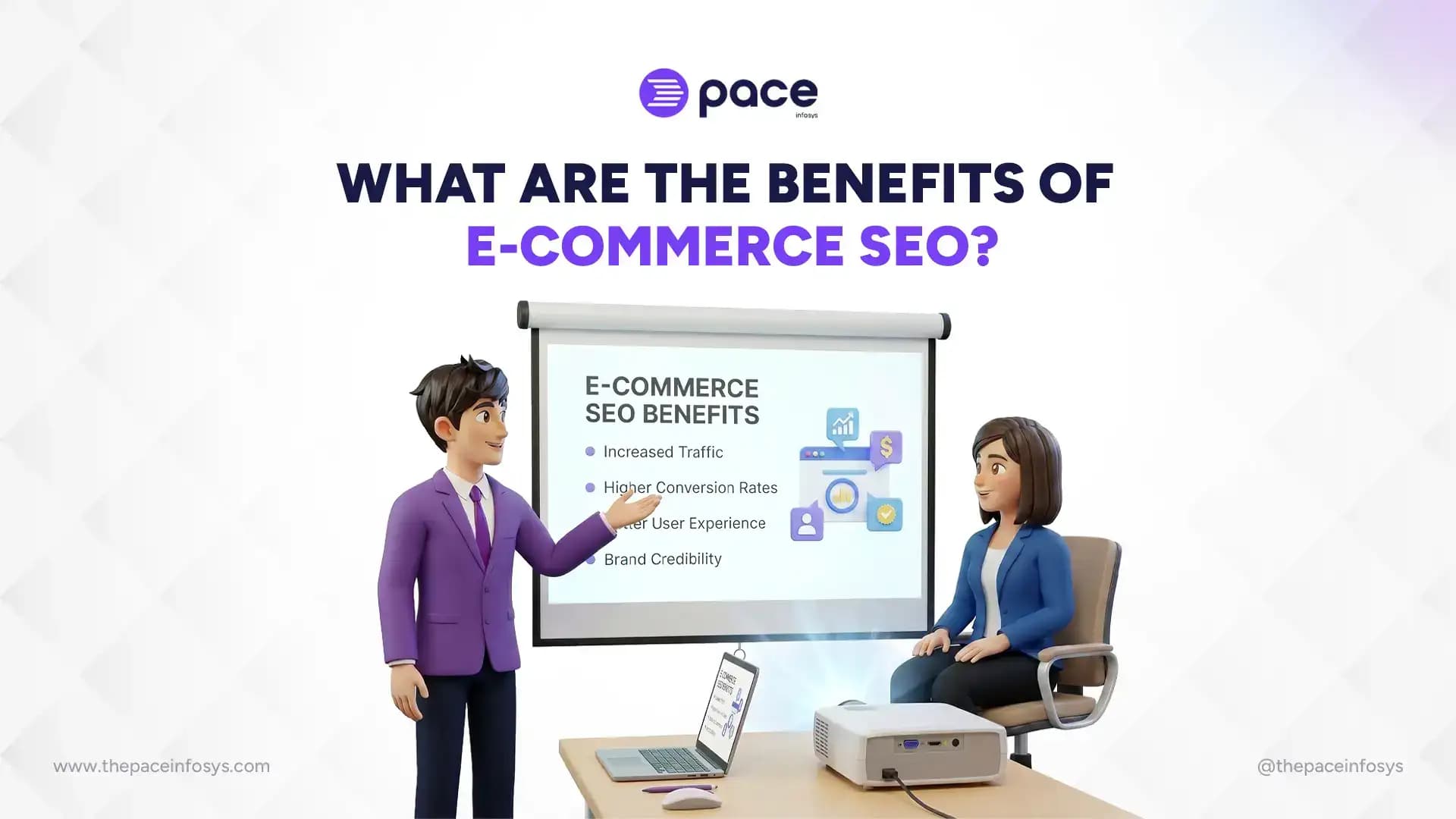
The top benefits of e-commerce SEO include increased organic traffic, higher search engine rankings, better user experience, improved conversion rates, cost-effective marketing, stronger brand awareness, sustainable long-term growth, competitive advantage, better local and global reach, and fully measurable results. Together, these benefits make e-commerce SEO one of the highest-return digital marketing investments available to online businesses today.
1. Increased Organic Traffic
Organic traffic is the foundation of a profitable e-commerce business. E-commerce SEO drives consistent, targeted visitors to product and category pages without requiring ongoing ad spend for every click. By ranking for commercial and transactional keywords, businesses attract users who are already in the buying mindset.
Unlike social media traffic that depends on algorithms or paid traffic that stops when budgets are exhausted, organic traffic from SEO is stable and grows over time. A product page that ranks on page one for a high-volume keyword can generate thousands of visits every month at zero marginal cost.
2. Higher Search Engine Rankings
Higher rankings mean more visibility, more clicks, and more revenue. Studies consistently show that the first position on Google receives the largest share of organic clicks, with traffic dropping sharply on pages two and beyond. E-commerce SEO focuses on ranking product pages, category pages, and informational content for the keywords most valuable to the business.
Ranking improvements compound over time. As domain authority increases through consistent SEO work, newer product pages benefit from the overall strength of the site and rank faster than they would on a weaker domain.
3. Better User Experience
Search engines reward websites that deliver excellent user experiences. Many of the technical improvements required for strong SEO rankings, faster page load speeds, mobile responsiveness, clear navigation, and structured product information directly benefit the experience of every visitor who lands on the store.
A better user experience reduces bounce rates, increases time on site, and improves the likelihood that visitors will browse multiple products before purchasing. Google's Core Web Vitals, which measure loading speed, interactivity, and visual stability, are now direct ranking factors, making UX optimization both an SEO and a conversion priority. Many of these improvements fall under technical SEO, which directly affects how search engines evaluate and rank your store.
4. Improved Conversion Rates
Organic traffic from e-commerce SEO tends to convert at higher rates than many other traffic sources because it is intent-driven. A user who searches for "buy wireless noise-cancelling headphones under $100" and lands on a perfectly optimized product page is far closer to making a purchase than someone who sees a display ad while browsing social media.
Optimized product pages with accurate titles, compelling descriptions, clear pricing, structured reviews, and schema markup give shoppers the information they need to make confident purchase decisions. This alignment between search intent and page content is one of the strongest drivers of e-commerce conversion rate improvements.
5. Cost-Effective Marketing Strategy
E-commerce SEO is one of the most cost-effective long-term marketing strategies available to online businesses. While there is an upfront investment in time, expertise, and tools, the cost per acquisition from organic search decreases significantly as rankings improve and traffic volumes grow.
Compared to pay-per-click advertising, where businesses pay for every visitor regardless of conversion, SEO delivers traffic that does not carry a per-click cost. Over a 12 to 24 month horizon, businesses that invest in SEO consistently report lower customer acquisition costs and higher marketing ROI than those relying primarily on paid channels.
6. Increased Brand Awareness and Credibility
Appearing consistently on page one of Google for important product and category keywords builds significant brand awareness over time. Even users who do not click on a listing the first time they see it are being exposed to the brand, which increases recognition and trust during subsequent searches.
Many consumers associate top organic rankings with credibility and authority. Unlike paid ads, which are visually labeled as advertisements, organic search results are perceived as earned positions, which makes them more trusted by a large segment of online shoppers. Consistent visibility across multiple search queries reinforces brand familiarity and confidence.
7. Sustainable Long-Term Growth
One of the most compelling advantages of e-commerce SEO over paid advertising is its sustainability. A well-ranked product page or category page continues to generate traffic and sales month after month without requiring continuous ad spend. This compounding nature of organic search is what makes SEO such a powerful long-term investment for online businesses.
As a store builds more content, earns more backlinks, and optimizes more pages, its overall organic presence grows. This creates a self-reinforcing cycle where greater authority leads to more rankings, more traffic, more sales, and more brand recognition, all of which further strengthen the site's SEO performance.
8. Competitive Advantage in the Market
E-commerce SEO gives businesses a significant competitive advantage by allowing them to capture organic market share that competitors who rely solely on paid advertising cannot sustain indefinitely. Ranking above competitors for high-value product keywords means capturing their potential customers before they even see a competitor's listing.
Smaller e-commerce businesses can use targeted long-tail keyword strategies to compete effectively against much larger retailers. By focusing on specific product niches, geographic markets, or audience segments that larger competitors overlook, smaller stores can build strong organic positions that deliver consistent sales.
9. Better Local and Global Reach
E-commerce SEO can be strategically applied at both the local and international levels. Local SEO helps businesses with physical locations or regional delivery areas appear in location-based product searches, Google Maps, and local pack listings. This is particularly valuable for businesses competing for customers in specific cities or regions.
International SEO expands a store's reach across multiple countries and languages, allowing businesses to target buyers in different markets through properly structured hreflang tags, localized content, and region-specific keyword targeting. Businesses that optimize for international search can significantly increase their total addressable market.
10. Measurable and Trackable Results
Unlike many traditional marketing methods, e-commerce SEO delivers fully measurable results. Tools like Google Analytics, Google Search Console, and third-party SEO platforms provide detailed data on organic traffic, keyword rankings, click-through rates, conversion rates, revenue from organic search, and return on investment.
This data allows businesses and their SEO teams to make informed decisions, identify high-performing pages, diagnose underperforming content, and continuously improve campaign results. The ability to track every aspect of SEO performance makes it one of the most accountable and optimizable marketing investments available.
How Does E-Commerce SEO Work?
E-commerce SEO works by optimizing every aspect of an online store from individual product pages to technical site architecture to help search engines understand, index, and rank the store for relevant commercial keywords. A successful e-commerce SEO strategy combines five core disciplines.
1. Keyword Research for Product Pages
Keyword research is the foundation of e-commerce SEO. It involves identifying the exact search terms potential customers use when looking for products online, including commercial keywords, transactional phrases, and long-tail variations that indicate strong purchase intent.
Effective keyword research for e-commerce focuses on product-specific terms, category keywords, and comparison queries. Long-tail keywords with lower competition and clear buying intent are particularly valuable for smaller stores because they attract highly qualified traffic while being more achievable to rank for than broad, highly competitive terms.
2. On-Page Optimization
On-page optimization covers all the content and HTML elements on individual product and category pages. This includes writing keyword-rich product titles and meta descriptions, crafting unique and informative product descriptions, optimizing image alt text, structuring URLs clearly, and implementing schema markup for product ratings, pricing, and availability.
Strong on-page optimization ensures that search engines can accurately understand what each page is about and match it to the most relevant search queries.
3. Technical SEO
Technical SEO addresses the structural and performance elements of an e-commerce website that affect how search engines crawl and index its pages. Key technical priorities include improving page load speed, ensuring full mobile responsiveness, fixing broken links and redirect chains, implementing proper canonical tags to prevent duplicate content issues, creating XML sitemaps, and structuring internal linking effectively.
For large e-commerce stores with thousands of product pages, technical SEO is especially critical. Poor crawlability can prevent large portions of a store's inventory from being indexed by search engines, directly limiting organic visibility and revenue potential.
4. Content Marketing
Content marketing drives top-of-funnel organic traffic through informational content that captures potential customers earlier in their buying journey. Buying guides, product comparison articles, how-to content, and category-level blog posts attract users who are researching options before making a purchase decision.
This content builds domain authority, earns backlinks, and creates internal linking opportunities to product and category pages. A strong content strategy also establishes the store as a knowledgeable resource in its niche, which supports both SEO performance and brand credibility.
5. Link Building
Link building earns backlinks from authoritative external websites to improve the domain authority and page authority of an e-commerce store. Higher authority pages rank more easily and competitively for targeted keywords. E-commerce link-building strategies include digital PR, product reviews, supplier and partner linking, and content-driven outreach. This is a core component of off-page SEO, which covers all the authority signals that happen outside the website itself.
E-Commerce SEO vs Paid Ads
Both e-commerce SEO and paid advertising help online businesses attract customers, but they work in fundamentally different ways and deliver very different long-term outcomes.
| Feature | E-Commerce SEO | Paid Ads (PPC) |
|---|---|---|
| Traffic Source | Organic | Paid |
| Speed of Results | Slow but sustainable | Fast but stops when budget runs out |
| Cost Structure | Time and resource investment | Pay per click |
| Long-Term Value | Compounds over time | No residual value |
| Best Use Case | Sustainable growth | Quick sales and promotions |
| ROI Timeline | Long-term | Short-term |
Paid ads are the right choice when a business needs immediate traffic, is launching a new product, or is running a time-sensitive promotion. SEO is the right investment when a business is focused on sustainable organic growth, reducing long-term customer acquisition costs, and building brand authority.
The strongest e-commerce marketing strategies combine both channels. Paid ads generate immediate revenue while SEO builds the organic foundation that reduces dependency on ad spend over time. As SEO performance improves, businesses can gradually reallocate advertising budgets to higher-margin channels without sacrificing overall traffic and sales volumes.
Benefits of Working With an SEO Agency for E-Commerce
Working with an SEO agency for e-commerce gives businesses access to specialized expertise, proven strategies, advanced tools, and dedicated optimization resources that are difficult and expensive to build in-house. For most online businesses, partnering with a qualified agency delivers faster results, stronger ROI, and more scalable growth than attempting to manage SEO internally.
1. Access to Expert Knowledge and Proven Strategies
A specialized e-commerce SEO agency brings years of experience across multiple industries, platforms, and campaign types. This expertise means businesses benefit from strategies that have been tested and proven to work, rather than spending months learning through trial and error. Agencies understand algorithm updates, platform-specific technical challenges, and competitive keyword dynamics in ways that take years to develop independently.
2. Saves Time and Internal Resources
SEO is a time-intensive discipline that requires consistent effort across keyword research, content creation, technical audits, link building, and performance analysis. Managing all of this internally diverts time and resources away from core business operations. Outsourcing to an agency allows business owners and internal teams to focus on product development, customer service, and operations while SEO specialists handle the technical work.
3. Faster Results Through Specialized Tools
SEO agencies invest in premium tools including Ahrefs, SEMrush, Screaming Frog, Moz, and custom analytics platforms that provide deeper insights than free tools can offer. These platforms enable agencies to identify technical issues, track competitor strategies, discover high-value keyword opportunities, and monitor rankings at a level of detail that directly accelerates campaign performance.
4. Data-Driven Campaign Management
Experienced SEO agencies make decisions based on data, not assumptions. They continuously analyze traffic patterns, conversion data, ranking movements, and competitor performance to refine strategies and prioritize the highest-impact optimizations. This data-driven approach reduces wasted effort and ensures that resources are directed toward the activities most likely to improve revenue from organic search.
5. Scalable SEO Strategies for Business Growth
As an e-commerce business grows, its SEO needs become more complex. An agency can scale strategies to match business growth, adding new product category optimizations, expanding into new markets, developing larger content programs, and managing increasingly complex technical infrastructure. This scalability is difficult to achieve with in-house teams alone, particularly for businesses in rapid growth phases.
6. Ongoing Monitoring and Performance Optimization
SEO is not a one-time project. Search engine algorithms update regularly, competitors continuously optimize their own strategies, and market conditions change over time. A dedicated SEO agency provides ongoing monitoring, proactive problem identification, and continuous optimization that keeps a store's organic performance strong and resilient against ranking fluctuations.
If you are evaluating your options, this guide on how to choose the right SEO agency covers exactly what to look for before making that decision.
Common Challenges in E-Commerce SEO
E-commerce SEO delivers powerful results, but online stores face specific challenges that can limit performance if not addressed systematically. Understanding these challenges is the first step toward overcoming them.
1. Duplicate Content on Product Pages
Duplicate content on product pages is one of the most common technical problems in e-commerce. Product variations, filtered URLs, and paginated category pages often create multiple URLs with near-identical content, which confuses search engines and dilutes ranking signals. Proper canonical tag implementation and URL parameter management are essential solutions.
2. Large Website Crawlability Issues
Large website crawlability issues affect stores with thousands of product SKUs. Search engines have a finite crawl budget for each website, and without proper internal linking, sitemap management, and crawl priority signals, large sections of a store's inventory may go unindexed and invisible to search engines.
3. High Competition for Product Keywords
High competition for product keywords makes it challenging for newer or smaller stores to rank for popular, high-volume terms. Competing against established retailers with massive domain authority requires a strategic approach to long-tail keywords, content differentiation, and niche-specific optimization.
4. Thin or Low-Quality Product Descriptions
Thin or low-quality product descriptions are a widespread issue in e-commerce, particularly for stores that use manufacturer-supplied copy across multiple product pages. Search engines penalize thin content and duplicate descriptions, making unique, informative product writing a critical ranking and conversion factor.
5. Slow Page Speed and Technical Issues
Slow page speed and technical issues directly harm both search rankings and user experience. E-commerce sites with heavy images, unoptimized code, and poor server response times consistently underperform in both organic rankings and conversion rates compared to faster competitors.
Why Businesses Should Invest in E-Commerce SEO
Businesses should invest in e-commerce SEO because it delivers long-term organic revenue growth, lower customer acquisition costs, stronger brand presence, better ROI than paid advertising alone, and a scalable marketing strategy that grows with the business.
1. Long-Term Organic Revenue Growth
Long-term organic revenue growth is the most compelling financial argument for e-commerce SEO. Unlike paid campaigns that generate revenue only while budgets are active, well-ranked organic pages continue driving traffic and sales for months and years after the initial optimization work is completed.
2. Lower Customer Acquisition Cost
Lower Customer Acquisition Cost is a direct financial benefit of strong organic performance. As organic traffic grows and paid ad dependency decreases, the average cost of acquiring each new customer falls, improving overall business profitability and marketing efficiency.
3. Stronger Online Brand Presence
A stronger online brand presence is built through consistent page-one visibility for relevant product and category searches. Businesses that appear at the top of organic results are perceived as category leaders, which builds customer trust and supports higher average order values and repeat purchase rates.
4. Better Return on Investment Than Paid Ads Alone
SEO proves that it is a better return on investment than paid ads alone, according to long-term digital marketing performance data. While paid ads deliver faster initial results, SEO typically generates higher cumulative ROI over a 12 to 24 month period due to the compounding nature of organic rankings and the elimination of per-click costs.
5. Scalable Strategy for Any Business Size
A scalable strategy for any business size makes e-commerce SEO accessible and valuable for startups, growing mid-market retailers, and large enterprise stores alike. SEO strategies can be scoped and prioritized to match any budget, with results scaling proportionally as investment and optimization depth increase over time.
Which Is the Best E-Commerce SEO Company?
When it comes to reliable and results-driven e-commerce SEO, The Pace Infosys stands out as a trusted partner for online businesses of all sizes. With deep expertise in on-page optimization, technical SEO, content strategy, and link building, The Pace Infosys delivers high-performance SEO solutions that drive consistent organic traffic, improve search rankings, and generate measurable revenue growth for e-commerce stores. Their team combines strong technical knowledge with a clear understanding of business goals, ensuring that every SEO strategy they build is precisely aligned with the client's products, target audience, and competitive landscape. From initial SEO audit and keyword research to full-scale optimization, content development, and ongoing performance monitoring, The Pace Infosys provides a complete end-to-end e-commerce SEO experience.
What sets The Pace Infosys apart is their commitment to transparency, structured campaign timelines, and consistent communication throughout every stage of the SEO process. They have a proven track record of delivering e-commerce SEO results across multiple industries, which means they bring relevant domain experience and tested strategies to every engagement. Whether you are a startup launching your first online store or an established retailer looking to reduce paid ad dependency and grow organic revenue, The Pace Infosys has the expertise, the tools, and the dedication to deliver. Choosing The Pace Infosys means choosing a partner that is invested in your e-commerce growth from the first consultation to long-term search dominance and beyond
Conclusion
The benefits of e-commerce SEO are clear, measurable, and long-lasting. From increased organic traffic and higher conversion rates to sustainable brand growth and lower customer acquisition costs, SEO is one of the most valuable investments an online business can make in its long-term digital marketing strategy.
Businesses that combine a strong SEO foundation with a data-driven paid advertising strategy consistently outperform competitors that rely on either channel alone. And for businesses that want to accelerate results, reduce costly trial and error, and build a scalable organic revenue channel, partnering with a specialized e-commerce SEO agency is the most efficient path to sustainable growth.
Ready to grow your e-commerce store through organic search? Contact The Pace Infoyss today for a free SEO consultation and discover how our proven e-commerce SEO strategies can help your business rank higher, attract more buyers, and generate consistent long-term revenue.