
.webp&w=3840&q=75)
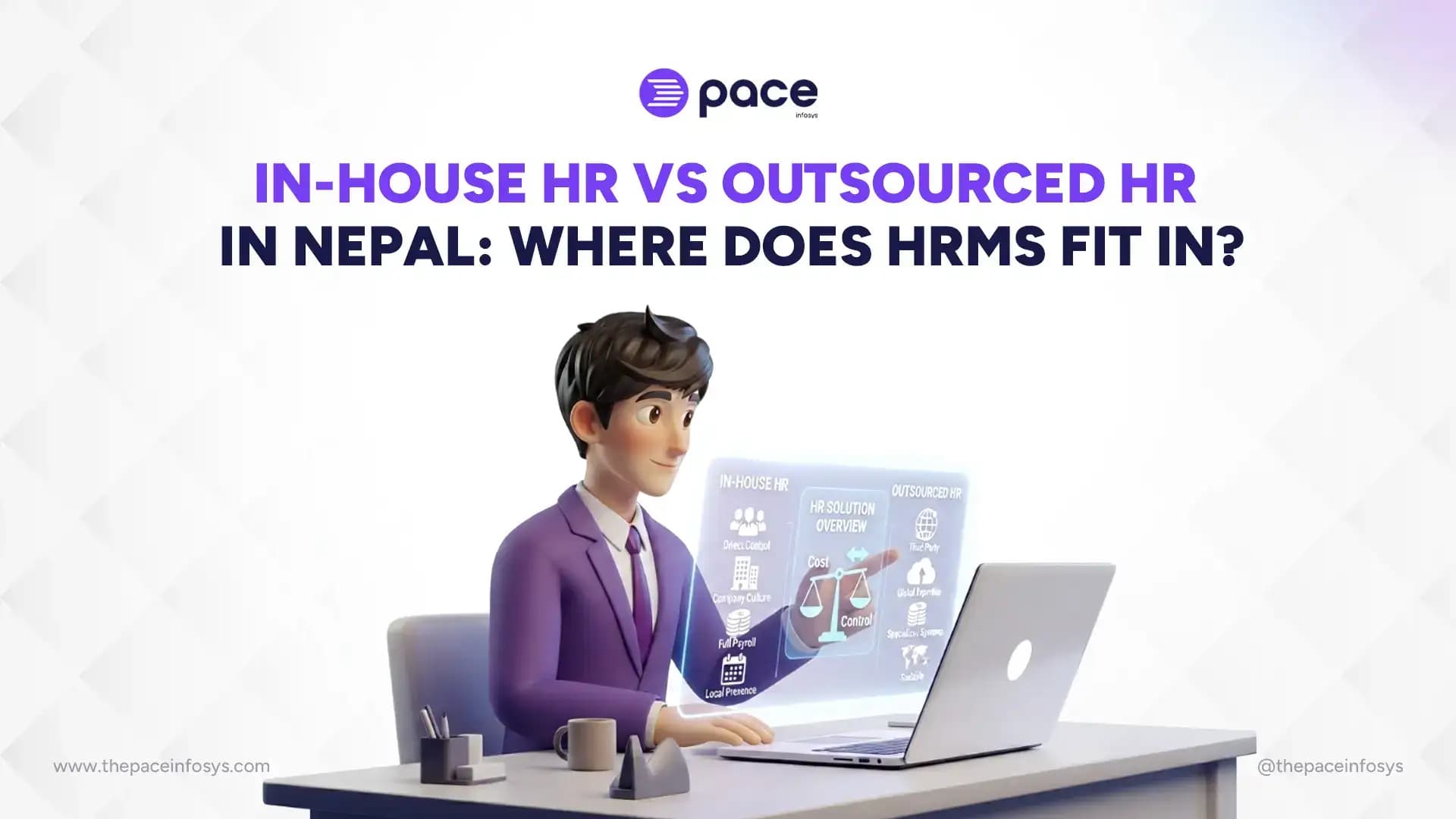
HRMS isn't a replacement for either in-house or outsourced HR; it's the system both models rely on to actually function, giving in-house teams automation and giving outsourced providers structured, controlled access to the same data. The question businesses usually ask, in-house or outsourced, often matters less than whether either model has a reliable system underneath it.
This guide covers the core difference between in-house and outsourced HR, why businesses in Nepal choose outsourcing, what each model handles better than the other, what happens when structure and systems don't align, what to weigh before choosing, and where HRMS actually fits into both, closing with which HRMS works well regardless of structure.
What's the Core Difference Between In-House and Outsourced HR?
In-house HR means a business employs its own dedicated staff to manage HR functions directly, while outsourced HR means those functions are handled by an external provider under a service agreement.
With in-house HR, the people managing employee relations, payroll, and compliance work directly for the business and are embedded in its day-to-day operations. With outsourced HR, those same functions are handled by a third party who serves multiple clients, working from a service agreement rather than direct employment. Control naturally follows this structure: in-house HR gives a business direct oversight over policy and process, while outsourced HR trades some of that control for external expertise and reduced internal overhead.
| Factor | In-House HR | Outsourced HR |
|---|---|---|
| Control | Direct, immediate | Shared, governed by contract |
| Cost Structure | Fixed salaries and overhead | Variable, service-based fees |
| Speed of Response | Fast, embedded in the business | Slower, dependent on provider availability |
| Institutional Knowledge | Deep, builds over time | Limited, spread across multiple clients |
Why Do Businesses in Nepal Choose Outsourced HR?
Businesses in Nepal choose outsourced HR for lower initial overhead, access to specialized expertise they don't have in-house, and simplicity for small teams that don't yet need a dedicated HR department.
1. Lower Initial Overhead
Outsourcing avoids the cost of hiring, training, and retaining full-time HR staff, which matters significantly for businesses still finding their footing. Lower initial overhead is often the deciding factor for early-stage businesses weighing this decision for the first time, especially when evaluating the cost of HR management software alongside salary expenses.
2. Access to Specialized Expertise
An outsourced provider brings experience across compliance, payroll, and HR best practices that a small internal team simply hasn't had time to build. Access to specialized expertise lets a growing business benefit from knowledge it couldn't otherwise afford to hire directly.
3. Simplicity for Small Teams
For a business with a handful of employees, building a dedicated HR function in-house is often more structure than the situation actually calls for. Simplicity for small teams is exactly why outsourcing tends to make the most sense before HR complexity grows.
What Does In-House HR Handle Better Than Outsourcing?
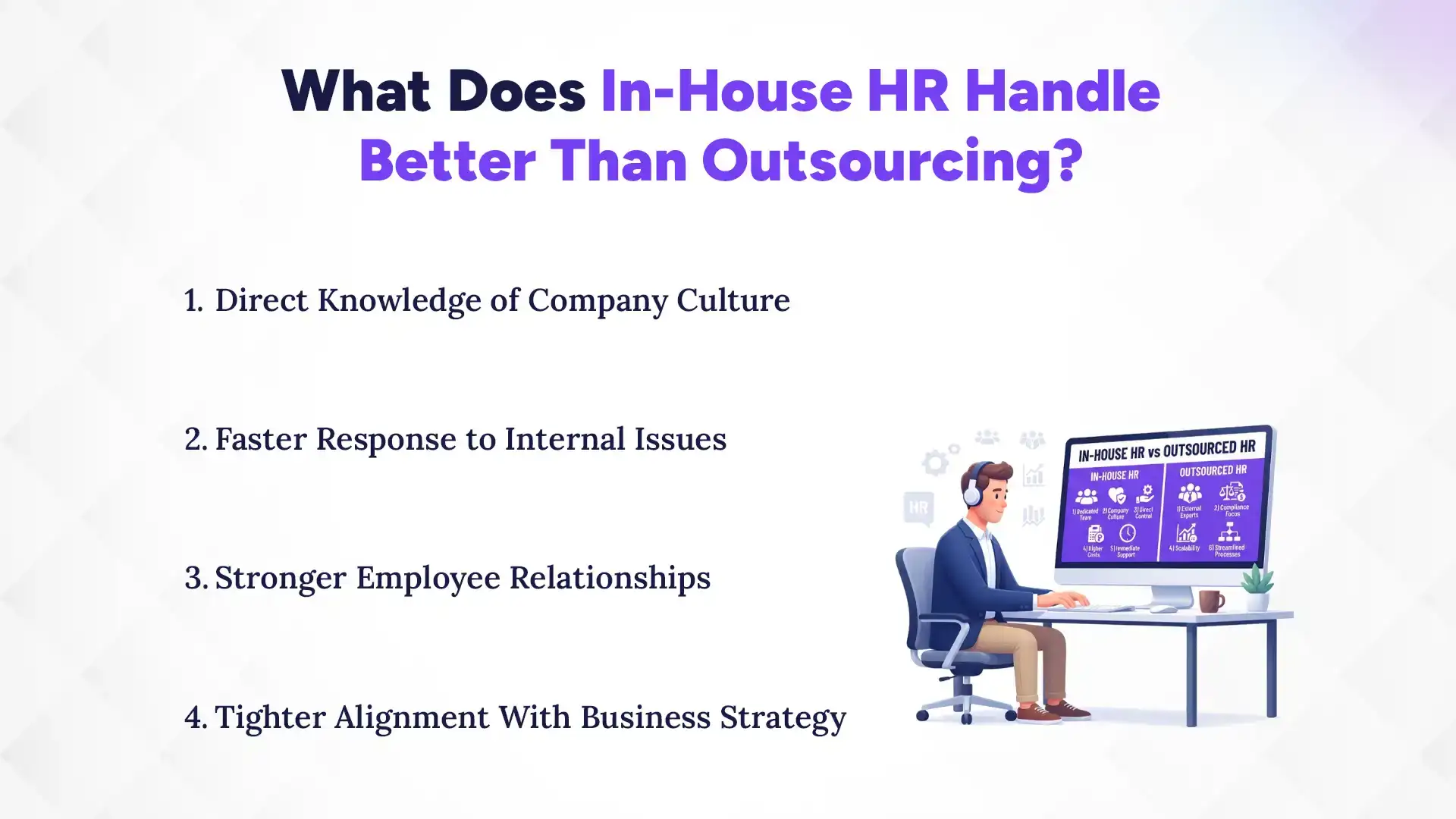
In-house HR handles direct knowledge of company culture, faster response to internal issues, stronger day-to-day employee relationships, and tighter alignment with overall business strategy better than outsourcing typically can.
1. Direct Knowledge of Company Culture
In-house HR staff live inside the company's culture every day, understanding nuances an external provider serving multiple clients simply can't absorb as deeply. Direct knowledge of company culture shapes better decisions around hiring, policy, and employee relations.
2. Faster Response to Internal Issues
Because in-house staff are physically or organizationally embedded in the business, they can respond to urgent employee issues immediately, without routing through an external contact. Faster response to internal issues matters most in situations where timing genuinely affects the outcome.
3. Stronger Employee Relationships
Employees tend to build more trust and rapport with HR staff they interact with regularly and in person, compared to a rotating or distant outsourced contact. Stronger employee relationships often translate directly into better retention and morale over time, maximizing the overall advantage of HR software.
4. Tighter Alignment With Business Strategy
In-house HR can align hiring, policy, and workforce planning directly with the company's evolving strategy, since they're part of ongoing internal conversations. Tighter alignment with business strategy is difficult for an external provider to replicate at the same depth.
What Does Outsourced HR Handle Better Than In-House Teams?
Outsourced HR typically handles broad compliance expertise, scalability without needing to hire additional staff, and access to established, tested processes better than a small in-house team can.
1. Broad Compliance Expertise
Outsourced providers work across many clients and industries, giving them exposure to a breadth of compliance scenarios a single in-house team rarely encounters. Broad compliance expertise reduces the risk of costly mistakes, especially for businesses without dedicated legal or compliance staff navigating complex areas like staff payroll deductions.
2. Scalability Without Hiring
An outsourced provider can absorb increased HR workload without the business needing to hire additional internal staff to keep up. Scalability without hiring gives a growing business flexibility that in-house teams, constrained by headcount, often can't match as quickly.
3. Access to Established Processes
Outsourced providers typically bring tested, refined processes built from working across many businesses, rather than developing everything from scratch internally. Access to established processes saves a business from the trial and error of building HR systems entirely on its own.
What Happens When HR Structure and Systems Don't Align?
When HR structure and systems don't align, data gets duplicated or conflicting, decision-making slows down, compliance gaps open up between parties, and confusion sets in over who actually owns which responsibility.
1. Duplicated or Conflicting Data
When in-house and outsourced parties each maintain their own separate records, the same employee information can end up inconsistent between systems. Duplicated or conflicting data creates confusion the moment anyone needs a single, reliable answer about an employee's status.
2. Delayed Decision-Making
Without a shared system, information has to be manually relayed between the business and its outsourced provider, slowing down decisions that should happen quickly. Delayed decision-making becomes a real operational cost when HR issues can't be resolved as fast as they arise.
3. Compliance Gaps Between Parties
When responsibility for compliance tasks isn't clearly systemized, it's possible for both sides to assume the other is handling something that neither actually is. Compliance gaps between parties are exactly the kind of risk a shared, well-structured system is meant to prevent.
4. Confusion Over Who Owns What
Without clear systemized boundaries, it's easy for both in-house staff and an outsourced provider to be unclear about who's actually responsible for a given task. Confusion over who owns what often only becomes visible after something has already been missed.
What Should You Weigh Before Choosing In-House or Outsourced HR?
Before choosing in-house or outsourced HR, businesses should weigh their size and complexity, their budget for ongoing HR costs, and how much need there is for direct, immediate employee access.
1. Business Size and Complexity
A larger, more complex organization generally benefits from the depth and responsiveness of in-house HR, while a smaller one may not yet need that level of investment. Weighing business size and complexity honestly helps avoid over- or under-investing in HR structure relative to actual need.
2. Budget for Ongoing HR Costs
In-house HR carries fixed salary costs regardless of workload, while outsourced HR scales more directly with actual usage, which changes the calculation depending on cash flow. Budget for ongoing HR costs should be weighed against long-term needs, not just the immediate price difference, a crucial step when choosing the right HR software to support either model.
3. Need for Direct Employee Access
Businesses where employees frequently need immediate, in-person HR support may find outsourcing's inherent distance a real limitation. Considering the need for direct employee access helps clarify how much responsiveness actually matters for your specific team.
Where Does HRMS Fit Into Both Models in Nepal?
HRMS fits into both models in Nepal as the shared source of truth, supporting in-house teams with automation while giving outsourced providers controlled, structured access to the same accurate data.
1. HRMS as the Shared Source of Truth
Regardless of whether HR is handled in-house or outsourced, HRMS gives both sides a single, consistent record to work from instead of maintaining separate versions of the truth. HRMS as the shared source of truth is what actually prevents the data conflicts that come from disconnected systems.
2. Supporting In-House Teams With Automation
Supporting in-house teams with automation relies on having the right core functions of HR software, so internal HR can focus on what it's actually good at, rather than manual administrative work.
3. Giving Outsourced Providers Controlled Access
HRMS can grant an outsourced provider access to exactly the data and functions they need, without exposing the entire system or handing over broader access than necessary. Giving outsourced providers controlled access keeps the relationship structured and secure rather than dependent on manual data sharing.
4. Keeping Compliance Consistent Either Way
Whether HR is managed internally or externally, HRMS applies the same compliance rules and recordkeeping standards, so the model chosen doesn't change how consistently compliance is actually handled. Keeping compliance consistent either way removes one of the biggest risks that comes from switching between HR models over time, showing exactly how HR software helps businesses stay compliant.
Which HRMS Works Best Regardless of HR Structure in Nepal?
Pace HRMS works best regardless of HR structure in Nepal, supporting in-house teams directly and giving outsourced providers the controlled access they need to work from the same accurate data. It's designed to reflect how Nepali businesses actually manage their HR structures.
For businesses in Nepal looking to move from fragmented systems to a single source of truth, Pace HRMS works underneath either model, giving in-house staff automation and giving outsourced providers exactly the access they need without compromising data control. It pulls together shared data, controlled access permissions, and consistent compliance handling into a single platform instead of disconnected spreadsheets. As one of the leading HR software in Nepal, it's designed to reflect how Nepali businesses actually manage their HR structures.
What sets Pace HRMS apart is that it was designed to be structure-agnostic from the start, supporting both models equally rather than assuming one is the default. Between shared data, controlled access permissions, and consistent compliance handling, it gives businesses the flexibility to change HR structure without having to rebuild their entire system around it.
Conclusion
Choosing between in-house and outsourced HR isn't the real decision that determines success; having one consistent system both sides can rely on is. HRMS is what makes either model actually work without duplicated effort, compliance gaps, or confusion over who owns what, giving businesses the freedom to choose the structure that fits without worrying the systems underneath won't keep up.
If your business is weighing in-house versus outsourced HR, reach out to Pace Infosys to see how it fits your team.