
.webp&w=3840&q=75)
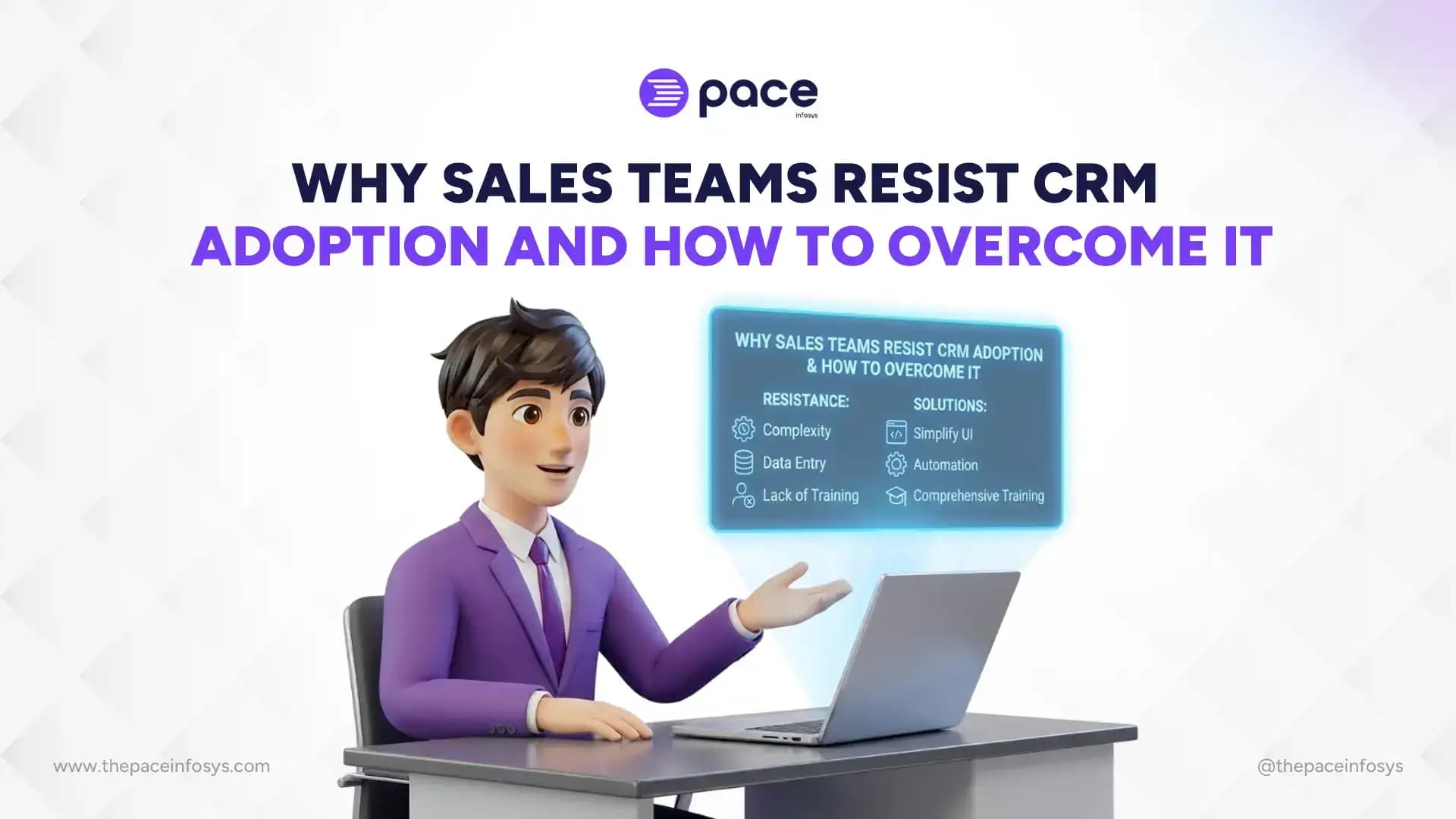
Sales teams resist CRM adoption because it feels like extra data entry with no personal payoff, and the fix is tying CRM use directly to how reps already sell, not adding oversight on top of their workflow. The software rarely fails on its own; adoption fails when it's introduced as a monitoring tool instead of a selling tool. This is a common pattern among sales teams in Nepal moving from relationship-driven, informal sales tracking to a structured CRM for the first time.
This guide covers what CRM resistance actually looks like, why sales reps push back, how poor onboarding makes it worse, the role leadership plays, what happens when adoption never takes hold, the strategies that actually work, and how to measure whether adoption is improving closing with which CRM sales teams adopt most easily.
What Does CRM Resistance Look Like Among Sales Teams?
CRM resistance among sales teams looks like inconsistent data entry, reliance on spreadsheets or personal notes instead of the system, and reps only logging activity right before a pipeline review. It often shows up quietly at first, making it easy for managers to miss until adoption has already stalled.
1. Common Signs of CRM Avoidance
Deals sitting in outdated stages, missing next steps, and contact records that haven't been touched in weeks are all early signs that a rep isn't actually using the system day to day. Spotting common signs of CRM avoidance early gives managers a chance to fix the problem before it becomes a team-wide habit.
2. Manual Workarounds Reps Fall Back On
Reps who don't trust or like the CRM often keep their own spreadsheet, notebook, or personal notes app running in parallel, treating the CRM as a formality rather than their actual system of record. Identifying manual workarounds sales reps rely on instead of the CRM reveals exactly where the tool isn't fitting their workflow. Without proper CRM contact management, managers won't see the full communication history, leading to blind spots in the pipeline.
3. Low Data Entry Compliance
When logging a call or updating a deal stage feels like an extra chore, reps tend to skip it unless someone is checking. Measuring low data entry compliance across the team is often the clearest early warning sign that adoption is slipping.
4. Vocal vs. Silent Resistance
Some resistance is loud, reps openly complaining about the system, while other resistance is silent, reps simply not using it and saying nothing. Recognizing the difference between vocal and silent resistance matters, because the silent version is easier to miss and harder to fix once it becomes routine.
Why Do Sales Reps Resist Adopting a New CRM?
Sales reps resist adopting a new CRM because it feels like added administrative work, raises concerns about being monitored, and disrupts habits they already trust to close deals. This resistance tends to be strongest among experienced reps who've relied on their own system for years.
1. Fear of Increased Workload
Reps already spend a large share of their day on non-selling tasks, so a new system that adds more data entry on top of that feels like it's working against them, not for them. Reducing the fear of increased workload starts with showing reps how the CRM actually saves them time rather than adding to their to-do list.
2. Distrust of Being Monitored
When a CRM is rolled out primarily as a way for managers to track activity, reps understandably read it as surveillance rather than support. Addressing distrust of being monitored requires framing the CRM around helping reps sell, not just giving leadership more visibility.
3. Comfort With Existing Habits
Experienced reps often have their own system, whether it's a spreadsheet, a notebook, or pure memory, that's worked for them for years, and switching to something new feels like starting over. Overcoming comfort with existing habits takes more than a single training session; it takes proof the new system genuinely works better.
4. Past Experience of Sales Reps With Failed Tool Rollouts
Reps who've lived through a CRM or sales tool launch that fizzled out after a few months are naturally skeptical that this rollout will be any different. Rebuilding trust after past experience of sales reps with failed tool rollouts means being upfront about what's different this time and following through on it.
How Does Poor CRM Onboarding Fuel Resistance?
Poor CRM onboarding fuels resistance by throwing reps into a new system without role-specific training, a clear migration path, or support once the initial rollout is over. When that first experience feels confusing or unsupported, reps quickly revert to whatever they used before.
1. Lack of Role-Specific Training
Generic training that covers every feature at once leaves reps unsure which parts of the system actually apply to their day-to-day job. Delivering role-specific training instead of a one-size-fits-all session helps reps see exactly how the CRM fits their own workflow.
2. Overwhelming Initial Setup
A CRM with every field, workflow, and integration turned on from day one can overwhelm reps who just need to log calls and track deals. Simplifying the overwhelming initial setup down to the essentials first makes the learning curve far less steep.
3. No Clear Migration Plan From Old Tools
When there's no clear plan for moving existing deals, contacts, and notes into the new system, reps are left recreating work manually or abandoning the old records altogether. Building a clear migration plan from old tools before rollout prevents this early frustration from souring the whole adoption process. When you choose the right CRM for your business, ensuring it has a seamless data import process is critical to preventing this exact bottleneck.
4. Absence of Ongoing Support
Training that ends after week one leaves reps stuck the first time they hit an edge case, and many simply revert to old habits rather than ask for help. Providing ongoing support well past the initial rollout is often the difference between adoption that sticks and adoption that fades.
What Role Does Leadership Play in CRM Adoption?
Leadership plays a central role in CRM adoption by setting clear expectations, using the CRM themselves, and tying its use to how performance is measured and rewarded. Without visible buy-in from managers, reps have little reason to treat the system as anything more than optional.
1. Setting Clear Expectations
When leadership doesn't clearly state that CRM use is expected, not optional, reps default to whatever feels easiest in the moment. Setting clear expectations around CRM use from the start removes the ambiguity that lets old habits persist.
2. Leading by Example
Reps notice quickly if their manager isn't using the CRM consistently, and that inconsistency undermines any message about why the tool matters. Leading by example through visible, consistent CRM use signals that the tool is actually valued, not just mandated.
3. Tying CRM Use to Incentives
When CRM data feeds directly into commission calculations, forecasting, or performance reviews, reps have a concrete reason to keep it accurate. Tying CRM use to incentives that reps already care about turns adoption into self-interest rather than compliance.
What Happens When Sales Teams Don't Adopt CRM?
When sales teams don't adopt CRM, the business loses pipeline visibility, forecasting becomes unreliable, deals slip through poor follow-up, and the CRM investment goes largely to waste. These effects compound quietly over time, often going unnoticed until a forecast badly misses reality.
1. Incomplete Pipeline Visibility
When deal stages and activity aren't logged consistently, managers lose an accurate picture of what's actually happening across the pipeline. Restoring incomplete pipeline visibility depends entirely on reps trusting and using the system as their real source of truth.
2. Inaccurate Sales Forecasting
Forecasts built on incomplete or outdated CRM data are only as reliable as the information reps actually entered, which makes low adoption a direct cause of forecasting errors. Fixing inaccurate sales forecasting starts with closing the adoption gap that's feeding it.
3. Lost Deals Due to Missed Deadlines
Without reliable follow-up reminders and next-step tracking, deals quietly go cold because no one remembered to reach back out. Preventing lost deals due to missed deadlines is one of the most immediate, tangible benefits of full CRM adoption. If a rep isn't logging activities, effective lead management in CRM becomes virtually impossible, and hot leads silently slip through the cracks.
4. Wasted Investment in the Platform
A CRM that isn't actually used still costs the business in licensing fees, implementation time, and ongoing maintenance, with none of the return it was meant to deliver. Looking closely at the cost of CRM software in Nepal reveals that paying for a tool no one uses is one of the biggest silent financial drains for a growing business. Avoiding wasted investment in the platform is ultimately what makes solving adoption resistance a financial priority, not just an operational one.
What Strategies Help Overcome CRM Adoption Resistance?
Strategies that overcome CRM adoption resistance include involving reps in tool selection, simplifying data entry requirements, and providing continuous coaching instead of a one-time training session. Each of these works by reducing friction rather than forcing compliance.
1. Involving Reps in Tool Selection
Reps are far more likely to adopt a system they had a say in choosing than one that was handed down without their input. Comparing the top 5 CRMs in Nepal as a team, rather than having leadership mandate a platform, builds organic buy-in before the rollout even begins.
2. Simplifying Data Entry Requirements
The more fields and steps required to log a single interaction, the more likely reps are to skip it or fill it in carelessly. Simplifying data entry requirements down to what's actually necessary makes consistent use realistic instead of aspirational.
3. Providing Continuous Coaching
One training session rarely changes long-term behavior; ongoing coaching and check-ins reinforce good habits until they become second nature. Providing continuous coaching after the initial rollout keeps adoption from quietly slipping back to old patterns.
4. Leveraging Mobile Access
Reps who spend most of their day on the road or on their phones need a system that travels with them. Utilizing a mobile-friendly, cloud-based CRM allows reps to log a call or update a deal stage immediately from their phone, rather than waiting to return to a desk, drastically reducing data-entry friction.
How Can Businesses Measure CRM Adoption Success?
Businesses can measure CRM adoption success by tracking login and usage frequency, data entry completeness, pipeline accuracy over time, and direct feedback from the sales team. Tracking these consistently turns adoption from a one-time rollout goal into an ongoing metric worth managing.
1. Login and Usage Frequency
How often and how long reps actually log into the CRM is one of the most basic, direct signals of whether adoption is real. Tracking login and usage frequency over time shows whether adoption is improving or quietly declining after the initial rollout excitement fades.
2. Data Entry Completeness
Checking whether required fields, like next steps and deal stages, are consistently filled in shows whether reps are using the system properly or just going through the motions. Monitoring data entry completeness across the team highlights exactly which reps or teams need additional support.
3. Pipeline Accuracy Over Time
Comparing forecasted deals against actual closed outcomes reveals whether the data in the CRM reflects reality or has drifted out of sync. Improving pipeline accuracy over time is one of the clearest proofs that adoption efforts are working.
4. Rep Feedback and Satisfaction Scores
Directly asking reps how the CRM fits into their workflow often surfaces friction points that usage data alone won't show. Collecting rep feedback and satisfaction scores regularly keeps adoption efforts responsive instead of static.
Which CRM Is Easiest for Sales Teams to Adopt?
Pace CRM is the easiest CRM for sales teams in Nepal to adopt, with a simplified interface, minimal manual data entry, and onboarding built around how sales reps actually work.
For businesses in Nepal that have struggled with low adoption on a previous platform or are moving off spreadsheets and phone-based tracking for the first time, Pace CRM is built around minimizing the friction that usually causes reps to disengage. Its interface keeps data entry to what's genuinely necessary, and onboarding is structured around actual sales workflows instead of a generic feature tour.
What sets Pace CRM apart is that adoption was treated as a design priority, not an afterthought solved through training alone. Realizing the true benefits of a CRM system only happens when reps actually use the platform. Between a simplified interface, role-specific onboarding, and reporting that ties CRM data to real sales outcomes, it gives sales teams a system they're far more likely to actually use.
Conclusion
CRM adoption failures are rarely about the software itself and almost always about workflow fit, training, and leadership follow-through, and fixing those three areas is what turns resistance into consistent use. When reps see the CRM as something that helps them sell rather than something that watches them work, adoption stops being a battle and becomes routine.
If your team is dealing with low CRM adoption, explore Pace CRM software and its approach to rep-friendly onboarding with a demo or contact Pace Infosys today to see how it fits your sales process.