In today’s digital world, shopping has completely shifted from physical stores to online platforms, making it easier, faster, and more convenient for customers. An e-commerce website allows businesses to sell products or services directly over the internet, reaching customers anytime and anywhere. From small startups to global brands, everyone is using online stores to grow faster and serve a wider audience. This digital shift has changed the way people buy and sell products globally.
In this blog on What is an E-Commerce Website?, we will explore everything you need to know about online stores in a simple and practical way. You will learn what an e-commerce website is, how it works, its key components, benefits, importance, and common mistakes businesses should avoid. By the end, you will have a clear understanding of how e-commerce websites function and how they help businesses grow in the modern digital economy.
What is an E-Commerce Website?
An e-commerce website is an online platform that allows businesses to sell products or services directly to customers through the internet. It acts like a digital store where users can browse products, add items to a cart, and complete purchases online. These websites operate 24/7, making shopping more convenient for customers worldwide. Businesses use e-commerce websites to expand their reach beyond physical locations and increase sales. It is a key part of modern digital business growth.
How Does an E-Commerce Website Work?
Customers visit the online store and browse available products or services
Products are displayed with images, descriptions, prices, and details
Users add selected items to a shopping cart for purchase
Checkout process allows users to enter shipping and billing information
Secure payment gateways process transactions safely and quickly
Order confirmation is sent, and products are delivered to customers' address
Key Components of an E-Commerce Website
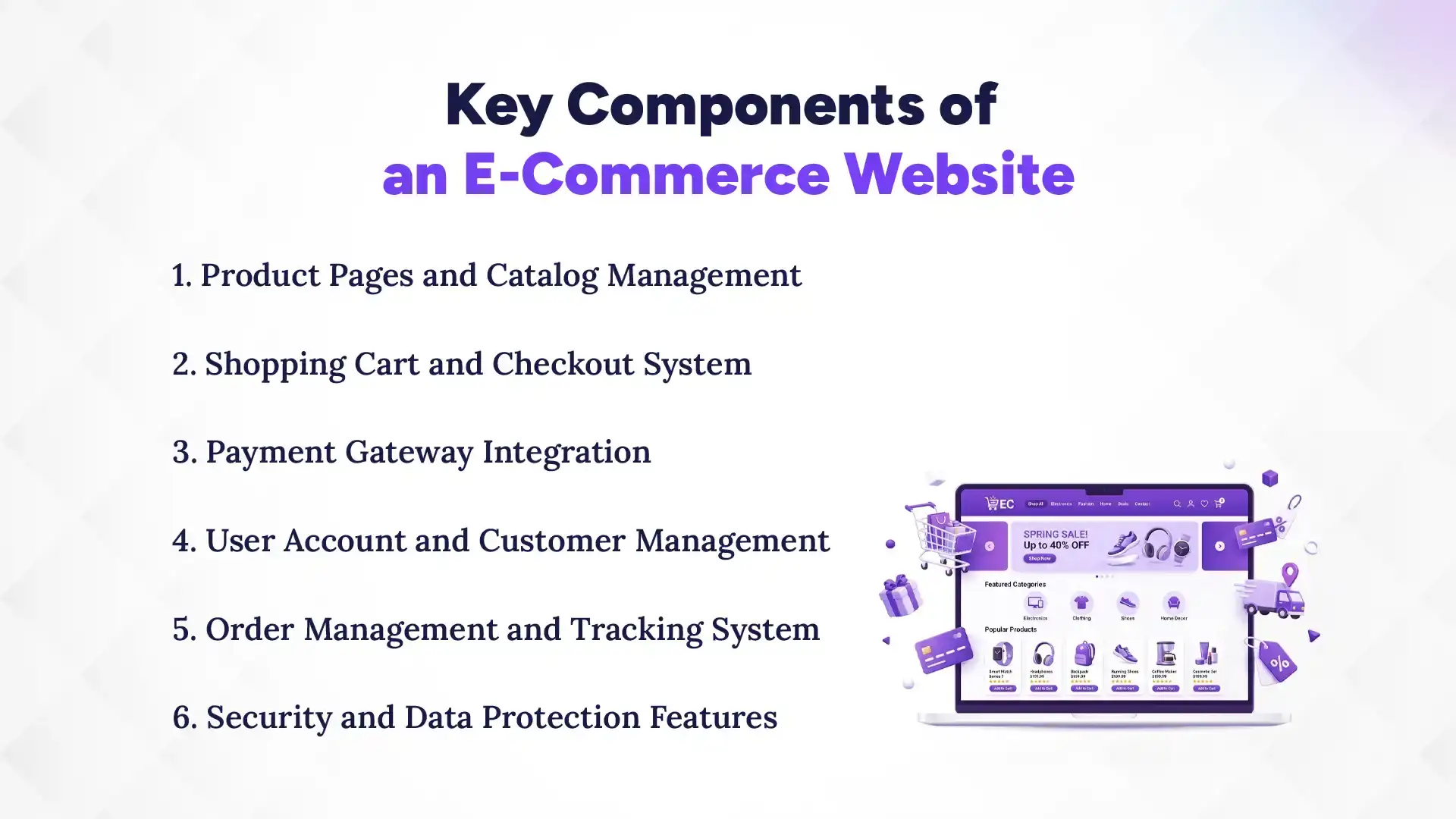
An e-commerce website is built using several essential components that work together to ensure smooth online buying and selling. These components help businesses manage products, handle customer orders, and provide a secure shopping experience. Each element plays a key role in improving usability, functionality, and performance of the online store. Without these components, an e-commerce website cannot operate efficiently. Together, they create a complete digital shopping system for both businesses and customers.
1. Product Pages and Catalog Management
Product pages display all essential details such as images, descriptions, prices, and specifications. A well-organized catalog helps customers easily find what they are looking for. Businesses can categorize products based on type, brand, or popularity. This improves user experience and navigation. Proper catalog management also helps in updating inventory quickly. It ensures accurate and clear product presentation.
2. Shopping Cart and Checkout System
The shopping cart allows users to store selected products for later purchase. It provides an overview of items, quantities, and total price. The checkout system guides users through payment and shipping details. A smooth checkout process reduces cart abandonment rates. It improves customer satisfaction and conversion rates. Easy navigation is essential for better sales.
3. Payment Gateway Integration
Payment gateway integration enables secure online transactions between customers and businesses. It supports multiple payment methods, including cards, wallets, and online banking. Security encryption ensures safe data transfer. It builds trust between customers and the platform. Fast payment processing improves user experience. Reliable gateways are crucial for successful e-commerce operations.
4. User Account and Customer Management
User accounts allow customers to register, log in, and manage their profiles. They can track orders, save preferences, and view purchase history. This improves personalization and customer experience. Businesses can also manage customer data for marketing purposes. It helps in building long-term relationships. Secure account systems enhance trust and usability.
5. Order Management and Tracking System
Order management systems help businesses process and fulfill customer orders efficiently. It tracks order status from purchase to delivery. Customers can monitor their orders in real time. This improves transparency and communication. It reduces confusion and improves service quality. Efficient tracking increases customer satisfaction.
6. Security and Data Protection Features
Security features protect customer data and payment information from cyber threats. SSL certificates and encryption are commonly used for safety. These systems prevent unauthorized access and fraud. A secure website builds customer trust and credibility. Regular updates improve system protection. Strong security is essential for online business success.
Benefits of an E-Commerce Website
An e-commerce website offers multiple advantages that help businesses grow faster in the digital marketplace. It allows companies to sell products online without the limitations of physical stores. With lower costs, wider reach, and better customer engagement, e-commerce platforms have become essential for modern businesses. They also provide valuable insights that help improve marketing and sales strategies. Overall, it is a powerful tool for increasing efficiency and profitability.
1. 24/7 Availability and Convenience
An e-commerce website is available 24/7, allowing customers to shop anytime without time restrictions. This convenience improves user experience and increases sales opportunities. Customers can browse and purchase products from anywhere in the world. It removes the need for physical store visits. Businesses benefit from continuous sales even outside working hours. This flexibility is a major advantage of online stores.
2. Wider Market Reach and Global Access
E-commerce websites allow businesses to reach customers beyond local boundaries. Products can be sold nationally and internationally with ease. This expands the customer base significantly. Online presence helps small businesses compete with larger brands. It increases brand visibility across different regions. Global access opens more growth opportunities.
3. Lower Operational and Marketing Costs
Running an e-commerce website reduces the need for physical store expenses. Businesses save on rent, staff, and maintenance costs. Digital marketing is also more affordable compared to traditional advertising. Online campaigns can be targeted and optimized easily. This helps improve return on investment. Overall, it makes business operations more cost-efficient.
4. Easy Product Management and Scalability
E-commerce platforms make it simple to manage products, inventory, and updates. Businesses can easily add or remove products as needed. It supports growth without major infrastructure changes. Scaling operations becomes faster and more efficient. Automation tools simplify management tasks. This flexibility supports long-term business expansion.
5. Better Customer Insights and Data Analytics
E-commerce websites collect valuable customer data such as buying behavior and preferences. This information helps businesses understand their audience better. Analytics tools provide insights into sales trends and performance. Businesses can make data-driven decisions. It improves marketing strategies and product offerings. Better insights lead to higher customer satisfaction.
6. Increased Sales and Revenue Opportunities
With a wider audience and 24/7 availability, e-commerce websites boost sales potential. Businesses can run promotions and discounts easily to attract customers. Online visibility increases conversion rates. Multiple payment options also improve customer convenience. It helps generate more revenue over time. Overall, it supports consistent business growth.
Importance of an E-Commerce Website in Modern Business
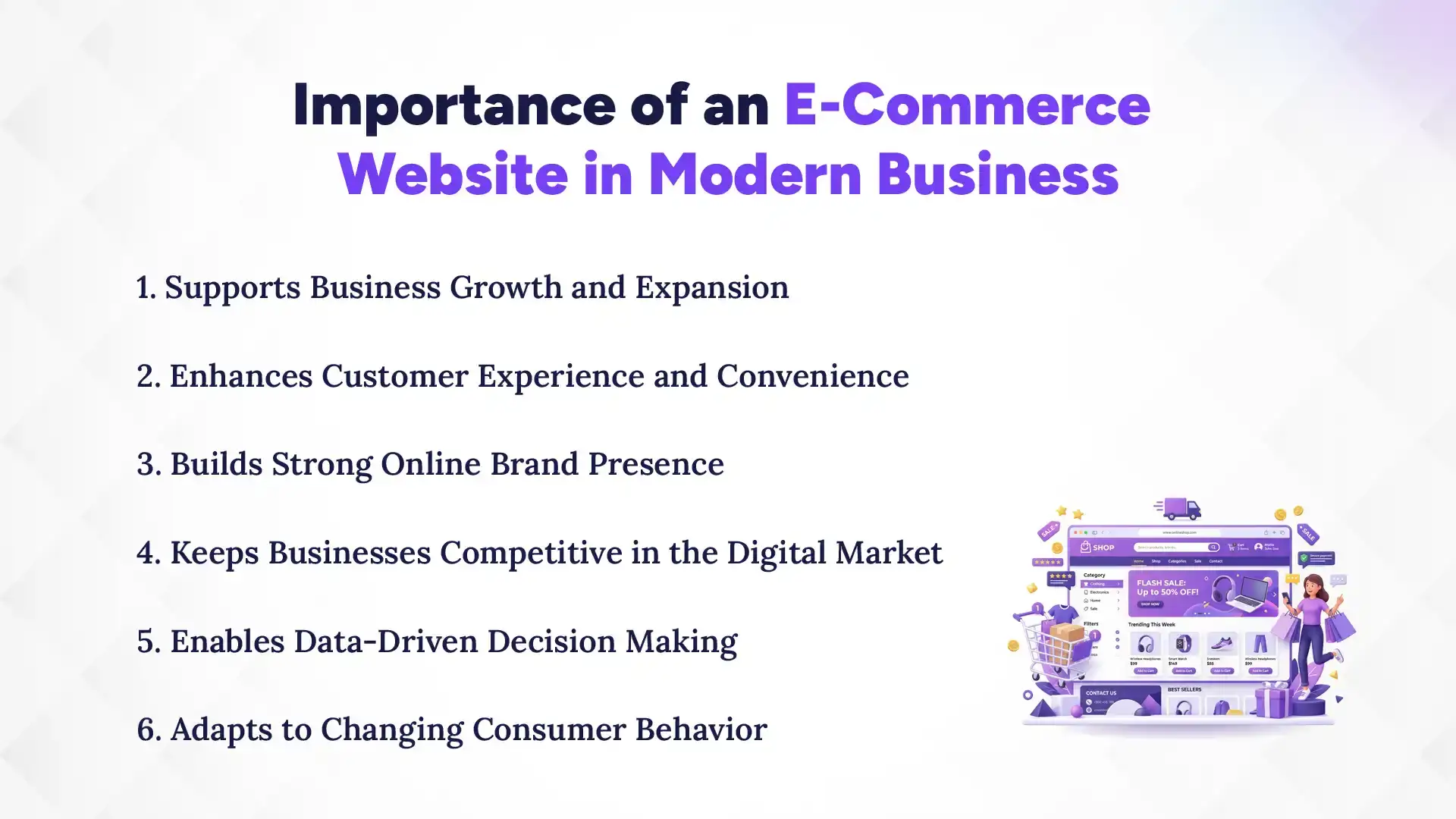
An e-commerce website plays a crucial role in modern business by enabling companies to operate and grow in the digital marketplace. It allows businesses to reach customers faster, sell products efficiently, and compete in an online-driven economy. As consumer behavior continues shifting toward online shopping, having an e-commerce platform is no longer optional but essential. It supports business scalability, branding, and customer satisfaction. Overall, it is a key driver of digital transformation and long-term success.
1. Supports Business Growth and Expansion
An e-commerce website helps businesses expand beyond local markets and reach a global audience. It allows companies to scale operations without needing physical expansion. Businesses can introduce new products quickly and enter new markets easily. This supports faster growth and increased revenue opportunities. It also helps small businesses compete with larger brands. Overall, it strengthens long-term business expansion.
2. Enhances Customer Experience and Convenience
E-commerce websites make shopping easier by allowing customers to browse and buy products anytime. Users can compare products, check reviews, and make informed decisions. The process is fast, simple, and user-friendly. This improves overall customer satisfaction. Convenient shopping experience increases repeat purchases. It builds stronger customer loyalty over time.
3. Builds Strong Online Brand Presence
An e-commerce website helps businesses establish a strong digital identity. It showcases products, services, and brand values effectively. A professional website increases credibility and trust among customers. Consistent online presence improves brand recognition. It also helps businesses stand out in competitive markets. Strong branding leads to better customer engagement.
4. Keeps Businesses Competitive in the Digital Market
Having an e-commerce website ensures businesses stay competitive in today’s digital economy. Most customers prefer online shopping over physical stores. Without an online presence, businesses risk losing potential customers. E-commerce platforms help companies match competitors’ strategies. It allows businesses to adapt quickly to market changes. Staying digital ensures long-term survival.
5. Enables Data-Driven Decision Making
E-commerce websites collect valuable customer data such as behavior, preferences, and purchase history. This data helps businesses make smarter decisions. Analytics tools provide insights into sales performance and trends. Companies can optimize marketing strategies based on real data. It reduces guesswork and improves efficiency. Data-driven decisions increase profitability.
6. Adapts to Changing Consumer Behavior
Modern consumers prefer fast, convenient, and online shopping experiences. E-commerce websites meet these expectations effectively. They allow businesses to respond quickly to changing trends. Mobile-friendly designs improve accessibility for users. Businesses can update products and offers instantly. This adaptability ensures long-term relevance and success.
Who is an E-Commerce Website For?
An e-commerce website is for small businesses, retailers, startups, entrepreneurs, and large enterprises that want to sell products or services online and expand their reach. It is suitable for any business that aims to grow digitally and reach a wider audience beyond physical locations. Whether you are starting small or managing a large brand, a website development service helps you build a strong online presence and scale efficiently. It provides equal opportunities for all types of businesses to compete in the online market. This makes it a versatile solution for modern commerce.
1. Small and Medium Businesses (SMEs)
E-commerce websites are highly beneficial for SMEs looking to grow with limited resources. They help small businesses reach more customers without needing physical stores. Online platforms reduce operational costs significantly. SMEs can compete with larger companies through digital presence. It improves sales opportunities and brand visibility. This makes business expansion more achievable.
2. Retailers and Product-Based Businesses
Retailers can use e-commerce websites to sell their products directly to customers online. It allows them to showcase a wide range of products with detailed information. Customers can easily browse and purchase items from anywhere. It helps increase sales and reduce dependency on physical stores. Inventory management also becomes easier. This improves overall business efficiency.
3. Startups and Entrepreneurs
Startups and entrepreneurs benefit greatly from e-commerce platforms as they require low initial investment. It helps them launch products quickly in the market. Online presence increases visibility and customer reach. They can test and scale their business ideas easily. Marketing becomes more cost-effective and targeted. It supports fast business growth.
4. Large Enterprises Expanding Online
Large enterprises use e-commerce websites to expand their digital footprint. It helps them reach global customers and increase revenue streams. Online platforms support large product catalogs and complex operations. Businesses can integrate advanced systems for better management. It enhances customer experience at scale. This ensures continuous business growth and competitiveness.
What is the Difference Between an E-Commerce Website and a Normal Website?
An e-commerce website is designed specifically for buying and selling products or services online, while a normal website is mainly used for providing information, branding, or communication purposes. The key difference lies in functionality, payment integration, and user interaction. E-commerce websites are transaction-focused, whereas normal websites are content-focused and do not support direct online purchasing.
Factor
E-Commerce Website
Normal Website
Purpose and Functionality
Designed for selling products or services online with full buying and selling features
Mainly used for sharing information, branding, or company details
Payment and Transaction Capability
Includes payment gateways for secure online transactions
Does not support online payments or direct purchases
User Interaction and Features
Users can browse products, add to cart, and complete purchases
Users mainly read content, view pages, or contact the business
Complexity and Development Requirements
More complex with inventory, cart, checkout, and security systems
Simpler structure with basic pages like Home, About, and Contact
Business Goal
Focused on generating online sales and revenue
Focused on providing information and building online presence
Maintenance Level
Requires frequent updates for products, pricing, and orders
Requires less frequent updates and maintenance
Technology Used
Uses advanced tools like databases, payment APIs, and security layers
Uses basic web technologies for static or dynamic content
Example
Amazon, Daraz
Company portfolio or informational websites
Common Mistakes While Creating an E-Commerce Website
Many businesses make critical mistakes while building an e-commerce website that can negatively affect user experience, sales, and overall performance. A poorly planned website can lead to low traffic, high bounce rates, and lost customers. From design issues to lack of optimization, these mistakes often prevent businesses from achieving their online goals. Choosing the right e-commerce website development service is essential to avoid such issues and build a successful and high-converting online store. Avoiding these errors is essential to build a successful and high-converting online store. A well-structured website ensures better trust, usability, and long-term growth.
1. Poor Website Design and User Experience
A poorly designed website makes it difficult for users to navigate and find products easily. Cluttered layouts, confusing menus, and slow loading pages reduce customer satisfaction. Good design should be simple, clean, and user-friendly. A positive user experience increases engagement and conversions. Visual appeal also builds trust in the brand. Better design directly improves sales performance.
2. Complicated Checkout Process
A complicated checkout process often leads to cart abandonment and lost sales. Customers prefer a fast and simple payment process. Too many steps or unnecessary form fields can frustrate users. A smooth checkout experience increases conversion rates. Offering guest checkout options can improve usability. Simplicity is key to better sales.
3. Ignoring Mobile Optimization
Ignoring mobile optimization is a major mistake, as most users shop through smartphones. A non-responsive website leads to poor user experience. Mobile-friendly design improves accessibility and engagement. It ensures smooth navigation on all devices. Search engines also rank mobile-optimized sites higher. Mobile optimization is essential for success.
4. Lack of Security Measures
Without proper security, customers may hesitate to share personal or payment information. Secure websites use SSL certificates and encryption technologies. Lack of security increases the risk of fraud and data breaches. This reduces customer trust and credibility. Strong security builds confidence in online shopping. It is essential for protecting businesses and users.
5. Not Using SEO and Digital Marketing Strategies
Ignoring SEO and digital marketing reduces website visibility on search engines like Google. Without optimization, it becomes difficult to attract organic traffic. Marketing strategies help reach the right audience effectively. Lack of promotion limits business growth opportunities. SEO improves rankings and visibility. Digital marketing is crucial for online success.
6. Poor Product Descriptions and Images
Low-quality product images and unclear descriptions reduce customer interest. Buyers rely on visuals and details before making decisions. Poor presentation decreases trust and conversion rates. High-quality images improve engagement and sales. Clear and informative descriptions help customers understand products better. Good content presentation is essential for e-commerce success.
Conclusion
An e-commerce website is a powerful digital tool that allows businesses to sell products and services online with ease and efficiency. It helps companies reach a wider audience, improve customer experience, and increase sales opportunities without the limitations of a physical store. From small businesses to large enterprises, e-commerce platforms have become essential for staying competitive in today’s digital marketplace. According to The Pace Infosys, when designed properly, these platforms can significantly enhance brand visibility, customer engagement, and overall business growth.
However, building a successful e-commerce website requires careful planning, the right features, and proper optimization. Avoiding common mistakes and focusing on user experience, security, and marketing strategies can make a huge difference in performance. As online shopping continues to grow, investing in a well-structured e-commerce website is one of the smartest decisions for long-term success and sustainability in the digital world. Also, explore the top 10 e-commerce website development companies in Austin, Texas.
FAQs
What is an e-commerce website in simple words?
+
An e-commerce website is an online store where people buy and sell products or services digitally. It works like a physical shop but operates completely on the internet.
How does an e-commerce website work?
+
It allows users to browse products, add items to cart, and make online payments. Orders are processed and delivered to customers through a structured system.
What are examples of e-commerce websites?
+
Popular examples include Amazon, Daraz, and other online shopping platforms. These websites allow users to shop for various products online easily.
What are the benefits of an e-commerce website?
+
It offers 24/7 availability, wider reach, and increased sales opportunities. Businesses can also reduce operational costs and grow faster online.
Who can use an e-commerce website?
+
Small businesses, startups, retailers, and large companies can use it. Anyone selling products or services online can benefit from it.
Is an e-commerce website expensive to build?
+
It depends on features, design, and platform used for development. Basic websites are affordable, while advanced ones cost more.
What is needed to create an e-commerce website?
+
You need products, a domain, hosting, payment gateway, and website design. Also, proper security and marketing tools are important.
Why is SEO important for e-commerce websites?
+
SEO helps improve visibility on search engines like Google and brings organic traffic. It increases chances of sales and improves online presence.
Ready to get started?
Book a 30-minute consultation call, and let's talk about your goals.