A customer relationship does not end when a sale is closed. Sales may know what the customer purchased and what was discussed during the deal, while support may know about complaints, service requests, and ongoing issues. When these details remain separated, neither team has a complete view of the customer.
This is especially relevant for Nepali businesses where customers may interact with sales representatives through field visits, phone calls, WhatsApp, email, and office visits before reaching the support team. Shared customer records bring these interactions together in one place, allowing sales and support to work from the same customer history, avoid repeated questions, and provide a more consistent customer experience.
What Are Shared Customer Records?
Shared customer records are a single customer profile in a CRM that both sales and support teams can access and update. If you're unfamiliar with what is CRM and how it structures customer data, shared records are one of its most practical applications. Instead of maintaining separate customer information, both teams work from the same record, giving them a consistent view of the customer's history, interactions, purchases, issues, and ongoing requests.
In a CRM, this shared profile can contain contact and company details, sales and purchase history, customer conversations, support requests, follow-up activities, and important notes. Sales can see what issues a customer has raised after a purchase, while support can review relevant sales conversations, products purchased, and commitments made during the sales process. This shared context helps both teams respond with better information and avoids customers having to repeat their situation whenever they interact with a different team.
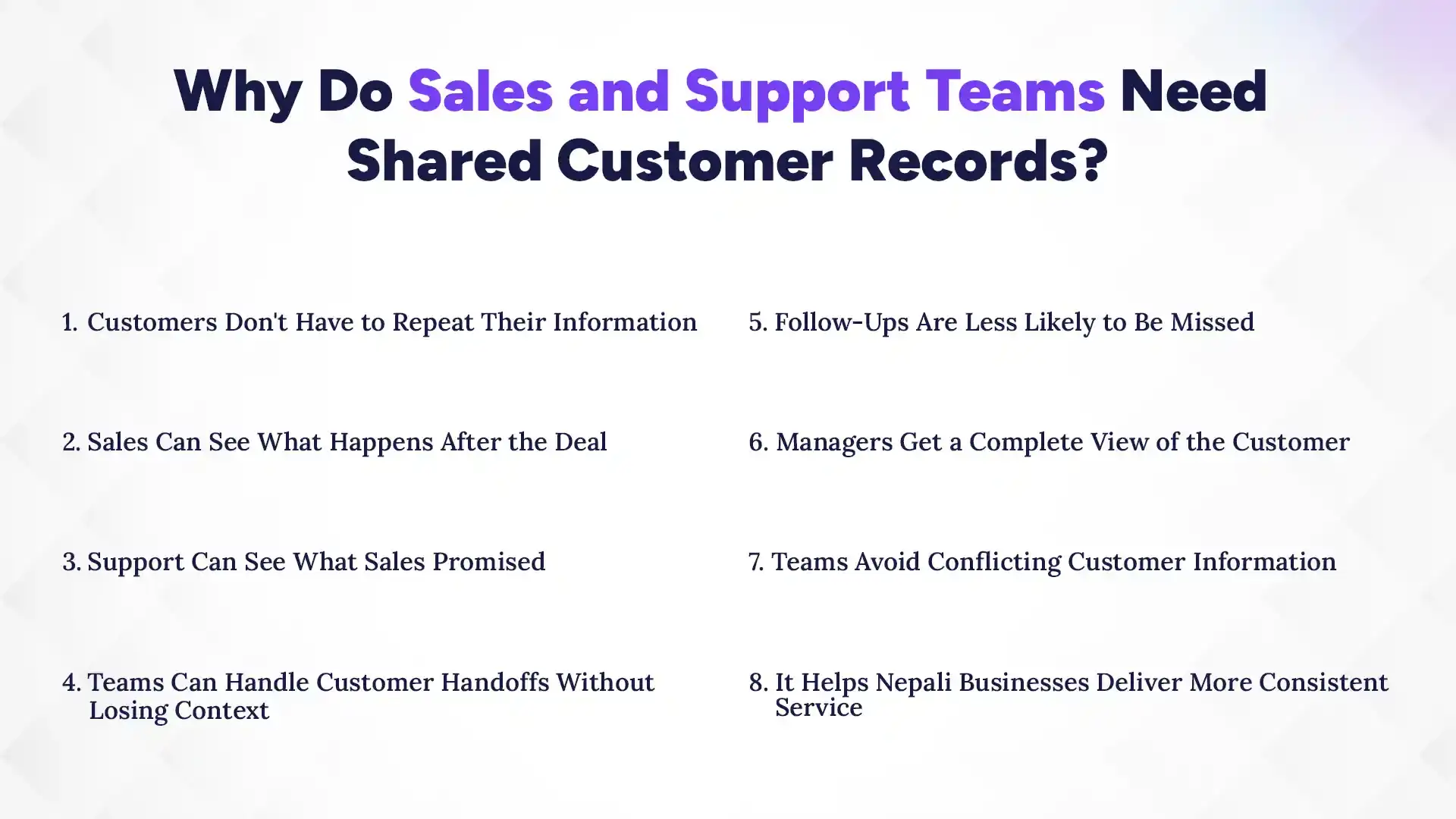
Why Do Sales and Support Teams Need Shared Customer Records?
Sales and support need shared customer records so both teams can see the same customer history, avoid repeated questions, and keep important context during handoffs and follow-ups. This shared information also helps managers get a complete customer view and ensures customers receive consistent service across every channel.
1. Customers Don't Have to Repeat Their Information
Support can see previous conversations, purchases, and requests the moment a customer reaches out, without needing to ask them to explain everything again. Having this history on hand instead of asking a customer to repeat themselves is one of the simplest, most immediate signs of good service a customer actually notices.
2. Sales Can See What Happens After the Deal
Sales can see complaints, service issues, and satisfaction signals that came in after close, instead of walking into a renewal conversation with no idea anything went wrong. Knowing this context before the call changes the entire tone of a renewal conversation, from pitching to actually addressing what's been on the customer's mind.
3. Support Can See What Sales Promised
Support can access product details, pricing, commitments, and prior discussions from the sales process, instead of guessing at what a customer was actually told. This access prevents support from accidentally contradicting a promise sales made weeks earlier, which is one of the fastest ways to damage trust.
4. Teams Can Handle Customer Handoffs Without Losing Context
Customer information stays fully available when responsibility moves from sales to support, so nothing depends on someone remembering to pass along notes manually. A clean handoff like this means the customer never has to notice that responsibility for their account changed hands at all.
5. Follow-Ups Are Less Likely to Be Missed
Both teams can see pending requests, scheduled callbacks, and next actions in one place, rather than each side tracking their own separate to-do list. This shared visibility catches the kind of follow-up that quietly falls through the cracks when it only exists in one person's head or inbox.
6. Managers Get a Complete View of the Customer
Management can see the full journey from lead to purchase to ongoing support in one record, instead of piecing it together from two disconnected systems. That complete view makes it possible to actually understand why a customer churned or renewed, rather than guessing based on whichever team's data happened to be handy.
7. Teams Avoid Conflicting Customer Information
When both teams work from the same record, there's no risk of sales telling a customer one thing while support tells them something else based on outdated or separate notes. Avoiding conflicting customer information keeps every interaction consistent, regardless of who the customer happens to speak with.
8. It Helps Nepali Businesses Deliver More Consistent Service
This matters especially when field sales, office-based sales, and support all interact with the same customer through different channels, since consistency depends on everyone working from the same information. A customer who met a field rep in person and later calls the support line shouldn't feel like they're talking to a completely different business. The benefits of a CRM system become most visible when businesses need this level of consistency across multiple touchpoints.
What Happens When Sales and Support Don't Share Customer Records?
Without shared customer records, important information can become scattered across separate systems, spreadsheets, messages, or individual employees. This can lead to duplicated data, conflicting answers, missed follow-ups, repeated customer explanations, and confusion between sales and support over who has the right information.
1. Duplicate Customer Information
The same customer ends up with two different profiles, one in sales and one in support, with details that drift further apart the longer they stay disconnected. Duplicate customer information is often the first sign a business has actually outgrown its current, disconnected setup.
2. Conflicting Information Given to Customers
A customer told one thing by sales and something else by support experiences that are inconsistent directly, and it rarely reflects well on either team. Conflicting information given to customers is one of the fastest ways to erode the trust a sales relationship worked hard to build.
3. Lost Follow-Ups and Requests
Without a shared view of what's pending, requests can sit unaddressed simply because neither team realized it was theirs to handle. Lost follow-ups and requests tend to surface only when the customer escalates their frustration, by which point the damage is already done.
4. Customers Repeating Their Issues
A customer who has to re-explain their situation to a new person notices that the business isn't actually connected internally, no matter how good either individual interaction was. Customers repeating their issues is a small moment that quietly signals a much bigger organizational gap.
5. Sales and Support Blaming Each Other for Missing Context
When something falls through the cracks, it's easy for each team to assume the other one dropped the ball, especially when neither had visibility into what the other actually knew. Sales and support blaming each other for missing context creates internal friction that has nothing to do with either team's actual performance.
What Should Sales and Support See in a Shared Customer Record?
A shared customer record should give sales and support teams a complete view of the customer, including contact details, company information, sales history, previous conversations, support issues, and follow-up activities. Having this information in one place helps both teams understand the customer's history, respond with the right context, and provide consistent service without making the customer repeat information.
Contact and Company Information: Store the customer's name, phone number, email address, company details, location, and other important information in one accessible profile.
Sales and Purchase History: Include previous deals, quotations, products or services purchased, transaction details, and other sales activity so support can understand the customer's relationship with the business.
Customer Conversations: Keep important notes from calls, emails, meetings, messages, and other interactions so both teams can see the context behind previous discussions.
Support Issues and Requests: Record complaints, service requests, support tickets, reported problems, and their resolution status so sales and support know what issues the customer has experienced.
Follow-Up Tasks and Notes: Track pending callbacks, assigned tasks, deadlines, reminders, and important notes so the next team member knows what needs to happen and when.
How Can a CRM Give Sales and Support a Shared Customer Record?
A CRM gives sales and support teams a shared customer record by centralizing customer information in one place and keeping the customer history accessible to both teams. It can record customer interactions, provide role-based access to relevant information, and keep records updated as sales and support activities continue. Among the different types of customer relationship management systems, those designed for collaborative workflows are best suited for this shared-record approach.
1. Centralizing Customer Information
Every piece of customer data lives in one system instead of split across a sales tool, a support tool, and someone's personal notes. Centralizing customer information is the foundation everything else in this list depends on.
2. Recording Every Customer Interaction
Calls, messages, emails, and visits get logged to the record automatically as they happen, rather than relying on someone remembering to update it manually. Recording every customer interaction is what keeps the shared record actually current instead of slowly going stale.
3. Giving Teams Appropriate Access
Role-based access lets both teams see the shared history while keeping certain sensitive details, like commission structures, appropriately restricted. Giving teams appropriate access solves the common worry that sharing means exposing everything to everyone.
4. Keeping Customer History Updated
As new interactions happen, the record updates in real time, so whoever looks at it next sees the current picture, not a snapshot from last week. Keeping customer history updated is what makes the shared record something both teams can actually trust before every customer conversation.
Which CRM Gives Sales and Support the Best Shared Visibility in Nepal?
Pace CRM Software gives sales and support teams shared visibility by bringing customer information and interactions into one centralized record. This helps both teams access the same customer history and stay aligned throughout the customer journey.
For Nepali businesses managing customer interactions across phone calls, WhatsApp, field visits, and email, Pace CRM keeps these activities connected in one place. Sales and support can see relevant conversations, follow-ups, and customer history without working from separate or incomplete records.
Role-based access helps ensure each team can access the information relevant to its work while keeping sensitive details appropriately controlled. With centralized records, interaction tracking, and a complete customer journey view, Pace CRM helps Nepali businesses provide more consistent customer service. These are also important factors to consider when choosing which is the best CRM software in Nepal for your business.
Conclusion
Customers experience one relationship with a business, not separate “sales” and “support” departments. Shared customer records connect both teams to the same customer history, helping them maintain context, avoid repeated questions, and provide consistent service throughout the customer journey.
If your sales and support teams are still working from separate records, consider exploring Pace CRM’s shared customer visibility. A demo can help you see how centralized customer records, interaction history, and team access can fit your business.