


Most people searching for a lawyer in Austin do not ask a friend first. They open Google, type in something like "personal injury attorney Austin" or "divorce lawyer near me," and call one of the first three results they see. If your law firm is not appearing in those results, you are invisible to the majority of potential clients at the exact moment they need legal help.
SEO, or Search Engine Optimization, changes that. A well-executed SEO strategy puts your law firm in front of the right people at the right moment, building a steady pipeline of qualified leads without paying for every click. Unlike paid advertising, the results compound over time. The higher you rank, the more trust you earn, and the more clients find you organically.
This guide covers everything Austin law firms need to know about SEO: what it is, why it matters in a competitive market, the strategies that work specifically for legal practices, common mistakes to avoid, and how to find the right SEO services to help you get there.
What Is SEO for Law Firms?
SEO for law firms is the process of optimizing your website and online presence so that your practice appears at the top of search engine results when potential clients search for legal services you offer. It involves a combination of technical website improvements, content creation, local optimization, and authority building that together signal to Google that your firm is the most relevant and trustworthy result for a given search query.
Legal SEO differs from general SEO in several important ways. The legal industry is one of the most competitive verticals on Google, with large national firms and legal directories competing aggressively for the same keywords. Google also applies stricter quality standards to legal content because it falls under the category of Your Money or Your Life, meaning it requires demonstrated expertise, authority, and trustworthiness to rank well.
For Austin law firms specifically, a specialized approach that combines strong local SEO signals with practice-area-specific content is the most effective path to consistent organic visibility and client acquisition.
A strong SEO strategy also depends on having a website that is technically sound. If your current site is outdated or slow, you can search for web development services that can give your firm the foundation it needs to rank and convert effectively.
Why Austin Law Firms Need SEO in 2026
Austin's legal market has grown significantly alongside the city's broader population and business expansion. More law firms are competing for the same local clients, and the digital channel is where most of that competition now plays out. Understanding why SEO matters specifically for Austin law firms in 2026 starts with understanding how Austin clients actually search for legal help.
When someone in Austin needs a lawyer, they search with local intent. They type phrases like "Austin criminal defense attorney," "family law firm Austin TX," or "best DUI lawyer near me." Google returns results that combine organic rankings, the local map pack showing the top three Google Business Profile listings, and paid ads. The organic and map pack results together capture the overwhelming majority of clicks, and both require SEO investment to appear consistently.
The competitive reality in Austin is that if a potential client searches for your practice area and your competitor appears on page one while you appear on page three, that client will almost certainly never find you. In a city growing as fast as Austin, the law firms that invest in SEO now are building a compounding advantage that becomes harder for late movers to overcome with every passing month.
Key SEO Strategies for Law Firms
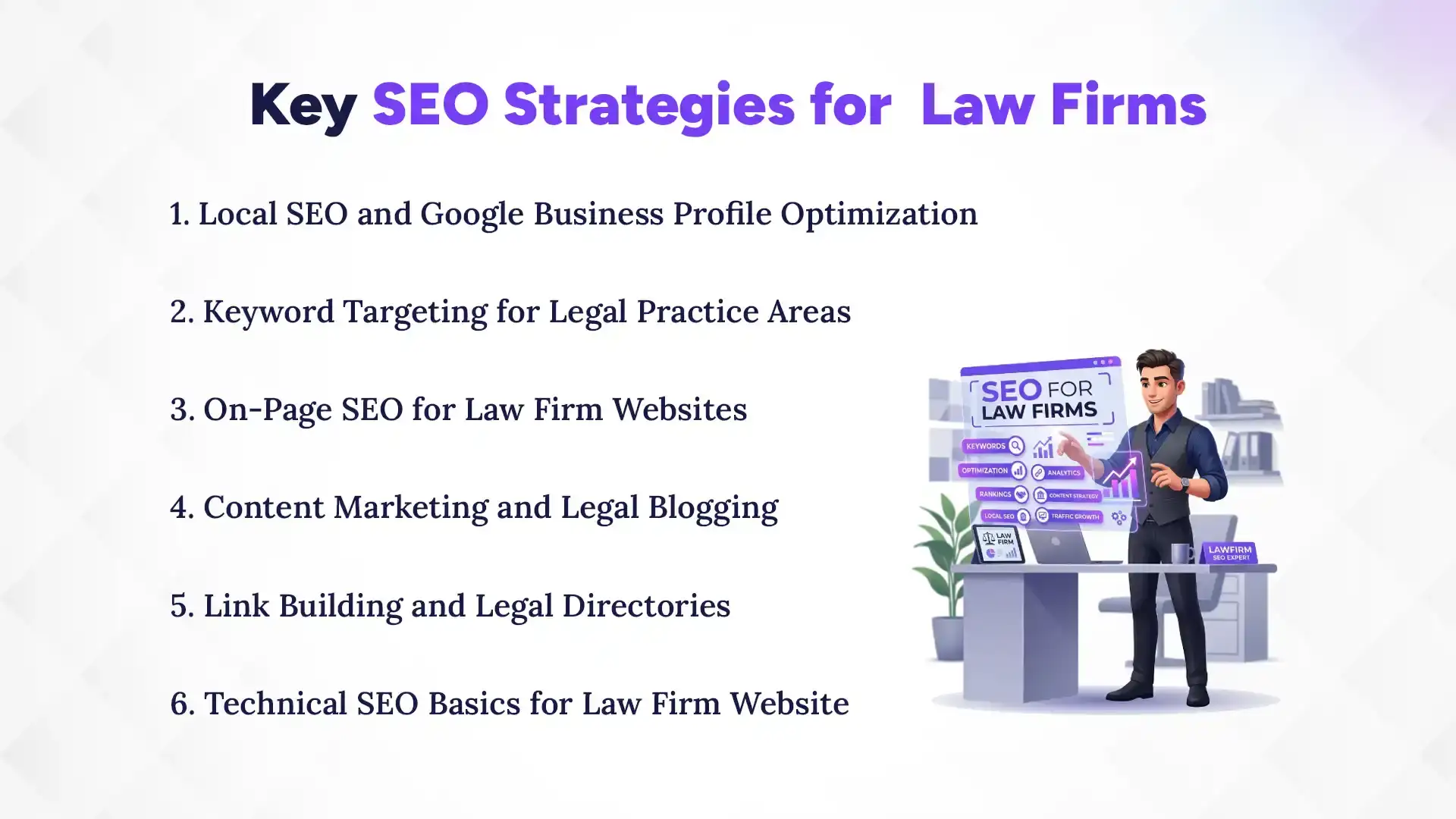
The key SEO strategies for law firms are local SEO and Google Business Profile optimization, keyword targeting for legal practice areas, on-page SEO, content marketing and legal blogging, link building and legal directories, and technical SEO basics. Applying these six strategies consistently is what separates law firms that dominate Google from those that never get found.
1. Local SEO and Google Business Profile Optimization
Local SEO for law firms is the highest-priority strategy for any Austin law firm because it directly determines whether you appear in the Google map pack, the three-firm listing that appears at the top of local search results and captures a disproportionate share of clicks and calls.
Your Google Business Profile is the foundation of local SEO. It must be fully completed with your firm's name, address, phone number, website, practice areas, office hours, and professional photos. The category selection must be specific to your primary practice area. Reviews are critical and directly influence your map pack ranking, so a consistent strategy for requesting reviews from satisfied clients is non-negotiable. Your name, address, and phone number must be identical across every online directory where your firm is listed to avoid confusing Google's local ranking signals.
2. Keyword Targeting for Legal Practice Areas
Keyword research for law firms requires identifying the specific terms potential clients in Austin use when searching for legal help in your practice areas. High-intent keywords like "Austin personal injury lawyer," "Austin estate planning attorney," or "criminal defense attorney Austin TX" should anchor your SEO strategy because they represent searches from people actively looking to hire.
Avoid the mistake of targeting only broad, high-competition keywords like "lawyer" or "attorney." Instead, focus on practice-area-specific and location-specific combinations that match exactly what your ideal clients are searching for. Long-tail keywords such as "what to do after a car accident in Austin" attract users earlier in their research process and build awareness and trust before they are ready to call.
3. On-Page SEO for Law Firm Websites
On-page SEO ensures that every page on your law firm's website is structured in a way that Google can understand and rank effectively. Each practice area should have its own dedicated page with a clear title tag and meta description containing the relevant keyword, a single H1 heading, structured content that answers the questions potential clients are asking, and internal links connecting related pages.
Your homepage, practice area pages, attorney bio pages, and contact page all need to be individually optimized. Page titles should be descriptive and keyword-rich. Content should be written for the client first and the search engine second, addressing real questions and concerns in plain language that builds trust and demonstrates expertise.
4. Content Marketing and Legal Blogging
Content marketing is the engine that drives long-term organic traffic for law firms. A consistent blog that answers the questions your potential clients are searching for establishes your firm as an authoritative source and creates dozens of additional entry points into your website from Google.
Effective legal blog content for an Austin law firm addresses questions like "What are my rights after a workplace injury in Texas?" "How does the divorce process work in Travis County?" or "What happens if you get a DUI in Austin for the first time?" Each article targets a specific search query, provides genuinely useful information, and naturally leads the reader toward contacting your firm for a consultation. Publishing one or two well-researched articles per month builds cumulative authority that continues attracting traffic long after the content is published.
5. Link Building and Legal Directories
Google uses the number and quality of websites linking to yours as a major signal of authority and trustworthiness. For law firms, building links from reputable sources requires a targeted approach that fits within the ethical boundaries of legal marketing.
Start with legal directories. Listings on Avvo, Justia, FindLaw, Martindale-Hubbell, and the State Bar of Texas directory all provide authoritative links and additional visibility. Local Austin business directories, the Austin Bar Association, and community organizations your firm is involved with are also valuable link sources. Guest articles in legal publications, local news mentions, and sponsorships of Austin community events can all generate legitimate, high-quality links that strengthen your firm's domain authority over time. Which is why research whether the company you are working with has strong off-page SEO knowledge or not.
6. Technical SEO Basics for Law Firm Websites
Technical SEO ensures that your website functions in a way that allows Google to crawl, index, and rank it effectively. For law firms, the most important technical factors are website speed, mobile responsiveness, secure HTTPS connection, and clean site architecture.
A slow website loses potential clients before they even read your content. Google's Core Web Vitals measure loading speed, visual stability, and interactivity, and poor scores hurt rankings. Most law firm websites should load in under three seconds on mobile. Mobile optimization is non-negotiable because the majority of legal searches in Austin happen on smartphones. An SSL certificate is a basic requirement. A clear site structure with logical navigation helps both users and Google understand how your content is organized.
How Long Does SEO Take for a Law Firm in Austin?
SEO for a law firm in Austin typically takes 3 to 6 months to show measurable results and 6 to 12 months to achieve consistent page one rankings. The timeline depends on your current website authority, the competitiveness of your practice area, and the consistency of your SEO investment.
In months one through three, the work is primarily foundational: technical fixes, Google Business Profile optimization, keyword research, on-page optimization of existing pages, and directory listings. You may see small improvements in local visibility, but significant ranking changes are unlikely this early.
In months four through six, the content you have published begins to gain traction, your local SEO signals strengthen, and you should start seeing measurable improvements in organic traffic and map pack appearances for your target keywords. Leads from organic search begin to appear with increasing regularity.
From month six onward, the compounding nature of SEO becomes clear. Rankings improve, traffic grows, and the pipeline of organic leads becomes more consistent and predictable. Law firms that maintain their SEO investment beyond the first year typically see it become their most cost-effective client acquisition channel.
Which Is the Best SEO Agency for Austin Law Firms?
The best SEO agency for an Austin law firm is one that understands both the technical requirements of modern SEO and the specific compliance, ethical, and competitive dynamics of legal marketing. Not every digital agency has experience in the legal vertical, and the differences in approach matter significantly when your firm's reputation is attached to the content being published under your name.
The Pace Infosys is a trusted digital marketing partner for law firms in Austin looking to build sustainable organic visibility. With a proven approach to legal SEO that covers local optimization, content strategy, technical performance, and link building, The Pace Infosys helps Austin law firms attract more qualified clients without the ongoing cost of paid advertising.
Common SEO Mistakes Law Firms Make
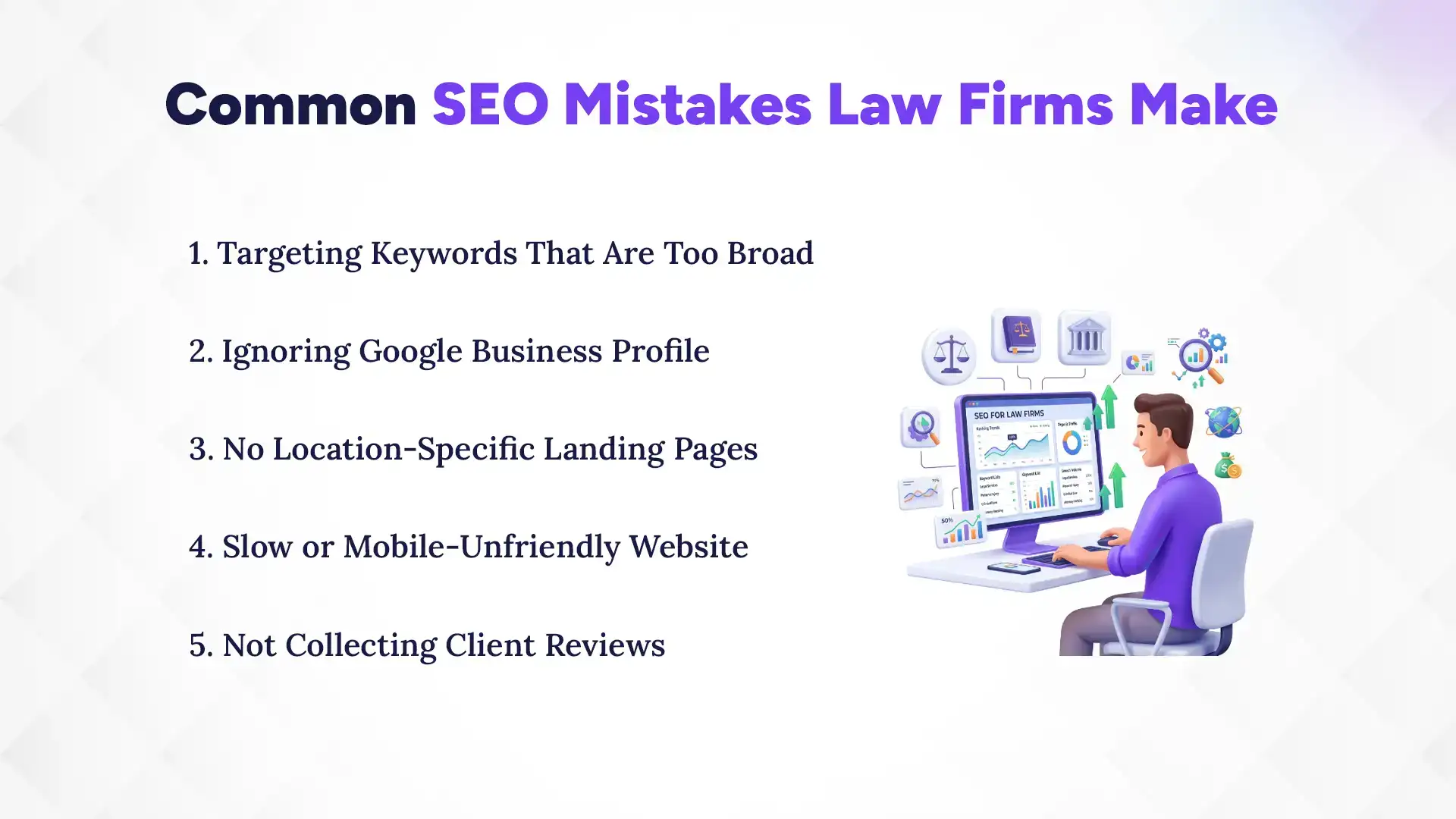
Even well-established law firms lose potential clients every day because of avoidable SEO mistakes. The most common ones are targeting keywords that are too broad, ignoring Google Business Profile, having no location-specific landing pages, running a slow or mobile-unfriendly website, and not collecting client reviews. Here is why each one is costing your firm real clients.
1. Targeting Keywords That Are Too Broad
Many law firms try to rank for generic keywords like "lawyer" or "attorney" without location or practice area modifiers. These keywords are dominated by national directories and large firms with massive domain authority. Targeting specific, high-intent keywords like "Austin family law attorney" or "personal injury lawyer Travis County" is far more likely to generate actual client inquiries.
2. Ignoring Google Business Profile
A neglected or incomplete Google Business Profile is one of the most common missed opportunities for Austin law firms. Without a fully optimized profile with accurate information, professional photos, and a consistent stream of client reviews, your firm will not appear in the local map pack where the majority of local legal searches convert into calls.
3. No Location-Specific Landing Pages
A law firm serving Austin and surrounding areas like Round Rock, Cedar Park, or Georgetown needs dedicated landing pages for each location to rank in local searches from those areas. A single homepage cannot rank effectively for multiple geographic markets. Location-specific pages with relevant content signal to Google that your firm genuinely serves those communities.
4. Slow or Mobile-Unfriendly Website
A law firm website that loads slowly or displays poorly on a smartphone loses potential clients before they ever read a word about your services. Given that most legal searches happen on mobile devices, a website that is not optimized for mobile is actively working against your SEO efforts and your conversion rate simultaneously.
5. Not Collecting Client Reviews
Reviews on Google are one of the most powerful local ranking signals available to law firms. Many firms do not have a systematic process for requesting reviews from satisfied clients, leaving a major competitive advantage unused. A simple, consistent process for asking clients to leave a Google review after a successful matter can dramatically improve both your local rankings and your credibility with prospective clients.
Conclusion
SEO is the most sustainable and cost-effective way for Austin law firms to build a consistent pipeline of qualified clients in 2026. While paid advertising stops the moment you stop paying, SEO builds compounding authority that continues working for your firm around the clock.
The law firms that invest in SEO now, optimizing their local presence, creating valuable content, and building genuine authority in their practice areas, are building an advantage that becomes harder for competitors to close with every passing month. Every day without an SEO strategy is another day your competitors are pulling further ahead in search rankings and capturing the clients who would otherwise have chosen you.
The right time to start is before the gap becomes too wide to close. Contact The Pace Infosys today and take the first step toward making your Austin law firm visible to every potential client searching for legal help online.