Businesses have two common ways to handle payroll: manage it internally using payroll software or outsource payroll processing to a third-party provider. Neither option is automatically better; the right choice depends on company size, payroll complexity, internal HR capacity, privacy requirements, and how much control the business wants to retain.
For Nepali businesses, this decision also involves local payroll requirements. Employee records, tax calculations, SSF, and provident fund contributions need to be handled accurately and on time, regardless of which approach you choose. Understanding how SSF contributions are structured helps businesses evaluate whether an internal system or external provider can handle this requirement reliably.
What Is Payroll Software?
Payroll software allows a business to manage salary calculations, deductions, employee payroll records, statutory contributions, and payroll reporting internally through a digital system. It gives HR and payroll teams a structured way to manage recurring payroll tasks while keeping employee and salary information in one place.
Payroll software typically handles salary structures, tax and statutory calculations, deductions, payslip generation, and payroll reports. The business remains responsible for payroll operations, while the software automates calculations and workflows. HR or payroll staff still need to configure the system, review the results, and make necessary adjustments.
What Is Payroll Outsourcing?
Payroll outsourcing means hiring an external provider to handle some or all payroll processing activities on behalf of a business. Instead of managing every payroll task internally, the business transfers agreed responsibilities to a third-party provider.
An outsourced payroll provider may handle salary calculations, statutory deductions, compliance filings, and payslip distribution, depending on the services included in the agreement. The business provides the required employee and salary information, while the provider manages the agreed payroll activities and delivers the required payroll outputs.
Payroll Software vs. Payroll Outsourcing: What's the Difference?
Payroll software and payroll outsourcing mainly differ in who manages payroll, how much control the business retains, and how much work stays with the internal team. Payroll software keeps payroll management within the business while automating calculations and workflows, whereas outsourcing transfers agreed payroll tasks to an external provider.
Factor
Payroll Software
Payroll Outsourcing
Payroll Processing
Internal HR/payroll team
External provider
Data Control
Greater internal control
Data is shared with the provider
Daily Involvement
The internal team manages payroll
The provider handles agreed tasks.
Expertise
Still required
Less internal expertise required
Automation
Built into the software
Depends on the provider
Customization
Usually greater control
Depends on the provider
Scalability
Scales with software and processes
Scales with provider capacity
Responsibility
Business retains most responsibility
More responsibility is transferred
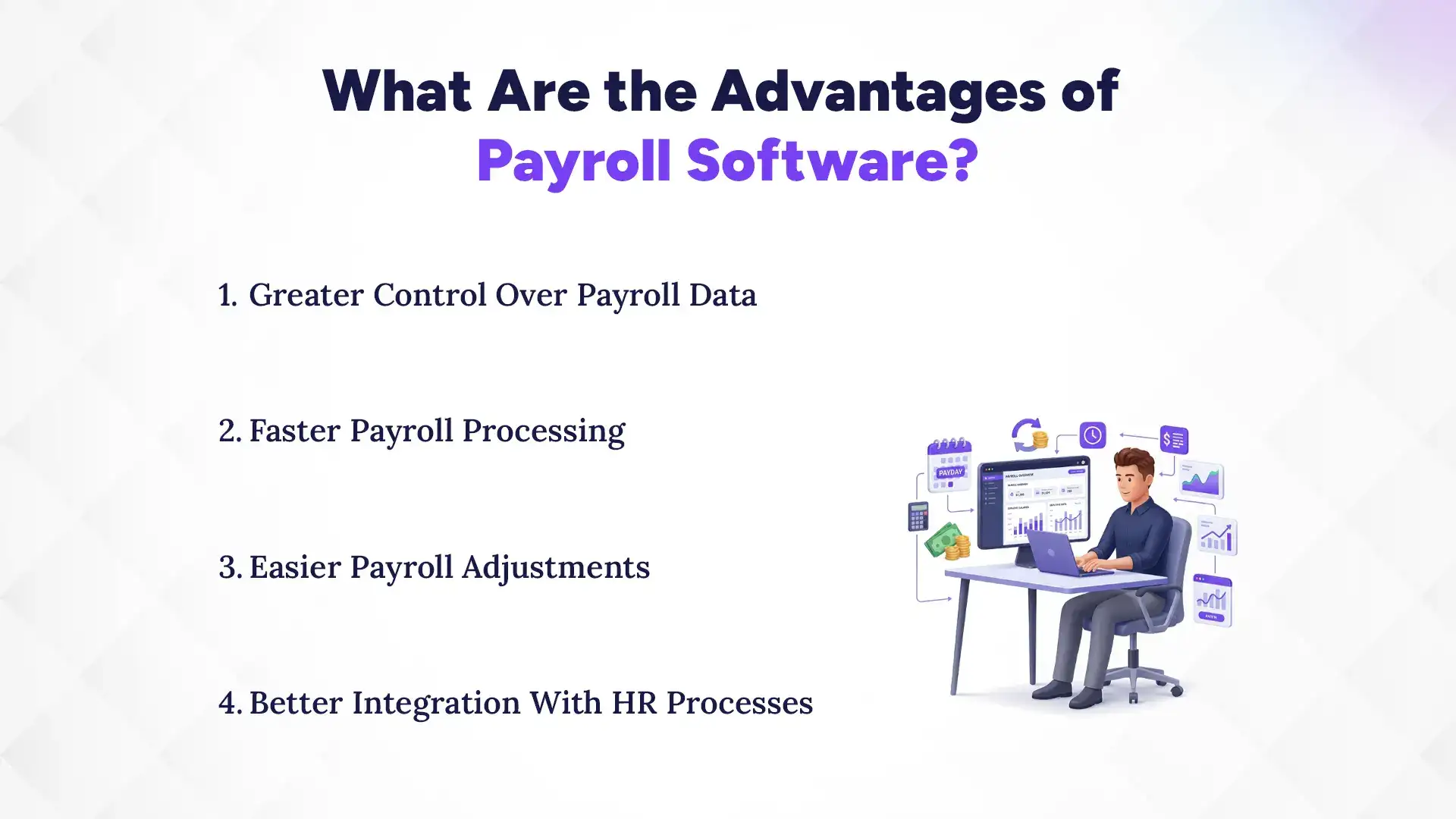
What Are the Advantages of Payroll Software?
Payroll software gives businesses more control over payroll while reducing repetitive manual work. For Nepali businesses, it can also simplify recurring tasks such as salary calculations, tax deductions, PF and SSF contributions, attendance-based deductions, and payslip generation. Having a clear understanding of how payroll deductions are calculated before implementation helps teams configure the system more accurately from the start.
1. Greater Control Over Payroll Data
HR and finance teams can access salary records, deductions, tax details, and employee information directly in the system. This makes it easier to review payroll data and make approved changes when needed.
2. Faster Payroll Processing
Automated calculations and connected employee data can reduce repetitive work during monthly payroll processing. This can make salary processing faster and more consistent, particularly when payroll includes attendance, leave, overtime, and deductions. Businesses that have moved away from manual spreadsheets to salary software often see a noticeable reduction in the time spent on each pay run.
3. Easier Payroll Adjustments
Internal teams can make approved changes to salaries, allowances, overtime, attendance, leave deductions, and other payroll items directly in the system. This is useful when employee or payroll information changes before the pay run.
4. Better Integration With HR Processes
Payroll software can connect payroll with attendance, leave, and employee records when these features are available in the same system. This helps reduce duplicate data entry and allows HR teams to use updated employee information during payroll processing. When time and attendance software feed directly into payroll, HR teams spend less time transferring data between separate tools.
What Are the Advantages of Payroll Outsourcing?
Payroll outsourcing reduces the amount of payroll work handled internally and gives businesses access to external payroll expertise. For Nepali businesses, it can be useful when HR teams have limited payroll capacity or do not have dedicated payroll specialists.
1. Less Internal Payroll Work
An external provider handles the payroll activities included in the outsourcing agreement. This reduces the processing work for HR teams and allows them to focus on recruitment, employee management, and other HR responsibilities.
2. Access to Payroll Expertise
Businesses without dedicated payroll specialists can work with professionals who regularly handle payroll processing. This can be useful when payroll involves complex calculations, deductions, tax requirements, and statutory contributions.
3. Useful Without a Dedicated Payroll Team
Small businesses may not need to build a separate payroll function just to manage monthly salaries. Outsourcing allows them to access payroll support without adding dedicated payroll staff.
4. Support With Payroll Administration
Depending on the agreement, the provider may handle tasks such as payroll calculations, payslips, statutory deductions, and payroll-related reporting. This can reduce the administrative work involved in each payroll cycle.
What Are the Drawbacks of Payroll Software?
Payroll software can reduce manual work, but businesses still need people who can manage payroll and review the results. Implementation and data accuracy also need to be considered.
Requires Payroll Knowledge: HR or finance staff need to understand salary calculations, deductions, tax, and other payroll requirements to manage the system effectively.
Incorrect Data Can Cause Errors: Incorrect employee details, salary information, attendance, or other payroll inputs can lead to incorrect results. Automation cannot fix inaccurate data.
Implementation Takes Time: Moving from spreadsheets or manual processes to software requires time for data migration, setup, training, and process changes.
Ongoing Review Is Needed: Payroll teams still need to check calculations, update employee information, and review payroll results before payments are released.
What Are the Drawbacks of Payroll Outsourcing?
Payroll outsourcing can reduce internal workload, but it also means giving an external provider a greater role in the payroll process. Businesses should consider control, data sharing, response times, and ongoing costs before choosing this approach.
Less Direct Control: The business has less control over day-to-day payroll processing because agreed tasks are handled by an external provider. Changes or corrections may also depend on the provider's process and response time.
Employee Data Is Shared Externally: Payroll outsourcing requires businesses to provide employee and salary information to the provider. Organizations should therefore understand how payroll data is accessed, stored, and protected under the outsourcing arrangement. For businesses that need to maintain clear records for audits or regulatory reviews, maintaining audit-ready payroll records becomes more complex when data is managed partly outside the organization.
Dependence on the Provider: The quality and timeliness of payroll processing depend partly on the provider's accuracy and responsiveness. Delays or errors can affect payroll operations and may require additional communication to resolve.
Ongoing Costs Can Increase: Outsourcing involves recurring service fees, which may increase as the number of employees, payroll complexity, or required services grows. Businesses should consider the long-term cost rather than comparing only the initial price.
Which Costs More: Payroll Software or Outsourcing?
Neither payroll software nor outsourcing is universally cheaper. The total cost depends on the size and complexity of your payroll, the software or provider you choose, and how much payroll work your internal team handles.
Payroll software: Subscription or licensing fees, implementation, training, integrations, and internal payroll time.
Payroll outsourcing: Provider fees, onboarding charges, additional services, and costs that may increase with employee numbers or payroll complexity.
Hidden internal costs: Software still requires staff time, while outsourcing requires time to provide payroll information, review results, and communicate with the provider.
The best comparison is the total cost of managing payroll under each option, rather than comparing only the software subscription or outsourcing fee.
Which Option Gives You More Control?
Payroll software generally gives businesses greater direct control because payroll is managed internally, with authorized staff able to access data and make changes directly when needed.
Outsourcing transfers more payroll responsibility to an external provider. While this can reduce internal workload, businesses become more dependent on the provider’s processes and responsiveness for changes, corrections, and other payroll needs.
Which Is Better for Nepali Businesses?
There is no single answer for every business. Payroll software may be a better fit for businesses with an HR or finance team that can manage payroll, want direct control over payroll data, need payroll connected with attendance and leave, or expect their payroll requirements to change as the business grows.
Payroll outsourcing may be a better fit for businesses with limited payroll expertise, those looking to reduce the time HR spends on payroll, or small businesses that do not want to build a dedicated payroll function. Teams exploring payroll software for small businesses in Nepal may find that even basic payroll tools offer enough functionality to handle monthly processing without needing external support. It can also suit businesses that are comfortable relying on an external provider for payroll processing and agreed service timelines.
Can Payroll Software and Outsourcing Be Used Together?
Payroll software and outsourcing do not always have to be an either-or choice. A business can use payroll software as its central payroll system while getting external support for accounting, compliance, implementation, or payroll advisory services when needed.
This hybrid approach can give businesses greater control over payroll data while reducing the need to handle every payroll-related task entirely in-house.
How Pace HRMS Can Support Your Payroll Process
If payroll software is the better fit for your business, the Pace HRMS payroll module provides a centralized system for managing payroll alongside core HR processes. It can help businesses manage employee records, attendance, leave, salary calculations, deductions, payslips, and payroll reports in one system.
For Nepali businesses, Pace HRMS also supports payroll requirements such as tax, PF, CIT, and SSF calculations. Connecting attendance and leave data with payroll can reduce repetitive data entry and help HR teams manage monthly payroll more efficiently.
Pace HRMS can be particularly useful for businesses that want to keep payroll management in-house while reducing manual work. As with any payroll system, businesses should evaluate its features, implementation requirements, support, and pricing against their specific needs before making a decision.
Conclusion
Payroll software and payroll outsourcing solve different problems. Software gives businesses more direct control and automation, while outsourcing reduces the amount of payroll processing handled internally.
For Nepali businesses, the better choice depends on payroll complexity, internal expertise, desired control, data requirements, and long-term cost. The goal should be to choose the approach that produces accurate, compliant, and manageable payroll without creating unnecessary operational burden.
If you're deciding between payroll software and outsourcing for your business, talk to Pace Infosys to discuss your payroll requirements and explore which approach fits your operations.
FAQs
Is payroll software better than payroll outsourcing?
+
Neither is always better. Payroll software gives businesses more control and automation, while outsourcing reduces the internal workload and expertise required.
Is payroll outsourcing cheaper than payroll software?
+
It depends on the business. Compare software, staffing, provider, and ongoing processing costs rather than just the monthly price.
Can small businesses use payroll software?
+
Yes. Small businesses can use payroll software to manage payroll internally and reduce reliance on spreadsheets or external providers.
Is payroll outsourcing suitable for Nepali businesses?
+
Yes. It can suit businesses with limited payroll expertise or HR capacity, provided the provider understands applicable Nepal requirements.
Can payroll software handle Nepal's payroll requirements?
+
It depends on the software. Businesses should confirm support for Nepal-specific calculations, deductions, contributions, and reporting.
Can a business use payroll software and outsourcing together?
+
Yes. Businesses can use payroll software internally while receiving external support for compliance, accounting, or payroll advisory services.
Ready to get started?
Book a 30-minute consultation call, and let's talk about your goals.