HRMS and performance management software are often discussed together, but they solve different HR problems. An HRMS typically handles employee records, attendance, leave, payroll, tax, PF, and SSF, while performance management focuses on employee goals, reviews, feedback, and development.
For Nepali businesses, these differences become important as HR operations grow more complex. Managing attendance and leave across field and office employees, calculating payroll and statutory contributions, maintaining employee records, and conducting consistent performance reviews can become difficult when information is spread across spreadsheets and manual processes. Growing businesses also need a reliable way to track employee goals and performance without relying entirely on informal feedback from managers.
This guide explains what HRMS and performance management software do, how they work together, and which solution may be more suitable for different HR needs in Nepal.
HRMS vs. Performance Management: The Key Difference
HRMS manages broader HR operations such as employee records, attendance, leave, payroll, and reporting, while performance management focuses on goals, reviews, feedback, and employee development. An HRMS handles the day-to-day administrative side of HR and keeps employee information organized in one system. Performance management focuses on how employees are performing, whether they are meeting goals, and how they can improve.
In simple terms, HRMS manages HR operations, while performance management evaluates and develops employees.
HR Function
HRMS
Performance Management
Employee Information
Manages employee profiles and records
Uses employee information for evaluations
Attendance & Leave
Tracks attendance, working hours, and leave
May use attendance and leave data as review context
Payroll
Handles salary, deductions, tax, PF, and SSF processes
Usually outside its scope
Goal Setting
May include goal-setting features
Focuses on setting and tracking goals
Performance Reviews
May include review features
Focuses on conducting and documenting reviews
Feedback & Development
May support employee-related records
Focuses on feedback and employee development
HR & Performance Reporting
Reports on employees, attendance, leave, and payroll
Reports on goals, reviews, ratings, and performance
An HRMS manages day-to-day HR operations and employee information, while performance management focuses on evaluating employees, tracking goals, providing feedback, and supporting development.
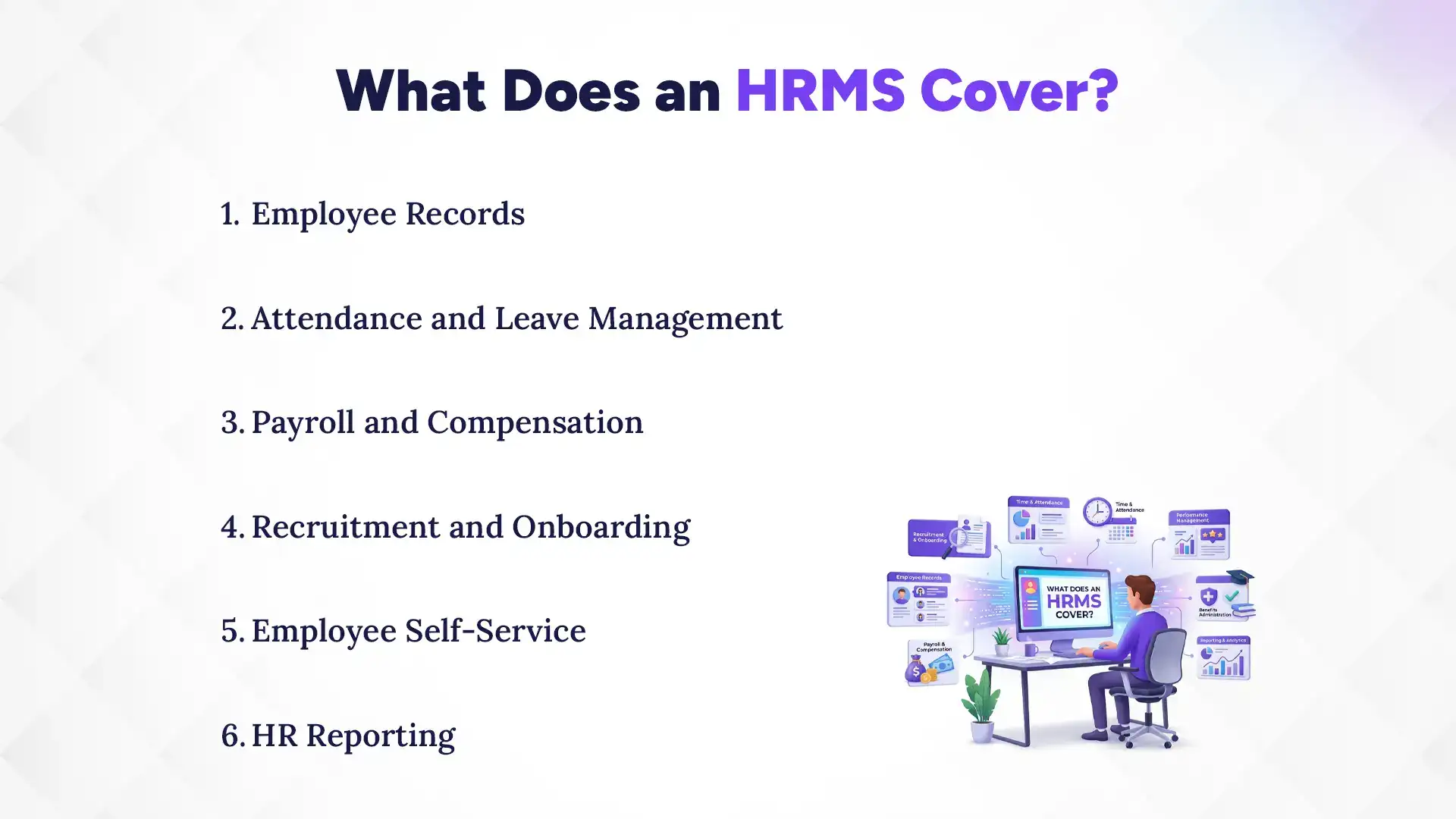
What Does an HRMS Cover?
An HRMS manages the core administrative processes involved in managing employees, from employee records and attendance to payroll, leave, and HR reporting. For Nepali businesses, it can bring these processes into one system instead of relying on separate spreadsheets, documents, and manual records.
1. Employee Records
An HRMS keeps employee information such as contact details, job title, department, salary structure, employment history, and documents in one centralized system. This reduces reliance on scattered spreadsheets and physical files and makes employee information easier to access and maintain.
2. Attendance and Leave Management
An HRMS tracks employee attendance, working hours, leave requests, and leave balances in one place. For Nepali businesses, this can also help connect attendance and leave data with payroll processing. When a leave management system operates within the HRMS, leave balances update automatically, and payroll deductions for unpaid absence stay accurate without manual transfers.
3. Payroll and Compensation
An HRMS helps manage salary calculations, deductions, tax, PF, SSF, payslips, and other compensation-related processes. Using HR software with SSF integration ensures these statutory contributions are calculated accurately while reducing manual payroll work.
4. Recruitment and Onboarding
An HRMS may help businesses manage job openings, applicants, hiring activities, and onboarding tasks. These features can make it easier to move new employees from recruitment into the organization's HR system.
5. Employee Self-Service
Employee self-service allows staff to update their information, request leave, access payslips, and complete routine HR tasks. This reduces repetitive administrative work for HR teams and gives employees easier access to their own information.
6. HR Reporting
An HRMS can generate reports on headcount, attendance, leave, payroll, turnover, and other workforce data. These reports give managers a clearer view of HR operations and support day-to-day decision-making.
Insights
Did You Know?
Performance management is only one part of managing employees. An HRMS can connect performance processes with employee records, attendance, leave, payroll, and other HR activities instead of managing each function separately.
What Does Performance Management Cover?
Performance management focuses on how employees perform, whether they are meeting their goals, and how they can improve over time. For Nepali businesses, a structured performance management process can help make employee evaluations more consistent instead of relying only on informal feedback or annual discussions.
1. Goal Setting
Managers and employees set clear goals that align with the organization's objectives and the employee's role. These goals provide a clear basis for tracking progress and evaluating performance.
2. Performance Reviews
Performance reviews evaluate employees against their goals, responsibilities, and expectations at regular intervals. Depending on company policy, reviews may take place quarterly, semi-annually, or annually and can be documented for future reference. Teams that are formalizing their review process for the first time may benefit from guidance on how to conduct performance reviews to ensure evaluations are structured and fair.
3. Feedback and Coaching
Managers provide ongoing feedback and guidance to help employees improve their performance. Regular coaching helps address issues and recognize progress throughout the year, rather than waiting for a formal review.
4. Performance Ratings
Performance ratings provide a structured way to assess how well employees are meeting expectations. Ratings can help inform decisions about promotions, salary increases, recognition, and development planning.
5. Employee Development
Performance management helps identify skill gaps and areas where employees may need training or additional support. Development plans can then help employees build relevant skills and progress within the organization. When development planning connects with broader talent management software, businesses can track training, career paths, and succession planning alongside performance data.
How Are HRMS and Performance Management Connected?
HRMS and performance management are connected because both rely on employee information, but they serve different purposes. An HRMS manages core employee and HR data, while performance management uses that information to set goals, evaluate performance, and support employee development.
1. HRMS Provides the Employee Foundation
An HRMS stores employee details such as job title, department, reporting manager, attendance, and other HR information. This provides the employee and organizational context needed to manage performance effectively.
2. Performance Management Adds the Performance Layer
Performance management builds on employee information by adding goals, reviews, feedback, ratings, and development plans. It helps managers understand how employees are performing and what support or development they may need.
3. Integration Brings Both Functions Together
Many modern HRMS platforms include performance management features, allowing businesses to manage both areas in one system. For Nepali businesses, this can reduce duplicate records, improve access to employee information, and connect performance data with related HR processes such as compensation and development.
HRMS vs. Performance Management: Which Does Your Business Need?
The right choice depends on the HR problems your business is trying to solve. If your main challenges are administrative, an HRMS may be the priority, while performance management may be more important when the focus is on employee goals, reviews, and development.
1. HRMS Is a Better Fit for Broader HR Operations
An HRMS is a better fit when your main challenges involve managing employee records, attendance, leave, payroll, and other routine HR processes. If employee information is scattered across files and spreadsheets, attendance and leave are handled manually, or payroll requires significant administrative work, an HRMS can help centralize these operations and reduce manual work.
2. Performance Management Is a Better Fit for Employee Development
Performance management is a better fit when your core HR processes are already organized but employee goals, reviews, feedback, and development are difficult to manage consistently. If employees lack clear goals, performance reviews are irregular, or managers struggle to track progress, a structured performance management system can provide a consistent framework for evaluating and developing employees.
If your business needs both broader HR automation and structured performance management, an HRMS with performance management features can provide both functions in one system.
Why This Difference Matters for Nepali Businesses
As Nepali businesses grow, the difference between HRMS and performance management becomes more important. Manual HR processes may work for a small team, but growing businesses often need more structured systems to manage employee information, HR operations, and performance consistently. Finding budget-friendly HR software in Nepal that scales with these needs is a common priority.
An HRMS can help address administrative challenges such as scattered employee records, manual attendance and leave tracking, payroll processing, and HR reporting. As teams and departments expand, performance management also becomes important for setting clear goals, conducting consistent reviews, documenting feedback, and supporting promotion, salary, and development decisions.
Certain industries require a more tailored approach to these systems. For example, deploying dedicated HR software for IT business often requires a unified platform to manage both flexible attendance and project-based performance effectively.
For growing Nepali businesses, an integrated approach can bring both functions together in one system. This can reduce duplicate records, improve consistency, and give HR teams and managers a clearer view of employee information and performance.
Manage HR Beyond Performance Reviews
Bring employee records, attendance, leave, payroll, and performance-related processes together with Pace HRMS.
What Should You Look for in an HRMS With Performance Management?
When evaluating an HRMS with performance management, businesses should look beyond individual features and consider how well the system connects HR operations with employee performance. For Nepali businesses, understanding HR management software pricing is also an important part of the evaluation process.
Employee information management: Can you manage employee records, documents, and employment history in one place?
Attendance and leave integration: Can attendance and leave data connect with other HR processes?
Payroll capabilities: Does the system support Nepal's tax, EPF, and SSF requirements?
Goal and appraisal management: Can managers set goals, conduct reviews, provide feedback, and rate performance?
Employee and manager access: Can users access the information and tasks relevant to their roles?
Reporting and dashboards: Can you track both HR data, such as payroll and attendance, and performance data, such as reviews and ratings?
Ease of use: Is the system practical for HR teams, managers, and employees to use?
Scalability: Can it support your business as your workforce and HR requirements grow?
Nepal-specific requirements: Does it support the local HR and payroll requirements your business needs?
Support and data security: Does the vendor provide reliable support and appropriate protection for employee data?
The key question is whether performance management is genuinely integrated into the HRMS or simply added as a separate feature. A well-integrated system should make it easy to manage HR administration and employee performance within the same platform.
How Pace HRMS Supports Broader Employee Management
The pace HR management system brings employee administration and performance management together in one platform for Nepali businesses. It supports employee records, attendance, leave, payroll, goals, performance reviews, feedback, and development planning.
This integration helps businesses reduce duplicate data entry, keep employee information centralized, and give managers access to relevant employee and performance information when conducting reviews or making promotion and salary decisions. For growing businesses, it also reduces the need to manage HR and performance data across separate systems.
Conclusion
HRMS and performance management serve different purposes, but they work well together. An HRMS manages core HR operations such as employee records, attendance, leave, payroll, and reporting, while performance management focuses on goals, reviews, feedback, and employee development.
For Nepali businesses, the right choice depends on current HR needs and future growth. If your main challenges are manual HR processes and scattered employee data, an HRMS can provide the foundation. If you also need structured performance management, an integrated HRMS with performance features can help manage both functions in one system as your business grows.
If you are evaluating HR systems for your business, talk to the Pace team to discuss your requirements and explore how Pace HRMS can support both your HR operations and performance management needs.
FAQs
Is performance management part of an HRMS?
+
Yes. Some HRMS platforms include performance management, while others offer it separately.
What is the main difference between HRMS and performance management?
+
HRMS manages records, attendance, leave, and payroll, while performance management focuses on goals, reviews, feedback, and development.
Do I need separate performance management software if I already have an HRMS?
+
Not necessarily. A separate system is unnecessary if your HRMS already provides the features you need.
Can an HRMS manage employee performance reviews?
+
Yes. Many HRMS platforms support goal setting, ratings, feedback, and appraisal workflows.
Which is better for a growing business in Nepal, HRMS or performance management software?
+
An HRMS is usually the better starting point, with performance management added as business needs grow.
Why should businesses integrate performance management with other HR processes?
+
Businesses should integrate performance data with employee records and other HR information for better decision-making.
Ready to get started?
Book a 30-minute consultation call, and let's talk about your goals.