

HRMS eliminates manual expense claims by digitizing submission, routing approvals automatically, and syncing reimbursements directly with payroll, removing the paper trail that causes delays and errors. What used to mean stapling receipts to a paper form and waiting weeks for repayment becomes a process employees can complete from their phone in minutes.
This guide covers what expense and reimbursement management actually involves, why manual claims create problems, how HRMS automates the process, what happens during approval, the risks of sticking with manual tracking, the features worth prioritizing, and how HRMS supports expense compliance in Nepal, closing with how HRMS handles this best.
What Does Expense and Reimbursement Management Involve?
Expense and reimbursement management involves employees submitting work-related costs for approval and repayment, covering everything from travel and meals to client entertainment and office supplies. The process spans submission, review, approval, and final payout, each of which can be handled manually or automatically.
Common categories include travel, meals, client entertainment, office supplies, and sometimes remote work costs like internet or equipment reimbursements. Tracking the full range of employee expense types in one system keeps spending visible across every category instead of scattered by department.
Traditionally, an employee collects paper receipts, fills out a claim form, and waits for a manager to review and approve it before finance processes payment. Relying on the traditional manual claims process means every step depends on someone remembering to follow up, which is exactly where delays creep in.
Employees who front their own money for work expenses feel the delay directly, and slow reimbursement can create real financial strain, especially for larger claims. Recognizing the importance of reimbursement speed to employees is part of why this process deserves more attention than it often gets.
HRMS replaces paper forms and manual routing with digital submission, automatic approval workflows, and direct payroll integration for payout. Understanding the core benefits of HR software makes clear why automation isn't just a convenience; it fundamentally changes how fast and reliably employees get paid back.
Why Do Manual Expense Claims Create Problems for Businesses?
Manual expense claims create problems for businesses because they rely on paper receipts, spreadsheet tracking, and manual approvals that are slow, error-prone, and hard to audit. As the number of claims grows, these small inefficiencies start adding up into real operational drag.
1. Time Lost on Manual Processing
Every step of a manual claim, from collecting receipts to routing approvals by email, takes time away from both employees and the finance team. Reducing time lost on manual processing is one of the most immediate returns businesses see after automating expenses using the right HR software features.
2. Errors From Manual Data Entry
Manually entering amounts, categories, and approval statuses into spreadsheets introduces mistakes that are easy to miss until they show up in a financial report. Cutting down errors from manual data entry keeps expense records accurate without requiring extra manual review.
3. Lack of Spending Visibility
When expense data lives in scattered forms and spreadsheets, finance teams struggle to see spending patterns across departments in real time. Solving the lack of spending visibility that manual tracking creates makes budgeting and forecasting far more reliable.
How Does HRMS Automate the Reimbursement Process?
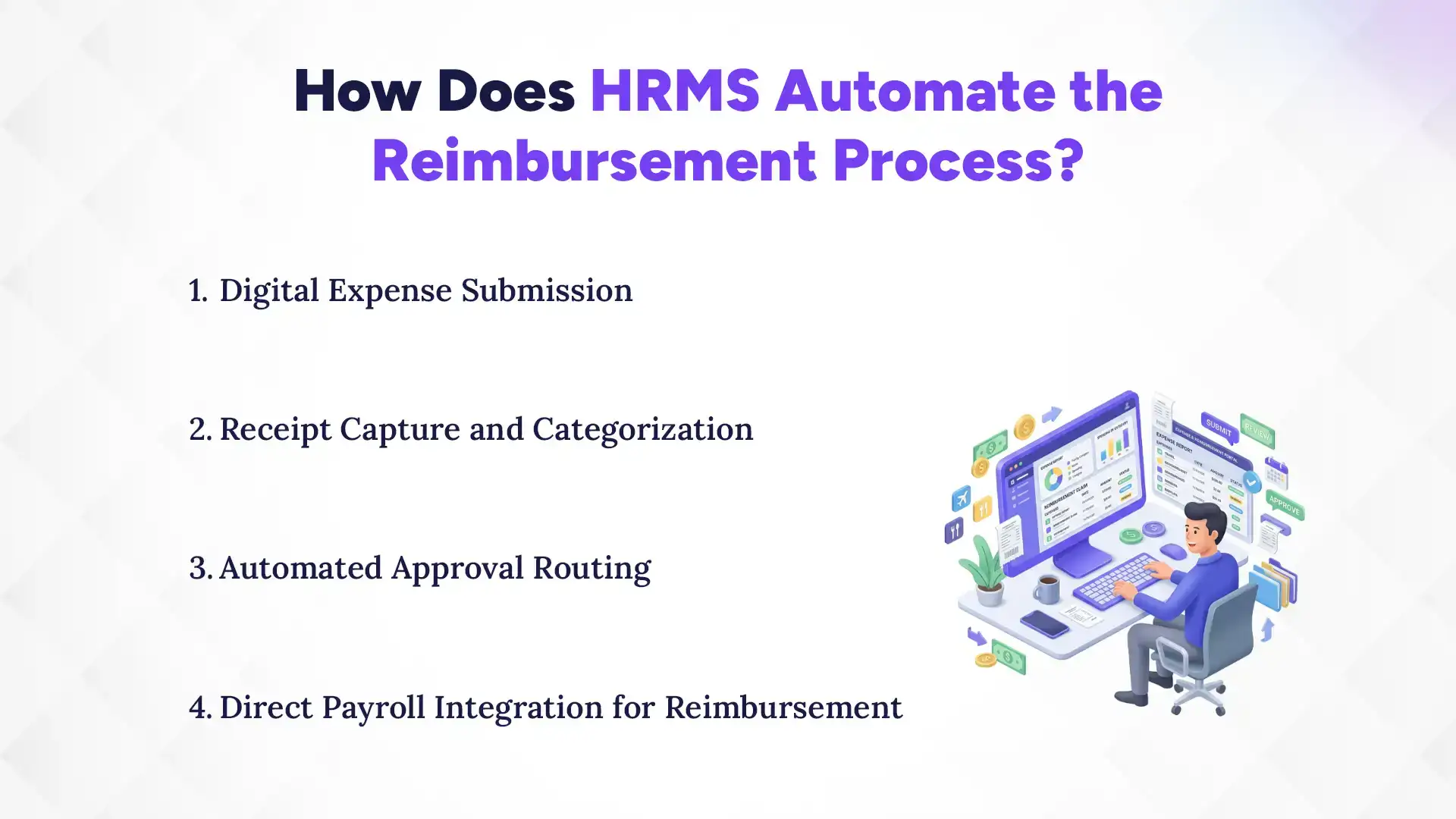
HRMS automates the reimbursement process by letting employees submit expenses digitally, routing them for approval automatically, and syncing approved claims directly with payroll for payout. This removes nearly every manual handoff that used to slow the process down.
1. Digital Expense Submission
Employees submit expenses directly through the HRMS, often from a mobile app, instead of filling out paper forms or emailing spreadsheets. Enabling digital expense submission removes the first and most common bottleneck in the traditional claims process.
2. Receipt Capture and Categorization
Receipts can be photographed and automatically categorized by the system, reducing the manual work of sorting and labeling each expense. Automating receipt capture and categorization keeps records organized without requiring employees or finance staff to do it by hand.
3. Automated Approval Routing
Once submitted, expenses are automatically routed to the correct approver based on predefined rules, rather than relying on someone to manually forward the request. Setting up automated approval routing removes the guesswork and delay that come with manual email chains.
4. Direct Payroll Integration for Reimbursement
Approved expenses can flow directly into the next payroll run, so reimbursement happens automatically instead of requiring a separate payment process. Using payroll software closes the final gap between approval and actually getting paid.
What Happens During an HRMS-Based Approval Workflow?
During an HRMS-based approval workflow, a submitted expense is automatically routed to the correct approver, checked against policy rules, and tracked in real time until it's approved or rejected. Employees can see exactly where their claim stands at every stage.
1. Automatic Routing to the Right Approver
The system identifies who needs to approve a given expense based on department, amount, or expense type and routes it there without manual intervention. Relying on automatic routing to the right approver prevents claims from sitting unnoticed in the wrong inbox.
2. Policy Checks Before Approval
Before an approver even sees the request, HRMS can flag expenses that exceed policy limits or are missing required documentation. Running policy checks before approval catches issues early instead of after a manager has already signed off.
3. Real-Time Status Tracking for Employees
Employees can check the status of their submitted expense at any time, rather than having to follow up manually to find out where it stands. Offering real-time status tracking for employees reduces the back-and-forth that used to be necessary just to get an update.
What Risks Come From Manual Expense Tracking?
Manual expense tracking creates risks such as lost or missing receipts, delayed reimbursements, inconsistent policy enforcement, and fraudulent or duplicate claims slipping through unnoticed. These risks tend to grow in parallel with the number of employees submitting claims.
1. Lost or Missing Receipts
Paper receipts get misplaced easily, and a lost receipt can mean an employee simply doesn't get reimbursed for a legitimate expense. Preventing lost or missing receipts is one of the simplest, most direct benefits of digital expense capture.
2. Delayed Reimbursements
Manual approval chains routed through email or in-person sign-off often stall when an approver is busy or unavailable. Fixing delayed reimbursements largely comes down to removing the manual handoffs that create these bottlenecks in the first place.
3. Inconsistent Policy Enforcement
Without automated checks, policy enforcement depends on individual approvers remembering and applying the rules correctly every time. Addressing inconsistent policy enforcement keeps spending limits and requirements applied the same way across every department.
4. Fraudulent or Duplicate Claims
Manual systems make it harder to catch the same receipt submitted twice or expenses that don't match actual business activity. Catching fraudulent or duplicate claims early protects the business from financial loss that's easy to miss without automated matching, a key reason many businesses automate salary and expense processing in Nepal.
What Features Should You Look for in HRMS Expense Management?
The features to look for in HRMS expense management include mobile receipt capture, configurable approval rules, and built-in reporting and analytics on spending patterns. These features determine how much friction is actually removed from the process day to day.
1. Mobile Receipt Capture
Look for a system that lets employees photograph and submit receipts directly from their phone, rather than requiring them to save physical copies. Prioritizing mobile receipt capture makes submission realistic for employees who are frequently traveling or out of the office.
2. Configurable Approval Rules
Approval workflows should be adjustable to match your business's specific structure, spending limits, and departments, rather than relying on a fixed, one-size-fits-all setup. Choosing HRMS with configurable approval rules keeps the workflow aligned with how your business actually operates.
3. Expense Reporting and Analytics
Built-in reporting should let finance teams see spending trends by department, category, or time period without manually compiling the data. Relying on expense reporting and analytics turns raw claim data into insight finance teams can actually use for budgeting.
How Does HRMS Support Expense Compliance in Nepal?
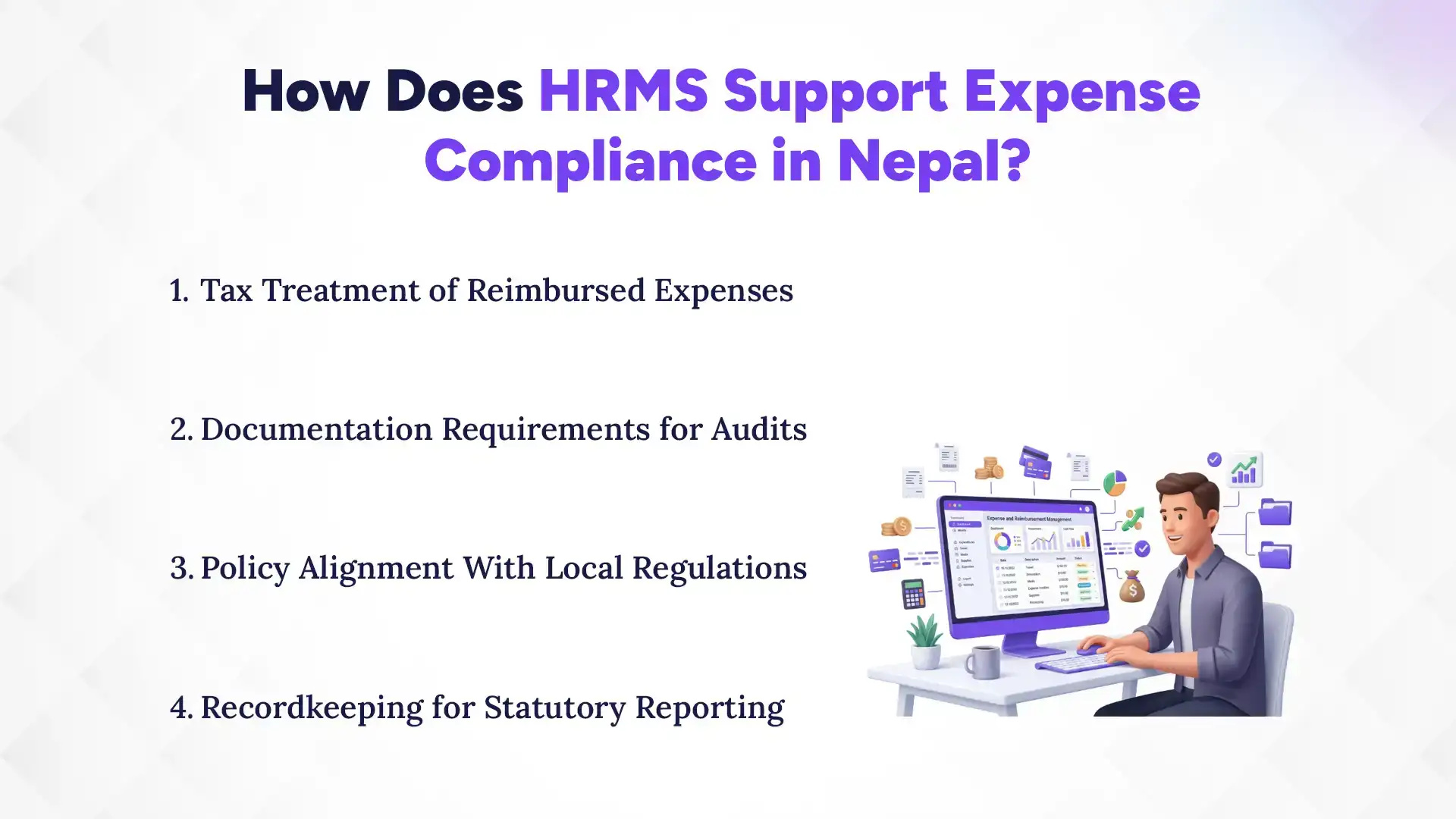
HRMS supports expense compliance in Nepal by applying correct tax treatment to reimbursed expenses, maintaining audit-ready documentation, and aligning expense policies with local regulations. This keeps businesses aligned with Nepal's specific requirements rather than relying on generic, global defaults.
1. Tax Treatment of Reimbursed Expenses
Certain reimbursed expenses in Nepal carry specific tax treatment that needs to be applied correctly to avoid compliance issues down the line. Applying the correct tax treatment of reimbursed expenses automatically reduces the risk of errors that could surface during a tax review.
2. Documentation Requirements for Audits
Nepal's audit expectations often require clear documentation trails showing what was claimed, approved, and paid for each expense. Meeting documentation requirements for audits becomes far easier when every claim already has a digital record attached.
3. Policy Alignment With Local Regulations
Expense policies need to reflect Nepal's specific regulatory expectations rather than assuming a global template will automatically apply. Ensuring policy alignment with local regulations keeps a business's internal rules consistent with what's actually required.
4. Recordkeeping for Statutory Reporting
Businesses may need to produce expense records for statutory reporting purposes, and having them centralized in HRMS makes this far less time-consuming. Maintaining recordkeeping for statutory reporting inside HRMS turns what used to be a scramble into a straightforward data pull.
Which HRMS Offers the Best Expense and Reimbursement Management in Nepal?
Pace HRMS offers the best expense and reimbursement management in Nepal, with automated approval routing, direct payroll integration, and compliance features built around local tax and reporting requirements. It's designed to handle Nepal-specific expense rules that generic platforms often overlook.
For businesses in Nepal looking to move expense tracking from paper chaos to something automated, Pace HRMS combines digital receipt capture with direct payroll integration that ensures employees get paid accurately and on time. It pulls together receipt data, approval workflows, and tax compliance into a single system instead of scattered paperwork. As one of the top 5 HR software options in Nepal, it's designed to reflect exactly how local businesses handle employee reimbursements and audit requirements.
Conclusion
Manual expense tracking becomes a growing drag on HR and finance teams as headcount grows, with more receipts to chase, more approvals to route, and more room for errors to slip through. HRMS turns reimbursement into a fast, auditable, policy-consistent process instead of a paper chase, giving both employees and finance teams a system they can actually rely on.
If your business is ready to move expense management off paper and spreadsheets, explore Pace HRMS's reimbursement features with a demo or contact Pace Infosys to see how it fits your team.