

Ever tried managing restaurant staff during a busy weekend shift, someone calls in sick, another forgets to clock in, and payroll at the end of the month feels like solving a mystery? Restaurants don’t just serve food; they juggle people, shifts, timing, and expectations all at once. And when attendance, payroll, and scheduling are handled manually, things can slip through the cracks pretty quickly.
In this blog, we’ll explore HR software for restaurants in Nepal and how it helps restaurant owners and managers bring order to the daily chaos. We’ll break down key features to look for, the real benefits for hospitality businesses, common mistakes to avoid, and how to choose the right HRMS for your restaurant. Whether you run a small café or a multi-outlet restaurant, this guide will help you manage your team more smoothly, and maybe with fewer headaches, using a Human Resource Management System.
What Is HR Software for Restaurants?
HR software for restaurants is a digital system designed to manage employee-related tasks like attendance, shift scheduling, payroll, and staff records in one place. It helps restaurant owners handle daily workforce operations more efficiently, especially in fast-paced environments where shifts and roles keep changing. Instead of juggling spreadsheets or manual logs, everything is automated and organized. In simple terms, it acts like a control center for managing restaurant staff smoothly and without the usual chaos, and understanding how to choose hr software is essential.
Why Restaurants in Nepal Need Specialized HR Software in 2026?
Restaurants in Nepal need specialized HR software in 2026 to manage complex staff operations, reduce manual errors, and handle dynamic workforce needs efficiently. With increasing competition and evolving work patterns, traditional HR methods simply can’t keep up. A dedicated HR system helps streamline daily operations while improving accuracy and productivity.
- Frequent shift changes and rotational schedules require automated scheduling tools
- High employee turnover makes hiring and onboarding more challenging
- Manual payroll calculations often lead to errors, especially with overtime and tips
- Managing part-time, full-time, and temporary staff becomes complicated without a system
- Real-time attendance tracking is essential for smooth daily operations
Compliance with labor regulations requires accurate and organized employee records
What Are the Key Features of HR Software for Restaurants in Nepal?
The key features of HR software for restaurants in Nepal include tools that manage staff attendance, scheduling, payroll, hiring, and compliance in one system. These features are designed to handle the fast-paced and shift-based nature of restaurant operations. Instead of juggling multiple tools or manual processes, everything is centralized and automated. This not only saves time but also reduces errors and improves overall workforce management.
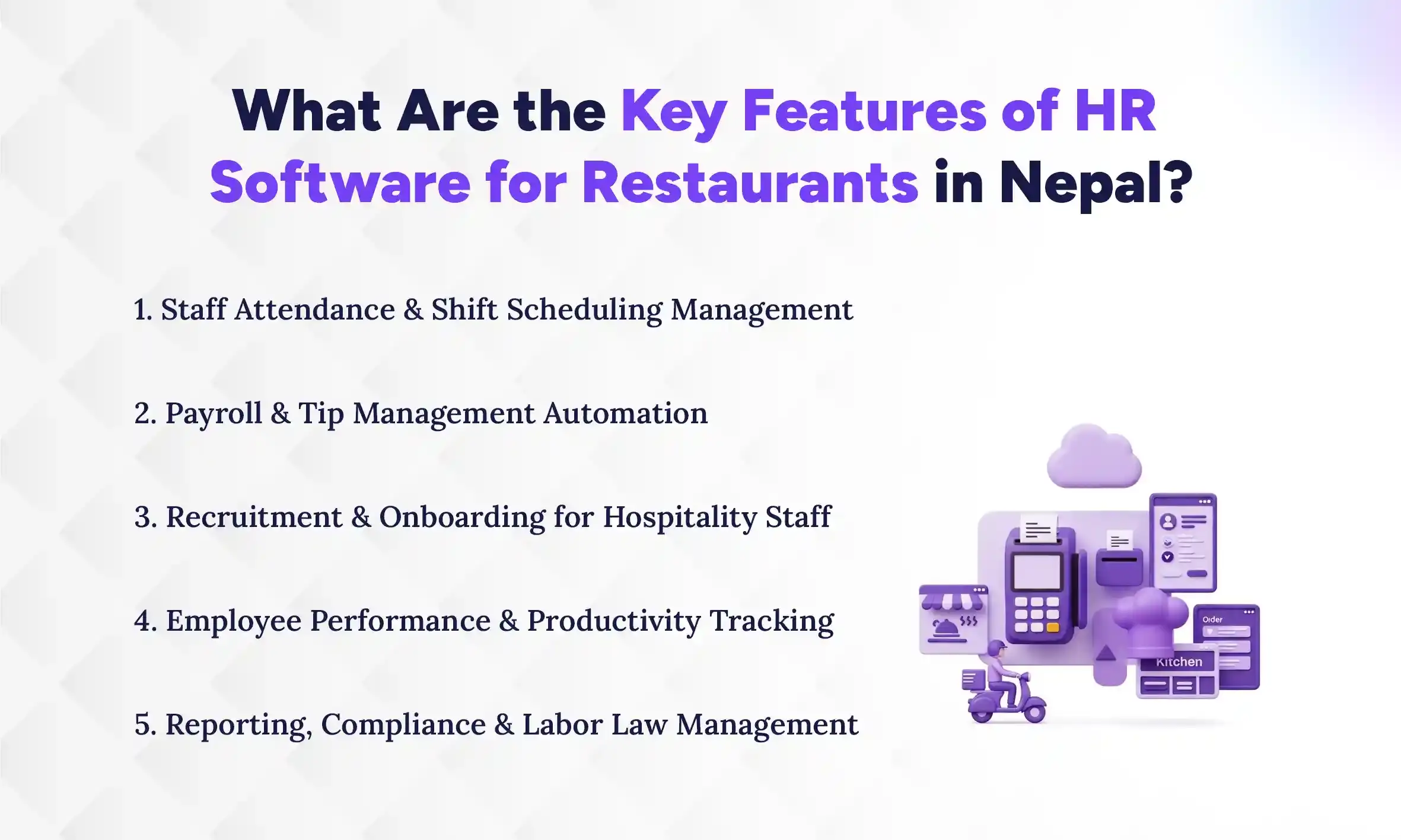
1. Staff Attendance & Shift Scheduling Management
Managing restaurant staff without proper scheduling tools can feel like organizing a kitchen during rush hour, messy and stressful. This feature allows managers to create, assign, and adjust shifts easily while tracking attendance in real time. It helps avoid scheduling conflicts, reduces no-shows, and ensures the right number of staff are available during peak hours. Employees can also view their schedules in advance, which improves coordination and reduces last-minute confusion. Over time, it creates a more balanced workflow where both staff and management stay aligned.
2. Payroll & Tip Management Automation
Payroll in restaurants isn’t always straightforward; there are tips, overtime, and varying shift hours to consider. This feature automates salary calculations based on attendance data, working hours, and additional earnings like tips or incentives. It minimizes manual errors and ensures employees are paid accurately and on time. For restaurant owners, it removes the headache of complex calculations and makes payroll processing much faster and smoother. It also builds trust among employees because payments become transparent and consistent.
3. Recruitment & Onboarding for Hospitality Staff
Restaurants often face frequent hiring needs, whether for seasonal demand or staff turnover. HR software simplifies recruitment by organizing candidate data, tracking applications, and speeding up the hiring process. Once hired, onboarding becomes more structured with digital documentation and training workflows. This ensures new employees can settle into their roles quickly without disrupting daily operations. A smoother onboarding process also helps reduce early employee turnover.
4. Employee Performance & Productivity Tracking
Keeping track of employee performance in a busy restaurant environment can be challenging. This feature helps managers monitor staff productivity, attendance patterns, and overall performance through data and reports. It allows businesses to identify top performers, address issues early, and make informed decisions about promotions or training. Over time, it helps improve service quality and team efficiency. It also creates a more accountable work environment where expectations are clear.
5. Reporting, Compliance & Labor Law Management
Restaurants need to maintain accurate employee records for compliance and reporting purposes. HR software automatically generates reports related to attendance, payroll, and workforce data, making audits and documentation much easier. It also helps ensure that labor laws and company policies are followed consistently. Having organized and accessible data reduces risk and gives business owners peace of mind. In the long run, it protects the business from legal issues and improves operational transparency.
Benefits of Using HR Software for Restaurants in Nepal
Using HR software for restaurants in Nepal helps streamline daily operations, reduce manual work, and improve overall workforce efficiency. In a fast-paced environment like the restaurant industry, managing staff manually can quickly become overwhelming. HR software simplifies processes like attendance, payroll, and scheduling while improving accuracy and transparency. It also helps managers make better decisions using real-time data. In short, it turns a chaotic workflow into a more organized and manageable system, highlighting the benefits of using hr software.
1. Better Shift and Workforce Management
Managing shifts in a restaurant can feel like solving a puzzle that keeps changing every day. HR software makes it easier by allowing managers to create, update, and monitor staff schedules in real time. It ensures the right number of employees are available during busy hours while avoiding overstaffing during slower periods. Employees can check their schedules easily, which reduces confusion and last-minute changes. This leads to smoother daily operations and better coordination between team members.
2. Faster Hiring and Staff Onboarding
Restaurants often deal with frequent hiring due to high staff turnover, and doing this manually can slow things down. HR software simplifies the recruitment process by organizing applications, tracking candidates, and speeding up hiring decisions. Once hired, onboarding becomes more structured with digital forms and guided processes. This helps new employees get up to speed quickly without disrupting operations. A faster onboarding process also improves the overall employee experience from day one.
3. Accurate Payroll and Tip Distribution
Handling payroll in restaurants can be tricky, especially when tips, overtime, and different shifts are involved. HR software automates these calculations, ensuring employees are paid accurately based on their actual working hours. It reduces the risk of errors and eliminates disputes related to salary or tip distribution. For managers, it saves time and removes the stress of manual calculations. Consistent and transparent payroll also builds trust among employees.
4. Reduced HR Workload and Errors
Manual HR processes often involve repetitive tasks like tracking attendance, calculating salaries, and managing leave records. These tasks not only take time but also increase the chances of human error. HR software automates these processes, allowing HR teams to focus on more important work like employee engagement and planning. With fewer errors and less manual effort, overall efficiency improves. It’s like having an extra pair of hands, only faster and more accurate.
5. Improved Employee Retention in Restaurants
Employee retention is a major challenge in the restaurant industry, where staff turnover is often high. HR software helps improve retention by creating a more organized and transparent work environment. Employees have clear visibility into their schedules, attendance, and payments, which reduces misunderstandings. Managers can also track performance and address issues early, creating a better workplace experience. When employees feel valued and treated fairly, they are more likely to stay longer.
How to Choose the Best HR Software for Restaurants in Nepal?
To choose the best HR software for restaurants in Nepal, start by understanding your operational needs and selecting a system that simplifies workforce management while supporting growth. The right solution should efficiently handle attendance, payroll, and scheduling without adding unnecessary complexity. It should also integrate smoothly with tools like POS systems and be easy for both managers and staff to use. A well-chosen HRMS saves time, reduces errors, and makes daily restaurant operations much smoother, especially when you understand the types of hr software available.
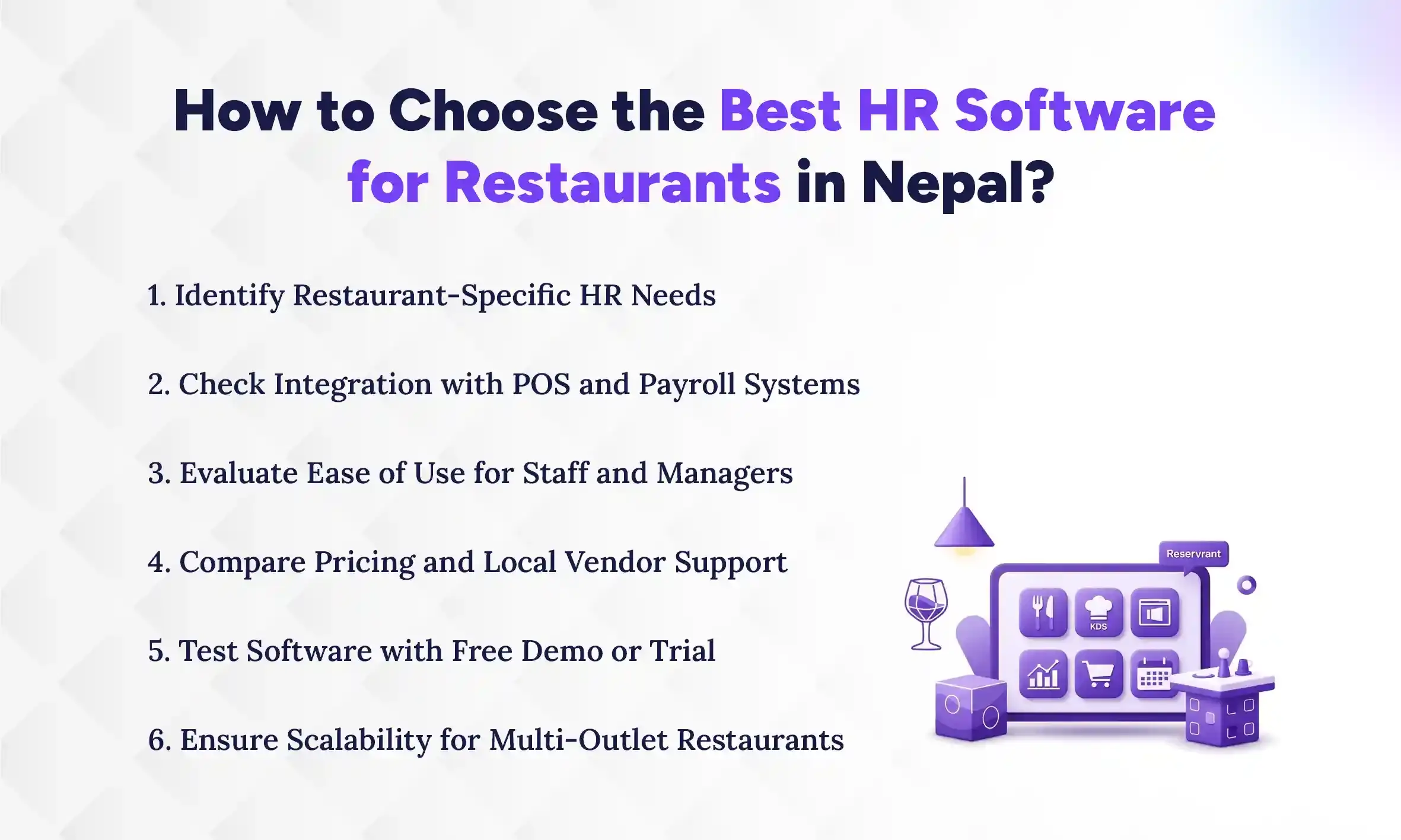
1. Identify Restaurant-Specific HR Needs
Every restaurant operates differently, so the first step is to clearly define your HR requirements. A small café may only need basic attendance and payroll, while a larger restaurant might require shift scheduling, multi-role tracking, and performance monitoring. You should also consider factors like staff size, turnover rate, and whether you manage multiple outlets. Understanding these needs helps you avoid choosing software that is either too basic or unnecessarily complex. It sets a strong foundation for selecting the right system.
2. Check Integration with POS and Payroll Systems
In restaurants, HR software doesn’t work in isolation, it needs to connect with other systems like POS and payroll. Integration ensures that attendance data, working hours, and sales-related incentives flow smoothly into payroll calculations. Without integration, managers often end up entering data manually, which increases the risk of errors. A well-integrated system saves time and keeps all operations aligned. It also provides a clearer picture of workforce performance linked to business outcomes.
3. Evaluate Ease of Use for Staff and Managers
No matter how powerful a system is, it won’t be effective if it’s difficult to use. Restaurant staff are often busy, and they need a system that is simple and quick to understand. Managers also need an intuitive dashboard to monitor attendance, approve leaves, and manage schedules efficiently. User-friendly software reduces training time and encourages adoption across the team. When everyone can use the system comfortably, it becomes a part of daily operations rather than a burden.
4. Compare Pricing and Local Vendor Support
Pricing is always an important factor, but it shouldn’t be the only deciding point. Restaurants should compare different software options based on features, value, and long-term benefits. At the same time, having reliable local support is crucial, especially in case of technical issues or system updates. Local vendors understand the Nepali business environment and can provide faster assistance when needed. A balance between cost and support ensures you get the best value from your investment.
5. Test Software with Free Demo or Trial
Before committing to any HR software, it’s always a good idea to test it through a demo or trial version. This gives you a real feel of how the system works in your restaurant environment. You can check whether it meets your requirements, how easy it is to use, and whether it integrates well with your existing processes. Testing also helps identify any limitations early on. It’s a simple step, but it can prevent costly mistakes later.
6. Ensure Scalability for Multi-Outlet Restaurants
If you plan to expand your restaurant or already operate multiple outlets, scalability becomes essential. The software should be able to handle increased staff numbers, multiple locations, and more complex operations without slowing down. A scalable HR system grows with your business, eliminating the need to switch platforms later. It also allows centralized management of all outlets from a single dashboard. This makes operations more efficient and easier to control as your business expands.
What Makes HR Software Different for Restaurants Compared to Other Businesses?
HR software for restaurants is different because it is designed to handle fast-paced, shift-based, and high-turnover work environments. Unlike traditional businesses with fixed schedules, restaurants deal with rotating shifts, part-time staff, and unpredictable workloads. This requires more flexibility, real-time tracking, and quick adjustments. The software must also handle tips, overtime, and multi-role employees efficiently. In short, restaurant HR software is built to manage the complexity that standard HR systems often struggle with.
1. High Employee Turnover Handling
Restaurants often experience higher employee turnover compared to other industries, which makes hiring and onboarding a continuous process. HR software helps manage this by keeping employee records organized and streamlining recruitment workflows. It allows managers to quickly onboard new staff without disrupting operations. Having a system in place reduces the stress of frequent hiring and ensures consistency in documentation and training. This makes it easier to maintain stability even when staff changes frequently.
2. Flexible Shift & Part-Time Staff Management
Unlike typical office jobs, restaurant staff often work in shifts that change daily or weekly. HR software allows managers to create flexible schedules and assign shifts based on demand. It also supports part-time workers, temporary staff, and employees working multiple roles. This flexibility helps avoid scheduling conflicts and ensures proper staff coverage during peak hours. With clear schedules in place, both employees and managers stay better coordinated.
3. Tip, Overtime & Incentive Tracking
Restaurants often include additional earnings like tips, service charges, and overtime pay, which can complicate payroll. HR software tracks these elements automatically and includes them in salary calculations. This reduces manual work and ensures that employees are compensated fairly. It also helps maintain transparency, which is important for building trust among staff. Accurate tracking of incentives and extra earnings simplifies payroll and reduces disputes.
4. Multi-Location Staff Coordination
Many restaurant businesses operate across multiple outlets, which makes staff management more complex. HR software provides a centralized system to monitor attendance, schedules, and performance across all locations. Managers can easily track which employees are working at which branch and make adjustments as needed. This improves coordination and ensures consistent management practices across outlets. It also saves time by bringing all workforce data into one unified platform.
Which Is the Best HR Software for Restaurants in Nepal?
Pace HRMS is the best HR software for restaurants in Nepal because it offers a complete, all-in-one system to manage attendance, payroll, employee records, and HR operations efficiently. It helps automate complex tasks like salary processing, leave tracking, and overtime management, reducing manual errors and saving time.
The software is cloud-based, supports real-time data access, and handles everything from employee data to payroll in a centralized system. This makes it especially useful for restaurants where shifts, staff changes, and payroll calculations can get messy. With its automation, scalability, and ease of use, Pace HRMS helps restaurant owners manage their workforce smoothly without the usual chaos.
Common Challenges Restaurants Face Without HR Software
Running a restaurant without HR software can quickly turn daily operations into a juggling act. From managing shifts to calculating payroll, everything becomes more time-consuming and prone to mistakes. As staff numbers grow and operations get busier, manual systems struggle to keep up. This often leads to confusion, inefficiency, and frustration for both managers and employees. Without a proper system in place, small issues can snowball into bigger operational problems.
1. Manual Attendance and Shift Confusion
When attendance and shifts are managed manually, things can easily go off track. Managers may struggle to keep up with changing schedules, last-minute absences, or overlapping shifts. Employees might not always be clear about their working hours, leading to missed shifts or overstaffing. This confusion can disrupt service quality, especially during peak hours. Over time, it creates unnecessary stress and inefficiency in daily operations.
2. Payroll Errors and Tip Mismanagement
Handling payroll manually in a restaurant is rarely straightforward. With tips, overtime, and different shift timings involved, even small calculation mistakes can lead to incorrect salaries. This often results in employee dissatisfaction and time spent resolving disputes. Tip distribution, in particular, can become unclear without proper tracking. A lack of automation increases errors and makes payroll processing more stressful for managers.
3. High Employee Turnover Tracking Issues
Restaurants often deal with frequent staff changes, and without HR software, keeping track of employee records becomes difficult. Important details like joining dates, attendance history, and performance data can get lost or disorganized. This makes rehiring, onboarding, and managing staff continuity more challenging. Without proper tracking, managers may struggle to maintain consistency in operations. It also becomes harder to identify patterns behind employee turnover.
4. Lack of Real-Time Workforce Insights
Without HR software, managers often rely on outdated or incomplete data to make decisions. There’s no clear visibility into employee attendance, performance, or productivity in real time. This makes it difficult to identify issues early or plan staffing effectively. Decisions are often based on guesswork rather than actual data. In a fast-paced restaurant environment, this lack of insight can impact both efficiency and service quality.
Future of HR Software for Restaurants in Nepal
The future of HR software for restaurants in Nepal is moving toward smarter, faster, and more automated workforce management. As the hospitality industry becomes more competitive, restaurants are adopting digital tools to improve efficiency and decision-making. Modern HR systems are no longer just about attendance or payroll, they’re becoming intelligent platforms that help predict staffing needs and optimize operations. With advancements in AI, mobile technology, and system integrations, restaurant HR management is set to become more proactive than reactive.
1. AI-Based Workforce Scheduling
AI-based scheduling is changing how restaurants manage their staff. Instead of manually planning shifts, the system can analyze past data, peak hours, and employee availability to create optimized schedules automatically. It helps ensure the right number of staff are present during busy times without overstaffing during slow periods. This not only improves efficiency but also reduces labor costs. Over time, AI can even predict staffing needs, making planning more accurate and less stressful for managers.
2. Mobile-First HR Systems for Staff
Mobile-first HR systems are becoming essential as more employees rely on smartphones for daily tasks. These systems allow staff to mark attendance, check schedules, apply for leave, and receive updates directly from their mobile devices. It gives employees more control and flexibility while reducing dependency on manual processes. For managers, it ensures real-time visibility of workforce activities. This convenience improves communication and keeps everyone on the same page.
3. Integration with Smart POS Systems
Integration between HR software and POS systems is becoming increasingly important for restaurants. This connection allows businesses to link employee performance with sales data, helping managers make more informed decisions. For example, staffing levels can be adjusted based on sales trends or peak hours recorded in the POS system. It also simplifies payroll by aligning working hours with actual business activity. This kind of integration creates a more connected and efficient restaurant operation.
Conclusion
Managing a restaurant team isn’t just about schedules and salaries, it’s about keeping everything running smoothly behind the scenes. The right HR software for restaurants in Nepal can simplify daily operations, reduce errors, and bring much-needed structure to a fast-moving environment. From attendance and payroll to hiring and performance tracking, everything becomes more organized and easier to manage.
The key is to choose a solution that fits your restaurant’s workflow and future growth. Look for features like automation, mobile access, and system integration to get the most value. When done right, HR software doesn’t just save time; it helps you build a more efficient, reliable, and well-managed team that supports long-term business success with The Pace Infosys.