

Ever tried managing a growing network of insurance agents, office staff, commissions, payroll, and compliance, all at once, and felt like everything might slip through the cracks? You’re not alone. Many insurance companies in Nepal still rely on spreadsheets, manual tracking, and “we’ll fix it later” systems until later becomes a problem. And in an industry built on trust and accuracy, even small HR mistakes can quietly snowball into bigger risks.
In this blog, we’ll break down everything you need to know about HR Software for Insurances In Nepal, what it is, why insurance companies are increasingly shifting toward HRMS, and how to choose the right solution for your business. From managing agents and automating commissions to ensuring compliance and improving efficiency, consider this your practical, no-nonsense guide to making smarter HR decisions in the insurance sector.
What Is HR Software for Insurance in Nepal?
HR software for insurance in Nepal is a digital system (HR software) designed to manage and automate employee and agent-related processes within insurance companies. It handles everything from attendance and payroll to commissions, recruitment, and compliance in one centralized platform. In an industry where both office staff and field agents need to be managed efficiently, this software brings structure and clarity. Simply put, it replaces scattered manual processes with a streamlined system that actually keeps things under control.
Why Insurance Companies in Nepal Need HR Software in 2026?
Insurance companies in Nepal need HR software in 2026 to manage complex agent networks, ensure compliance, and handle operations more efficiently. As the industry grows, relying on manual systems becomes slow, error-prone, and difficult to scale. HRMS helps bring everything, agents, employees, payroll, and compliance, into one structured system while highlighting the benefits of using hr software. It simply makes operations smoother, faster, and far less stressful.
1. Managing Large Agent and Employee Networks Efficiently
Insurance companies deal with both office staff and a wide network of agents, which can be hard to track manually. HR software centralizes all employee and agent data in one place. It makes monitoring performance, attendance, and productivity much easier. This reduces confusion and improves overall coordination. It also helps managers keep a clear overview without constantly chasing updates.
2. Handling Multi-Branch and Field-Based Operations
With branches and field agents spread across different locations, managing HR manually becomes complicated. HR software connects all operations into a single system with real-time updates. It ensures consistency in data and communication across branches. Even field staff activities can be tracked without constant follow-ups. Everything stays aligned, even when teams are physically apart.
3. Ensuring Compliance with Insurance Board Nepal & Labor Laws
Insurance companies must follow strict regulations from the Insurance Board Nepal and the labor authorities. HR software helps maintain records, automate compliance tracking, and generate reports when needed. This reduces the risk of penalties and errors. It keeps the organization aligned with regulatory requirements without constant manual effort. And honestly, it makes audits a lot less stressful.
4. Automating Payroll, Incentives, and Commission Structures
Payroll in insurance is not just about salaries, it includes incentives and commissions. HR software automates these calculations, ensuring accuracy and timely payments. It reduces manual workload and avoids disputes related to incorrect payouts. Everything becomes transparent and easy to manage. Employees and agents also gain more trust when payments are consistent.
5. Enhancing Data Security and Confidential Client Handling
Insurance companies handle sensitive employee and client-related data. HR software provides security features like encryption and controlled access. This ensures that only authorized users can view or manage critical information. It reduces the risk of data leaks and builds trust within the organization. In an industry built on trust, this level of security really matters.
What Are the Key Features of HR Software for Insurance in Nepal?
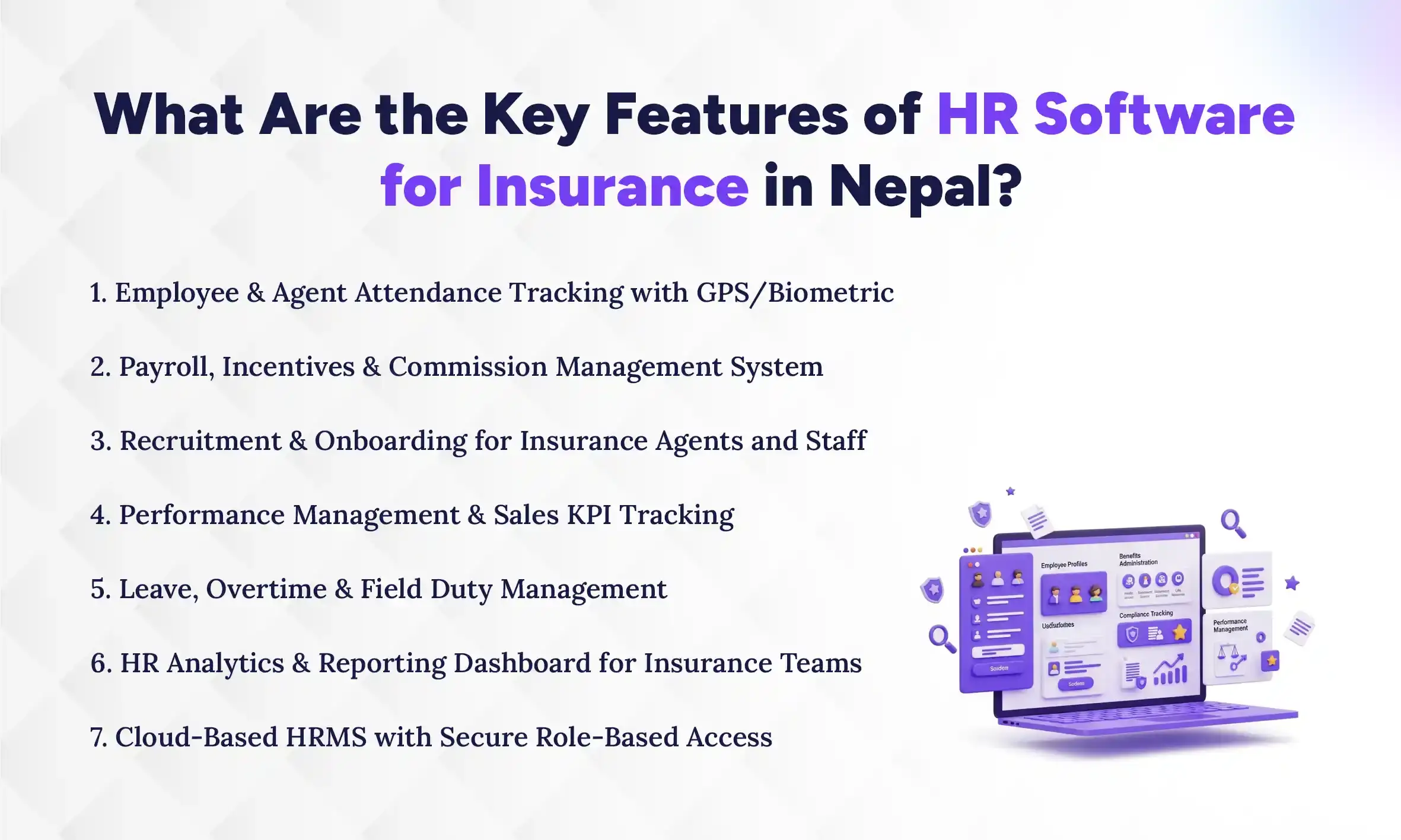
The key features of HR software for insurance in Nepal include attendance tracking, commission-based payroll, recruitment tools, performance monitoring, and secure cloud access, all designed for both agents and office staff. Insurance companies operate differently from typical offices, so HRMS must handle field work, incentives, and compliance smoothly. Instead of juggling multiple systems, everything is managed in one place. It brings clarity, control, and, honestly ,a lot less chaos.
1. Employee & Agent Attendance Tracking with GPS/Biometric
Insurance companies often have field agents, so traditional attendance systems don’t always work. HR software uses GPS tracking and biometric devices to record accurate attendance. This helps monitor both office employees and agents working remotely. It reduces manual tracking and improves accountability. Managers can see who’s working, where, and when, without constant follow-ups. It also builds a reliable record of attendance over time.
2. Payroll, Incentives & Commission Management System
Payroll in insurance is more complex due to incentives and commissions. HR software automates these calculations, ensuring accurate and timely payments. It reduces errors and avoids disputes over commissions. Everything is calculated transparently, which builds trust among employees and agents. It also saves HR teams from spending hours on manual calculations every month. Over time, this creates a smoother and more dependable payroll process.
3. Recruitment & Onboarding for Insurance Agents and Staff
Hiring agents and staff frequently is common in insurance companies. HR software streamlines recruitment by managing applications, tracking candidates, and organizing hiring workflows. Onboarding becomes faster with digital documentation and structured processes. New hires can get started without delays. It creates a smoother experience for both HR teams and employees. A strong onboarding process also helps improve early retention.
4. Performance Management & Sales KPI Tracking
Insurance businesses rely heavily on performance and sales targets. HR software tracks KPIs, agent performance, and productivity in real time. Managers can easily identify top performers and those who need support. This makes performance reviews more objective and data-driven. It also motivates employees when goals and progress are clearly visible. Over time, it builds a more performance-driven culture.
5. Leave, Overtime & Field Duty Management
Managing leave and duty schedules for both office staff and field agents can get confusing. HR software allows employees to apply for leave digitally, with quick approvals from managers. It also tracks overtime and field duties accurately. This ensures fair compensation and avoids misunderstandings. Everything stays transparent and easy to manage. It reduces conflicts and improves overall coordination.
6. HR Analytics & Reporting Dashboard for Insurance Teams
Data plays a huge role in decision-making, and HR is no exception. HR software provides dashboards and reports that show insights into workforce performance, attendance, and trends. Managers can make better decisions based on real data instead of assumptions. It also helps in planning and forecasting. In a way, it turns HR into a more strategic function. Clear insights lead to smarter long-term decisions.
7. Cloud-Based HRMS with Secure Role-Based Access
Modern HR software is cloud-based, allowing access from anywhere at any time. This is especially useful for companies with field agents and multiple branches. Role-based access ensures that sensitive information is only available to authorized users. It improves data security while maintaining flexibility. As the company grows, the system can scale easily without major changes. It gives both control and convenience at the same time.
Benefits of Using HR Software for Insurance in Nepal
The benefits of using HR software for insurance in Nepal go far beyond just automation; it actually changes how insurance companies operate daily. From managing agents to handling commissions and compliance, everything becomes more structured and efficient across different types of hr software. Instead of chasing data and fixing errors, HR teams can focus on improving performance and growth. In an industry where both speed and accuracy matter, HRMS acts like a backbone that quietly keeps everything running smoothly.
1. Improved Productivity of Agents and Office Staff
When agents and employees are managed through a centralized system, productivity naturally improves. HR software reduces manual tasks like attendance tracking and reporting. This allows staff to focus more on core activities like sales and client service. Managers can monitor performance in real time, which helps in quick decision-making. Overall, less time on admin work means more time on actual business. It creates a more focused and efficient workforce.
2. Faster Hiring and Onboarding of Insurance Agents
Insurance companies often need to recruit agents quickly to stay competitive. HR software speeds up the hiring process by automating applications, tracking candidates, and managing documentation. Onboarding becomes smoother with digital workflows and structured processes. New agents can start working without unnecessary delays. It also creates a more professional and organized first impression. Faster onboarding means quicker contribution to business growth.
3. Accurate Payroll and Commission Calculations
Calculating salaries along with commissions and incentives can be complicated. HR software automates these calculations, ensuring accuracy and timely payments. This reduces disputes and builds trust among employees and agents. It also minimizes the risk of costly errors. Everything becomes transparent and easy to verify. Over time, it creates a more reliable and stress-free payroll process.
4. Better Compliance with Insurance Regulations in Nepal
Insurance companies must follow strict rules set by regulatory authorities. HR software helps maintain records, track compliance requirements, and generate reports when needed. This reduces the risk of penalties and missed deadlines. It keeps the organization aligned with both insurance and labor laws. In short, it makes compliance less stressful and more manageable. It also prepares companies better for audits and inspections.
5. Enhanced Employee and Agent Experience
A smooth HR system directly improves how employees and agents feel at work. Processes like leave requests, payroll, and performance tracking become faster and more transparent. This reduces frustration and builds trust within the organization. Employees feel more supported and valued. And when people feel that way, they tend to stay, and perform better. A better experience often leads to stronger long-term retention.
How to Choose the Best HR Software for Insurance in Nepal?
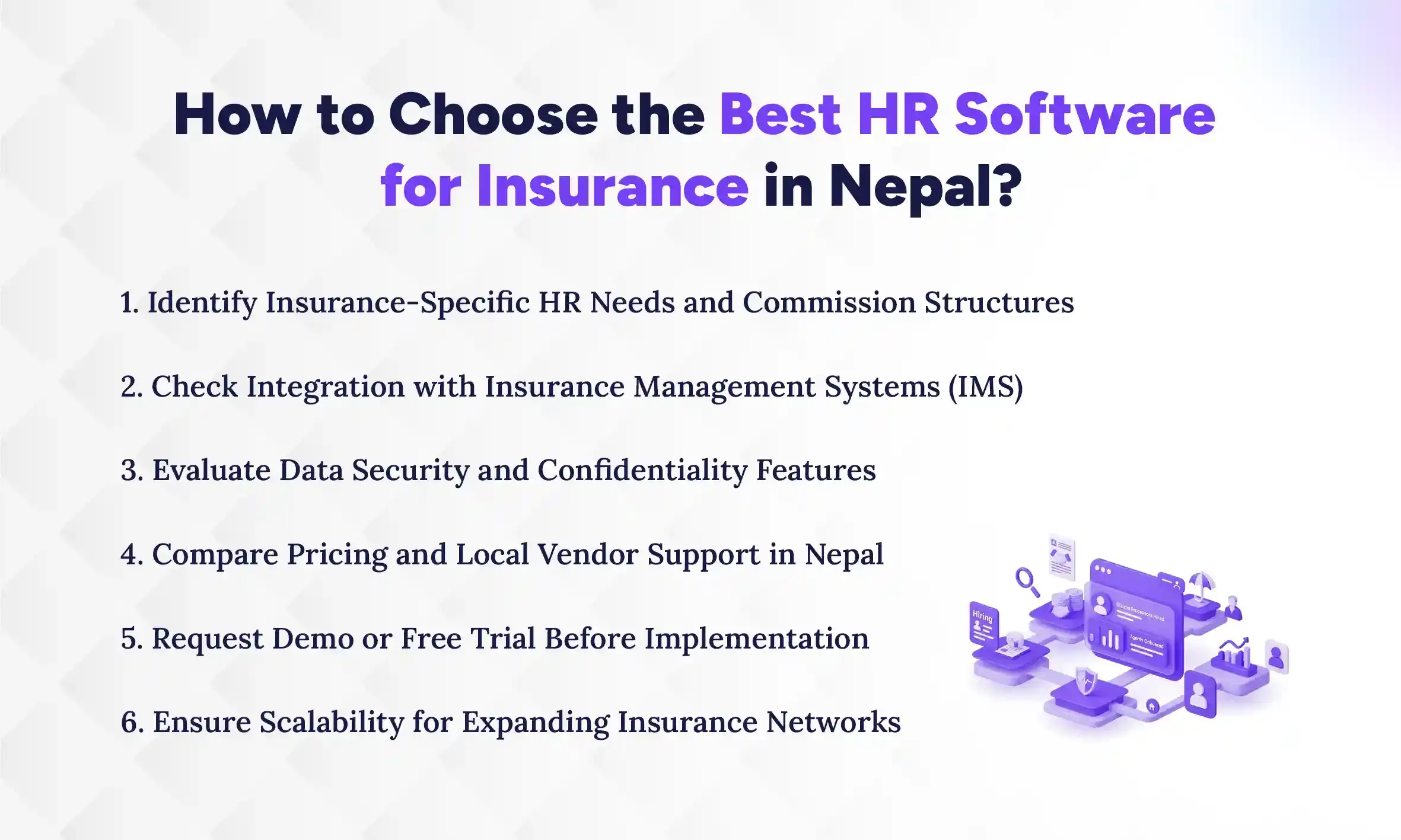
Choosing the best HR software for insurance in Nepal means selecting a system that fits your agent-driven model, handles commissions accurately, and stays compliant with local regulations. It’s not just about ticking features, it’s about finding a solution that actually works for your daily operations. Insurance companies deal with field agents, incentives, and multi-branch setups, so the HRMS must handle all of that smoothly. To explore better options, you can review the top 5 hr software in Nepal. A good choice should simplify work today and still support your growth tomorrow.
1. Identify Insurance-Specific HR Needs and Commission Structures
Start by understanding your unique HR requirements, especially how you manage agents and commissions. Insurance businesses rely heavily on incentives, so your HR software must support flexible commission structures. List out your current challenges and what you want to improve. This helps you choose a system that fits your workflow instead of forcing you to adjust. A clear requirement list saves time, money, and future headaches. It also ensures you don’t miss critical features during selection.
2. Check Integration with Insurance Management Systems (IMS)
Your HR software should integrate with your existing insurance management systems. This ensures smooth data flow between departments without duplication or manual entry. For example, employee data, payroll, and reports can sync automatically. Without integration, you’ll end up doing extra work, which defeats the purpose of automation. A connected system simply makes operations more efficient. It keeps all departments aligned and working seamlessly.
3. Evaluate Data Security and Confidentiality Features
Insurance companies handle sensitive data, so security must be a top priority. Look for features like data encryption, role-based access, and secure cloud storage. Only authorized users should access critical information. This reduces the risk of internal and external data breaches. It’s always better to be cautious than deal with a data issue later. Strong security builds trust within the organization.
4. Compare Pricing and Local Vendor Support in Nepal
Pricing matters, but support matters just as much ,sometimes more. Choose software that fits your budget while offering essential features. Also, consider vendors with local support in Nepal, as they understand the market and regulations better. Quick support can save you a lot of trouble when issues arise. Cheap software without support often becomes expensive later. Good support ensures smoother long-term usage.
5. Request Demo or Free Trial Before Implementation
Always test the software before making a final decision. A demo or free trial helps you understand how the system works in real scenarios. You can evaluate ease of use, features, and compatibility with your processes. It also allows your team to get familiar with the system early. Think of it as trying before buying ,it reduces the risk of making the wrong choice. It also builds confidence in your final decision.
6. Ensure Scalability for Expanding Insurance Networks
Insurance companies grow, more agents, more branches, more data. Your HR software should be able to scale without needing frequent upgrades or replacements. A scalable system supports growth without slowing down operations. It should handle increasing users and data smoothly. Choosing a future-ready system saves both time and cost in the long run. It ensures your system grows along with your business.
What Makes HR Software for Insurance Different from Other Industries?
HR software for insurance is different because it must handle agent-based models, commission structures, field operations, and strict compliance requirements. Unlike typical industries with fixed employees and simple payroll, insurance companies deal with dynamic teams and performance-driven payouts. This makes HR processes more complex and data-heavy. So, the HRMS needs to be smarter, more flexible, and built specifically for this kind of environment.
1. Agent-Based Workforce with Commission-Driven Models
Insurance companies rely heavily on agents who work on commissions rather than fixed salaries. HR software must support flexible commission structures and track performance-based earnings accurately. This adds a layer of complexity compared to standard payroll systems. It also needs to handle varying incentive plans across teams. A good HRMS ensures everything is calculated correctly and transparently.
2. High Dependency on Field Staff and Remote Operations
A large portion of insurance work happens outside the office, with agents working in the field. HR software must support remote attendance tracking, mobile access, and real-time updates. This ensures that even field staff remain connected to the system. It reduces the need for constant manual reporting. Managing remote teams becomes much easier and more organized.
3. Strict Regulatory and Policy Compliance Requirements
Insurance companies must follow strict guidelines from regulatory authorities. HR software helps maintain proper documentation, track compliance requirements, and generate reports when needed. This reduces the risk of penalties and ensures smooth audits. It also helps keep policies consistent across the organization. Compliance becomes more manageable and less time-consuming.
4. Need for Real-Time Sales and Workforce Insights
Insurance businesses depend heavily on sales performance and workforce productivity. HR software provides real-time insights into employee performance, sales KPIs, and attendance. Managers can quickly identify trends and make informed decisions. This improves overall efficiency and accountability. With real-time data, decision-making becomes faster and more accurate.
Which Is the Best HR Software for Insurance in Nepal?
Pace HRMS is the best HR software for insurance in Nepal because it offers a complete, scalable, and locally tailored solution for managing complex HR operations. It centralizes payroll, attendance, recruitment, and performance management into one system, making daily HR tasks much easier and more accurate.
What makes it especially suitable for insurance companies is its ability to handle compliance, automate processes, and provide secure data management, all critical in this industry. It is also built with local regulations in mind and offers reliable support within Nepal.
Common Challenges Insurance Companies Face Without HR Software
Insurance companies without HR software often struggle with inefficiencies, errors, and lack of control over their workforce. Managing agents, commissions, and compliance manually can quickly become overwhelming. As operations grow, spreadsheets and paperwork simply can’t keep up. This leads to delays, confusion, and missed opportunities for improvement.
1. Manual HR Processes and Delayed Operations
Without HR software, most HR tasks are handled manually ,attendance, leave, payroll, everything. This slows down operations and increases dependency on paperwork. Simple tasks take longer than they should, especially during peak periods. It also leads to frequent delays and miscommunication. Over time, this affects overall productivity and team efficiency.
2. Errors in Payroll and Commission Calculations
Insurance payroll is complex due to commissions and incentives. When done manually, errors are almost inevitable. Incorrect payouts can lead to disputes and loss of trust among agents and employees. It also creates extra work for HR teams to fix mistakes. These small errors can quickly turn into bigger operational problems.
3. Difficulty Managing Field Agents and Branch Teams
Insurance companies rely heavily on field agents working across different locations. Without a centralized system, tracking their attendance, performance, and activities becomes difficult. Data gets scattered, and coordination suffers. Managers often lack a clear view of what’s happening in real time. This makes managing teams inefficient and frustrating.
4. Lack of Real-Time HR Data and Insights
Without HR software, accessing accurate and up-to-date data is a challenge. Reports take time to prepare and may not always be reliable. This makes decision-making slower and less effective. Managers often rely on assumptions instead of actual insights. It’s like trying to run a business without a clear picture of what’s going on.
Future of HR Software for Insurance in Nepal
The future of HR software for insurance in Nepal is moving toward smarter, more connected, and data-driven systems. As the insurance industry becomes more digital, HRMS is evolving from a basic management tool into a strategic asset. It’s no longer just about handling employees, it’s about improving decisions, predicting trends, and enhancing productivity by understanding what does hr software does. The shift is clear: from manual HR to intelligent HR.
1. AI-Based Sales and Workforce Analytics
AI is beginning to reshape how insurance companies manage their workforce. HR software can now analyze sales performance, predict agent productivity, and identify trends in real time. This helps managers make better, data-driven decisions instead of relying on guesswork. It also allows companies to plan hiring and training more effectively. Over time, AI makes HR more proactive rather than reactive.
2. Mobile HRMS for Field Agents and Remote Employees
With a large number of insurance agents working in the field, mobile access is becoming essential. HR software now allows employees to manage attendance, apply for leave, and check updates directly from their smartphones. This improves convenience and speeds up processes. Managers can also approve requests instantly without delays. It makes HR more accessible and efficient for everyone.
3. Integration with InsurTech and Digital Insurance Platforms
As insurance companies adopt digital tools and insurtech solutions, HR software is becoming more integrated. Modern HRMS can connect with insurance platforms to ensure seamless data flow. This reduces duplication and improves accuracy across systems. It also aligns HR operations with overall business goals. In the future, HR will be more deeply connected to core insurance operations.
Conclusion
Choosing the right HR software for insurance in Nepal is no longer just about convenience, it’s about staying competitive in a fast-evolving industry. As insurance companies manage growing agent networks, complex commissions, and strict regulations, manual processes simply can’t keep up anymore. A well-implemented HRMS brings structure, accuracy, and efficiency into everyday operations. It reduces errors, improves compliance, and allows teams to focus more on growth rather than routine tasks.
At the end of the day, the goal is not just to adopt software, but to choose a solution that truly fits your business model. The right HR system should support your agents, scale with your growth, and simplify your operations quietly in the background. If your current system feels slow or messy, it might be time to rethink with The Pace Infosys. Because in insurance, smoother HR operations often lead to stronger business performance.