

Still managing payroll on spreadsheets while your accounting team is buried in audit files and tax deadlines? That’s like trying to balance books during year-end with a calculator from the 90s, it works, but barely. In today’s fast-moving financial world, accounting firms in Nepal need more than just accuracy, they need speed, compliance, and zero room for HR errors.
In this blog, we’ll explore HR Software For Accounting Firms in Nepal and break down everything you need to know before choosing the right HRMS. From must-have features and real benefits to how it simplifies payroll, compliance, and workforce management during peak seasons, you’ll get a clear, practical guide to make a smart decision (without the usual confusion).
What Is HR Software For Accounting Firms?
HR software for accounting firms is a digital system that automates employee management, payroll, attendance, and compliance tasks. It helps firms handle workforce operations efficiently, especially during audit and tax seasons, by reducing manual work and errors. In simple terms, it acts like a behind-the-scenes assistant that keeps your hr software and people operations as organized as your financial reports.
Why Accounting Firms in Nepal Need HR Software?
Accounting firms in Nepal need HR software to manage employees efficiently, ensure payroll accuracy, and stay compliant with labor and tax regulations. It simplifies complex HR processes, highlights the benefits of hr software, reduces manual errors, and helps firms operate smoothly, especially during audit and tax-heavy periods when pressure is already sky-high.
1. Managing Skilled Accounting Workforce Efficiently
Accounting firms employ highly skilled professionals such as auditors, accountants, and tax consultants, and managing them manually can quickly become chaotic. HR software centralizes employee data, roles, and responsibilities, making it easier to assign tasks and track performance. It ensures the right people are working on the right assignments without confusion, improving overall workforce coordination. In simple terms, it brings structure to what would otherwise feel like controlled chaos.
2. Tracking Attendance During Audit and Tax Seasons
During audit and tax seasons, working hours are anything but regular; late nights, overtime, and field visits become normal. HR software helps track attendance, working hours, and overtime accurately, even for remote or on-site employees. This ensures fair compensation and transparency, which keeps employees motivated during stressful periods. Without it, tracking hours manually can easily lead to errors (and frustration on both sides).
3. Ensuring Compliance with Nepal Labor and Tax Laws
Accounting firms must follow strict labor laws and tax regulations in Nepal, and even a small mistake can lead to penalties or legal issues. HR software helps automate compliance by managing tax deductions, employee benefits, and statutory requirements accurately. It reduces dependency on manual calculations and keeps records properly documented. Think of it as a built-in compliance safety net that minimizes risks.
4. Improving Payroll Accuracy for Accountants and Staff
Payroll in accounting firms often includes salaries, overtime, bonuses, and various allowances, making it quite complex. HR software automates payroll processing, ensuring accurate calculations and timely payments without errors. It also generates payslips and handles tax deductions seamlessly. This not only saves time but also avoids those uncomfortable salary correction conversations that nobody enjoys.
5. Enhancing Productivity in Finance and Audit Teams
When HR tasks like leave management, approvals, and reporting are handled manually, they consume valuable time. HR software automates these routine processes, allowing employees to focus on core accounting and financial work. It reduces administrative burden and improves workflow efficiency across teams. As a result, productivity increases naturally, without pushing employees to work harder, just smarter.
Key Features of HR Software For Accounting Firms in Nepal
HR software for accounting firms in Nepal comes packed with features of hr software designed to handle complex workforce needs, especially during audit and tax seasons. It helps streamline employee management, automate payroll, and ensure compliance with local regulations without constant manual effort. These tools are built to reduce errors, improve efficiency, and give firms better control over their operations. In short, it’s like upgrading from manual bookkeeping to modern accounting software, but for your people.
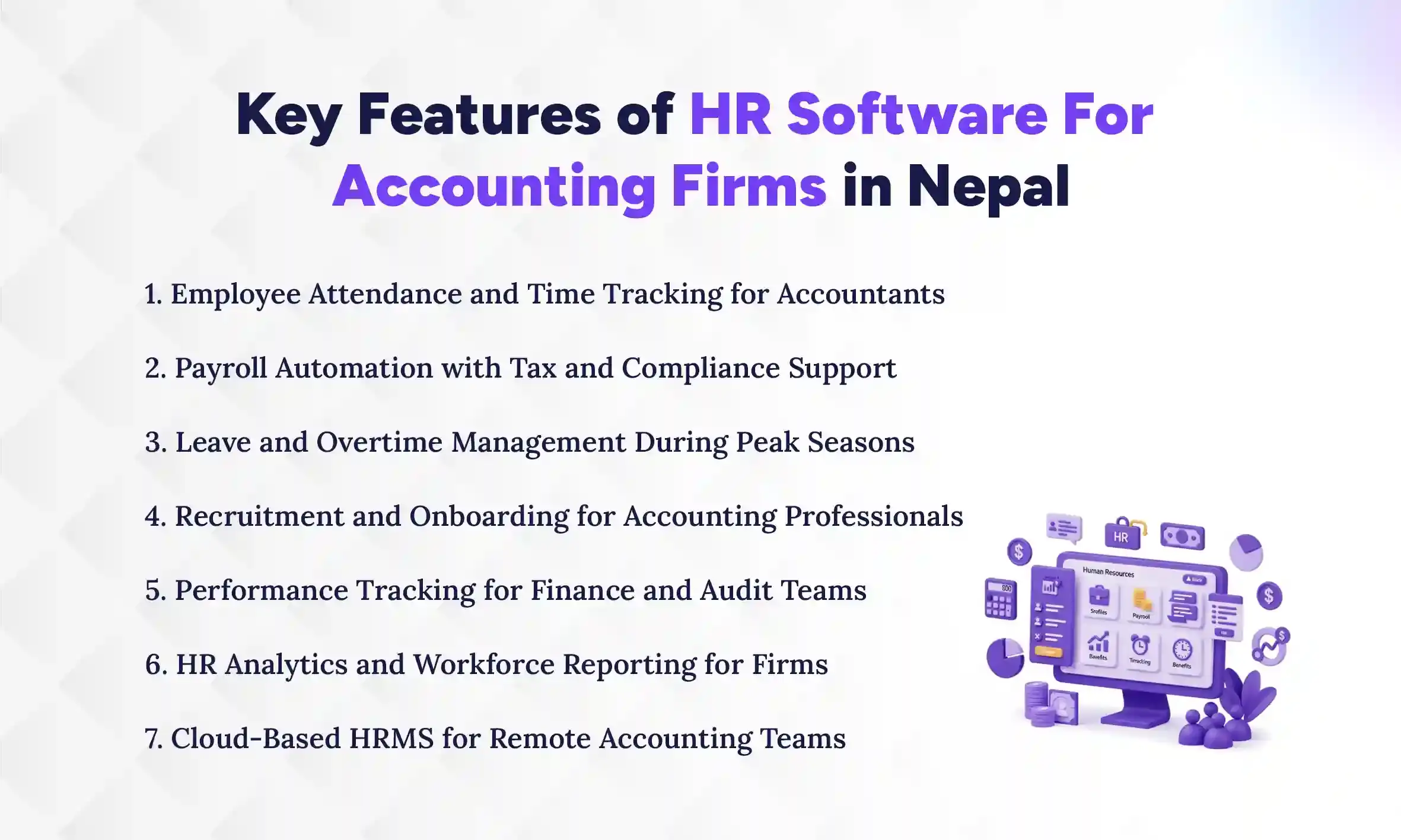
1. Employee Attendance and Time Tracking for Accountants
Employee attendance and time tracking features help accounting firms monitor working hours accurately, even during hectic audit seasons. It records check-ins, check-outs, overtime, and fieldwork attendance without manual logs. This is especially useful when employees work irregular hours or from multiple client locations. The system ensures transparency and fairness in work-hour calculations, reducing disputes. Plus, it gives managers a clear view of workforce availability in real time.
2. Payroll Automation with Tax and Compliance Support
Payroll automation is one of the most critical features, as accounting firms deal with complex salary structures, bonuses, and tax deductions. HR software calculates salaries, deductions, and benefits automatically, ensuring accuracy every time. It also aligns with Nepal’s tax laws and compliance requirements, reducing the risk of penalties. Payslip generation and reporting become effortless, saving hours of manual work. Honestly, it’s like having a payroll expert working silently in the background.
3. Leave and Overtime Management During Peak Seasons
Managing leave and overtime during busy periods can be tricky, especially when multiple employees request time off. HR software simplifies this by tracking leave balances, approvals, and overtime in one system. It ensures that staffing levels remain balanced during critical audit and tax deadlines. Employees can request leave easily, and managers can approve it without back-and-forth confusion. This keeps operations running smoothly even when workloads spike unexpectedly.
4. Recruitment and Onboarding for Accounting Professionals
Hiring skilled accountants and auditors requires a structured process, and HR software makes recruitment more efficient. It helps manage job postings, track applicants, and streamline the hiring pipeline. Once selected, onboarding becomes faster with digital documentation and training workflows. New employees can get up to speed quickly without overwhelming HR teams. It basically turns a slow, paperwork-heavy process into a smooth, organized experience.
5. Performance Tracking for Finance and Audit Teams
Performance tracking tools allow firms to evaluate employees based on productivity, accuracy, and project contributions. Managers can set KPIs, monitor progress, and provide feedback regularly. This helps identify top performers as well as areas that need improvement. In accounting firms where precision matters, having measurable performance insights is a big advantage. It also encourages employees to stay motivated and consistently improve.
6. HR Analytics and Workforce Reporting for Firms
HR analytics provides valuable insights into workforce trends, attendance patterns, and employee performance. Instead of guessing, firms can make data-driven decisions about hiring, workload distribution, and employee retention. Reports can be generated instantly, saving time and improving accuracy. This feature helps management plan better, especially during peak business cycles. Think of it as turning raw HR data into meaningful business intelligence.
7. Cloud-Based HRMS for Remote Accounting Teams
Cloud-based HRMS allows accounting firms to access HR data anytime, anywhere, perfect for teams working remotely or on client sites. Employees can log attendance, apply for leave, and access documents without being physically present in the office. It ensures flexibility without losing control over HR operations. Data is stored securely and updated in real time, reducing dependency on physical records. In today’s work environment, this flexibility is not just useful, it’s essential.
What Are the Benefits of HR Software For Accounting Firms?
The benefits of HR software for accounting firms are improved efficiency, accurate payroll processing, better compliance, and streamlined workforce management. It reduces manual HR workload, highlights the best hr software for small businesses, minimizes errors, and helps firms stay organized during high-pressure periods like audits and tax seasons. Automating routine processes, it allows teams to focus more on financial tasks rather than administrative work. Overall, it creates a smoother, faster, and more reliable HR system for accounting operations.
1. Reduces Manual HR Tasks in Accounting Firms
HR software eliminates repetitive tasks like attendance tracking, leave approvals, and record-keeping that are often done manually. This saves a significant amount of time for HR teams and reduces the chances of human errors. Instead of juggling spreadsheets and paperwork, everything is managed in one centralized system. It also speeds up processes that would otherwise take hours. Simply put, less manual work means more time for meaningful tasks.
2. Improves Payroll Accuracy and Financial Compliance
Payroll errors can be costly, both financially and in terms of employee trust. HR software automates salary calculations, tax deductions, and compliance requirements, ensuring everything is accurate and up to date. It aligns with Nepal’s tax and labor regulations, reducing the risk of penalties. Payslips and reports are generated instantly without calculation mistakes. This makes payroll smooth, reliable, and stress-free.
3. Streamlines Employee Data and Document Management
Managing employee records manually can quickly become disorganized, especially as firms grow. HR software stores all employee data, contracts, personal details, and performance records in one secure system. It allows easy access and updates whenever needed, without digging through files. This improves data accuracy and reduces the risk of losing important documents. Everything stays organized, searchable, and secure.
4. Enhances Workforce Planning During Audit Periods
Audit seasons bring heavy workloads, and planning resources effectively becomes critical. HR software helps managers allocate tasks, monitor employee availability, and manage workloads efficiently. It ensures that the right number of employees are assigned to critical tasks at the right time. This prevents overloading some team members while others remain underutilized. Better planning leads to smoother operations during peak periods.
5. Supports Data-Driven HR Decisions in Finance Teams
Instead of relying on guesswork, HR software provides real-time data and insights into employee performance, attendance, and productivity. Managers can use this data to make informed decisions about hiring, promotions, and workload distribution. It helps identify trends and areas that need improvement. With clear insights, firms can plan strategically rather than reactively. In short, it turns HR into a more analytical and decision-driven function.
How HR Software Improves Accounting Firm Operations?
HR software improves accounting firm operations by automating HR processes, improving workforce coordination, and ensuring accuracy in payroll and compliance. It also supports firms in understanding how to implement hr software, reduces administrative workload, and helps firms handle peak audit and tax periods more efficiently. Overall, it brings better control, visibility, and structure to daily operations.
1. Managing Audit Season Workload and Staff Allocation
Audit season can feel like controlled chaos, tight deadlines, heavy workloads, and everyone stretched thin. HR software helps managers allocate tasks based on employee availability, skills, and workload capacity. It ensures that no one is overloaded while others sit underutilized (yes, that happens). Real-time tracking makes it easier to adjust assignments when priorities shift. This leads to better team balance and smoother project execution during peak periods.
2. Monitoring Employee Performance in Accounting Tasks
HR software allows firms to track employee performance through measurable KPIs, task completion rates, and productivity metrics. Managers can monitor how efficiently accountants are handling audits, reports, and financial tasks. It provides insights into who’s performing well and who might need support or training. This creates accountability without micromanagement. Over time, it helps build a more productive and high-performing team.
3. Simplifying Payroll for Multi-Client Accounting Firms
Accounting firms often deal with employees working across multiple clients, projects, or billing structures. HR software simplifies payroll by automatically calculating salaries, overtime, and project-based incentives. It ensures that every detail is captured accurately without manual calculations. Payslips and reports are generated quickly, saving time and avoiding confusion. This makes payroll management smooth, even when things get complicated.
4. Reducing HR Errors in Financial and Compliance Tasks
Manual HR processes are prone to errors, especially when dealing with tax deductions, compliance rules, and employee records. HR software minimizes these risks by automating calculations and maintaining accurate records. It ensures compliance with Nepal’s labor and tax laws without constant manual checks. This reduces the chances of costly mistakes or penalties. In short, fewer errors mean fewer headaches for both HR and finance teams.
How to Choose the Best HR Software For Accounting Firms in Nepal?
To choose the best HR software for accounting firms in Nepal you must evaluate your firm’s needs, ensure compliance support, and select a solution that integrates well with your existing systems. It should simplify payroll, handle audit-season pressure, and scale as your firm grows. A smart choice here saves you from future headaches (and costly software switches later).
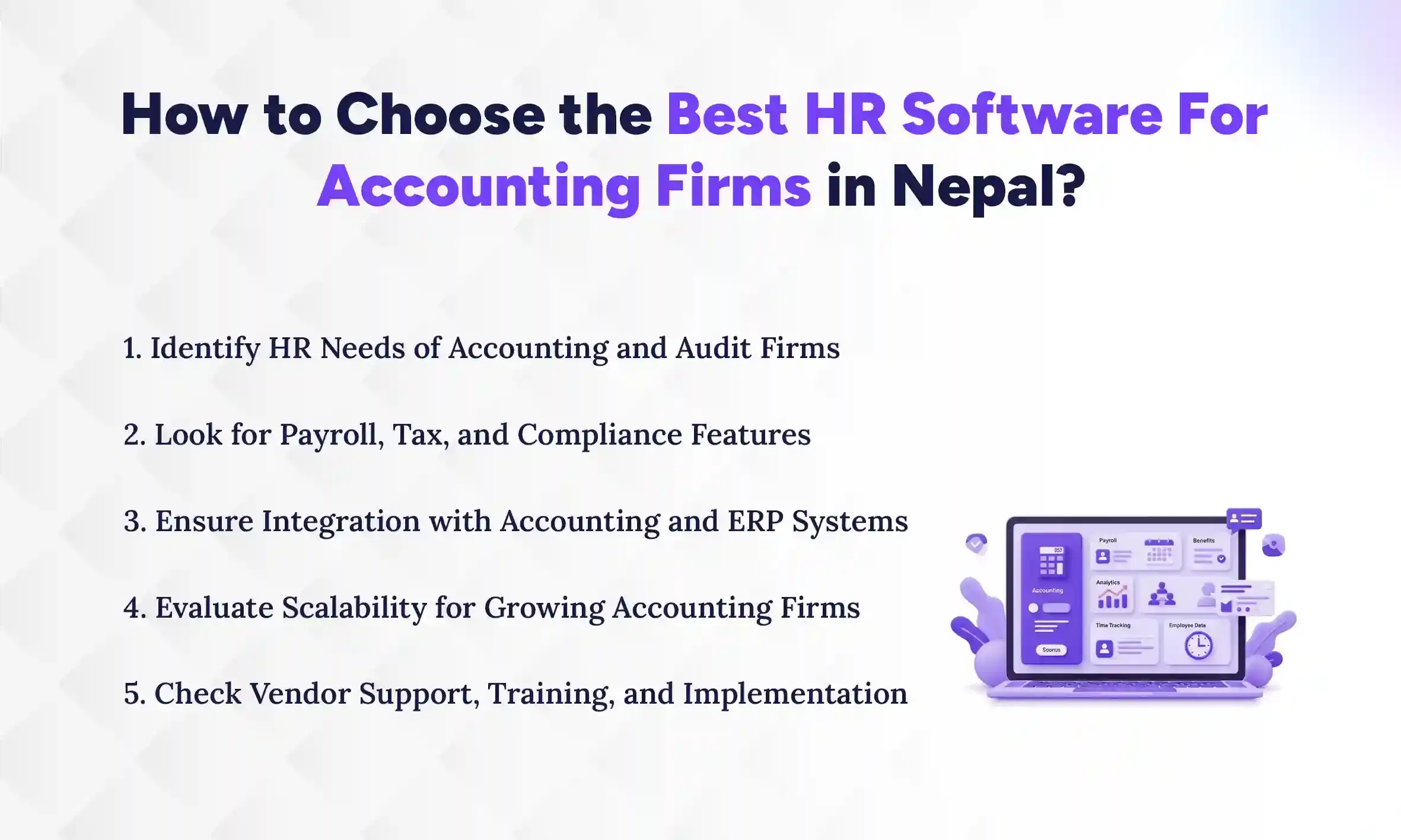
1. Identify HR Needs of Accounting and Audit Firms
Before choosing any HR software, you need to understand what your firm actually requires, because not every tool fits every firm. Identify whether your main challenge is payroll, attendance tracking, compliance, or workforce planning during audits. Smaller firms may need basic features, while larger ones may require advanced analytics and automation. Make a list of must-have and nice-to-have features to avoid overpaying for things you won’t use. This step basically sets the foundation for the entire decision.
2. Look for Payroll, Tax, and Compliance Features
For accounting firms, payroll and compliance are non-negotiable; this is where accuracy matters the most. Ensure the software can handle Nepal’s tax regulations, deductions, and statutory requirements automatically. It should generate payslips, tax reports, and compliance documents without manual effort. A system that constantly needs manual corrections defeats the purpose. So, if payroll isn’t strong, that software is probably not worth your time (or money).
3. Ensure Integration with Accounting and ERP Systems
Your HR software should work smoothly with your existing accounting or ERP systems, not against them. Integration helps sync employee data, payroll records, and financial reports without duplicate entries. This reduces errors and saves time spent on manual data transfer. It also gives you a more connected and efficient workflow across departments. Think of it like having all your tools speaking the same language instead of arguing in silos.
4. Evaluate Scalability for Growing Accounting Firms
Your firm might be small today, but growth is always the goal, right? Choose HR software that can scale as your team expands and operations become more complex. It should support additional users, advanced features, and larger data volumes without slowing down. Switching software later can be expensive and disruptive. So, it’s smarter to pick something that grows with you from the start.
5. Check Vendor Support, Training, and Implementation
Even the best software can feel complicated if proper support isn’t available. Look for vendors that offer strong customer support, onboarding assistance, and training sessions for your team. Good implementation ensures a smooth transition from your current system without disruptions. Also, check how responsive the support team is, because issues don’t wait for business hours. Reliable support can make or break your overall experience with the software.
Best HR Software For Accounting Firms in Nepal
Pace HRMS is the best HR software for accounting firms in Nepal because it offers a complete, all-in-one platform that handles payroll, attendance, compliance, and employee management seamlessly. It is specifically designed to simplify complex HR operations and reduce manual workload, which is crucial for accounting firms during audit and tax seasons. The software is cloud-based, scalable, and integrates smoothly with other systems, making it ideal for growing firms. Most importantly, it ensures accurate payroll processing and compliance with Nepal’s regulations, helping firms operate efficiently without costly errors.
Future of HR Technology in Nepal’s Accounting Industry
Future of HR technology in Nepal’s accounting industry is moving toward smarter, faster, and more automated systems that reduce manual effort and improve accuracy. As accounting firms deal with increasing workloads and tighter compliance requirements, HR tools are evolving to support better workforce management. From automation to real-time data insights, these technologies are helping firms stay competitive and efficient. In simple terms, HR is no longer just support, it’s becoming a strategic driver of growth.
1. AI and Automation in Accounting HR Processes
AI and automation are slowly taking over repetitive HR tasks like payroll processing, attendance tracking, and employee data management. This means fewer manual errors and faster operations, especially during high-pressure audit and tax periods. AI can also help in screening candidates, predicting workforce needs, and identifying performance trends. Instead of spending hours on routine tasks, HR teams can focus on more strategic roles. It’s like having an extra brain working quietly in the background, no coffee breaks needed.
2. Cloud-Based HRMS Adoption in Nepalese Firms
Cloud-based HRMS is becoming the go-to solution for accounting firms in Nepal due to its flexibility and accessibility. Teams can access HR data anytime, whether they’re in the office or working at client sites. It reduces dependency on physical records and ensures real-time updates across the system. This is especially useful for firms managing multiple clients and locations. Plus, cloud systems are easier to scale, making them ideal for growing accounting businesses.
3. Advanced Workforce Analytics for Accounting Firms
Advanced analytics is transforming how accounting firms make HR decisions by turning data into actionable insights. Firms can track employee performance, attendance patterns, and productivity trends in real time. This helps managers plan workloads, improve efficiency, and reduce employee burnout during peak seasons. Instead of relying on guesswork, decisions are backed by actual data. In short, it helps firms work smarter, not just harder.
Common Mistakes When Choosing HR Software in Nepal
Choosing HR software without proper evaluation can lead to more problems than solutions; yes, it happens more often than firms admit. Many accounting firms rush into decisions based on price or popularity, ignoring long-term needs. This results in poor performance, compliance risks, and wasted investment. A little planning upfront can save a lot of frustration later (and maybe a few regretted meetings too).
1. Ignoring Nepal-Specific Payroll and Tax Compliance
One of the biggest mistakes is choosing software that doesn’t fully support Nepal’s payroll and tax regulations. Accounting firms deal with sensitive financial data, and even small compliance errors can lead to penalties. Some international tools may look attractive but lack local compliance features. This forces firms to rely on manual adjustments, which defeats the purpose of automation. Always ensure the software is built or customized for Nepal’s legal requirements.
2. Choosing Software Without Accounting Integration
Selecting HR software that doesn’t integrate with accounting or ERP systems creates unnecessary complications. It leads to duplicate data entry, higher chances of errors, and wasted time switching between systems. For accounting firms, smooth data flow between HR and finance is critical. Without integration, processes become slower instead of faster. It’s like using two calculators that don’t agree with each other, frustrating and inefficient.
3. Overlooking User Experience and Staff Training Needs
Even powerful software can fail if it’s difficult to use or understand. Many firms ignore the user experience and end up with a system that employees struggle to adopt. Without proper training, teams may resist using the software or use it incorrectly. This reduces efficiency instead of improving it. A user-friendly interface and proper onboarding make a huge difference in successful implementation.
4. Not Considering Scalability for Firm Growth
Some firms choose software that works for their current size but fails as they grow. As the number of employees and operations increase, the system may become slow or limited in features. This leads to the need for switching software later, which can be costly and disruptive. It’s always better to invest in a solution that can scale with your business. Future-proofing your choice saves time, money, and a lot of headaches.
Conclusion
Choosing the right HR software for accounting firms in Nepal isn’t just a tech decision; it’s a business decision that directly impacts efficiency, accuracy, and growth. From managing audit-season pressure to ensuring payroll compliance, the right HRMS, like The Pace Infosys, can take a huge load off your team’s shoulders. It helps you move away from manual chaos to a more structured, reliable, and smarter way of managing people.
At the end of the day, the best HR software is the one that fits your firm’s needs today and grows with you tomorrow. Take your time, evaluate features carefully, and don’t just go for what looks good, go for what actually works. Because when your HR runs smoothly, everything else in your accounting firm starts falling into place (almost like perfectly balanced books). Also check out hr software for banks.