

The cost of an e-commerce website can vary depending on the business size, website features, design quality, and development method. A simple online store with basic functions costs much less than a custom e-commerce platform with advanced tools, integrations, and automation systems. Many businesses also spend differently on hosting, payment gateways, SEO, and website maintenance based on their long-term goals.
E-commerce website pricing varies because every online store has unique requirements. Factors such as custom design, mobile responsiveness, product management systems, and third-party integrations directly affect the total development cost. Before starting an online store, businesses should create a clear budget to avoid unexpected expenses and choose the right e-commerce solution for future growth.
What Is the Average E-Commerce Website Cost?
The average ecommerce website cost usually ranges from $500 to $50,000 or more, depending on the website size, features, design complexity, and development approach. Small businesses often choose affordable e-commerce solutions, while larger companies invest in custom e-commerce platforms with advanced functionality, automation, and scalable infrastructure.
Basic e-commerce website costs are lower because they use ready-made templates and standard features. Medium-sized ecommerce stores require better design, custom integrations, and improved user experience, which increases development costs. Enterprise ecommerce websites are the most expensive because they include custom development, advanced security, multi-vendor systems, API integrations, and high-performance hosting solutions.
1. Small Business E-commerce Website Cost
A small business e-commerce website usually costs between $500 and $5,000. These websites often use platforms like Shopify or WooCommerce with pre-designed themes, basic product pages, payment gateway integration, and limited customization.
Small e-commerce stores are suitable for startups, local shops, and businesses with fewer products. I have seen many small businesses reduce initial costs by using template-based designs and focusing only on essential e-commerce features during the first stage of development.
Monthly expenses for small e-commerce websites may include hosting, plugins, maintenance, and transaction fees. Businesses should also reserve part of their budget for SEO, product photography, and digital marketing to attract customers after launch.
2. Mid-Level Ecommerce Store Pricing
A mid-level ecommerce website typically costs between $5,000 and $25,000. These online stores usually include custom website design, advanced product filtering, inventory management, customer login systems, and better mobile optimization.
Medium-sized ecommerce businesses often need custom functionality to improve customer experience and increase conversions. I worked with a retail brand that upgraded from a basic WooCommerce store to a custom Shopify setup, and the improved navigation and checkout process increased online sales within a few months.
Development costs increase because mid-level ecommerce stores require stronger security, faster website speed, and integration with third-party tools such as CRM software, shipping systems, and marketing platforms. Businesses at this stage also invest more heavily in e-commerce SEO and performance optimization.
3. Enterprise E-commerce Website Cost
An enterprise ecommerce website can cost anywhere from $25,000 to over $100,000, depending on the project scope and technical requirements. Large ecommerce businesses often build custom platforms with advanced automation, AI-powered recommendations, multi-store management, and enterprise-level security systems.
Enterprise ecommerce development involves frontend development, backend architecture, API integrations, cloud hosting, and database optimization. These websites usually handle large product catalogs, high traffic volumes, and multiple payment systems across different regions.
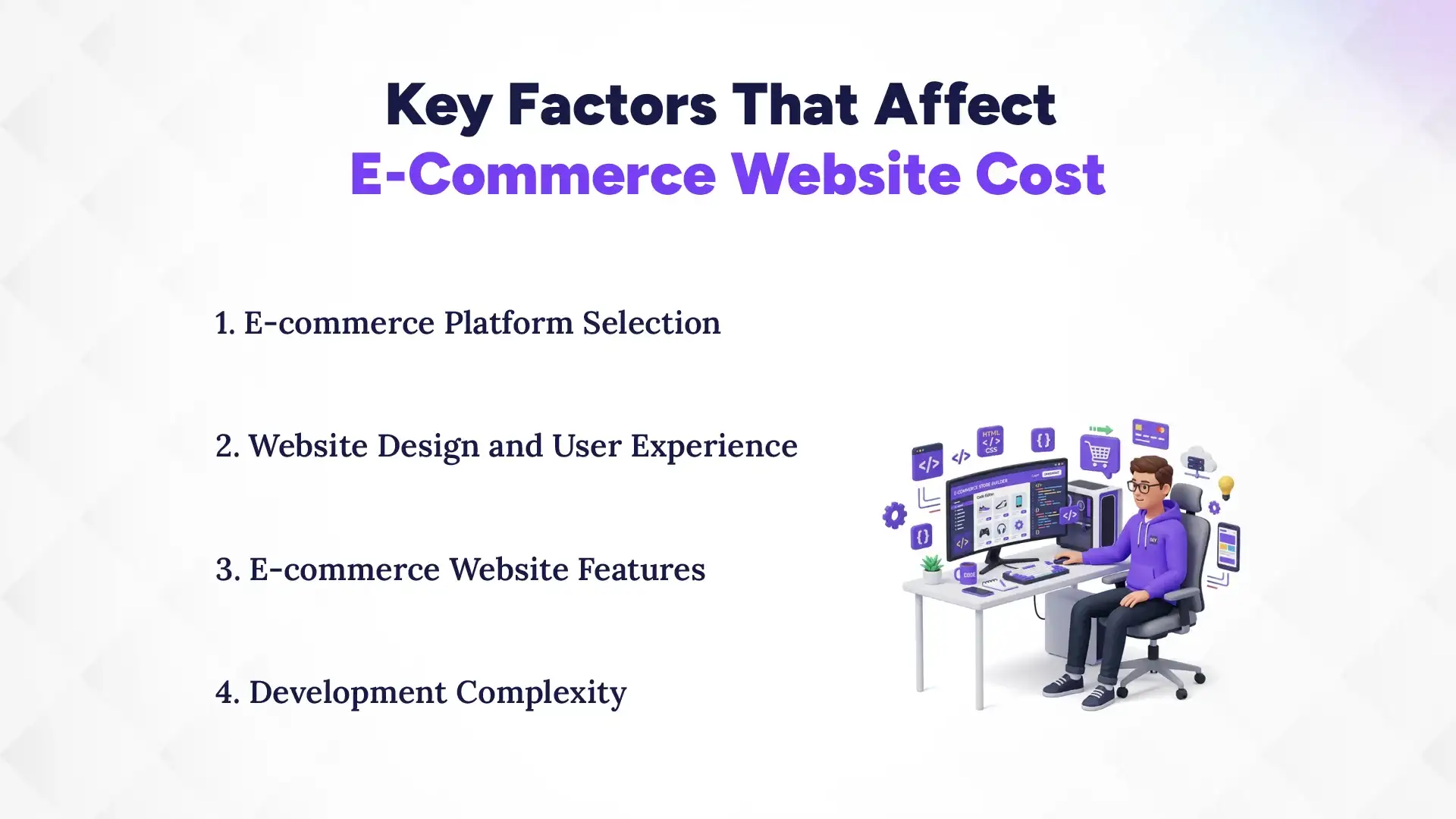
Key Factors That Affect E-Commerce Website Cost
Several factors affect an e-commerce website's cost, including the platform, website design, required features, and development complexity. Businesses that need custom functionality, advanced integrations, and scalable infrastructure usually spend more than businesses using simple template-based ecommerce solutions.
The total e-commerce development cost also depends on long-term business goals. I have worked with businesses that started with basic online stores and later upgraded to custom e-commerce platforms after increasing their product range and customer traffic.
1. E-commerce Platform Selection
The e-commerce platform directly affects website development cost because every platform offers different pricing, customization options, and scalability. Businesses should choose a platform based on product size, budget, technical requirements, and future growth plans.
Shopify is one of the most popular e-commerce platforms for small and medium businesses because it offers a simple setup, built-in hosting, and user-friendly management tools. Shopify websites usually cost less during the initial setup phase, but monthly subscription fees and paid apps can increase long-term expenses.WooCommerce is a flexible e-commerce solution built for WordPress websites. I often recommend WooCommerce for businesses that want more control over customization and SEO, but development costs can rise when businesses add premium plugins, custom themes, or advanced ecommerce features.
Magento is suitable for large e-commerce businesses that require enterprise-level customization and scalability. Magento development costs are usually higher because the platform needs experienced developers, stronger hosting infrastructure, and advanced security management.
BigCommerce offers built-in ecommerce tools, scalability, and multi-channel selling features. Many growing ecommerce businesses choose BigCommerce because it balances customization, performance, and easier store management compared to fully custom-built systems.
Custom-built ecommerce platforms are the most expensive option because developers create every feature specifically for the business. These websites require custom coding, backend development, API integration, and ongoing technical maintenance, which significantly increases the overall e-commerce website cost.
2. Website Design and User Experience
Website design and user experience strongly influence e-commerce website pricing because modern online stores must look professional, load quickly, and work smoothly on all devices. Businesses with custom UI/UX requirements usually spend more than those using standard templates.
Custom UI/UX design improves customer navigation, product visibility, and conversion rates. I recently reviewed an e-commerce redesign project where simplifying the checkout process reduced cart abandonment and improved sales performance within weeks.
Mobile responsiveness is another major cost factor because most e-commerce traffic now comes from smartphones and tablets. Developers must optimize layouts, product pages, and payment systems to ensure smooth mobile shopping experiences across different screen sizes.
Branding and visual elements also increase e-commerce design costs. Custom logos, banners, animations, product photography, and interactive visuals help businesses build a stronger brand identity and improve customer trust.
3. E-commerce Website Features
The number and complexity of e-commerce website features directly affect development costs. Basic e-commerce websites include simple shopping functionality, while advanced stores require automation systems, third-party integrations, and custom management tools.
Product management systems allow businesses to organize products, categories, pricing, and inventory. E-commerce stores with thousands of products often require advanced filtering systems, bulk upload tools, and automated inventory tracking.
Shopping cart functionality and secure payment gateway integration are essential features for every e-commerce website. Businesses usually integrate payment systems such as PayPal, Stripe, or local payment gateways, and each integration can increase development time and cost.
Inventory management tools help businesses track stock levels, orders, and shipping updates in real time. I worked with a growing online retailer that automated its inventory system, which reduced manual errors and improved order fulfillment speed.
Customer accounts and login systems improve personalization and customer retention. Many e-commerce businesses also invest in multi-vendor functionality, which allows multiple sellers to manage products and orders within a single e-commerce platform.
4. Development Complexity
Development complexity is one of the biggest factors affecting e-commerce website cost because advanced technical requirements need more time, expertise, and testing. Businesses that require custom functionality and enterprise-level performance usually face higher development expenses.
Template-based e-commerce websites are more affordable because developers use pre-built layouts and standard e-commerce functions. These websites work well for startups and small businesses that need a fast and budget-friendly online store.
Custom ecommerce development services increases costs because developers build unique features, designs, and workflows specifically for the business. I have seen businesses spend significantly more on custom systems when they need specialized customer portals, booking systems, or advanced product configurators.
API integrations also increase e-commerce development costs because websites must connect with third-party software such as CRM systems, ERP tools, shipping providers, and marketing platforms. Each integration requires testing, security checks, and ongoing maintenance.
Advanced automation systems can further increase the total cost of an e-commerce website. Businesses often automate inventory updates, customer communication, order processing, and analytics reporting to improve efficiency and reduce manual workload.
E-commerce Website Cost Breakdown
E-commerce website costs include both one-time development expenses and recurring monthly or yearly costs. The final budget depends on the platform, website complexity, hosting performance, custom features, SEO strategy, and long-term maintenance requirements. Based on current 2026 market pricing, most ecommerce businesses spend between $3,000 and $50,000+ for development and additional monthly costs for operation and marketing.
E-commerce Website Cost Breakdown:
| E-commerce Component | Estimated Cost Range |
|---|---|
| Domain Name | $10 – $50 per year |
| Web Hosting | $50 – $2,000+ per year |
| SSL Certificate | $0 – $300 per year |
| E-commerce Platform Fees | $29 – $2,300+ per month |
| Website Design | $500 – $15,000+ |
| Development | $1,000 – $100,000+ |
| Payment Gateway Setup | $0 – $1,500 |
| Maintenance and Support | $50 – $5,000+ per month |
| SEO and Marketing | $300 – $10,000+ per month |
A domain name is usually cheap with .com being best for trust, while hosting costs vary depending on your site traffic. SSL certificates are critical for securing transactions but are often provided for free by hosts. Platform fees can be subscription-based or free with separate plugin costs, whereas design and development will take up the largest chunk of your budget. Payment gateway fees depend entirely on your transaction volume, and ongoing maintenance is a frequently underestimated cost required to prevent downtime. Finally, continuous marketing and SEO investments are always necessary after launch to maintain steady traffic.
How Much Does Custom E-commerce Website Development Cost?
Custom ecommerce website development usually costs between $10,000 and $150,000 or more, depending on the website size, features, integrations, and technical complexity. Businesses that require unique design, advanced automation, enterprise-level security, and scalable infrastructure generally invest much more than businesses using ready-made ecommerce templates.
Custom ecommerce development gives businesses full control over design, functionality, and customer experience. I recently reviewed a custom e-commerce project for a large retail business where the company invested heavily in API integrations, inventory automation, and personalized shopping features to support long-term growth and high customer traffic.
1. Frontend Development Cost
Front-end ecommerce development typically costs between $3,000 and $30,000, depending on the design quality and user experience requirements. Frontend development focuses on everything customers see and interact with on the e-commerce website, including product pages, navigation menus, shopping carts, and mobile responsiveness.
Custom UI/UX design service increases frontend development costs because developers create unique layouts, animations, and interactive features specifically for the business. E-commerce websites with advanced filtering systems, dynamic product displays, and personalized user interfaces require additional coding and testing.
Mobile optimization is another major frontend expense because e-commerce websites must function smoothly across smartphones, tablets, and desktop devices. I worked with an e-commerce brand that improved mobile speed and simplified navigation, which significantly increased mobile conversion rates after launch.
Frontend developers also optimize website speed, accessibility, and SEO-friendly structure. Businesses investing in premium customer experience usually spend more on frontend performance improvements and visual branding.
2. Backend Development Cost
Backend ecommerce development usually costs between $5,000 and $50,000 or more, based on website functionality and system architecture. Backend development handles server operations, database communication, order processing, user authentication, and overall website performance.
Complex e-commerce websites require custom backend systems to manage inventory, customer data, shipping processes, and payment transactions efficiently. Enterprise e-commerce stores often need a scalable backend architecture to support high traffic volumes and thousands of daily orders.
Custom backend coding increases development costs because developers must create secure workflows, automation systems, and integration support. I recently analyzed a backend ecommerce upgrade where the company improved order processing speed by integrating automated inventory and logistics systems.
Backend performance also affects website security and loading speed. Businesses that require advanced analytics, AI-driven recommendations, or real-time product updates usually invest more in backend infrastructure.
3. Database and Security Setup
Database and e-commerce security setup generally costs between $2,000 and $20,000, depending on data size, compliance requirements, and security standards. E-commerce websites store sensitive customer information, payment details, and order history, so businesses must invest in strong database management and protection systems.
Database setup includes product storage, customer account management, order tracking, and website backup systems. Large e-commerce businesses often use cloud-based databases for better scalability and faster performance during traffic spikes.
Security setup includes SSL certificates, firewall protection, malware monitoring, encrypted payment systems, and compliance with PCI DSS standards. I have seen e-commerce businesses face serious financial losses after ignoring proper security updates and vulnerability testing.
Advanced e-commerce websites also implement multi-factor authentication, fraud detection systems, and automated backup solutions. Businesses handling large customer databases or international transactions usually spend more on enterprise-level security infrastructure.
4. Third-Party Integrations
Third-party ecommerce integrations usually cost between $1,000 and $25,000, depending on the number and complexity of connected systems. E-commerce businesses often integrate their websites with CRM software, ERP systems, shipping providers, accounting tools, and marketing platforms.
Payment gateway integration is one of the most common e-commerce integrations because businesses must process secure online transactions. Additional integrations such as live chat systems, email automation tools, and inventory software can further increase development costs.
API integrations require custom coding, testing, and long-term maintenance to ensure smooth communication between different platforms. I worked on an e-commerce project where integrating warehouse management software reduced manual order processing errors and improved delivery efficiency.
Complex integrations increase both development time and future maintenance expenses. Businesses planning to scale their e-commerce operations should choose flexible integration systems that support future upgrades and automation needs.
E-commerce Website Design Cost
E-commerce website design costs range from $500 to over $20,000, heavily influenced by customization, UI/UX complexity, and mobile optimization.
Template-based designs are highly affordable and faster to build, making them ideal for startups, though they limit branding flexibility. In contrast, custom designs offer complete control over navigation and user experience, which helps businesses stand out and support long-term growth despite the higher price tag.
Design directly impacts trust and sales, meaning optimizing product pages, checkout systems, and mobile layouts significantly improves conversions, customer engagement, and long-term retention.
Why E-commerce Website Maintenance Is Important
E-commerce website maintenance is important because it keeps the website secure, fast, updated, and working properly for customers. Regular maintenance helps prevent security issues, improve website speed, fix technical errors, and maintain a smooth online shopping experience.
Businesses usually spend between $50 and $5,000+ per month on ecommerce website maintenance, depending on the website size and complexity. Maintenance services often include security updates, speed optimization, bug fixes, technical support, product updates, and performance monitoring.
Hidden Costs of E-commerce Websites
Post-launch hidden costs can significantly increase your total e-commerce budget due to several ongoing expenses. Payment gateways and platforms like Shopify, PayPal, and Stripe charge transaction and processing fees on every sale, while advanced features often require ongoing paid plugins for inventory, security, and SEO. To drive traffic and manage fulfillment, businesses must continuously invest in marketing (such as Google Ads and social campaigns) and scalable shipping logistics like real-time tracking and warehouse systems. Finally, maintaining growth requires an ongoing budget for professional content creation (photography and descriptions) alongside continuous SEO and digital marketing optimization.
E-commerce Website Cost by Business Type
E-commerce website costs vary based on business size, required features, customer volume, and development complexity. Small startups usually choose affordable e-commerce solutions, while larger businesses invest in custom e-commerce platforms with advanced integrations and scalable infrastructure.
1. Startup E-commerce Website
A startup ecommerce website usually costs between $500 and $5,000. Most startups use platforms like Shopify or WooCommerce with basic design, standard features, and limited customization to launch quickly on a smaller budget.
2. Small Business Online Store
A small business ecommerce website typically costs between $5,000 and $15,000. These online stores often include custom design, mobile optimization, payment gateway integration, SEO setup, and improved user experience features.
3. B2B E-commerce Website
A B2B ecommerce website generally costs between $10,000 and $50,000 or more. B2B platforms usually require custom pricing systems, bulk ordering, customer portals, ERP integration, and advanced inventory management tools.
4. Enterprise E-commerce Platform
An enterprise ecommerce platform can cost between $50,000 and $500,000+, depending on the project scope and technical requirements. Large businesses often invest in custom development, AI-powered automation, advanced security, multi-store management, and scalable cloud infrastructure.
How to Reduce E-Commerce Website Development Costs?
To reduce e-commerce website development costs from $10,000+ down to $500–$5,000, choose affordable platforms like Shopify or WooCommerce, use pre-made templates to avoid custom design fees, focus strictly on essential features for the initial launch, utilize scalable hosting, avoid unnecessary customizations, and outsource specific tasks instead of hiring a full in-house team.
What Features Should an E-commerce Website Include?
An e-commerce website should include secure payment gateways, product search and filtering, mobile-friendly design, SEO optimization, customer reviews, and analytics tools to improve user experience and increase online sales. These features help customers shop easily, build trust, and support long-term business growth.
Secure payment gateways protect customer transactions and improve checkout safety. Product filtering and advanced search features help customers quickly find products, while a mobile-friendly design ensures the website works smoothly across smartphones and tablets.
SEO optimization helps e-commerce websites rank higher in search engines and attract organic traffic. Customer reviews and ratings improve trust and conversion rates, while analytics and reporting tools help businesses track sales, customer behavior, and website performance. E-commerce
Website SEO and Marketing Costs
E-commerce SEO and marketing costs usually range from $300 to $10,000+ per month, depending on business size, competition level, and growth goals. These ongoing expenses are essential for driving traffic, increasing visibility, and generating consistent online sales.
E-commerce SEO pricing typically starts from $300–$2,000 per month for small businesses and can go up to $5,000–$10,000+ for competitive industries. Content marketing, PPC ads, social media campaigns, and email marketing tools all add to the total marketing budget.
Content marketing expenses usually range from $100–$3,000+ per month, depending on blog writing, product descriptions, and video content. High-quality content helps improve search rankings and builds trust with potential customers. PPC advertising budgets vary widely, starting from $200 per month for small campaigns and going beyond $10,000+ for large ecommerce stores. Google Ads and social media ads are commonly used to drive instant traffic and sales.
Social media marketing costs typically range from $100–$5,000+ per month,depending on ad spend, influencer collaborations, and content creation. Platforms like Facebook, Instagram, and TikTok are widely used for e-commerce promotion. Email marketing tools usually cost between $10–$500+ per month, depending on subscriber size and automation features. These tools help businesses retain customers, promote offers, and increase repeat sales.
Best E-commerce Platforms for Different Budgets
The best e-commerce platform depends on budget, business size, and required features. E-commerce platform costs can range from $0 to $2,000+ per month,depending on whether you choose a free open-source system or a fully hosted enterprise solution.
Budget-friendly platforms like WooCommerce and basic Shopify plans are ideal for startups because they keep initial costs low while still offering essential ecommerce features. Small businesses often choose Shopify, Wix, or Squarespace for easy setup and predictable monthly pricing.
Scalable e-commerce platforms such as Shopify Advanced, BigCommerce, and Magento are suitable for growing businesses that need better performance, automation, and integration options. These platforms support larger product catalogs and higher traffic volumes.
Enterprise ecommerce solutions like Magento Commerce and custom-built platforms are designed for large businesses with complex requirements. These solutions can cost $25,000–$200,000+ annually when including development, hosting, and maintenance.
Common Mistakes to Avoid When Budgeting for E-commerce Websites
Many businesses underestimate e-commerce website costs by focusing only on development and ignoring long-term expenses. These budgeting mistakes can lead to performance issues, poor user experience, and higher unexpected costs later.
Ignoring maintenance costs is a common mistake because e-commerce websites require regular updates, security monitoring, and performance optimization. Maintenance usually costs $50–$5,000+ per month, depending on website size.
Choosing the cheapest hosting can negatively affect website speed and security. Low-quality hosting may save money initially, but it often leads to downtime, slow loading speed, and lost sales. Overlooking SEO optimization during development reduces long-term traffic potential. Businesses that skip SEO setup often spend more later on paid ads to bring customers.
Adding too many unnecessary features increases both development and maintenance costs. Extra plugins and custom functions can slow down the website and create technical issues. Not planning for future scalability is another major mistake. Businesses should invest in a flexible e-commerce architecture so the website can grow with increasing traffic, products, and customer demand.
Future Trends Affecting E-Commerce Website Costs
Future e-commerce website costs are increasing due to advanced technologies like AI, headless architecture, and personalized shopping systems. These trends improve user experience and sales performance but also require higher development budgets and ongoing technical maintenance.
AI-powered ecommerce features are becoming common for product recommendations, chatbots, and customer behavior analysis. Implementing AI tools can increase development costs by $2,000–$20,000+, depending on complexity and integration level. Headless commerce development separates the frontend and backend, allowing faster performance and better scalability. However, it increases development costs because it requires advanced engineering and API-based architecture. Voice commerce integration allows customers to shop using voice assistants, but it requires additional development for natural language processing and system integration. This feature is mostly used by large e-commerce brands.
Progressive Web Apps (PWAs) improve mobile shopping experiences by making e-commerce websites faster and app-like. Building a PWA can add $5,000–$50,000+ to total development costs,depending on features and customization. Advanced personalization tools increase e-commerce costs by enabling dynamic product recommendations, personalized offers, and behavior-based marketing. These systems require data analytics, machine learning models, and continuous optimization to perform effectively.
Conclusion
E-commerce website cost depends on multiple factors such as platform selection, design quality, features, development complexity, and ongoing maintenance. Overall pricing can range from a few hundred dollars for basic stores to $100,000+ for large custom ecommerce platforms.
Choosing the right development approach is important because it directly affects performance, scalability, and long-term business growth. A well-planned e-commerce website helps reduce future expenses and improves user experience.
Investing in a high-quality e-commerce website delivers long-term value through better conversions, stronger branding, and sustainable online sales growth.