
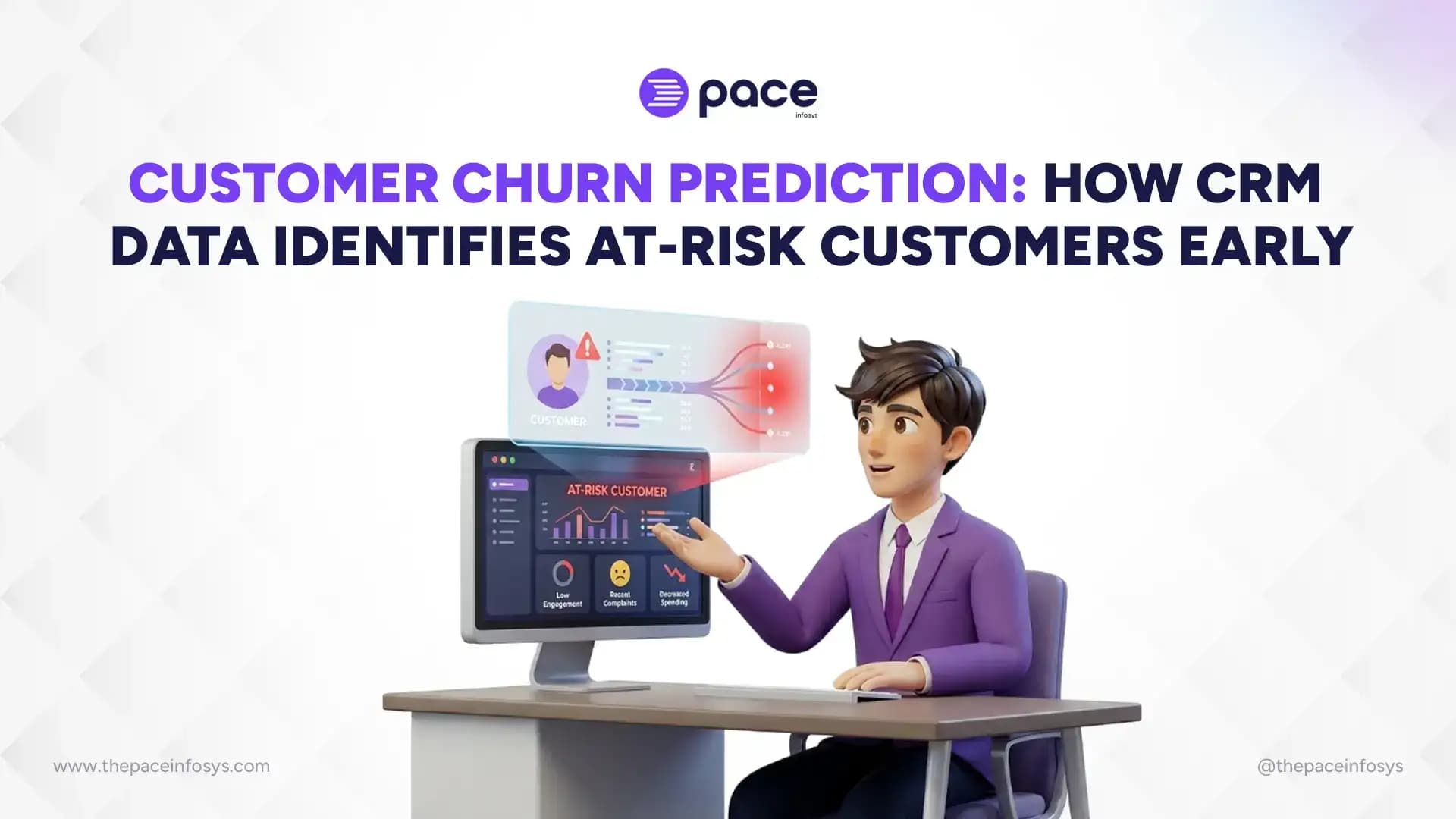

CRM data identifies at-risk customers early by tracking engagement drops, purchase pattern changes, and rising support complaints before a customer actually cancels. Most churn doesn't happen suddenly; it builds up through signals that are usually already sitting inside the CRM, just not being acted on.
This guide covers what customer churn prediction actually is, why catching it early matters, how CRM data identifies at-risk customers, the behavioral signals worth watching, what happens when those signals get missed, the features worth prioritizing in a CRM, and how Nepali businesses can put this to use, closing with which CRM handles churn prediction best.
What Is Customer Churn Prediction?
Customer churn prediction is the process of using customer data to identify which customers are likely to stop doing business with you before they actually leave. It shifts retention from a reactive response to something a business can act on ahead of time.
"Churn" refers to customers who stop purchasing, renewing, or engaging with a business altogether, whether through an active cancellation or simple disengagement over time. Understanding the full definition of customer churn matters because silent disengagement is just as costly as an explicit cancellation.
Reporting tells a business how many customers already churned last quarter, while prediction flags which current customers are likely to churn next. Recognizing the difference between prediction and reporting is what separates reactive retention efforts from proactive ones.
Churn prediction typically draws on purchase history, support interactions, login or usage frequency, and communication response rates, all of which usually already exist inside the CRM. Pulling from the right data sources used in prediction is what makes the resulting risk signals accurate rather than guesswork.
A warning sign caught weeks before cancellation gives a business time to intervene, while the same signal caught too late is just an explanation for what already happened. Understanding the role of timing in churn prediction is why early detection matters more than detection alone.
Why Does Early Churn Detection Matter for Businesses?
Early churn detection matters for businesses because retaining an existing customer is significantly cheaper than acquiring a new one, and early warning gives teams time to intervene before the relationship is lost. Once a customer has mentally checked out, winning them back becomes far harder than keeping them engaged in the first place.
1. Cost of Acquiring New Customers vs. Retaining Existing Ones
Acquiring a new customer typically costs far more in marketing and sales effort than retaining one who's already on board. Weighing the cost of acquiring new customers against retaining existing ones makes clear why churn prevention deserves as much attention as new customer growth. This is one of the core benefits of a CRM system for businesses looking to protect their ROI.
2. Compounding Effect of Preventable Churn
A single missed churn signal doesn't just cost one customer; it often signals a broader pattern affecting similar customers who haven't shown warning signs yet. Addressing the compounding effect of preventable churn early prevents a small leak from turning into a larger one.
3. Impact on Long-Term Revenue Stability
Customers who stay longer tend to spend more over time, so churn doesn't just reduce current revenue; it undermines future revenue predictability. Protecting long-term revenue stability is one of the clearest business cases for investing in churn prediction.
How Does CRM Data Identify At-Risk Customers?
CRM data identifies at-risk customers by tracking engagement and interaction frequency, analyzing purchase and renewal patterns, monitoring support ticket trends, and scoring each customer by risk level. Combining these signals gives a more reliable picture than relying on any single metric alone, especially when leveraging the right types of CRM designed for deep analytics.
1. Tracking Engagement and Interaction Frequency
A steady drop in emails opened, calls returned, or logins recorded is often one of the earliest signs that a customer is pulling away. Tracking engagement and interaction frequency over time surfaces this kind of gradual disengagement before it becomes obvious elsewhere.
2. Analyzing Purchase and Renewal Patterns
Customers who start ordering less frequently, downgrading, or delaying renewal decisions are showing behavior that historically precedes churn. Analyzing purchase and renewal patterns inside the CRM turns this behavior into an early warning rather than something noticed only after the fact.
3. Monitoring Support Ticket Trends
A rise in complaints, unresolved issues, or repeated tickets about the same problem often signals frustration building toward a decision to leave. Monitoring support ticket trends alongside sales data connects service issues directly to retention risk.
4. Scoring Customers by Risk Level
CRM systems can combine these signals into a single risk score, ranking customers from low to high risk so teams know where to focus first. Using a clear system for scoring customers by risk level turns scattered signals into a prioritized action list.
What Behavioral Signals Indicate a Customer Is At Risk?
Behavioral signals that indicate a customer is at risk include declining product or service usage, reduced response to outreach, and an increase in support complaints. None of these signals alone confirms churn, but together they build a reliable pattern.
1. Declining Product or Service Usage
A customer who used to log in daily and now barely opens the platform is showing one of the clearest behavioral warning signs available. Watching for declining product or service usage is often the single most reliable early indicator across industries.
2. Reduced Response to Outreach
When a customer stops replying to check-ins, renewal reminders, or account manager emails, it often reflects a broader loss of interest in the relationship. Noting reduced response to outreach as a risk signal helps teams prioritize follow-up before the silence becomes permanent. This is particularly important for lead management in CRM processes.
3. Increased Support Complaints
A sudden uptick in complaints or negative feedback, especially about issues that were previously minor, can indicate frustration reaching a tipping point. Treating increased support complaints as a churn signal, not just a service issue, connects retention and support teams around the same data.
What Happens When Businesses Miss Early Churn Signals?
When businesses miss early churn signals, they lose revenue that could have been preventable, end up managing retention reactively instead of proactively, and waste the acquisition spend that brought the customer in the first place. These costs tend to show up quietly, spread across many small losses rather than one obvious event.
1. Lost Revenue From Preventable Churn
Every customer who leaves without a retention attempt represents revenue that a timely intervention might have saved. Reducing lost revenue from preventable churn is often the most direct financial argument for adopting churn prediction.
2. Reactive Instead of Proactive Retention
Without early signals, retention teams only step in once a customer has already decided to leave, by which point most offers or interventions come too late. Shifting from reactive retention efforts to proactive ones depends entirely on catching signals before the decision is final.
3. Wasted Acquisition Spend
The marketing and sales investment that brought a customer in delivers no long-term return if that customer churns shortly after, regardless of the original acquisition cost. Protecting acquisition spend from being wasted is a direct consequence of catching churn risk earlier.
4. Damaged Customer Lifetime Value
A customer who churns early cuts short the full revenue potential a business expected from that relationship, distorting projections built around expected lifetime value. Preserving customer lifetime value depends on identifying and addressing risk before the relationship ends prematurely.
What Features Should You Look for in CRM Churn Prediction Tools?
The features to look for in CRM churn prediction tools include automated risk scoring, real-time alerts for sales and support teams, and integration with customer interaction data across every touchpoint. These CRM features together determine how early and how accurately risk actually gets flagged.
1. Automated Risk Scoring
Manual review of every customer account doesn't scale, so automated scoring that continuously updates based on new activity is essential for catching risk at any meaningful volume. Relying on automated risk scoring frees teams to focus on outreach instead of manual analysis.
2. Real-Time Alerts for Sales and Support Teams
A risk score is only useful if the right person sees it in time to act, which is why real-time alerts matter as much as the scoring itself. Setting up real-time alerts for sales and support teams closes the gap between detection and action.
3. Integration With Customer Interaction Data
Churn prediction is only as accurate as the data feeding it, so a CRM that pulls in support tickets, usage data, and communication history all in one place produces a more complete risk picture. Prioritizing integration with customer interaction data avoids blind spots that come from tracking signals in separate, disconnected systems, which is a common issue when learning how to choose the right CRM.
How Can Nepali Businesses Use CRM Data to Reduce Churn?
Nepali businesses can use CRM data to reduce churn by tracking localized engagement patterns, applying retention strategies suited to the local market, and acting quickly on CRM alerts before a customer disengages fully. Local buying behavior and communication preferences often shape what an early warning sign actually looks like.
1. Localized Customer Engagement Patterns
Response times, preferred communication channels, and typical purchase cycles can look different across Nepal's market compared to global benchmarks baked into generic CRM defaults. Tracking localized customer engagement patterns helps churn prediction reflect how customers in Nepal actually behave. Depending on the cost of CRM software in Nepal, businesses can scale these localized tracking efforts efficiently.
2. Retention Strategies Suited to the Nepali Market
Retention tactics that work elsewhere, like automated discount emails, may land differently with customers who value personal relationships and direct outreach more than automated messaging. Building retention strategies suited to the Nepali market keeps interventions relevant instead of generic.
3. Using CRM Alerts for Timely Outreach
Once a customer is flagged as at-risk, a quick, personal follow-up often matters more than the specific offer attached to it. Using CRM alerts for timely outreach turns a data signal into an actual relationship-saving conversation.
4. Building Loyalty Through Data-Driven Follow-Up
Consistent, well-timed follow-up based on CRM data signals builds the kind of trust that keeps customers engaged well beyond the first warning sign. Building loyalty through data-driven follow-up turns churn prediction into an ongoing retention habit, not a one-time fix.
Which CRM Offers the Best Churn Prediction Capabilities in Nepal?
Pace CRM offers the best churn prediction capabilities in Nepal, with automated risk scoring, real-time alerts, and reporting built to surface at-risk customers before they're gone. It's designed to reflect how Nepali businesses actually engage with and retain their customers.
For businesses in Nepal looking to move retention from guesswork to something data-driven, Pace CRM combines automated risk scoring with real-time alerts that reach the right team member as soon as a customer shows warning signs. It pulls together engagement, purchase, and support data into a single risk view instead of scattered reports. As one of the top 5 CRM software options in Nepal, it's designed to reflect how Nepali businesses actually engage with and retain their customers.
What sets Pace CRM apart is that its scoring and alerting were built around practical, actionable use, not just dashboards that look good but sit unused. Between early detection, real-time alerts, and reporting built for local retention patterns, it gives businesses a genuine head start on customers who might otherwise leave quietly.
Conclusion
Churn rarely happens suddenly; it builds up through signals most businesses already have sitting in their CRM but aren't acting on. Catching those signals early, through engagement drops, changing purchase patterns, and rising support complaints, is what actually protects revenue instead of just explaining a loss after it's already happened.
If your business wants to move from reacting to churn to predicting it, explore Pace CRM's churn prediction features with a demo or contact Pace Infosys to see how it fits your customer base.