

.webp&w=3840&q=75)
CRM eliminates commission disputes by logging every action tied to a deal with a timestamp and owner, so credit is based on recorded activity instead of memory or opinion. When two reps disagree about who actually closed a deal, the argument usually comes down to who remembers events differently, not who actually did the work.
This guide covers what sales commission tracking involves, why disputes happen in the first place, how CRM assigns credit for closed deals, what data settles disagreements, what happens when tracking is left manual, the features worth prioritizing, and how Nepali sales teams can put this into practice closing with which CRM handles commission tracking best.
What Is Sales Commission Tracking?
Sales commission tracking is the process of recording who is responsible for each closed deal and calculating the payout owed to them based on the business's commission structure.
At its core, it means matching each closed deal to the rep, or reps, who earned credit for it, then applying the agreed commission rate to determine payout. When this is done manually, it depends on someone accurately remembering or documenting who did what on a given deal. When it's built into a CRM, every action tied to a deal is already logged automatically, so credit and payout follow directly from the recorded activity rather than after-the-fact recollection. Understanding how CRM works to capture this data is what makes automated commission tracking possible.
Why Do Commission Disputes Happen on Sales Teams?
Commission disputes happen on sales teams because roles often overlap on the same deal, attribution rules aren't clearly defined, and ownership ends up relying on memory or informal records instead of a documented trail. These conditions make disagreement almost inevitable once deal volume grows.
1. Overlapping Roles on the Same Deal
Deals often pass through multiple reps, from initial outreach to final close, and without clear rules, more than one person can reasonably believe they earned the credit. This is especially common in longer sales cycles where handoffs happen naturally as a deal progresses, often starting during the initial lead management in the CRM phase.
2. Lack of Clear Attribution Rules
When a business hasn't defined exactly how credit is assigned for shared or handed-off deals, reps are left to interpret fairness on their own. That ambiguity tends to surface only after a high-value deal closes, when the stakes for getting it wrong are highest.
3. Reliance on Memory or Informal Records
Without a documented trail, resolving a dispute often comes down to whoever argues their case more convincingly, not whoever actually contributed more. This puts managers in the uncomfortable position of settling disputes based on incomplete information.
How Does CRM Assign Credit for Closed Deals?
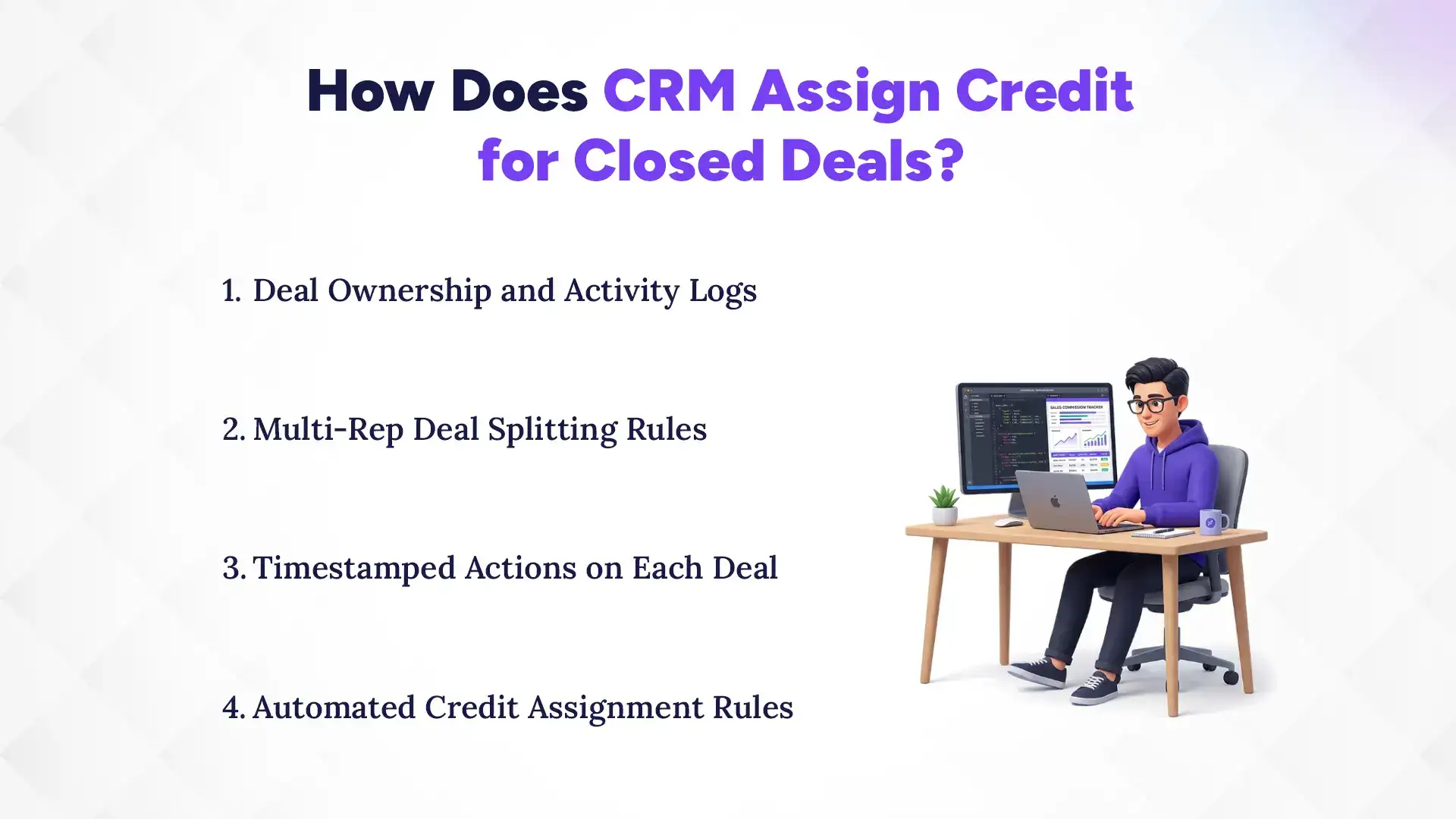
CRM assigns credit for closed deals by tracking deal ownership and activity logs, applying multi-rep splitting rules where needed, and timestamping every action taken on a deal from first contact to close. Every step is recorded automatically as it happens, not reconstructed afterward. This is especially effective when using the right types of CRM systems built for deep sales analytics.
1. Deal Ownership and Activity Logs
Every deal has a recorded owner from the moment it's created, along with a running log of every action taken on it by every rep involved. This creates a factual record that both reps and managers can refer back to instead of relying on recollection.
2. Multi-Rep Deal Splitting Rules
When more than one rep contributes meaningfully to a deal, CRM can apply predefined split rules to divide commission fairly based on documented contribution. This removes the need for reps to negotiate a split informally after the fact.
3. Timestamped Actions on Each Deal
Every call, email, meeting, and status change is logged with a timestamp, creating a clear sequence of who did what and when throughout the deal's lifecycle. That sequence becomes the objective reference point whenever a disagreement arises.
4. Automated Credit Assignment Rules
Businesses can configure rules that automatically assign credit based on specific triggers, like who moved the deal to "closed-won," removing subjective judgment from the process. This keeps attribution consistent across every deal instead of varying case by case.
What Data Does CRM Use to Settle Commission Disputes?
CRM settles commission disputes using activity timestamps and ownership history, deal stage progression records, and communication logs that show exactly who did what and when. This turns a dispute into something that can be checked rather than debated.
1. Activity Timestamps and Ownership History
A complete history of who owned the deal at each stage, and when ownership changed, provides a factual timeline that settles most disputes on its own. This history also protects reps from having their contributions overlooked when a deal changes hands.
2. Deal Stage Progression Records
Records showing exactly when a deal moved from one stage to the next reveal whose actions actually advanced it toward close. This is often more telling than who technically had the deal assigned to them at the final stage.
3. Communication and Interaction Logs
Logged emails, calls, and meeting notes show the substance of what each rep contributed, not just that they were involved. This level of detail helps distinguish meaningful contribution from incidental involvement in a deal.
What Happens When Commission Tracking Is Left to Manual Records?
When commission tracking is left to manual records, disputes over deal ownership become common, payments get delayed or miscalculated, trust within the sales team erodes, and time is lost resolving conflicts that data could have settled instantly. These issues compound as a team grows and deal volume increases, highlighting one of the core benefits of a CRM system.
1. Disputes Over Deal Ownership
Without a documented trail, ownership disputes become a matter of opinion, and resolving them fairly gets harder as more people are involved. Managers end up spending time playing referee instead of focusing on actual sales performance.
2. Payment Delays and Errors
Manually calculating and verifying commission payouts introduces delays and mistakes that are easy to make and hard to catch. Reps who are underpaid due to an error often don't notice until well after the payout has already gone out.
3. Damaged Trust Within the Sales Team
Reps who feel they were denied credit they deserved start to lose trust not just in the process, but in their teammates and managers as well. That erosion of trust tends to outlast the specific dispute that caused it.
4. Time Lost Resolving Conflicts
Every hour spent litigating who gets credit for a deal is an hour not spent selling, and disputes have a way of dragging on far longer than they should. This time cost is often invisible until it's added up across a full sales team.
What Features Should You Look for in CRM Commission Tracking?
The features to look for in CRM commission tracking include automated commission calculation, customizable split rules, and transparent reporting that reps can view themselves. These features remove both the manual effort and the ambiguity that cause most disputes.
1. Automated Commission Calculation
Look for a CRM that calculates payout automatically based on closed deals and configured commission rates, without requiring manual math. This eliminates a common source of both delay and error in the payout process.
2. Customizable Split Rules
Split rules should be adjustable to match how your team actually sells, whether that means role-based splits, percentage splits, or milestone-based credit. A rigid, one-size-fits-all split model rarely reflects how deals actually get closed in practice, which is why knowing how to choose the right CRM matters so much for growing teams.
3. Transparent Reporting for Reps
Reps should be able to see their own commission calculations and the activity behind them at any time, not just receive a final number at payout. This transparency removes much of the incentive to dispute a payout in the first place.
How Can Nepali Sales Teams Reduce Commission Disputes With CRM?
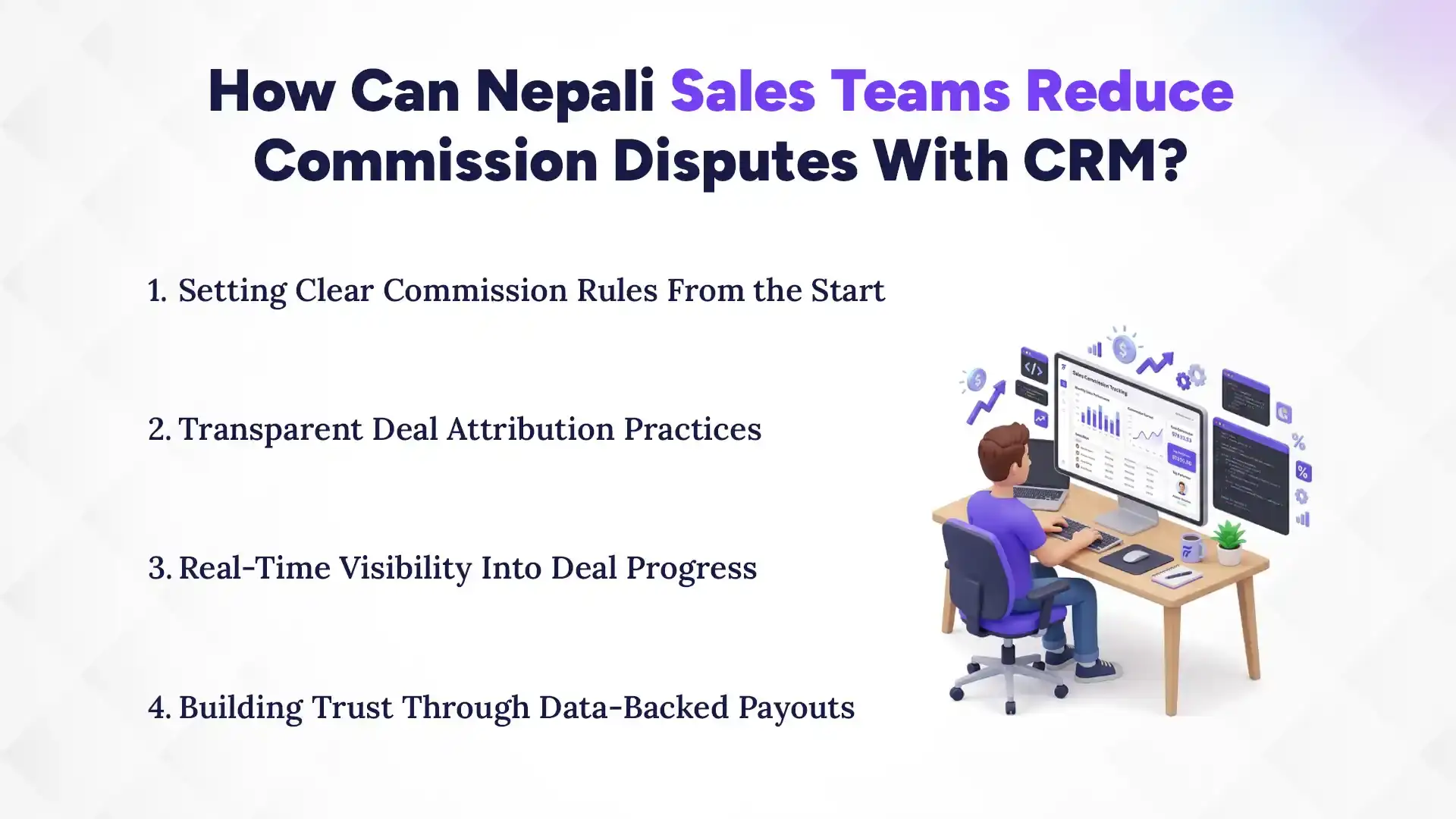
Nepali sales teams can reduce commission disputes with CRM by setting clear commission rules from the start, adopting transparent deal attribution practices, and giving reps real-time visibility into deal progress instead of relying on end-of-month reconciliation. Addressing this early prevents disputes from becoming a recurring pattern as teams grow.
1. Setting Clear Commission Rules From the Start
Defining commission and split rules before disputes arise, rather than after a contested deal closes, sets expectations everyone can refer back to. This is especially important for growing teams in Nepal, where informal, verbal agreements are still common.
2. Transparent Deal Attribution Practices
Making attribution rules visible to the whole team, not just management, keeps the process consistent and reduces the sense that decisions are made behind closed doors. Transparency here does more to prevent disputes than any amount of after-the-fact explanation.
3. Real-Time Visibility Into Deal Progress
When reps can see deal progress and ownership changes as they happen, disagreements get caught and resolved early instead of surfacing only at payout time. This also helps reps course-correct if they feel a deal is slipping away from their ownership unfairly.
4. Building Trust Through Data-Backed Payouts
Payouts that are clearly tied to documented activity build long-term trust in the commission process, which matters as much for retention as the payout amount itself. Over time, this consistency becomes a quiet but significant factor in keeping good reps on the team, regardless of the cost of CRM software in Nepal your business invests in.
Which CRM Offers the Best Commission Tracking Capabilities in Nepal?
Pace CRM offers the best commission tracking capabilities in Nepal, with automated deal attribution, customizable split rules, and transparent reporting that removes the guesswork from every payout. It's designed to reflect how Nepali sales teams actually close deals and manage attribution.
Commission disputes often arise when deal ownership depends on memory or disconnected spreadsheets. Pace CRM eliminates that uncertainty by automatically tracking deal activities, applying predefined commission rules, and maintaining a complete audit trail for every sale. These capabilities have helped establish Pace CRM as one of the top 5 CRM software platforms in Nepal for businesses seeking fair, accurate, and transparent commission management.
Conclusion
Commission disputes damage trust and morale far more than most businesses realize, quietly eating into both team cohesion and time that should be spent selling. CRM removes the ambiguity by turning deal attribution into a documented, data-backed process instead of a debate, so payout decisions are settled by evidence rather than opinion.
If your sales team is dealing with recurring commission disputes, explore Pace CRM's deal attribution features with a demo or contact Pace Infosys to see how it fits your sales process.