Managing customers and sales without a proper system often leads to missed follow-ups, scattered customer data, and lost revenue. Many businesses struggle to track leads, remember past interactions, and understand where deals are getting stuck, which directly impacts growth and customer satisfaction.
In this blog, you will learn how CRM works, why it is important for businesses in Nepal, and how it helps organize customer data, automate sales and support tasks, and improve decision-making for small, medium, and large businesses.
What Is a CRM System and Why It Matters
A CRM (Customer Relationship Management) system is software that helps businesses store, manage, and analyze customer data and interactions in one centralized platform. It enables teams to track leads, sales activities, communication history, and customer support efficiently.
The purpose of a CRM system is to improve business operations by strengthening customer relationships, increasing sales efficiency, and ensuring better coordination between sales, marketing, and support teams. CRM software is commonly used by small businesses, startups, service-based companies, e-commerce businesses, sales-driven organizations, and large enterprises handling high customer volumes.
How Does CRM Work?
CRM works by collecting customer data, organizing it in a central system, and using that data to automate sales, marketing, and support activities. It helps businesses track every customer interaction and make informed decisions at each stage of the customer journey.
A CRM system first collects data from multiple touchpoints such as websites, emails, calls, social media, and sales teams. All this information is stored in a centralized customer database that gives teams a complete view of each customer. CRM tools then automate key tasks like lead follow-ups, email campaigns, deal tracking, and customer support tickets. Finally, built-in reports and dashboards help businesses monitor sales performance, customer behavior, and team productivity in real time.
How CRM Works in Simple Steps
Captures customer data from websites, emails, calls, and social media
Stores all customer information in a single, centralized database
Tracks leads, deals, and customer interactions across teams
Automates sales follow-ups, marketing campaigns, and support tasks
Provides real-time reports and performance dashboards
Helps businesses improve decision-making and customer experience
How CRM Supports the Complete Customer Journey
CRM supports the complete customer journey by tracking, organizing, and managing every customer interaction from the first contact to post-sale support in one centralized system.
CRM works across all stages of the customer journey, starting with lead capture through websites, ads, or referrals. It records initial interactions and helps sales teams follow up on time using automated reminders and pipelines. As leads move closer to conversion, CRM tracks deal progress, communication history, and customer preferences to ensure consistent engagement.
After a sale, CRM continues to support customer relationships by managing support tickets, follow-ups, and repeat sales opportunities. Businesses can analyze customer behavior, satisfaction, and retention data through reports and dashboards. By connecting sales, marketing, and support data, CRM helps businesses deliver a smooth, personalized customer experience and build long-term relationships.
Key Features of CRM Software
CRM software offers a set of core features that help businesses manage customer relationships, improve sales efficiency, and streamline daily operations. These features ensure that customer data is organized, accessible, and actionable across teams.
1. Contact and Lead Management
Contact and lead management allows businesses to store complete customer information in one place. It helps track leads from first interaction to conversion. Sales teams can view communication history, notes, and customer preferences easily. This feature reduces data duplication and missed opportunities. It also improves coordination between sales and marketing teams.
2. Sales Pipeline Tracking
Sales pipeline tracking provides a clear view of each deal’s progress. Businesses can monitor leads at different stages such as new, contacted, or closed. This helps sales teams prioritize high-value opportunities. Managers can identify bottlenecks in the sales process. It improves forecasting and revenue planning.
3. Task and Follow-Up Automation
Task automation helps sales teams schedule calls, meetings, and follow-ups automatically. CRM systems send reminders so no lead is forgotten. This reduces manual work and improves response time. Automated workflows increase team productivity. Consistent follow-ups lead to higher conversion rates.
4. Customer Support and Ticket Management
Customer support features allow businesses to manage inquiries and complaints efficiently. Support tickets are tracked from creation to resolution. Teams can assign tickets, set priorities, and monitor response times. This improves customer satisfaction and service quality. All support history is stored for future reference.
5. Analytics and Reporting
Analytics and reporting tools provide insights into sales performance and customer behavior. Businesses can generate real-time reports and dashboards. These reports help measure team productivity and campaign success. Data-driven insights support better decision-making. CRM reporting helps businesses plan strategies more effectively.
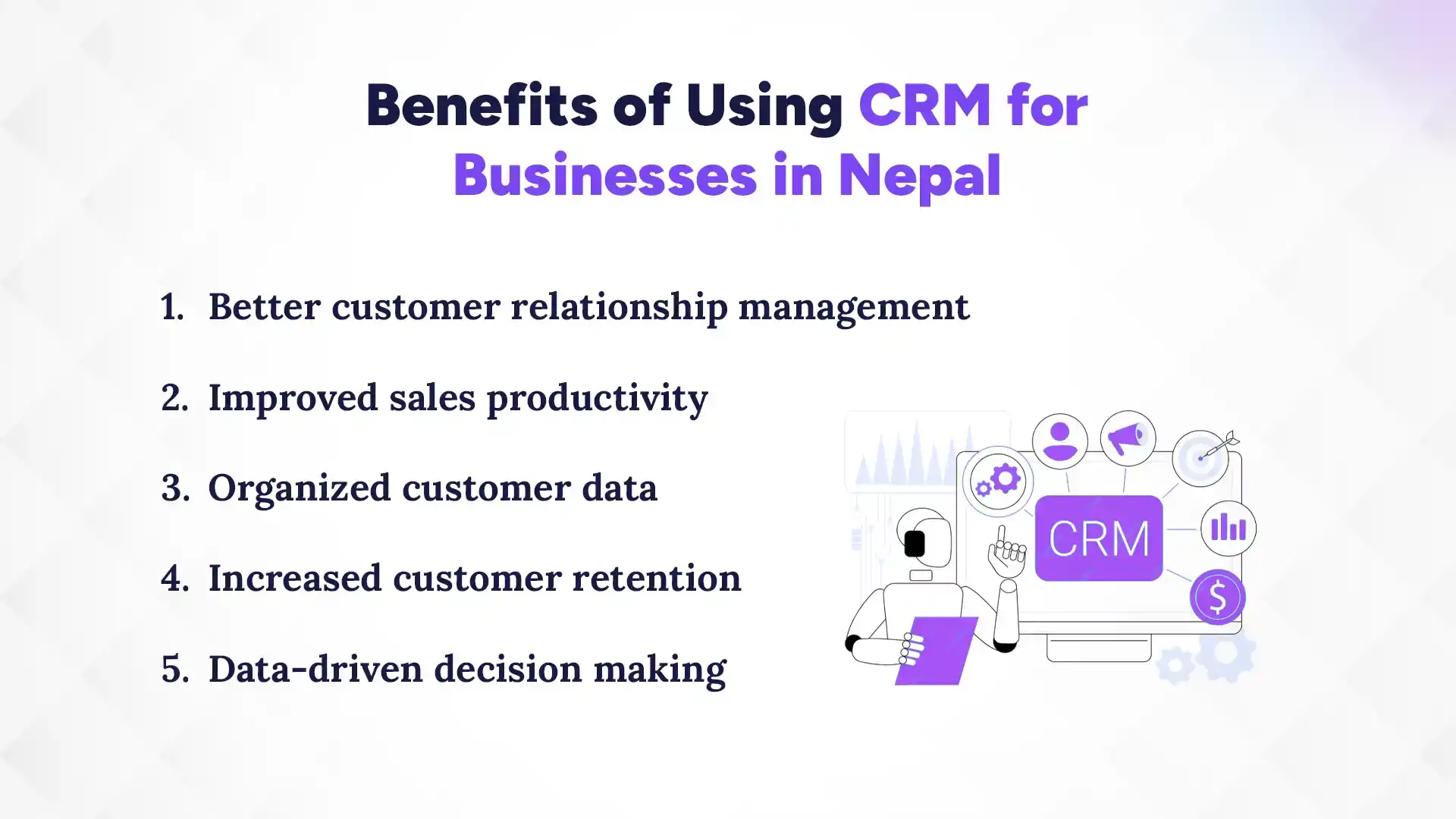
Benefits of Using CRM for Businesses in Nepal
CRM systems help businesses in Nepal manage customers more efficiently while improving sales performance and long-term growth. By centralizing data and automating processes, CRM software supports smarter and faster business decisions.
1. Better Customer Relationship Management
CRM helps businesses maintain complete customer profiles and interaction history. Teams can respond to customer needs more accurately and on time. Personalized communication improves trust and satisfaction. Better relationship management leads to stronger customer loyalty. This is especially important in competitive Nepali markets.
2. Improved Sales Productivity
CRM tools automate repetitive sales tasks such as follow-ups and reminders. Sales teams can focus more on closing deals instead of manual tracking. Clear pipeline visibility improves lead prioritization. Faster response times increase conversion rates. Overall sales efficiency improves significantly.
3. Organized Customer Data
CRM stores all customer data in one secure, centralized system. This eliminates scattered spreadsheets and manual records. Teams can access accurate information anytime. Data consistency improves collaboration between departments. Organized data reduces errors and duplication.
4. Increased Customer Retention
CRM helps businesses track customer behavior and preferences. Timely follow-ups and personalized offers improve retention. Support teams can resolve issues faster with complete customer history. Retaining existing customers reduces acquisition costs. Strong retention supports long-term business growth.
5. Data-Driven Decision Making
CRM analytics provide insights into sales trends and customer performance. Managers can make informed decisions using real-time data. Reports help identify what strategies are working. Data-driven planning reduces business risks. This leads to smarter growth strategies for Nepali businesses.
Which is the Best CRM Software in Nepal?
Pace CRM is one of the best CRM software options available for businesses in Nepal. It combines local support, easy setup, and essential CRM features tailored to Nepali business needs, making it ideal for companies of all sizes.
Pace CRM offers core tools like contact and lead management, sales pipeline tracking, task automation, and reporting all in a user-friendly interface. Because it is built with local business practices in mind, it often costs less than international alternatives while providing Nepal-specific support. Small and medium businesses especially benefit from its simplicity and scalability, while larger teams can customize workflows as they grow. When choosing a CRM, factors like pricing, feature set, ease of use, and scalability should guide your decision and for most Nepali companies, Pace CRM hits the balance well.
Common CRM Implementation Challenges
Implementing a CRM system can significantly improve business operations, but many organizations face challenges during the process. Understanding these common issues in advance helps businesses plan better and avoid costly mistakes.
1. User Adoption Issues
One of the biggest challenges is resistance from employees who are used to existing processes. Poor adoption often happens when users do not clearly understand how the CRM benefits their daily work. A complex interface or lack of involvement during implementation can also reduce usage. Without proper adoption, even the best CRM system fails to deliver results.
2. Data Migration Problems
Migrating data from spreadsheets or old systems into a new CRM can be time-consuming and risky. Incomplete, duplicate, or inaccurate data may reduce the effectiveness of the CRM. Poor data mapping can also lead to missing customer history and reporting errors. Proper data cleaning and testing are essential before full migration.
3. Training and Setup Costs
Many businesses underestimate the time and cost required for CRM training and setup. Without proper training, teams may not use advanced features correctly or at all. Customization and integration with existing tools can also increase initial costs. Planning a realistic budget and timeline helps reduce these issues.
4. How to Avoid Common Mistakes
To avoid these challenges, businesses should choose a CRM that matches their size and workflow. Involving users early, providing clear training, and starting with essential features improves success. Data should be cleaned and migrated in phases to reduce errors. Continuous support and regular reviews ensure long-term CRM effectiveness.
Conclusion
CRM works by collecting customer data from multiple touchpoints, storing it in a centralized system, and using automation and analytics to improve sales, marketing, and customer support. It allows businesses to track every interaction, manage leads efficiently, and make informed decisions throughout the customer journey.
Choosing the right CRM for small business, or even the larger ones, is critical because not all systems fit every business. A CRM that matches your business size, industry, and growth plans ensures better user adoption, lower costs, and long-term value. For Nepali businesses, selecting a CRM that understands local workflows and support needs makes implementation smoother and more effective.
CRM is no longer optional for growing businesses in Nepal. The right CRM helps you build stronger customer relationships, increase sales productivity, and stay competitive in a data-driven market.
FAQs
How does CRM work in a business?
+
CRM works by collecting customer data, storing it in one system, and helping teams manage sales, marketing, and support activities efficiently.
What is CRM and how does it help sales teams?
+
CRM is customer relationship management software that helps sales teams track leads, follow up on time, and close deals faster.
How does CRM software manage customer data?
+
CRM stores customer details, interactions, and transaction history in a centralized and secure database.
Is CRM useful for small businesses in Nepal?
+
Yes, CRM helps small businesses in Nepal manage customers professionally and improve sales with limited resources.
How does CRM improve customer relationships?
+
CRM records every interaction, allowing businesses to provide personalized and timely communication.
What are the main features of a CRM system?
+
Key features include contact management, sales tracking, task automation, customer support, and reporting.
How does CRM automation work?
+
CRM automation handles tasks like follow-ups, emails, reminders, and deal updates automatically.
Is CRM software difficult to use?
+
Most modern CRM software is user-friendly and easy to learn with basic training.
Which is the best CRM software in Nepal?
+
Pace CRM is considered one of the best CRM software options in Nepal due to its local support and business-focused features.
Ready to get started?
Book a 30-minute consultation call, and let's talk about your goals.