

Running a manufacturing business in Nepal is an exciting journey, especially as you scale your production and expand your network of distributors across the provinces. But with so many moving parts, from managing customer expectations to coordinating with your dedicated sales team, having the right tools in place is essential for keeping everything running smoothly.
In such a case, a CRM (Customer Relationship Management) system is a game-changer for industrial businesses, serving as the digital backbone that connects your hard work to consistent, sustainable growth.
In this guide, we will explore how adopting the right CRM can help you move past manual hurdles, improve your day-to-day efficiency, and build deeper, more reliable relationships with your clients and partners, ensuring your brand continues to thrive in a competitive market.
What is CRM for Manufacturing Industry?
A CRM for manufacturing is a specialized digital tool designed to help factories and industrial businesses keep track of all their customer interactions and sales processes in one secure place. Manufacturing CRMs are built to handle the complex, long-term relationships you have with B2B clients, dealers, and distributors.
By using this system, your sales team can easily see where a deal stands, while your operations team gets the information they need to plan production cycles more accurately. It creates a seamless flow of data across your entire organization, ensuring that everyone from the front office to the factory floor is always on the same page.
Why Nepalese Manufacturing Companies Need CRM in 2026
In the competitive landscape of Nepali manufacturing, relying on outdated methods is like trying to race a motorbike while riding a bicycle. You need a system that grows with you, turns raw data into clear insights, and keeps your team focused on what really matters i.e., closing deals and delivering quality goods. With a CRM, you can easily:
- Navigate complex sales cycles with many stakeholders.
- Solve difficult demand forecasting challenges with real data.
- Effectively manage distributors, dealers, and direct clients.
- Fix the lack of centralized customer data.
Key Features of CRM System for Manufacturing Industry
An effective CRM for manufacturing combines essential tools like lead management, order tracking, and automated reporting to streamline your entire business workflow. These features help you replace messy spreadsheets with a clear, reliable system that keeps every detail organized. Let’s dive deeper into how these specific CRM tools and features can change your daily operations.
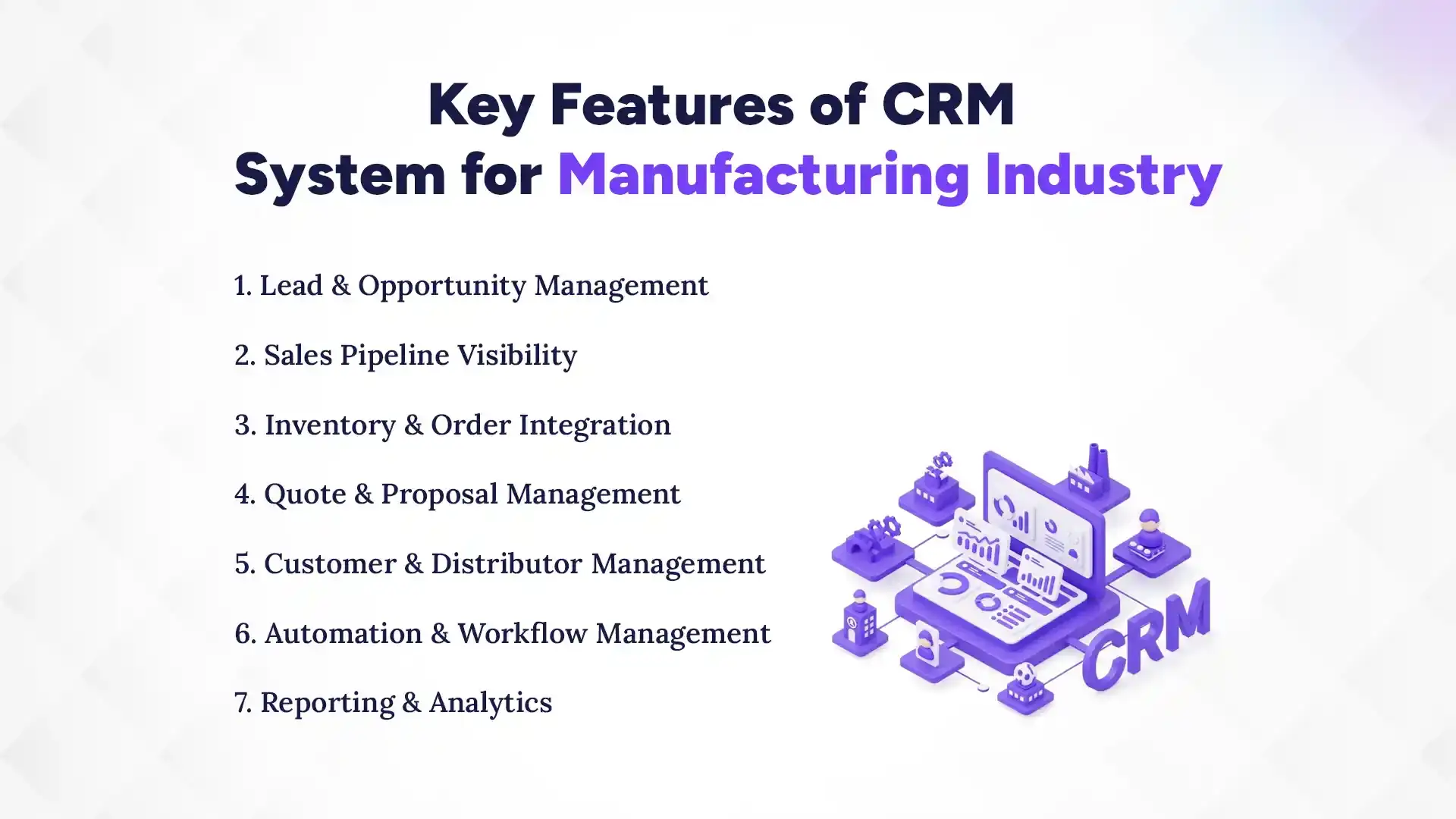
1. Lead & Opportunity Management
In the Nepali manufacturing market, a single lead can involve months of negotiation with various stakeholders. This feature helps you capture every inquiry and track it through every stage of the funnel without letting anything slip through the cracks. By keeping all communication history in one place, your team knows exactly when to call back or send a quote. It turns potential interest into a structured, trackable opportunity.
2. Sales Pipeline Visibility
You need to see exactly where your deals are at any given moment to hit your quarterly targets. This feature provides a visual dashboard of all your active sales, from the initial site visit to the final purchase order. It helps your team identify which prospects are ready to buy and which ones need a little more convincing. With this clarity, you can forecast your revenue much more accurately.
3. Inventory & Order Integration
Manufacturing is all about the balance between supply and demand, and this feature connects your sales data directly with your stock levels. When a sale is confirmed, the system can instantly alert the warehouse team to prepare the order, reducing the time between a request and a delivery. It prevents the frustration of promising products that aren't currently available, which is vital for maintaining trust with your distributors.
4. Quote & Proposal Management
Creating accurate quotes for custom industrial orders can be time-consuming if you are doing it manually. This feature allows you to generate professional, error-free proposals in minutes, complete with accurate pricing based on your current catalog. It keeps all your price lists updated so that your sales representatives never accidentally offer outdated deals. Faster, more accurate quoting directly leads to faster customer approvals.
5. Customer & Distributor Management
Managing a wide network of dealers across different regions in Nepal requires a very organized approach. This feature lets you categorize your partners, track their specific purchase history, and manage the unique pricing agreements you have with each one. By understanding the needs of every distributor, you can provide better support and build long-term loyalty. It ensures your channel partners feel valued and informed at all times.
6. Automation & Workflow Management
Repetitive administrative tasks can slow down your entire team, but this feature handles them for you automatically. You can set up workflows to send follow-up emails, remind sales staff about pending tasks, or notify managers about large orders. It frees up your team to spend more time building relationships rather than filling out forms or updating files. Automation ensures that important steps are never forgotten, even when your business gets really busy.
7. Reporting & Analytics
You cannot improve what you do not measure, and this feature gives you a bird's-eye view of your business performance. You can track everything from total sales volume by region to the performance of individual sales agents. These reports provide the factual data you need to make smart decisions about where to invest your resources next. It turns raw information into clear, actionable insights for your management meetings.
What are the Benefits of CRM for Manufacturing Industry in Nepal?
A robust CRM system significantly boosts your sales efficiency, improves customer retention, and allows for more accurate demand planning across your production line. These CRM benefits transform how you interact with your market and help you stay ahead of your local competition. Below, we look at exactly how these improvements impact your bottom line.
1. Improved Sales Efficiency and Conversion Rates
When your team spends less time searching for data, they spend more time selling. A CRM organizes your leads, making sure your sales staff is always focusing on the most promising opportunities first. By automating follow-ups, you ensure that no potential customer is left waiting for an answer. This leads to faster conversions and a much more productive sales department.
2. Better Customer Retention and Service
In manufacturing, keeping a happy dealer is often more valuable than finding a new one. A CRM stores all the history of your interactions, ensuring that every time a client calls, your team knows their specific needs and past orders. This personal touch builds deep trust and long-term loyalty that is hard for competitors to break. Happy customers become your best advocates in the market.
3. Accurate Demand Forecasting
Predicting what your customers will need next is the secret to a smooth production schedule. By analyzing sales trends and historical data stored in your CRM, you can forecast demand with much higher confidence. This helps you order the right amount of raw materials and plan your factory output more effectively. You avoid the high costs of overproducing or the risk of running out of stock.
4. Enhanced Collaboration Between Sales and Production
The disconnect between the sales team and the production floor is a common headache for many manufacturers. A CRM acts as a bridge, sharing real-time information so that production always knows what sales has promised. This transparency prevents communication gaps and ensures that your manufacturing team can meet the deadlines set by the sales department. When these teams work together, the entire business moves faster.
5. Data-Driven Decision-Making
Moving away from gut feelings to real data is how you scale a business effectively. A CRM gives you a clear picture of your most profitable products, your best-performing regions, and where you are losing potential sales. With these insights, you can stop guessing and start making strategic moves that are backed by hard numbers. It gives your leadership team the confidence to pivot or expand when the opportunity arises.
5 Best CRM Software for Manufacturing Companies in Nepal
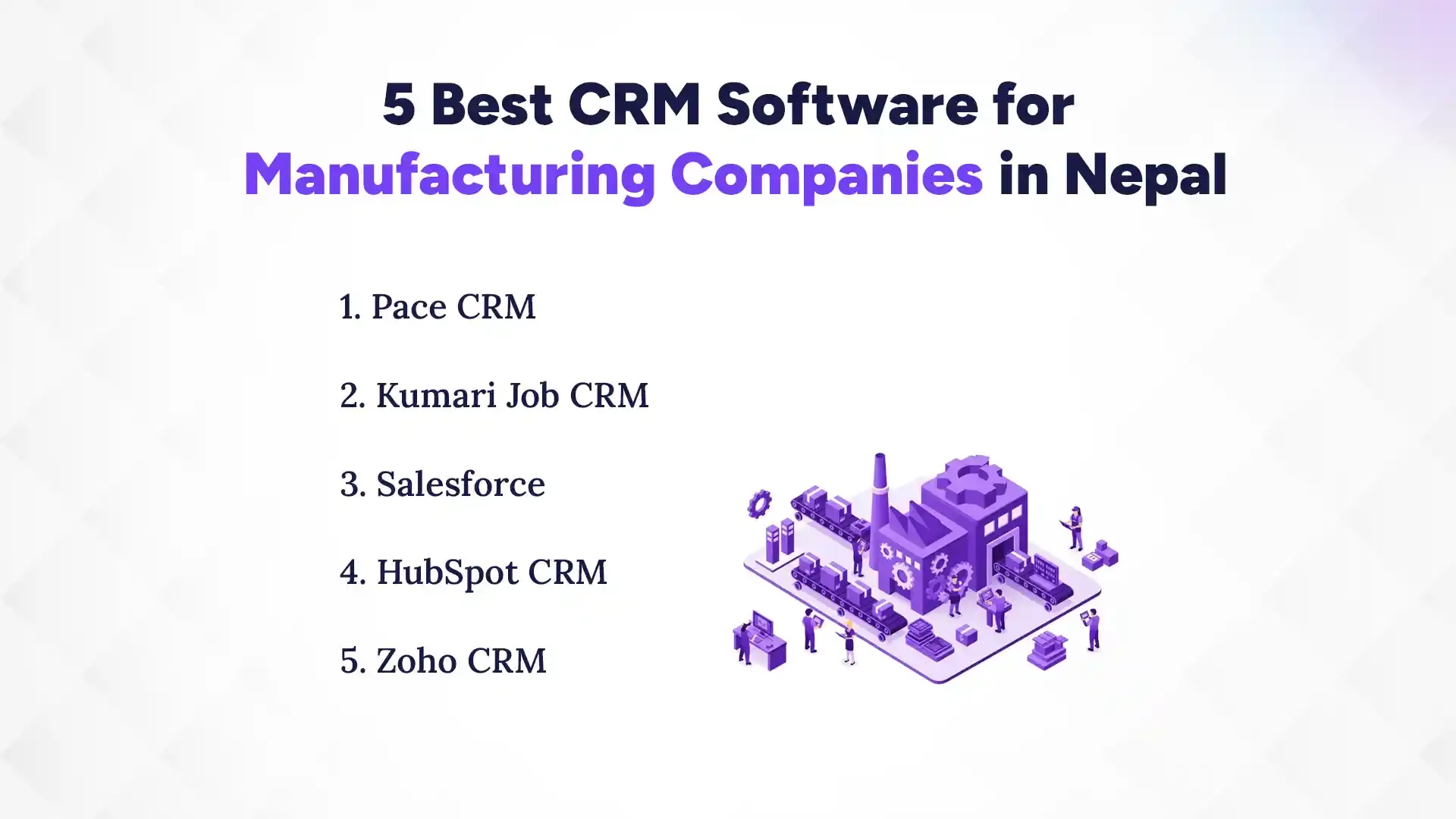
The best manufacturing CRM depends on your business size, and requirements, but platforms like Pace CRM and Kumari Job CRM provide the features most Nepali manufacturers need to succeed. While each tool has its own strengths, they all aim to organize your sales and customer data efficiently. Let's look at how these top 5 CRM options in Nepal can support your growth.
1. Pace CRM
Pace CRM is a popular local choice known for being user-friendly and perfectly tailored to the specific operational needs of Nepali businesses. It simplifies the way you track sales and manage your ongoing relationships with distributors across the country. Because Pace CRM is built with the local market in mind, it handles regional complexities much better than many international alternatives. It is a solid, practical option for manufacturers looking to modernize their sales processes without unnecessary complications.
2. Kumari Job CRM
Kumari Job CRM is another highly effective local solution that has gained trust by focusing on straightforward, functional design for local enterprises. It provides all the essential tools to track leads and maintain client records, making it a great fit for businesses that want a clean and simple interface. You will find it particularly helpful for keeping your team organized without needing weeks of intensive training. It’s an excellent bridge to professional, digital sales management for growing factories.
3. Salesforce
Salesforce is a global powerhouse that offers almost endless customization for large-scale manufacturing operations. It is packed with advanced features that can handle everything from complex supply chain integration to deep, data-driven analytics. While it has a steeper learning curve, it provides the kind of scalability that companies need when they are planning for rapid, massive growth. It is ideal for manufacturers who want a comprehensive, top-tier system that can grow with them for years.
4. HubSpot CRM
HubSpot is well-loved for its intuitive, easy-to-use platform that doesn't sacrifice power for simplicity. It makes it very easy for your sales team to start using the system immediately, which can significantly speed up your transition period. Beyond just a CRM, it offers excellent marketing and service tools that help you manage the entire customer journey in one place. Many businesses prefer it because it feels modern, friendly, and very effective for daily use.
5. Zoho CRM
Zoho is a fantastic, versatile choice that offers a great balance between affordable pricing and robust, professional features. It integrates incredibly well with a wide range of other business apps, making it a flexible part of your digital ecosystem. Whether you need custom workflows or advanced reporting, Zoho provides a modular approach that lets you pay only for what you really use. It is a very reliable option for manufacturers who want professional-grade tools on a manageable budget.
Ready to Manage Leads Better?
Use Pace CRM to track leads, automate follow-ups, and close deals faster. Simple, powerful, and built for your growth.
How to Choose the Right CRM for Manufacturing Industry in Nepal?
Selecting the right CRM requires you to prioritize scalability, smooth integration with your current tools, and a design that is truly easy for your team to adopt. You also need to weigh the upfront costs against the long-term value it brings to your production and sales goals. Let’s look at the critical actions you should take to make an informed choice.
1. Prioritize Scalability and Customization
Your business will likely grow and change, so you need a system that can grow right along with you. Ensure the CRM can be easily customized to handle your unique product lines, sales cycles, and partner networks. A rigid system will quickly become a bottleneck, while a scalable one will support your expansion for years to come. Think about your future needs, not just what you need today.
2. Verify Integration Capabilities
Your CRM will be much more effective if it can talk to your existing ERP and inventory systems. Before you commit, confirm that the CRM has the technical ability to sync data smoothly with the tools you already rely on. Integration prevents double-entry of data and ensures your operations and sales teams stay perfectly in sync. It is the best way to avoid the headache of managing isolated, disconnected platforms.
3. Evaluate Ease of Use
Even the most powerful CRM is useless if your team finds it too confusing to use daily. During the demo phase, have your sales and production staff test the interface to see if it feels intuitive and friendly. If they find it frustrating or overly complex, they will likely avoid using it, which defeats the whole purpose. Choose a platform that feels natural and makes their daily tasks easier to handle.
4. Check for Mobile Accessibility
In the manufacturing world, your team is often moving between the office, the factory floor, and meetings with distributors. A CRM that works well on mobile devices allows your staff to access important customer data and update records from anywhere. This flexibility keeps your team connected and responsive, regardless of where they are working. It is a modern requirement for any sales team that is always on the move.
5. Calculate Cost vs Long-term Value
Look past the initial subscription price and think about the overall value the CRM will bring to your business. Will it help you save valuable time, reduce expensive errors, and help you close more deals over the next few years? A slightly higher investment in a system that truly fits your needs is often much cheaper than paying for a "cheap" tool that doesn't actually solve your problems. Always view your CRM as a growth partner, not just another monthly expense. It should pay for itself by helping your team work smarter every single day.
CRM vs ERP in Manufacturing: What’s the Difference?
The main difference is that CRM software is built to manage the customer-facing side of your business, while ERP software handles the internal operational and production side. While they do different things, they are actually partners that work best when they talk to each other. Integrating them allows your whole company to run smoothly, from the first customer inquiry to the final delivery.
Here’s a tabular comparison of ERP vs CRM:
| Feature | CRM | ERP |
|---|---|---|
| Primary Goal | Customer Relations & Sales | Production & Internal Operations |
| Key Focus | Marketing, Leads, Sales | Inventory, Accounting, Manufacturing |
| User Base | Sales & Marketing Teams | Finance, HR, Factory Managers |
| Data Source | External customer interactions | Internal company processes |
| Main Benefit | Revenue growth & retention | Operational efficiency & cost reduction |
| Lifecycle Stage | Pre-sale & Post-sale engagement | Order fulfillment & supply chain |
| Decision Type | Market-oriented strategy | Resource-oriented planning |
How CRM Improves Manufacturing Sales Process in 2026?
A CRM transforms your sales process by organizing how you capture leads, shorten the time it takes to close deals, and keep your customers well-informed. It replaces disorganized methods with a structured path that moves prospects from initial interest to loyal repeat buyers. Here is how this change specifically helps your sales team become more successful.
1. Convert Your Lead Capture
This system ensures that every inquiry from a potential dealer or distributor is captured and tracked immediately. Your team can then quickly qualify these leads to see which ones are worth pursuing first, preventing wasted time on low-interest prospects. By moving them through a clear, defined path, your team stays organized and focused on the finish line. It turns the often-confusing world of industrial sales into a predictable, manageable process.
2. Shorten Long Sales Cycles
Manufacturing deals often take months to finalize, but a CRM keeps you from losing momentum during that long period. It reminds your team to perform key follow-ups and provides all the information needed to move the conversation to the next stage. When you have all the history at your fingertips, you can answer technical questions immediately, which builds confidence and speeds up the decision. It keeps the deal moving forward instead of stalling in a black hole.
3. Better Follow-up and Communication
Consistently reaching out to your clients is what separates great sales teams from the rest. The CRM ensures your team remembers every scheduled call, email, or meeting, so no opportunity is ever forgotten. This level of reliability demonstrates professionalism, which is crucial for building trust with industrial clients who value consistency. By staying top-of-mind with your distributors, you increase the likelihood of securing their next big order.
4. Real-time Insights for Sales Teams
Giving your team access to real-time data means they can make better decisions on the fly during a negotiation. They can see inventory status, pricing agreements, and past order history instantly, allowing them to provide accurate information to the client immediately. This responsiveness is a huge competitive advantage in the fast-paced manufacturing market in Nepal. It empowers your staff to act like experts, strengthening your brand's reputation for quality service.
Challenges in Implementing CRM in Nepalese Manufacturing Companies
Implementing a CRM involves overcoming common hurdles like team resistance, technical setup issues, and ensuring everyone knows how to use the new system. These challenges are normal, but addressing them early with a clear plan makes the entire process much smoother for your staff. Here is how you can proactively handle these common hurdles.
1. Resistance to Team Culture Change
It is natural for long-time employees to feel uncomfortable when you introduce a brand new way of working. You can overcome this by showing them exactly how the CRM works and makes their daily job easier, not harder. Involve them early in the process so they feel like part of the decision, rather than just being told to change. When they see the benefits for themselves, the initial resistance usually turns into full support.
2. Data Migration from Old Files
Moving your years of customer history from messy spreadsheets to a new CRM can feel like a huge task. The best way to handle this is to clean and organize your data before you even start the transfer. Prioritize the most important information first and do the process in stages to avoid becoming overwhelmed. Taking the time to do this right ensures your new system starts with clean, reliable, and useful information.
3. Complexity of ERP System Integration
Connecting your new CRM to an existing ERP is a technical step, but it is necessary for a truly seamless business operation. Work closely with your IT partners to map out exactly how information should flow between the two systems from the start. A clear plan prevents common errors and ensures your sales team has the real-time data they need without manual work. Getting this right creates a solid, unified backbone for your entire factory.
4. Low User Adoption and Training
A system is only as good as the people who use it, which makes proper training an absolute necessity. Instead of one long session, offer ongoing support and short, practical tutorials that focus on the specific tasks your team does every day. This helps them understand what exactly is CRM and its advantages. Encourage your staff to ask questions and provide feedback, as this helps them feel comfortable with the new tools. When your team is properly trained, they will feel confident and empowered to use the CRM effectively.
Conclusion
To wrap things up, a CRM is no longer just a luxury for large corporations; it is a vital necessity for any manufacturing business in Nepal that wants to scale. By centralizing your customer data, streamlining your sales pipeline, and bridging the gap between your office and factory floor, you gain the efficiency needed to outpace the competition.
This isn't just about software, it is about building a foundation where your hard work translates into consistent, measurable growth and stronger relationships with every dealer and client you serve. Choosing the right CRM will motivate your team, clear up daily confusion, and give you the peace of mind to focus on what you do best: manufacturing quality products.
Don't wait for the chaos to grow even further. Take the first step today. Find which is the best CRM software in Nepal, evaluate your options, and pick the system that will support your journey toward long-term success.