Running a nonprofit is genuinely hard work. You're juggling donors, volunteers, campaigns, and events, all at once, often with a small team and an even smaller budget. And somewhere in between all of that, important donor information slips through the cracks, follow-ups get missed, and fundraising feels more chaotic than it should. Sound familiar?
The good news is, there's a smarter way to manage all of it. The right CRM software can bring everything together in one place. A reliable CRM software for Nepalese nonprofit organisations saves your time, strengthens relationships, and helps your mission grow.
In this guide, we'll walk you through the best CRM software for nonprofits in Nepal, break down what actually matters, and help you pick the right fit for your organization.
What Is CRM Software for Nonprofits?
CRM stands for Customer Relationship Management, but for nonprofits, think of it less as "customer" and more as donor, volunteer, and supporter relationship management. It's a software tool that helps you store, organize, and track every interaction you've had with the people who support your cause. Instead of scattered spreadsheets and lost email threads, everything lives in one clean, searchable place.
Unlike a traditional business CRM, which focuses on sales and revenue, a nonprofit CRM is built around mission-driven goals. So rather than tracking purchase history, it tracks donation history, volunteer hours, event attendance, and communication records. It's designed to help you understand your supporters better and connect with them in a more meaningful way.
The most common uses include donor tracking, which includes knowing who gave, how much, and when, volunteer management, and running fundraising campaigns. Whether you're organizing a charity drive or sending thank-you emails after an event, a good nonprofit CRM makes the whole process smoother and more organized.
Nonprofits in Nepal need CRM software to efficiently manage donors, streamline fundraising, and scale impact without increasing operational burden. Most nonprofits in Nepal start out managing everything manually in notebooks, Excel sheets, maybe a shared Google Drive. And for a while, that works.
But as your organization grows, those systems start to break down fast. Donors feel forgotten, campaigns lose momentum, and your team ends up doing the same repetitive tasks over and over again.
That’s exactly where a CRM steps in. It brings structure to the chaos, helps you build real relationships with donors, and gives you the data you need to make smarter decisions. Simply put, it helps your nonprofit do more with less effort.
Here’s why nonprofits across Nepal are switching to CRM software:
All your donor data in one centralized place
Better donor retention through personalized outreach
Automation of repetitive, time-consuming tasks
Clearer fundraising reports and actionable insights
Easy scalability as your organization expands
Key Features to Look for in Nonprofit CRM Software (2026)
A good nonprofit CRM should comprise of donor management, donation tracking, automation, campaign tools, and solid reporting dashboards right out of the box. Beyond these core features, the best tools also include volunteer management, event tools, and integrations with apps you already use. Let's look at each feature of CRM closely, so you know exactly what to expect and what to demand when comparing your options.
1. Donor & Contact Management
This is the heart of any nonprofit CRM. It lets you store detailed profiles for every donor, volunteer, and supporter, including contact info, donation history, communication logs, and personal notes. So when a major donor calls, you're not scrambling to remember who they are or what they gave last year. Everything is right there, easy to access, and up to date. A strong contact management system also lets you segment your audience, so you can send the right message to the right people at the right time.
2. Donation Tracking & Reporting
Knowing how much you raised is great, but knowing who gave, when, how often, and through which channel is even better. A good CRM tracks every donation automatically and turns that data into visual reports you can actually use. This helps you identify your top donors, spot giving patterns, and set more realistic fundraising targets. Instead of pulling numbers from five different places, you get one clean dashboard that tells the whole story.
3. Email & Campaign Automation
Sending personalized thank-you emails, donation receipts, and campaign updates manually is exhausting, and honestly, it's not sustainable. CRM automation lets you set up email workflows that trigger based on actions, like when someone donates for the first time or misses a recurring gift. This saves your team hours of work every week while making donors feel genuinely appreciated. The result? Better engagement, stronger relationships, and more consistent communication without the extra workload.
4. Volunteer Management
Volunteers are the backbone of most nonprofits, so managing them well matters. A CRM with volunteer management tools lets you track who's available, assign roles, log hours, and keep communication organized all in one spot. You can also build profiles for each volunteer, including their skills, interests, and past involvement, making it easier to match the right people to the right tasks. When volunteers feel organized and valued, they show up more and stay longer.
5. Event & Fundraising Tools
Whether you're hosting a charity gala, a community workshop, or an online fundraiser, your CRM should support the entire process. That means managing registrations, sending reminders, processing payments, and tracking attendance, all from the same platform. Some CRMs even let you build custom event pages and link them directly to your donor database. This makes follow-up incredibly easy because you already know exactly who attended, what they gave, and how they engaged.
6. Grant & Membership Management
If your nonprofit relies on grants or operates a membership program, these tools are non-negotiable. Grant management features help you track application deadlines, reporting requirements, and funder relationships. This ensures nothing slips through the cracks. Membership tools, on the other hand, let you manage renewals, send reminders, and personalize benefits based on membership tiers. Together, they add a layer of financial structure that keeps your organization sustainable and accountable.
7. Integrations with Other Systems
A CRM that works well with your other tools is worth its weight in gold. Whether it's Mailchimp for email marketing, Stripe for payment processing, Zoom for virtual events, or QuickBooks for accounting, seamless integrations mean your data flows between platforms without manual exports or copy-pasting. This saves time, reduces errors, and keeps your entire operation connected. Before choosing a CRM, always check its integration list against the tools your team already uses daily.
8. Custom Dashboards & Analytics
Raw data is only useful if you can understand it quickly. Custom dashboards let you build a visual snapshot of the metrics that matter most to your organization, like monthly donations, donor retention rate, campaign performance, or volunteer hours. You can share these dashboards with your board or leadership team without needing a data analyst to explain them. The ability to customize what you see means you spend less time digging through reports and more time acting on insights.
Top 5 Most Trusted CRM Software for Nonprofits in Nepal
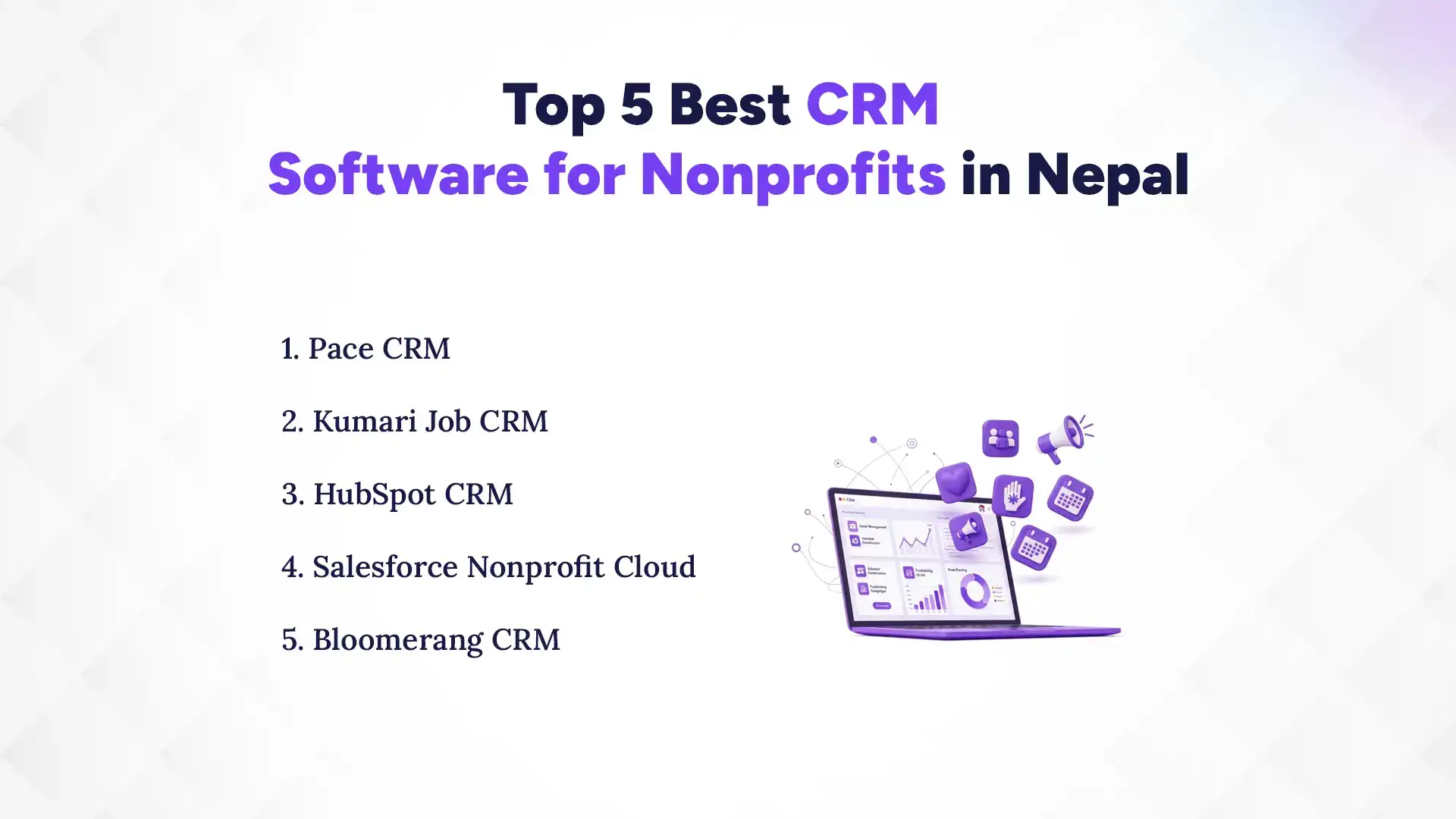
When it comes to the best CRM software for nonprofits in Nepal, tools like Pace CRM and Kumari Job CRM stand out as locally relevant choices. Alongside, globally trusted platforms like HubSpot, Salesforce, and Bloomerang are also considered. Each one brings something different to the table, from local support and affordability to powerful automation and deep donor insights. Here's a closer look at each one of the top 5 CRM options in Nepal for non profits, so you can find your best match.
1. Pace CRM
Pace CRM is one of the most practical choices for nonprofits operating in Nepal, largely because it's built with local businesses and organizations in mind. It offers clean, intuitive dashboards that make donor tracking and contact management easy, even if your team isn't particularly tech-savvy. What sets it apart is how well it adapts to smaller teams that need structure without complexity. If you're a growing nonprofit that wants a reliable, locally supported CRM without paying enterprise-level prices, Pace CRM is a very strong place to start.
2. Kumari Job CRM
Kumari Job CRM brings a Nepal-focused approach to relationship management, making it a compelling option for nonprofits that want local relevance baked into their system. It supports contact and donor management with straightforward workflows that don't require extensive onboarding. The platform is particularly useful for organizations that also manage human resource functions alongside outreach activities. For nonprofits that want a single tool to handle both people management and donor engagement without switching between platforms, Kumari Job CRM is worth a serious look.
Ready to Manage Leads Better?
Use Pace CRM to track leads, automate follow-ups, and close deals faster. Simple, powerful, and built for your growth.
HubSpot is one of the most popular free CRM platforms in the world, and nonprofits love it for good reason. The free plan is genuinely powerful, giving you contact management, email tools, deal pipelines, and basic reporting without spending a single rupee. As your organization scales, you can unlock more advanced features through paid tiers. It also integrates smoothly with dozens of third-party tools, making it a great central hub for nonprofits that already use tools like Mailchimp, Zoom, or Google Workspace.
4. Salesforce Nonprofit Cloud
Salesforce Nonprofit Cloud, built on the Salesforce platform through its Power of Us program gives eligible nonprofits access to one of the world's most powerful CRM systems at a significantly reduced cost. It offers deep donor management, fundraising pipelines, program tracking, and advanced reporting that can handle organizations of any size. The trade-off is the learning curve. It takes time to set up and train your team. But once you're up and running, it's incredibly flexible and scalable, making it ideal for larger nonprofits with complex needs.
5. Bloomerang CRM
Bloomerang is designed specifically for nonprofits, with donor retention at the center of its philosophy. It measures your donor retention rate right on the dashboard, a simple but powerful reminder of why relationship-building matters. Features include donation tracking, email communication tools, and reporting that helps you understand why donors leave and how to keep them engaged. For nonprofits that struggle with donor drop-off, Bloomerang isn't just a CRM, it's practically a retention strategy built into software.
Comparing the Top 5 Best Nonprofit CRM Software in Nepal
CRM
Best For
Free Trial
Key Strength
Pace CRM
Nepal-based nonprofits
Yes
Local support & usability
Kumari Job CRM
Nepal orgs with localized needs
Yes
Local relevance + HR tools
HubSpot CRM
Small to mid-size nonprofits
Yes
Free plan + integrations
Salesforce Nonprofit Cloud
Large nonprofits
Yes
Advanced customization
Bloomerang
Donor retention-focused orgs
No
Retention analytics
Which Is the Best CRM Solution for Nonprofits in Nepal?
For most nonprofits in Nepal, Pace CRM stands out as the best choice. It is built with flexibility in mind, so teams can customize it based on their needs, whether it’s donor tracking, fundraising, or communication. It also works well for local organizations, making it easier to manage data, automate tasks, and scale without needing a large tech team.
Now, if we compare a few options, each has its strengths. Pace CRM is strong in customization and local adaptability, which makes it a great fit for Nepal-based nonprofits. Kumari Job CRM is more focused on recruitment and HR workflows, so it may not fully meet nonprofit fundraising needs. On the other hand, HubSpot CRM is popular globally and offers a solid free plan, but it can feel limited unless you upgrade, and it may require more setup for nonprofit-specific use.
In the end, the best CRM depends on your goals. However, for nonprofits in Nepal looking for a balance of ease, flexibility, and relevant features, Pace CRM is the most practical and well-rounded choice.
How to Choose the Right CRM for Your Nonprofit in Nepal?
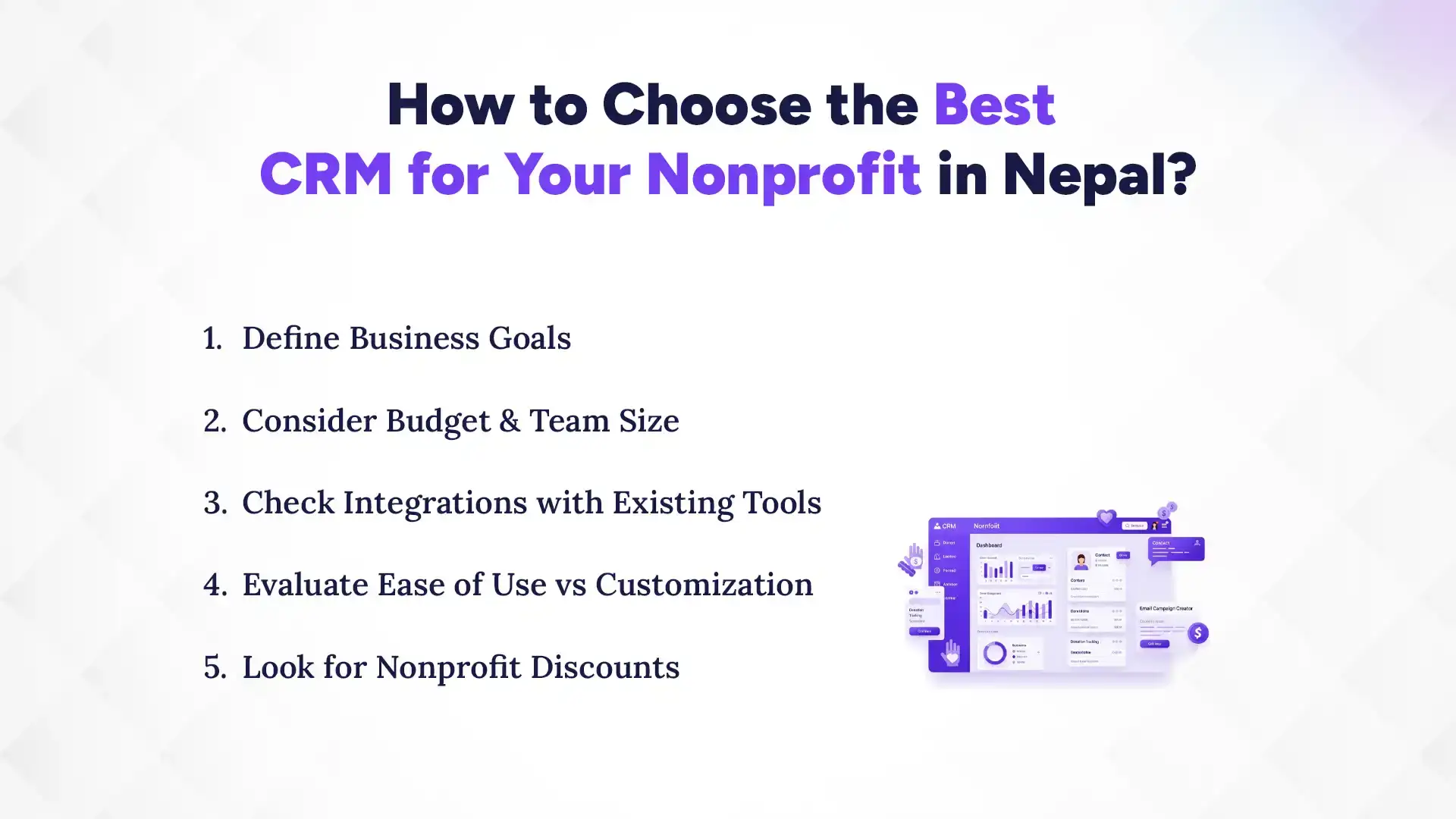
Choosing the right CRM comes down to three things: your goals, your budget, and how your team actually works. No single CRM is perfect for everyone, and the most popular tool isn't always the most useful one for your specific situation. With that in mind, here's a simple breakdown of what to think through before you make your decision.
1. Define Your Goals First: Fundraising or Engagement?
Before comparing features, get clear on what you actually need the CRM to do. If your main goal is to raise more money, look for strong donation tracking, fundraising pipelines, and campaign automation. If you're more focused on community engagement or volunteer programs, prioritize contact management, communication tools, and event features. Mixing up priorities early leads to buying a tool that checks a lot of boxes but solves none of your actual problems, so start with your "why."
2. Consider Your Budget and Team Size
A powerful CRM that your team can't afford, or can't figure out how to use, won't help anyone. For small nonprofits with tight budgets, start with free or low-cost options like Pace or Kumari Job CRM. For mid-to-large organizations with dedicated staff, investing in a more feature-rich platform like Salesforce or Bloomerang can pay off significantly over time. Evaluate which CRM pricing package comes with what all features. Always factor in not just the subscription cost, but also the time it takes to onboard your team and maintain the system.
3. Check Integrations with Your Existing Tools
Your CRM shouldn't exist in isolation, it needs to work smoothly with the tools you already rely on. Think about your email platform, payment processor, accounting software, and social media tools. If your CRM doesn't integrate with them, you'll end up manually moving data between platforms, which defeats the whole purpose. Make a list of your current tools before you start evaluating CRMs, and then cross-check each platform's integration directory carefully before committing.
4. Ease of Use vs. Customization
Some CRMs are incredibly powerful but require technical expertise to set up and maintain. Others are easy to use right away but don't offer much flexibility as you grow. The key is finding the right balance for your team's skill level. If your team isn't particularly tech-heavy, go for a platform known for its clean interface and strong customer support. If you have someone technical on your team and need a highly tailored system, then a more customizable CRM is worth the complexity.
5. Look for Nonprofit Discounts and Special Programs
Many CRM companies offer significant discounts or even free access for registered nonprofits. Salesforce has its Power of Us program, HubSpot offers discounts through TechSoup, and several other platforms have dedicated nonprofit pricing pages. Before you assume a CRM is out of budget, check whether you qualify for a nonprofit plan. You might be surprised, sometimes the best tools are far more affordable than their standard pricing suggests.
What Are the Benefits of Using a Nonprofit CRM in Nepal?
The biggest advantages of using a nonprofit CRM are that you raise more money, build stronger donor relationships, and free up your team's time through smart automation. On top of that, you gain access to real data that helps your leadership make better decisions, faster. Let's break down each benefit of CRM in a way that shows you exactly what changes once a good CRM is in place.
1. Raise More Donations Without Working Harder
A CRM gives you a complete picture of your donor base. Who donates regularly, who hasn't donated in a while, and who might be ready to increase their gift. With that information, you can run targeted campaigns that feel personal, not mass-produced. Personalized outreach consistently outperforms generic mass emails, both in open rates and in giving amounts. So instead of sending the same message to everyone and hoping for the best, you're reaching the right donors with the right ask at the right time.
2. Build Donor Relationships That Actually Last
Donors don't just give to causes, they give to organizations they trust and feel connected to. A CRM helps you remember the small things, like a donor's giving anniversary, their preferred communication channel, or the programs they care about most. When you follow up with that level of attention, it signals that they matter to you beyond just their donation. That kind of relationship-building turns one-time donors into long-term supporters, and long-term supporters into advocates for your mission.
3. Save Hours Every Week with Smart Automation
Think about how much time your team spends sending thank-you emails, issuing receipts, scheduling reminders, or updating donor records manually. A CRM automates all of that. Once you set up your workflows, they run in the background without anyone having to think about them. That means your team spends less time on repetitive admin and more time on the work that actually moves your mission forward, whether that's community outreach, program delivery, or donor stewardship.
4. Make Better Decisions with Real Data
Gut instinct is great, but data is better, especially when you're managing limited resources. A nonprofit CRM gives you clear, visual reports on donation trends, campaign performance, donor retention, and more. Instead of guessing which fundraising strategy worked or which email campaign drove the most giving, you can see it clearly in your dashboard. Over time, this data helps you allocate your budget smarter, focus your energy on what works, and stop wasting time on what doesn't.
Insights
Did You Know?
Nonprofits using CRM systems are able to improve donor engagement and retention by centralizing communication, tracking contributions, and automating follow-ups in one unified platform.
5. Grow Your Organization Without Losing Control
As your nonprofit grows, managing more donors, volunteers, and campaigns becomes exponentially harder without the right systems in place. A CRM scales with you. The same platform that helped you manage 200 donors can handle 2,000 without falling apart. You can add users, unlock advanced features, and expand your processes without starting from scratch. This makes a CRM one of the best long-term investments a nonprofit can make, regardless of where you're starting from today.
Common CRM Challenges for Non-Profits (and How to Overcome Them)
The biggest challenges nonprofits face when adopting a CRM are tight budgets, low team adoption, and the headache of migrating existing data. These are real obstacles, but they're also very solvable ones with the right approach and the right expectations from the start. Let's look at each challenge honestly and walk through practical ways to handle them.
1. Budget Constraints: Start Free and Scale as You Grow
Budget is the most common reason nonprofits delay getting a CRM, and it's a fair concern. But you don't have to start with a paid plan. Platforms like HubSpot offer free tiers with genuinely useful features that can carry a small team for quite a while. Start there, get comfortable, and upgrade only when you've outgrown what's available. Not having a CRM at all will cost you more in the long run than any subscription ever would.
2. Low Team Adoption: Prioritize Onboarding from Day One
A CRM only delivers value if your team actually uses it, and getting people on board is often the hardest part. The solution isn't forcing a full system switch overnight; it's making the transition gradual and supported. Begin with a focused onboarding session covering the two or three features your team will use most. Designate an internal CRM champion someone colleagues can turn to with questions, and adoption will follow naturally once people see how much time it saves them.
3. Data Migration: Move Records in Phases
Moving years of donor data from spreadsheets into a new CRM feels overwhelming, especially when you try to do it all at once. A phased approach works far better: import your most active donors first, then bring in historical data gradually over the following weeks. Most platforms provide import templates and support to guide you through it. Taking it step by step reduces errors and makes the transition far less disruptive.
4. Unclear Success Metrics: Define What You're Tracking
Many nonprofits set up a CRM without deciding what they actually want to measure, and that leads to underuse and eventual abandonment. Before going live, align your team on three to five key metrics tied to your goals, like donor retention rate or monthly giving growth. Build your dashboards around those metrics from day one. When everyone knows what success looks like, the CRM becomes a decision-making tool rather than just another platform to log into.
5. Choosing the Wrong CRM: Always Pilot Before You Commit
Signing a long-term contract for a CRM that doesn't fit your workflow is an expensive and avoidable mistake. Most platforms offer free trials. Use them fully and involve the people who will actually use the system daily, not just leadership. Their feedback will tell you far more about real usability than any feature comparison table. A CRM that works for a large international NGO may not suit a small nonprofit in Kathmandu, and finding that out before you commit saves both time and budget.
Conclusion
Now that we’ve explored everything, including features, tools, pricing, benefits, and challenges,the honest bottom line is that the best CRM for your nonprofit isn't the most popular one, it's the one that fits your team, your budget, and your mission.
Whether that's a locally built platform like Pace CRM, a free global tool like HubSpot, or a purpose-built solution like Bloomerang, the right choice is always the one your team will actually use, and benefit from, every single day.
Nonprofits in Nepal are doing incredible work with limited resources, and you deserve tools that work as hard as you do. A good CRM won't replace the heart behind your mission, but it will give that heart the structure and support it needs to reach further, retain more donors, and create lasting impact in your community.
So avoid overthinking. Pick one tool that aligns with where you are today, try it out, and grow from there. Start by understanding how CRM works or requesting a free demo from Pace CRM, and take your first real step toward running a smarter, stronger nonprofit.
FAQs
What is the best CRM software for nonprofits?
+
Pace CRM and Kumari Job CRM offer locally relevant features and support for nonprofits in Nepal. The best pick, however, depends on your budget, team size, and fundraising needs.
Is there a free CRM for nonprofits?
+
HubSpot offers some free resources and attractive discounts for nonprofits. For Nepal-based nonprofits, Pace CRM could be an affordable choice that comes with international-level features and local support.
How much does nonprofit CRM software cost?
+
Costs range widely, from completely free to anywhere between NPR 3,000, depending on the platform, number of users, and features you need.
What features should a nonprofit CRM have?
+
At a minimum, look for donor management, donation tracking, fundraising tools, email automation, reporting dashboards, and integrations with tools like Mailchimp or Stripe. Volunteer management and event tools are strong bonuses.
Can small nonprofits use CRM software?
+
Absolutely. Many CRMs Pace CRM and Hubspot CRM offer free or affordable plans that are well-suited for small nonprofits with basic needs. You don't need a large team or big budget to get meaningful value from a good CRM.
How to choose a nonprofit CRM?
+
Choose based on budget, team size, fundraising needs, integrations, ease of use, and scalability. Always test demos before finalizing.
Can nonprofit CRM software improve fundraising?
+
Yes, CRM software boosts fundraising by tracking donor behavior, automating outreach, and personalizing campaigns, leading to higher engagement and recurring donations.
Ready to get started?
Book a 30-minute consultation call, and let's talk about your goals.