Choosing the right HR software can feel like a maze for Nepali nonprofits. With so many options promising the best features, it’s easy to get confused, waste time, or pick a tool that doesn’t fit your team’s needs. The wrong choice can slow down payroll, make volunteer tracking harder, and create more work instead of less.
That’s why it’s important to know which software truly works for nonprofits like yours; tools that are simple, affordable, and built to handle staff and volunteer management efficiently.
In this guide, we will show you the best HR software for nonprofits in Nepal, compare their features, and help you pick the right one for your organization.
What is HR Software for Nonprofits in Nepal?
HR software for nonprofits in Nepal is a digital tool that helps organizations manage their staff and volunteers in one place. Unlike regular business software, these systems are built to handle the unique needs of the social sector, such as tracking donor-funded project hours and keeping up with local labor laws like the Social Security Fund (SSF) and CIT.
In Nepal, most nonprofits operate with tight budgets and strict reporting rules. This software replaces messy paper files and complex Excel sheets with a central dashboard. It ensures that everyone, from field workers in remote districts to office staff in Kathmandu, is paid correctly and on time.
Key things this software handles for Nepali NGOs:
Local Compliance: Automatically calculates TDS (tax), SSF contributions, and festival bonuses according to Nepal’s Labor Act.
Volunteer Tracking: Keeps a record of volunteer hours and contact details, which is crucial for donor reporting.
Remote Attendance: Uses mobile GPS or selfie attendance so field staff can check in from project sites without coming to the office.
Grant Management: Links staff time and salaries to specific projects or grants to show donors exactly how money is spent.
Digital Records: Stores citizenship copies, contracts, and certificates securely in the cloud instead of physical cupboards.
Simply put, it is a digital assistant that takes care of the office work, so your team can focus on making a real impact in the community.
Why Nonprofits in Nepal Need Dedicated HR Software?
Nonprofits in Nepal need HR software to stop wasting time on manual paperwork and to stay safe from legal trouble. While small teams often try to manage everything on paper, the constant pressure of donor reports and changing government rules makes manual tracking nearly impossible. Switching to a digital system ensures your organization stays organized, compliant, and ready for any audit.
Easier Work for Small Teams: Most nonprofits in Nepal have small teams where one person handles multiple roles. HR software automates boring tasks like tracking leave and filing documents, which gives your staff more time to work on your actual mission.
Better Reports and Legal Safety: Donors and the Nepal government require very specific reports on how money and time are spent. The software automatically calculates taxes and SSF contributions, ensuring you never face fines for incorrect payroll or missing data.
Managing Staff and Volunteers Together: It can be a headache to track full-time staff in one place and volunteers in another. These platforms let you manage everyone in one list, making it easy to see who is working on which project and for how many hours.
Tracking Field Staff: Since many NGO projects happen in remote areas, it is hard to know if staff are on-site. Good HR software uses GPS mobile check-ins, so you can see real-time attendance from any district in Nepal without needing a physical machine.
Key Features of HR Software for Non-Profit Organizations
Picking the right HR software is like choosing a good teammate for your organization. It should take over the boring, repetitive tasks so your real team can focus on helping people. The best tools for Nepali nonprofits are the ones that are easy to use and understand the local rules we have to follow every day. Here are the main features of HR software you should look for to make your life easier.
1. Employee Onboarding Software
When a new person joins your team, there is usually a mountain of paperwork to sign. Onboarding software lets you send all those forms, like the appointment letter and code of conduct, digitally before they even step into the office. It keeps a digital folder for every person where you can save their citizenship copy and certificates safely. This makes a great first impression and shows the new hire that your organization is professional. Instead of spending their first day filling out forms, they can start learning about your mission right away. It also helps you track if they have received their office laptop or ID card.
2. Payroll and Benefits Management
Managing salaries in Nepal is tricky because you have to calculate things like TDS, SSF, and CIT correctly every month. Good HR software does all this math for you automatically, so you don’t have to worry about making a mistake. It also handles festival bonuses (Dashain bonus) and ensures everyone gets their payslip on their phone or email. This keeps your staff happy because they can see exactly how their salary was calculated. For nonprofits, it is also great because it can track which donor's budget is paying for which staff member. You can finish your monthly payroll in a few clicks instead of spending days on an Excel sheet.
3. Time Tracking and Attendance
In Nepal, many nonprofit staff work in the field or from remote project sites. Modern HR software uses GPS tracking so staff can mark their attendance from their mobile phone wherever they are. You won't need those old fingerprint machines that often break or lose data during power cuts. The system also tracks leave automatically, so if someone takes a day off, their balance is updated instantly. This stops confusion about how many days of Home Leave or Sick Leave someone has left. It makes the whole process fair for everyone and saves the HR manager from constant phone calls asking about leave balances.
4. HR Compliance Tools
Following the Nepal Labor Act 2074 is very important to avoid legal trouble or fines. Compliance tools built into the software make sure you are following the rules for working hours, overtime, and public holidays. It sends you alerts if a contract is about to expire so you can renew it on time. The software also helps you stay ready for any government audit by keeping all your records organized and easy to print. If the government changes a tax rule or the minimum wage, the software updates itself so you stay protected. It basically acts like a legal expert sitting inside your computer.
5. Volunteer Management Systems
Nonprofits often rely on volunteers who might only help out for a few weeks or for specific events. This feature helps you keep a separate list of these helpers, tracking their skills and the hours they contribute. You can send them group messages about upcoming tasks or training sessions without mixing them up with your permanent staff. It is also very helpful for reporting to donors, as you can show exactly how much volunteer power went into a project. Having a dedicated spot for volunteers makes them feel valued and keeps your database clean. Most importantly, it ensures you have their emergency contact info and ID proof ready just in case.
Best HR Software for Nonprofits in Nepal
Finding the right HR software in Nepal is a big decision for any nonprofit. You need a tool that is easy for your team to use but also smart enough to handle local taxes and donor reports. Many organizations are moving away from paper files to these digital systems to save time and stay organized. Here is a closer look at the best options available for your organization in 2026.
1. Pace HRMS
Pace HRMS is a top-rated choice for Nepali nonprofits because it was built specifically to follow our local labor laws and government rules. It is a complete system that handles everything from the day someone is hired until the day they leave.
Complete Local Compliance: It automatically calculates TDS, Social Security Fund (SSF), and Citizen Investment Trust (CIT) so you never make a mistake with government taxes.
Asset Tracking: You can easily keep a record of which field staff have which office laptop, camera, or motorbike, ensuring nothing gets lost.
Biometric & Mobile Sync: It works perfectly with fingerprint machines in your office and has a mobile app with GPS for staff working in remote districts.
Project Tracking: It lets you link staff hours to specific donor-funded projects, which makes your monthly reporting much faster.
2. Kumari Job HRMS
Kumari Job is a household name in Nepal, and their HRMS is loved for being very simple and user-friendly. It is perfect if you want a system that your staff can learn to use in just one day. The software focuses on making daily tasks like managing attendance and asking for leave very quick. Because they are based in Kathmandu, you can get quick support if you ever run into a problem.
3. Zoho People
Zoho People is a global software that offers a special Zoho for Nonprofits program with huge discounts for social organizations. It is incredibly flexible, allowing you to create custom forms for volunteer sign-ups or travel requests. The best part is how it grows with you; you can start with just the basic features and add more as your team gets bigger. It also integrates with other tools like Zoho Books for your accounting. For tech-savvy nonprofits, this is often the most powerful and affordable choice.
4. Gusto HR
Gusto is famous for being the most friendly HR software, designed to make employees feel valued and happy. While it is a global tool, many international nonprofits (INGOs) in Nepal use it for its world-class security and ease of use. It handles all the complex paperwork for new hires digitally, so you don't have to print anything. It is the best choice if you want your HR to feel more human and less like a machine.
5. Rippling HR
Rippling is a very powerful system, but it is often better suited for international nonprofits than small local ones. It is famous for being a complete system that manages not just your staff, but also your office computers and software apps. However, because it is a global tool, it can be quite expensive as you add more features or staff members. While it is very advanced, it might feel like too much for a nonprofit that only needs basic payroll and attendance for a local team.
How to Choose the Best HR Software for Your Nonprofit?
To choose the best HR software for your nonprofit, you should prioritize a tool that fits your current budget while handling the specific local tax and volunteer needs of your team. Since every organization in Nepal has a different number of field staff and donors, there is no single perfect choice for everyone. By looking closely at your daily tasks and future goals, you can find a system that makes your work easier rather than more complicated.
1. Check Your Team Size and Budget
Before you start looking at software, count exactly how many staff and volunteers you have. Some software companies charge you for every single name you add to the list, while others have a flat monthly price. If you have a huge number of volunteers, a per-person price might become way too expensive very quickly. It is better to pick a system that can grow with you without doubling your costs next year. Always look at the total cost for the whole year to make sure your donors will approve the expense.
2. Make Sure it is Easy to Use
If the software is too difficult or confusing, your staff will simply stop using it and go back to paper. You want a tool that looks like a simple mobile app where even non-technical staff can mark their attendance. Ask the software provider if they offer a free trial or a live demo for your HR manager to test out. If it takes more than a day to learn the basics, it might be too complicated for a busy nonprofit team. A good system should save you time on the very first day you start using it.
3. Look for Nonprofit Discounts
Many global companies like Zoho or Gusto offer special NGO pricing, which can save you up to 50% on your monthly bill. Even local Nepali providers might give you a better deal if you explain that you are a social organization with a limited budget. Never pay the full business price without asking for a discount first, as many tech companies want to support good causes. You should also check if there are hidden costs for setup, training, or adding new features later on. Finding these discounts can allow you to get a premium tool for a much lower price.
4. Prioritize Security and Data Safety
Your HR system will hold private information like citizenship copies, bank account numbers, and home addresses of your staff. It is your responsibility to make sure this data is kept safe from hackers or accidental leaks. Look for software that uses cloud storage with strong passwords and Two-Factor Authentication (where you get a code on your phone to log in). It is also very important that the system makes automatic backups of your files every day. If your computer breaks or the office has a power cut, you should be able to log in from anywhere and find your data exactly as you left it.
Which is the Best HR Software for Nonprofit Organizations in Nepal?
When it comes to managing a nonprofit in Nepal, Pace HRMS is widely considered the best choice. While global tools have fancy designs, Pace HRMS is built specifically for the Nepali context. It understands that our NGOs have to follow strict local laws, deal with the Social Security Fund (SSF), and report every rupee to donors. Having a local team behind the software means you get support from people who actually understand how business works in Kathmandu and beyond.
The reason Pace HRMS stands out is its ability to handle complex local payroll and compliance without any extra manual work. It automatically calculates the correct TDS (tax), handles festival bonuses like Dashain, and keeps track of staff provident funds. For a nonprofit, this is a lifesaver because it prevents legal mistakes that could lead to heavy government fines. It also makes your annual audits much smoother since all your data is organized exactly how the tax office wants to see it.
Another major benefit is how it handles field staff and project assets. Since many NGOs work in remote districts, Pace HRMS allows employees to mark their attendance using a mobile app with GPS, so you know they are actually at the project site. You can also track office equipment, like motorbikes or laptops, that are assigned to different staff members across the country. Overall, it provides the best balance of local features, security, and price for the unique needs of a Nepali nonprofit.
Benefits of Using HR Software in Nonprofit Organizations
Using HR software is one of the smartest moves a nonprofit in Nepal can make to grow and stay organized. It takes away the heavy lifting of managing people, so your team can focus on helping the community. Instead of searching through dusty file cabinets, everything you need is right there on your computer or phone. It basically turns a messy office into a smooth, professional operation in just a few clicks. Let’s see some of the major benefits of using HR software for nonprofits:
1. Simplified Compliance and Risk Management
In Nepal, government rules for things like the Social Security Fund (SSF) and labor taxes change quite often. HR software stays updated with these rules, so you don’t have to be a legal expert to stay out of trouble. It automatically calculates the right tax amounts for every staff member, which prevents mistakes that could lead to big fines. Having all your digital documents ready also makes your yearly audits much faster and less stressful. It acts like a shield that protects your organization from legal headaches.
2. Cost and Time Efficiency
Managing a nonprofit means every rupee and every hour counts toward your mission. When you automate tasks like tracking leave or calculating payroll, you save hours of work every single month. This means you don’t need to hire extra office staff just to handle paperwork and spreadsheets. The money you save on administration can go directly into your social projects, like buying supplies or funding a local event. It allows a small team to do the work of a much larger one without getting burned out.
3. Enhanced Volunteer and Staff Management
Nonprofits often have a mix of full-time employees and short-term volunteers working in different districts. HR software lets you see everyone in one clear list, showing who is working where and what their skills are. You can easily track how many hours a volunteer has contributed, which is very helpful when writing reports for your donors. It keeps all contact details and emergency info in one spot so you can reach anyone instantly. This makes coordinating big events or field projects much simpler for the manager.
4. Improved Employee Experience
Staff members feel more respected when they can access their own information without always asking the HR manager. With a simple app, they can check how many vacation days they have left or download their monthly payslips whenever they want. It also makes things like requesting sick leave or claiming travel expenses much faster and more transparent. When the "office stuff" is easy and professional, your team feels more valued and stays happy at their jobs. Happy staff are much more likely to stay with your organization for a long time.
5. Strategic Workforce Planning
Good software gives you clear reports that show you the "big picture" of your organization. You can see which projects are using the most staff time and where you might need to hire more help next year. This helps you talk to donors with real data, showing them exactly how many people are needed to make a project successful. Instead of just guessing, you can make smart decisions based on numbers and facts. It helps you plan for the future so your nonprofit can keep doing good work for years to come.
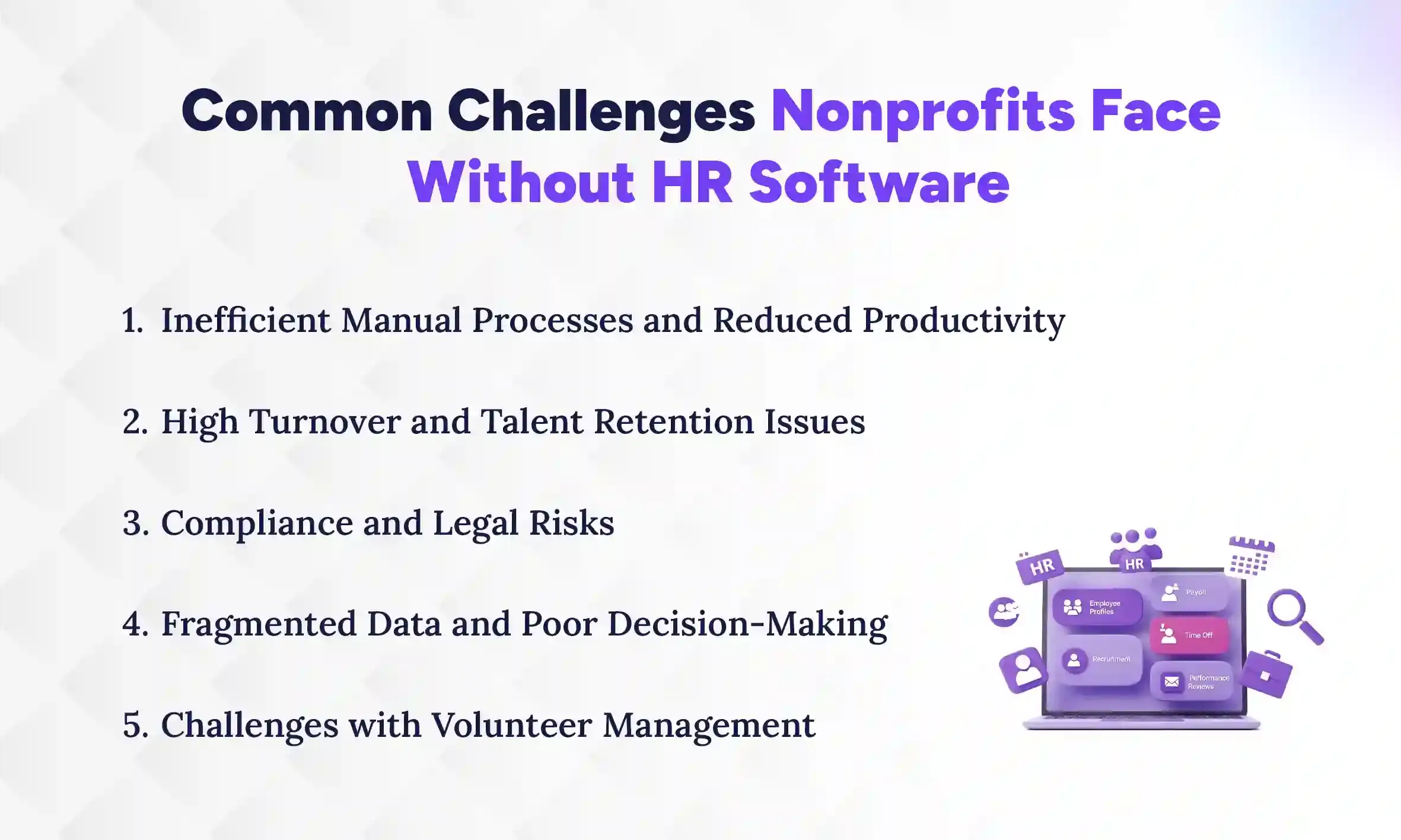
Common Challenges Nonprofits Face Without HR Software
Running a nonprofit without the right tools is like trying to build a house without a blueprint. While your heart is in the right place, you quickly find that small mistakes in paperwork can lead to big problems later on. Relying on old methods often leaves your team feeling frustrated and slows down the important work you do in the community. Here are the most common struggles Nepali nonprofits face when they stay manual.
1. Inefficient Manual Processes and Reduced Productivity
When you don't use software, basic tasks like tracking daily attendance or calculating monthly salaries take up way too much time. Your staff might spend hours every week just updating Excel sheets or looking for lost paper files in the office. This paperwork trap prevents your team from focusing on field visits or helping the people who need your services. Eventually, your whole organization starts moving more slowly because everyone is stuck doing boring administrative chores.
2. High Turnover and Talent Retention Issues
In Nepal, many talented people leave for better-paying jobs or move abroad because they feel their local workplace is disorganized. Without a proper HR system to track performance or offer training, staff members often feel ignored and undervalued. If they have to wait days just to get a simple leave approval or a payslip, they quickly lose interest in their work. High staff turnover is expensive because you have to keep spending time and money training new people who might also leave.
3. Compliance and Legal Risks
Following the Nepal Labor Act and keeping up with Social Security Fund (SSF) rules is very difficult to do by hand. One small math error in a tax calculation or a missed deadline for a government report can lead to heavy fines for your nonprofit. Without software to send you alerts, it is easy to forget when an employee's contract is about to expire. These legal mistakes don't just cost money; they can also damage your reputation with the government and your donors.
4. Fragmented Data and Poor Decision-Making
When your information is scattered across different notebooks and computers, it is impossible to see the big picture. If a donor asks for a report on how many hours were spent on a specific project, you might have to spend days digging through files to find the answer. Without clear data, you are basically guessing when it comes to planning your budget or hiring new staff for next year. Having messy records makes it very hard to prove to your partners that your organization is professional and trustworthy.
5. Challenges with Volunteer Management
Volunteers are the backbone of many Nepali nonprofits, but tracking their hours and skills manually is a total headache. You might lose track of who is currently active or forget to thank someone who has been helping for a long time. Without a central list, it is hard to coordinate where volunteers are needed most, leading to some projects having too many people and others having none. This confusion often makes volunteers feel frustrated, and they may stop showing up because they feel their time is being wasted.
Conclusion
Choosing the right HR software in Nepal is not just about having a digital list of names; it is about finding a tool that understands our local laws and makes your mission easier to achieve. While global options like Zoho are great for discounts, Pace HRMS is the best choice for nonprofits in Nepal today. It stands out because it is built locally to handle the specific tax, SSF, and government rules that we face every day.
By switching to a dedicated system like Pace, you stop wasting time on messy spreadsheets and start spending your energy where it matters most, making a real difference in the community. It is the smartest way to keep your organization professional, compliant, and ready for the future.
FAQs
Which is the best HR software for nonprofits in Nepal?
+
The best HR software for nonprofits in Nepal is Pace HRMS. However, it purely depends on your team size, budget, and needs.
How much does HR software for nonprofits cost in Nepal?
+
The cost of HR software for nonprofits in Nepal varies by tool and features. Some software charges per employee per month, while others offer flat pricing or nonprofit discounts.
Can HR software manage both staff and volunteers?
+
Yes, HR software can manage both staff and volunteers in one system. It helps track attendance, roles, and tasks for everyone.
Are there free or low-cost HR tools for small nonprofits?
+
Yes, some HR software offers free or low-cost plans for small nonprofits. Examples include Zoho People and Bitrix24.
How can HR software help with payroll and leave management?
+
HR software can calculate salaries, deductions, and taxes automatically. It can also track leave, attendance, and overtime easily.
Does HR software for nonprofits comply with Nepali labor laws?
+
Yes, many HR tools are designed to follow local labor rules and regulations. They generate reports and records that meet Nepali compliance standards.
Can HR software integrate with accounting or donor management tools?
+
Yes, most HR software can connect with accounting or donor management systems. This helps reduce manual work and keeps data consistent.
How easy is it to switch from spreadsheets to HR software?
+
Switching from spreadsheets to HR software is usually straightforward. Most tools offer import features and simple setup guides for small teams.
Ready to get started?
Book a 30-minute consultation call, and let's talk about your goals.