

If your hotel is growing but your guest list feels like a messy pile of names, notes, and scattered follow-ups, you’re not alone. Many hotel teams in Nepal handle bookings, WhatsApp replies, call logs, and feedback… all at once, on different screens, until nothing is truly connected.
Sounds like a mess?
That’s exactly where a hotel CRM helps. A CRM lets you organise your guests, their preferences, and your potential next step, all in a single place, without having to chase things manually.
In today’s hospitality world, guests expect personalization, faster replies, and smooth service from booking to checkout and beyond. That is why it becomes important to understand what CRM is, and what all a CRM software can do!
This guide breaks it all down, including features that matter most, and the top picks for the best CRM software for hotels in Nepal. You’ll also learn how to choose the right one for your hotel size and goals.
What is CRM in Hotel Management?
CRM (Customer Relationship Management) in hotel management is a strategy and technology-driven system that centralizes guest data, such as preferences, booking history, and feedback to personalize experiences, boost loyalty, and increase revenue. A hotel CRM software helps you manage guest relationships, before, during, and after the stay.
Now, here’s the difference. Traditional CRM was usually built for sales teams and leads across industries, while hotel CRM is designed around hospitality workflows. That means it supports reservation-related follow-ups, automated messages, and guest experience tasks that match hotel operations.
Most importantly, hotel CRM connects guest data to better service. When your team knows what a guest prefers (like a pillow type or late check-out request), you can respond faster and feel more organized.
Why Hotels Need CRM Software
Hotels need CRM software to turn guest data into better service and repeat bookings. When everything is organized and automated, your team spends less time searching and more time creating a great stay. Next, let’s look at the main reasons hotel CRM becomes a practical advantage for Nepali properties.
- Personalized guest experiences
- Centralized guest data
- Improved booking and retention rates
- Automation of marketing and communication
- Integration with PMS (Property Management Systems)
- Multi-property visibility when you scale
Key Features to Look for in Hotel CRM Software
The right hotel CRM should offer essential features like guest profile management, booking history tracking, automated communication, and PMS integration. Choosing the best CRM for hotels comes down to features that improve guest follow-up, marketing, and operations together. So focus on tools that actually help you respond faster and book more repeat stays. With that in mind, here are the CRM features you should prioritize before you buy:
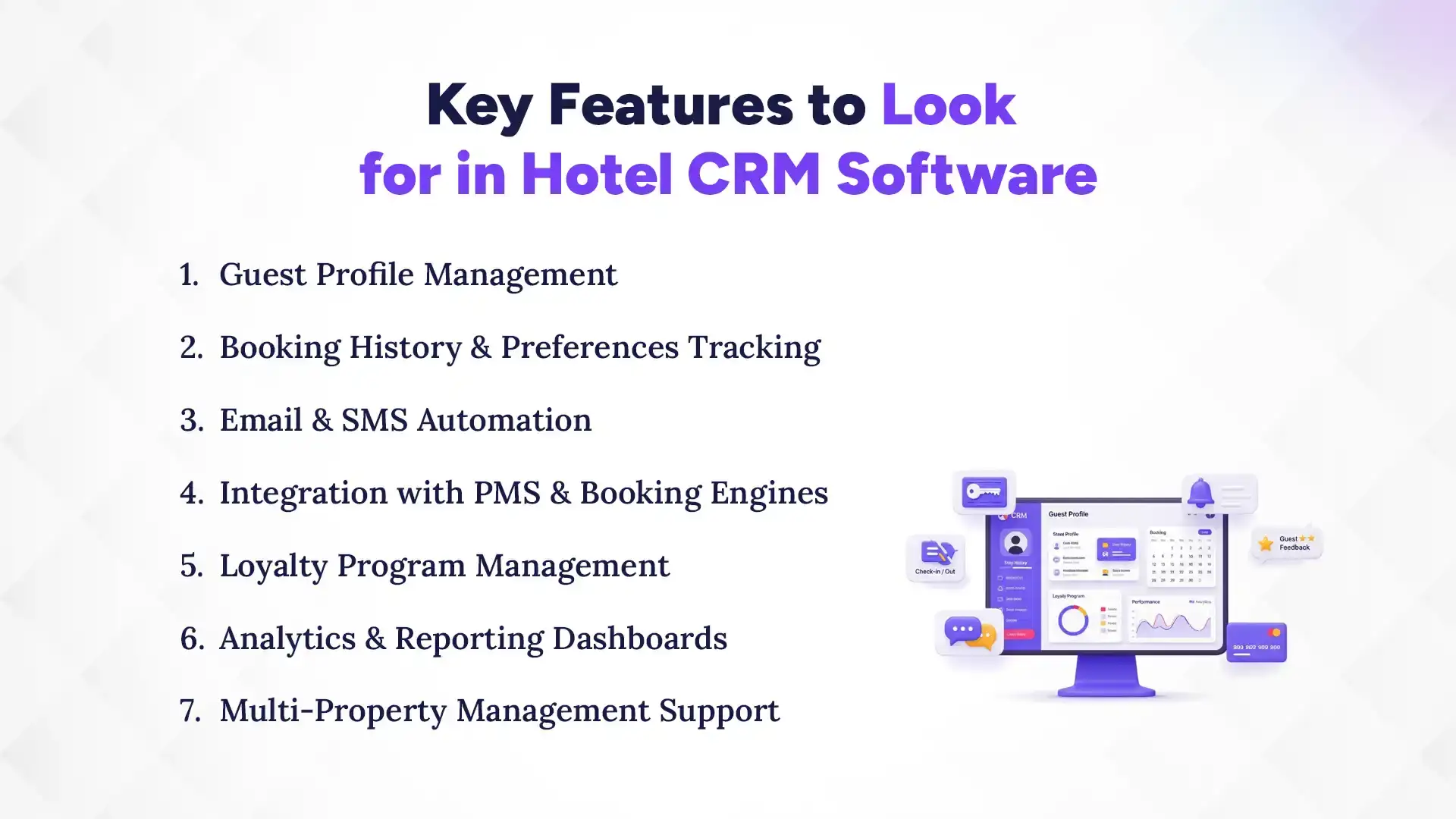
1. Guest Profile Management
You want CRM that builds a real guest profile, not just a contact list. Look for fields that capture stay dates, booking channels, room preferences, meal preferences, and past requests. Then, make sure the profile updates automatically when new bookings come in, so your team isn’t manually copying data like it’s 2012. Also check if you can tag guests by segments (such as VIP, family, corporate, honeymoon) for smarter follow-up.
2. Booking History & Preferences Tracking
Hotel CRM should help you track what guests booked and what they liked. For example, if a guest stays twice and always requests a quieter room, that preference should be visible instantly to reception and management. Next, confirm the CRM supports notes and history so your team can learn from feedback (complaints, service wins, special occasions) and act the next time. This is where personalization stops being “a nice idea” and becomes a system.
3. Email & SMS Automation
Automation is where hotels save time and avoid missed follow-ups. Choose a CRM that can schedule emails and SMS for key moments like pre-arrival confirmations, arrival reminders, feedback requests, and special-day greetings. In Nepal, many guests also prefer quick messaging, so check if the platform supports fast communication workflows your team will actually use. Then test whether templates look good and are easy to edit, because no one wants messages full of weird formatting.
4. Integration with PMS & Booking Engines
Your CRM should not be a separate “extra tool” that your staff must manually feed. Instead, it should integrate with your PMS and booking channels/engines so guest data flows correctly. Ask vendors how integration works, what data transfers (such as bookings, guest details, reservations), and how reliable it is during peak seasons. Smooth integration reduces errors and helps your team stop repeating work, especially during busy check-in days.
5. Loyalty Program Management
If you run loyalty perks, VIP upgrades, or repeat-stay rewards, CRM can manage them properly. Look for features that track points or tiers, store reward rules, and trigger member-only offers automatically. Then connect loyalty with guest history so you can reward the right people at the right time, not randomly. When loyalty becomes organized, repeat bookings feel more valuable for guests, and more predictable for your revenue team.
6. Analytics & Reporting Dashboards
Good CRM gives you visibility, not just storage. Focus on dashboards that show booking conversion by channel, campaign results, guest retention trends, and response timing. Then make sure reports are easy to export and share with your manager without needing a data scientist. This matters in Nepal because many hotels make decisions quickly, so your CRM should help you act with confidence, not guesses.
7. Multi-Property Management Support
If you manage multiple properties or plan to open more locations, choose a CRM that supports multi-property setups. That means one system for staff visibility, guest history, and reporting across hotels, without mixing data. Also check whether you can set different permissions by property, so the team of one branch doesn’t accidentally access another site’s sensitive info. With multi-property support, scaling becomes smoother instead of turning into a messy migration project later.
What Are Benefits of Using CRM Software in Nepalese Hospitality?
Using CRM helps Nepalese hotels improve guest relationships, grow repeat bookings, and run marketing more smartly. When data and communication are organized, your team becomes faster and your decisions become clearer. Now let’s break down the biggest benefits of CRM system that hotels feel in day-to-day work.
1. Increased Direct Bookings
CRM supports direct booking growth by helping you follow up better and faster. When you capture lead details from web forms or inquiries, CRM can trigger timely messages, so guests don’t disappear into the “maybe later” zone. Next, you can personalize offers based on guest preferences and previous stays, which makes direct booking feel worth it. Over time, this reduces dependence on third-party channels.
2. Better Guest Retention
Retention improves when your hotel remembers what guests care about. CRM can track guest history and send the right follow-up at the right time, like a thank-you message after checkout or a seasonal offer before the next trip. Also, it helps you react to feedback quickly, which turns unhappy guests into saved relationships. Then, retention becomes a system, not a lucky surprise.
3. Enhanced Marketing ROI
CRM makes marketing measurable. Instead of guessing which campaign worked, you can track engagement, conversions, and guest responses. Next, segment audiences (families, couples, corporate) so messages feel relevant instead of generic. This improves marketing ROI because you spend time and money on what actually brings bookings, not what only looks good on slides.
4. Improved Staff Productivity
When guest information is stored in one place, staff stops repeating questions and searching everywhere. That saves time for front desk teams and helps managers respond faster to issues. Next, automation reduces manual work like copying guest names into templates and sending reminders one by one. As a result, your staff can focus on service, not paperwork.
5. Data-driven Decision Making
CRM gives you insights about your guests and performance. You can see what channels drive bookings, which guest segments convert, and what follow-ups create returns. Next, use this information in weekly meetings so decisions become practical and evidence-based. Over time, you’ll spot patterns early, especially, before problems turn into lost revenue.
What Are the Top 5 Best CRM Software for Hotels in Nepal?
The best CRM software for hotels in Nepal often depends on your budget, tech setup, and how many properties you manage, but Pace CRM is a strong local-focused option, alongside HubSpot CRM, Salesforce Hospitality Cloud, and Zoho CRM. Each of these has different strengths, so the goal is to match the tool to how your hotel works. Now let’s talk through the top picks, so you can shortlist with clarity:
1. Pace CRM
Pace CRM Pace CRM has become a reliable choice for businesses in Nepal that prioritize usability, local support, and real-world implementation over flashy features. For hotels, it helps you keep guest records organized, stay on top of follow-ups, and communicate better with repeat guests without a complicated setup.
What stands out here is the support and flexibility. Instead of forcing you to change your process, the system can be adjusted to match how your hotel already operates. Such a customisation serves especially useful in Nepal, where many businesses need to rely on foreign tools and features, that do not really get the local requirements.
If you’re up for a demo of Pace CRM, it is worth asking about things like booking follow-ups, guest preferences, and how it connects with your existing booking or PMS system.
2. HubSpot CRM
HubSpot CRM is popular because it’s easy to get started with, and it grows with you. For hotels, it can help you manage guest contacts, send out email campaigns, and see who’s actually engaging with your offers. A simple way to use it is to map out your guest journey, like sending a welcome message before arrival, a feedback request after checkout, and special offers later on. This way, your communication feels more planned instead of random.
3. Salesforce Hospitality Cloud
Salesforce is more suited for larger hotels or groups that deal with higher volumes and more complex operations. If you’re managing multiple properties or departments, it helps bring everything into one system. It’s known for handling large amounts of data, detailed reporting, and structured workflows. So if your goal is to standardize how your team communicates with guests and manages operations, it can be very effective. That said, it’s not a plug-and-play solution. It usually needs proper planning and training. In simple terms, it works best for hotels that are ready to treat CRM as a core system, not just a basic tool.
4. Zoho CRM
Zoho CRM is a good middle-ground option with strong features without a very high cost. It covers the basics well: managing contacts, setting up follow-ups, and automating routine tasks. For hotels in Nepal, it’s especially useful if you deal with different types of bookings, like corporate clients, events, or travel agencies, and want to track everything in one place. If your goal is to keep guest data organized and improve communication without overspending, Zoho is definitely worth considering.
5. Pipedrive
Pipedrive is built around tracking deals, but that can actually work well for hotels that rely on bookings, partnerships, and repeat business. Think corporate clients, group bookings, or event inquiries, it helps you keep track of who needs follow-up and when. The interface is simple, so your team can clearly see what’s in progress and what needs attention. That alone can reduce missed opportunities. Just keep in mind, for deeper guest details like preferences and stay history, you may need to set things up carefully or connect additional tools
Comparing the 5 Best Hotel CRM Software for Nepalese Businesses
The biggest difference between these tools is how they match hotel workflow complexity, budget, and integration needs. Pace CRM focuses on local support and practical day-to-day use, HubSpot is strong for marketing and guest communication, Salesforce handles large and complex operations, Zoho offers a balance of features and cost, and Pipedrive is best for tracking bookings and follow-ups like a sales pipeline.
Instead of chasing the most popular name, choose the CRM that fits your operations like a well-tailored uniform. Below is a comparison of the top 5 best CRM software for Nepalese businesses to help you shortlist faster.
| CRM | Best For | Hotel-Friendly Strengths | Ease of Start |
|---|---|---|---|
| Pace CRM | Nepal-focused adoption | Local support, practical workflows | Usually strong onboarding |
| HubSpot CRM | Marketing + guest lifecycle | Automations, tracking, campaigns | Easy for most teams |
| Salesforce | Enterprise scale | Advanced enterprise data/workflows | Requires structured rollout |
| Zoho CRM | Value + customization | Automations, workflows, reports | Mid-easy, configurable |
| Pipedrive | Pipeline-led hotels | Deal tracking, task reminders | Very easy to adopt |
How to Choose the Best CRM for Your Hotel in Nepal?
To choose the best CRM for your hotel, start by checking fit with your size, budget, and integrations, then test usability with your staff. After that, confirm the CRM can support your guest journey steps, from pre-arrival to post-stay follow-up. Finally, use this checklist to make the selection process smoother.
1. Evaluate Your Hotel Size
First, decide how complex your guest operations are. A small boutique hotel may need simple guest profiles, automated follow-ups, and easy reporting. A larger chain or group of properties may need multi-property support, role-based access, and deeper system integration. Next, think about departments too! If you have front office, marketing, and sales working separately, your CRM must support coordination, not confusion.
2. Consider Your Budget & Pricing
When exploring the pricing of CRM, don’t only compare monthly costs, compare total cost of ownership. That includes implementation time, training, any integration work, and ongoing support. Also, ask whether the CRM offers a free plan or trial so you can test it before committing. Then, choose a plan that matches your “must-have” features today, not every feature you might someday wish for.
3. Understand the Integration Needs
Your CRM should connect with how you already run bookings. So list your current tools: PMS, booking engine, channel manager, and any customer messaging method your team uses. Then ask vendors directly what data syncs, how often it updates, and what happens if the integration breaks. After that, you’ll know whether the CRM will reduce work or accidentally create more work.
4. Prioritise Ease of Use
CRM adoption fails when the tool is too hard for busy staff. So check if the interface is simple, reports are readable, and templates are easy to set up. Next, run a small trial with reception staff and marketing staff, not just management. If your team can’t use it in real life, you won’t get real results, even if the CRM has impressive features on paper.
5. Seek Scalability
Pick a CRM that can grow with you, especially if you plan to increase rooms, add properties, or expand marketing. That means flexible user access, automation upgrades, and support for more guest segments. Next, confirm whether the system can handle peak seasons without slowdowns or data issues. Then, you’ll avoid the painful switch later when your operations become bigger and more connected.
6. Test the Providers’ Customer Support
Finally, choose a vendor that responds quickly and clearly. In Nepal, support speed matters because hotels face time pressure during events and busy check-in days. Ask about onboarding, training sessions, documentation quality, and how help requests are handled. Then, choose CRM partners who can guide your team in the first few months, not only after problems become serious.
Common Challenges When Implementing Hotel CRM in Nepalese Businesses
Many hotels struggle because CRM implementation involves changes in process, not just software. If integration, training, and data migration aren’t planned, teams may stop using the system, or use it incorrectly. Next, let’s look at the most common issues so you can avoid them early.
1. Integration Complexity
Integrating CRM with PMS, booking engines, and other tools can get tricky, especially if the systems use different data formats. So plan the integration step carefully and confirm what data syncs properly. Next, test the integration in a real booking scenario, not only in demos. Then, assign someone to monitor the first weeks so errors are caught quickly.
2. Staff Training
CRM adoption depends on training, and training doesn’t happen by accident. If staff only get a one-time walkthrough, they’ll revert to old habits like spreadsheets and WhatsApp notes. So schedule hands-on training for the actual roles (front office, marketing, sales), and include simple examples from daily work. Next, keep a quick “how-to” guide for common tasks so staff can learn without waiting for someone else.
2. Data Migration Issues
Data migration can be messy if your guest records are incomplete or stored in different formats. So clean your data before importing, remove duplicates, and standardize naming rules. Next, migrate in small batches so you can verify accuracy each step. Then, confirm that historical data displays correctly in guest profiles, because wrong history leads to wrong follow-ups.
3. Cost Concerns
CRM costs can feel high if you don’t control scope. So define your must-have features first, then build gradually. Next, ask vendors about licensing, support, and integration costs upfront. After that, compare alternatives with real needs, not just feature lists. There is no loss in buying an affordable CRM software with your most-needed features complemented by quality support. When budget planning is clear, CRM becomes an investment, not a stressful expense.
Conclusion
In Nepalese hospitality, the best CRM software for hotels is the one that fits your operations, simplifies guest communication, and helps you book repeat stays. If you take something from this guide, remember this: CRM is not just data storage, it’s a system for better guest experience and stronger revenue.
From Pace CRM to HubSpot, Salesforce, Zoho, and Pipedrive, each option has strengths, but your hotel’s goals should decide the winner.
Now, you don’t need a perfect system to start improving. Begin with your must-have features, test with your staff, and choose a vendor that supports real rollout.
If you want to move faster, schedule a demo or consultation, compare your top two options, and pick what feels easiest to implement. Your future repeat guests are waiting.
Searching for CRM solutions for retails in Nepal? Discover the best CRM software for retail industry in Nepal, its key features, benefits, and implementation steps to improve sales, customer engagement, and growth.