

Nepal's construction sector contributed approximately 7.8% to the national GDP in 2023, with over 15,000 registered construction companies competing for projects across residential, commercial, and infrastructure segments. Yet most builders still track client inquiries across multiple construction sites using scattered spreadsheets and WhatsApp messages juggling site visits, follow-ups, and sales team coordination without a unified system.
CRM software for builders solves this by centralizing all your prospect data, automating reminders, and giving your sales team visibility into every deal from first inquiry to project handover. In this guide, we'll cover the best CRM options for Nepali construction companies, the features that actually matter for builder sales cycles, and how to choose the right system for your business.
What is CRM Software for Builders?
CRM stands for Customer Relationship Management. For builders, it's software that centralizes all your client and prospect information, storing contact details, tracking every phone call and site visit, managing follow-ups, and moving deals through your sales pipeline from initial inquiry to project handover.
Unlike generic CRM systems built for retail or service businesses, builder CRM includes construction-specific features that match how you actually sell properties and projects. This means you receive tools for scheduling site visits, tracking which plots or units each prospect is interested in, coordinating sales teams across multiple construction sites, managing project milestones, and generating quotes tied to specific properties.
Top CRM software options for builders in Nepal include locally-supported solutions like Pace CRM, affordable platforms like Zoho CRM, and marketing-focused tools like HubSpot CRM. Specialized construction management platforms like ProjectSayogi also offer CRM capabilities alongside project tracking. The right choice depends on your team size, budget, and whether you need local support or can work with international providers.
Why Construction Companies in Nepal Need CRM Software?
Construction companies in Nepal need CRM software to centralize client inquiries from phone calls, WhatsApp messages, and walk-ins into one unified system. Most builders still rely on spreadsheets or paper notebooks to track prospects, which breaks down quickly as project portfolios grow.
Without CRM, one forgotten follow-up can mean a lost sale worth lakhs of rupees. When sales teams work across multiple sites, keeping everyone aligned becomes nearly impossible without a shared system that tracks every client interaction, automates reminders, and provides real-time visibility into deal progress.
1. Managing Multiple Project Inquiries and Leads
Construction companies receive inquiries from many channelsphone calls, site visits, referrals, and online forms. Without a central system, leads end up scattered across different phones and notebooks. CRM software captures every inquiry in one database, showing exactly where each lead came from and what stage they're at in the buying process.
2. Tracking Site Visits and Client Follow-ups
Remembering which clients visited which plots and when to call them back is difficult when you're juggling dozens of prospects. CRM automates reminders and logs every interaction, so nothing slips through the cracks.
3. Coordinating Sales Teams Across Construction Sites
When your sales staff works at different project locations, visibility becomes a challenge. CRM gives managers a clear view of who is handling which lead and what progress has been made.
4. Preventing Lost Deals and Missed Opportunities
The cost of a forgotten follow-up in construction sales can be significant. CRM ensures every potential buyer receives timely attention, which directly impacts your conversion rates.
What Features Builders Look for in CRM Software
Builders need CRM software with lead management, visual sales pipelines, site visit scheduling, mobile access for field teams, quote generation tools, and integration with accounting software. These features match the longer, more complex sales cycles in construction compared to retail or service businesses.
Not every CRM fits construction businesses. The sales cycle for building projects is longer and more complex than retail or service businesses, so you'll want features that match how builders actually sell.
- Lead and contact management: A centralized database storing all prospect and client information with complete interaction history.
- Visual sales pipeline: Drag-and-drop interface showing where each deal standsfrom initial inquiry through site visit, negotiation, booking, and closing.
- Site visit scheduling: Calendar integration and activity logs to track when clients visited properties and what was discussed.
- Quote and proposal management: Tools to generate and send price quotes directly from the CRM.
- Mobile access for field teams: App or mobile-responsive access so sales staff at construction sites can update records in real time.
- Integration with accounting tools: Connections to accounting and project management software to avoid duplicate data entry.
- Reporting and analytics: Dashboards showing conversion rates, sales performance, and revenue forecasts.
How to Choose the Right CRM for Your Building Business?
Choose a CRM by evaluating cloud vs on-premise deployment, pricing that fits your budget, scalability for growth, local support availability in Nepal, and integration with your existing accounting and project management tools. Start by assessing your current sales process, then match CRM features to your specific workflow needs.
Selecting CRM software involves more than comparing feature lists. You'll want to consider how the system fits your current operations and future growth plans.
1. Cloud-Based vs On-Premise CRM
Cloud-based CRM is hosted online and accessible from anywhere with the internet. On-premise CRM is installed on your local servers. For most Nepali builders, cloud-based options make more sense due to lower upfront costs and the ability to access data from job sites.
2. Pricing and Budget for Construction Companies
CRM pricing typically follows per-user monthly subscriptions, flat fees, or freemium models. Factor in training and support costs when comparing options. The cheapest subscription isn't always the best value.
3. Scalability for Growing Project Portfolios
Choose a CRM that can grow with your business. If you're planning to take on more projects or expand your sales team, the system can handle additional users and data without performance issues.
4. Local Support and Nepal-specific Compliance
CRMs with local support teams understand the Nepali construction landscape better. Look for providers offering Nepali language options and compliance with local data practices.
5. Integration with Your Existing Tech Stack
Your CRM can connect with tools you already use email, calendar, accounting software. Poor integration creates extra manual work and defeats the purpose of automation.
Top 5 Best CRM Software for Builders in Nepal
Pace CRM, Zoho CRM, HubSpot CRM, Salesforce, and Pipedrive are among the top CRM software options for builders in Nepal. These platforms offer a mix of local relevance, scalability, and construction-focused features like lead tracking, project coordination, and client management. From Nepal-built systems to globally trusted tools, each caters to different business sizes and operational needs.
Here’s how they compare and where each stands out:
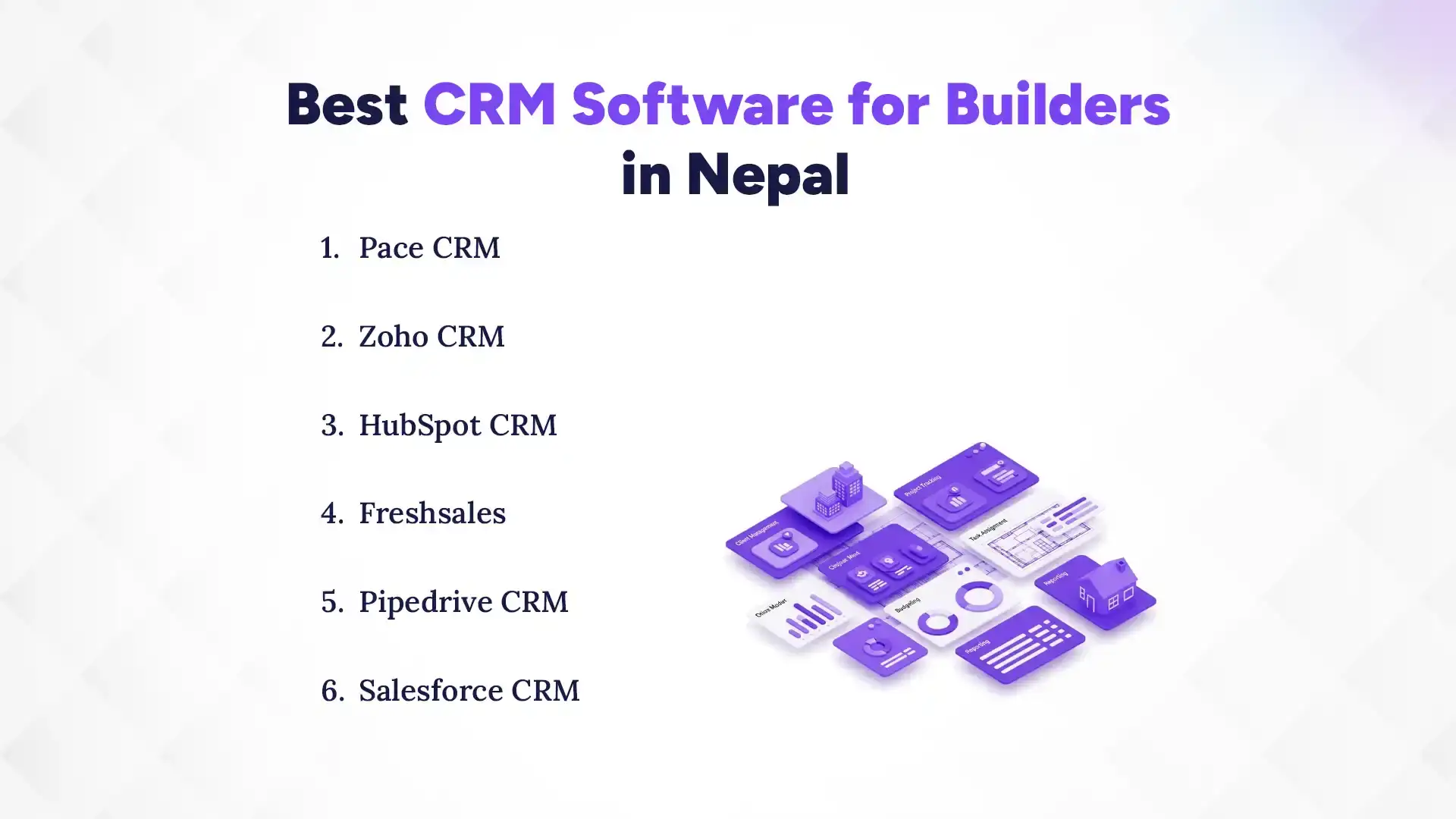
1. Pace CRM
Pace CRM is designed specifically for SMEs and growing businesses in Nepal, making it highly relevant for local builders. It offers visual pipeline management, marketing automation, and workflow tools, all backed by reliable local support from The Pace Infosys team. With features like drag-and-drop sales pipelines, automated follow-up reminders, lead scoring, custom dashboards, and email/calendar integration, it helps streamline both sales and project coordination. It is best suited for Nepali builders who want hands-on local support and alignment with Nepal-specific business practices and compliance.
2. Zoho CRM
Zoho CRM is an affordable and feature-rich CRM widely used by SMEs in Nepal. It provides strong functionality including contact and deal management, workflow automation, email integration, and a robust mobile app for on-the-go access. Its flexible pricing and availability of local partners make it easy to adopt and scale. This makes it ideal for small to mid-sized builders looking for a balance between cost and capability.
3. HubSpot CRM
HubSpot CRM is a popular choice for builders who want a free, easy-to-use CRM with built-in marketing capabilities. It includes core CRM features along with email tracking, templates, meeting scheduling, marketing automation, and reporting dashboards. The platform is especially useful for managing leads and nurturing prospects through digital channels. It is best for builders who want marketing and CRM tools combined without high upfront investment.
4. Pipedrive CRM
Pipedrive is known for its intuitive and highly visual sales pipeline, making deal tracking simple and efficient. It includes activity reminders, email integration, sales reporting, and mobile access to keep teams organized and responsive. Its simplicity is a major advantage for teams that prefer ease of use over complex systems. It is ideal for builders who prioritize clear pipeline visibility and straightforward sales management.
5. Salesforce CRM
Salesforce is a global leader in CRM, offering unmatched customization and scalability for complex business needs. It provides advanced analytics, extensive integrations, enterprise-grade security, and the flexibility to handle large teams and multi-layered sales processes. While powerful, it requires more setup and investment compared to other options. It is best suited for large construction firms with dedicated IT resources and complex operational requirements.
Comparison of the Best CRM Software for Nepalese Businesses
| CRM | Best For | Starting Price | Local Support |
|---|---|---|---|
| Pace CRM | Nepal-focused SMEs | Contact for pricing | Yes |
| Zoho CRM | Budget-conscious builders | Free tier available | Via partners |
| HubSpot CRM | Marketing-focused builders | Free tier available | Online |
| Freshsales | Mid-sized companies | Per user/month | Online |
| Pipedrive | Sales-focused teams | Per user/month | Online |
| Salesforce | Enterprise builders | Premium pricing | Online |
Benefits of CRM Software for Construction Companies
CRM software transforms how construction companies manage their sales operations. Beyond just organizing contact information, the right CRM system directly impacts your bottom line by preventing lost opportunities, improving team coordination, and giving you clear visibility into your sales performance across all active projects.
Here are the major advantages of CRM software you receive:
1. Improved Lead Tracking And Higher Conversion Rates
Centralized lead data and automated follow-ups help convert more inquiries into actual sales. You can see exactly which leads are hot and which ones require nurturing. CRM systems track every touchpoint with prospects, giving you complete visibility into which marketing channels bring the best leads and where potential buyers drop off in your sales process.
2. Centralized Client And Project Information
All client details, documents, and communications live in one accessible place. No more searching through emails or notebooks to find a client's requirements. When a prospect calls asking about a property they viewed three weeks ago, your sales team can instantly pull up their complete history including which units they liked, their budget range, and what objections they raised.
3. Better Coordination Between Office And Field Teams
Real-time updates ensure everyone knows the current status of each deal. Sales staff at different sites stay aligned without constant phone calls. When your site manager updates a unit's availability or pricing, your entire sales team sees the change immediately, preventing embarrassing situations where multiple agents promise the same property to different buyers.
4. Reduced Manual Data Entry And Errors
Automation eliminates repetitive tasks and reduces mistakes from manual record-keeping. Your team spends less time on admin and more time selling. Instead of typing the same client information into multiple spreadsheets, your staff enters it once and the CRM automatically populates all relevant fields, schedules follow-up reminders, and generates reports without additional manual work.
5. Scalability For Multiple Construction Projects
CRM grows with your business, supporting more users, projects, and data as you expand your operations. Whether you're managing three projects or thirty, the system handles increased complexity without requiring you to rebuild your entire sales process from scratch.
Cloud-Based CRM vs On-Premise CRM for Nepali Builders
Cloud-based CRM is typically the smarter and more practical choice for most Nepali builders. It significantly reduces upfront investment, eliminates the need for managing servers, and allows teams to access data from construction sites, offices, or anywhere with an internet connection. In a fast-moving construction environment where site visits, client follow-ups, and real-time updates matter, this flexibility and ease of use make a clear difference in productivity and decision-making.
Here’s a snapshot of the comparison to help you decide:
| Factor | Cloud-Based CRM | On-Premise CRM |
|---|---|---|
| Upfront Cost | Lower (subscription) | Higher (license + hardware) |
| Accessibility | Anywhere with internet | Office network only |
| Maintenance | Handled by provider | Requires in-house IT |
| Data Control | Stored on provider servers | Full local control |
| Best For | Most Nepali builders | Large firms with IT teams |
It is clear that for most construction companies in Nepal, cloud-based CRM makes more sense. The lower cost, easier setup, and accessibility from job sites outweigh the benefits of on-premise systems unless you have specific data control requirements.
Common Challenges Builders Face without CRM Software
Without CRM software, construction companies struggle with disorganized client data, missed follow-ups, and poor visibility into their sales pipeline. These operational gaps directly impact revenue and make scaling nearly impossible as your business grows.
1. Client Data Scattered Across Spreadsheets And Notebooks
Tracking prospects across multiple files leads to confusion and lost information. Important details about client preferences get buried or forgotten. When a prospect calls back weeks later, your team wastes valuable time searching through different spreadsheets and notebooks to find their information.
2. Forgotten Follow-Ups After Site Visits
Without automated reminders, sales staff forget to contact interested buyers. Each missed follow-up is a potential lost sale. A buyer who visited your site last week might sign with a competitor simply because you didn't call them back at the right time.
3. No Visibility Into Sales Pipeline And Deal Status
Managers can't see which deals are progressing and which are stalled. Forecasting and planning become nearly impossible. You're essentially running your sales operation blind, unable to predict revenue or identify bottlenecks until it's too late.
4. Poor Communication Between Sales And Project Teams
Lack of shared information leads to miscommunication and client frustration. The sales team promises something the project team doesn't know about. This disconnect damages your reputation and creates operational chaos when commitments can't be fulfilled.
5. Difficulty Scaling Operations With Business Growth
Manual processes break down as you take on more projects and hire more staff. What worked for five employees became chaos with twenty. Your growth gets constrained not by market demand, but by your inability to manage increasing complexity with outdated systems.
How To Implement CRM Software In Your Construction Company?
Implement CRM software by auditing your current sales process, defining clear requirements and budget, selecting a builder-focused CRM, migrating your existing data, training your teams, and continuously monitoring adoption. While most construction companies in Nepal can complete the basic setup within 2–4 weeks, achieving full efficiency typically takes 2–3 months as teams adjust and workflows are refined. A structured approach ensures smoother adoption and helps you get real value from your CRM investment.
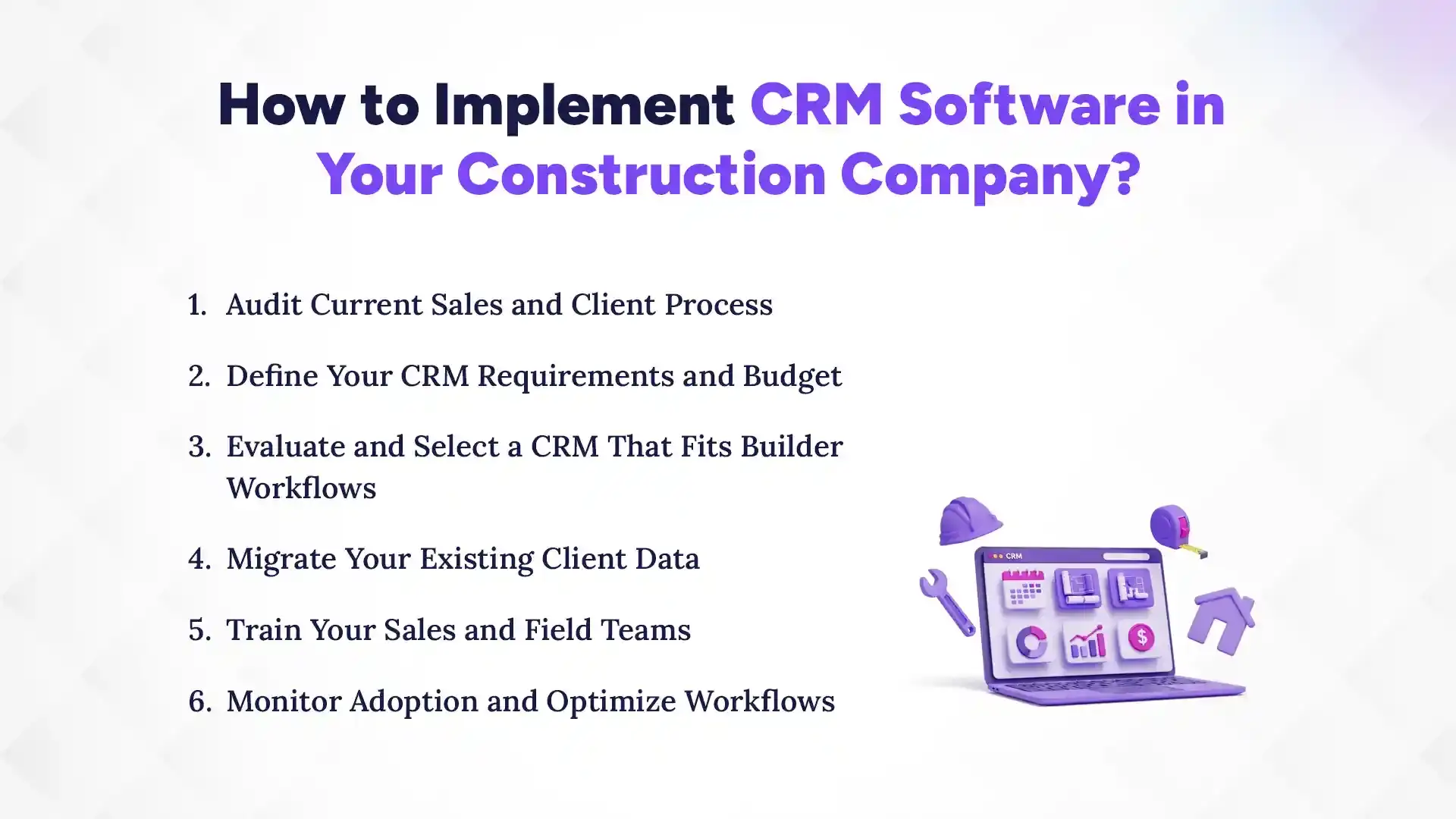
1. Audit Your Current Sales And Client Management Process
Start by mapping how your leads currently move from inquiry to final deal. Check each stage like site visit, follow-up, and closing to see where delays happen. This helps you clearly spot gaps in your sales process. As a result, you understand exactly what needs fixing.
Also review where all client data is stored today. It may be in spreadsheets, notebooks, or multiple tools. This scattered setup often causes missed follow-ups and confusion. With this clear view, you can plan your CRM setup better.
2. Define Your CRM Requirements And Budget
List the key features your construction business needs in a CRM. Focus on lead tracking, follow-ups, and site management tools. This keeps your choice practical and need-based. It also avoids paying for extra features you don’t use. Then set a clear budget including setup and training costs. This gives you a full picture of total investment. It also helps you compare options more easily. With this, you can make a confident decision.
3. Evaluate And Select A CRM That Fits Builder Workflows
Shortlist CRM tools that match construction workflows. Compare how they handle leads, projects, and team coordination. This helps you quickly filter out weak options. It also saves time in decision-making. Next, try demos or free trials before final selection. Focus on ease of use for your team. A simple system ensures faster adoption. This improves daily usage and results.
4. Migrate Your Existing Client Data
Collect all your existing data from spreadsheets and other tools. Organize it properly before importing into the CRM. This avoids errors and missing information. Clean data improves system accuracy. Remove duplicates and update old records during migration. Check important details like contacts and project status. This ensures your CRM starts with reliable data. It also supports better follow-ups.
5. Train Your Sales And Field Teams
Begin with basic CRM functions like adding leads and updating status. Keep training simple and easy to follow. This helps your team learn faster. It also builds confidence early. Then give hands-on practice inside the system. Real tasks help better understanding than theory. This reduces mistakes during real use. Over time, your team becomes more efficient.
6. Monitor Adoption And Optimize Workflows
Track how often your team uses the CRM after setup. Check which features are used regularly. This shows how well the system is adopted. It also highlights gaps. Collect feedback from your team and improve workflows. Adjust settings based on real usage needs. This makes the CRM more practical. Over time, it becomes fully aligned with your work.
Ready to Manage Leads Better?
Use Pace CRM to track leads, automate follow-ups, and close deals faster. Simple, powerful, and built for your growth.
Conclusion
Choosing the right CRM is only part of the equation. Having a partner who understands Nepal's construction industry and can provide ongoing support matters just as much as the software itself.
Local expertise means faster problem resolution, better understanding of your sales process, and guidance tailored to how Nepali builders actually operate. The Pace Infosys team has worked with construction and real estate companies across Nepal, combining CRM implementation with broader digital solutions like HR software for construction companies.
If you're ready to stop losing leads and start closing more deals, a conversation about your specific requirements is the logical next step.
Schedule a call with The Pace Infosys team to discuss your CRM requirements.