
.webp&w=3840&q=75)
Every day, US businesses search Google for phrases like "IT staffing agency Austin," "healthcare recruitment firm near me," or "executive search firm for startups." Candidates search for "best recruitment agency for marketing jobs" or "staffing agency that places remote workers." These are high-intent searches from people who are ready to engage, and the recruitment agencies that appear at the top of those results get the inquiry.
Most recruitment agencies in the US are invisible in these searches, not because they lack expertise, but because they have no SEO strategy. A strong LinkedIn presence and a referral network are not enough when potential clients and candidates are starting their search on Google. This guide covers what SEO for recruitment agencies involves, the strategies that work, common mistakes to avoid, and how to find the right partner to build your organic visibility.
What Is SEO for Recruitment Agencies?
SEO for recruitment agencies is the process of optimizing a staffing or recruitment firm's website and online presence so it ranks higher on Google when businesses search for hiring partners and candidates search for placement opportunities. It combines local optimization, niche keyword targeting, content creation, job listing optimization, and technical improvements to build consistent organic visibility that drives both client and candidate inquiries without paying for every click.
Recruitment agency SEO differs from general SEO because the audience is dual: businesses looking to hire and candidates looking for jobs. Both groups use different search terms, have different intent, and need different content to convert. A specialized recruitment SEO strategy addresses both audiences simultaneously, building a website that ranks for client-facing queries like "executive search firm Chicago" and candidate-facing queries like "tech jobs in Austin" within the same domain.
Why US Recruitment Agencies Need SEO in 2026
Businesses in the US increasingly search for staffing and recruitment partners online before making contact. A hiring manager looking for a specialized recruitment firm will search Google, review the top results, check the agency's website for relevant industry experience, and then reach out. If your agency does not appear in that search, you are not part of that conversation.
Candidates follow the same pattern. A marketing professional looking for a recruiter who specializes in their field will search for "marketing recruitment agency in New York" or "best staffing agency for brand managers" and evaluate the agencies that appear. A strong organic presence puts your firm in front of both audiences at exactly the moment they are looking.
The US recruitment market is intensely competitive. Large staffing firms like Robert Half, Kforce, and Hays invest heavily in digital marketing and SEO. Job aggregator platforms like Indeed and LinkedIn dominate many broad search terms. Independent and mid-sized recruitment agencies that do not invest in SEO are consistently outranked by competitors who do, losing both client inquiries and candidate registrations to firms with stronger organic presence.
When a competitor ranks above you for a search like "healthcare staffing agency Texas" or "finance recruitment firm San Francisco," they receive the inquiry, build the relationship, and earn the placement fee. SEO determines which agency gets that first call.
The benefits of SEO in the long term far outweigh the paid marketing campaign. Recruitment firms that want to stay in business should shift their focus toward sustainable organic growth, investing in a robust digital strategy that secures top Google rankings, builds trust with high-value clients, and reduces reliance on expensive ad spend.
Key SEO Strategies for Recruitment Agencies
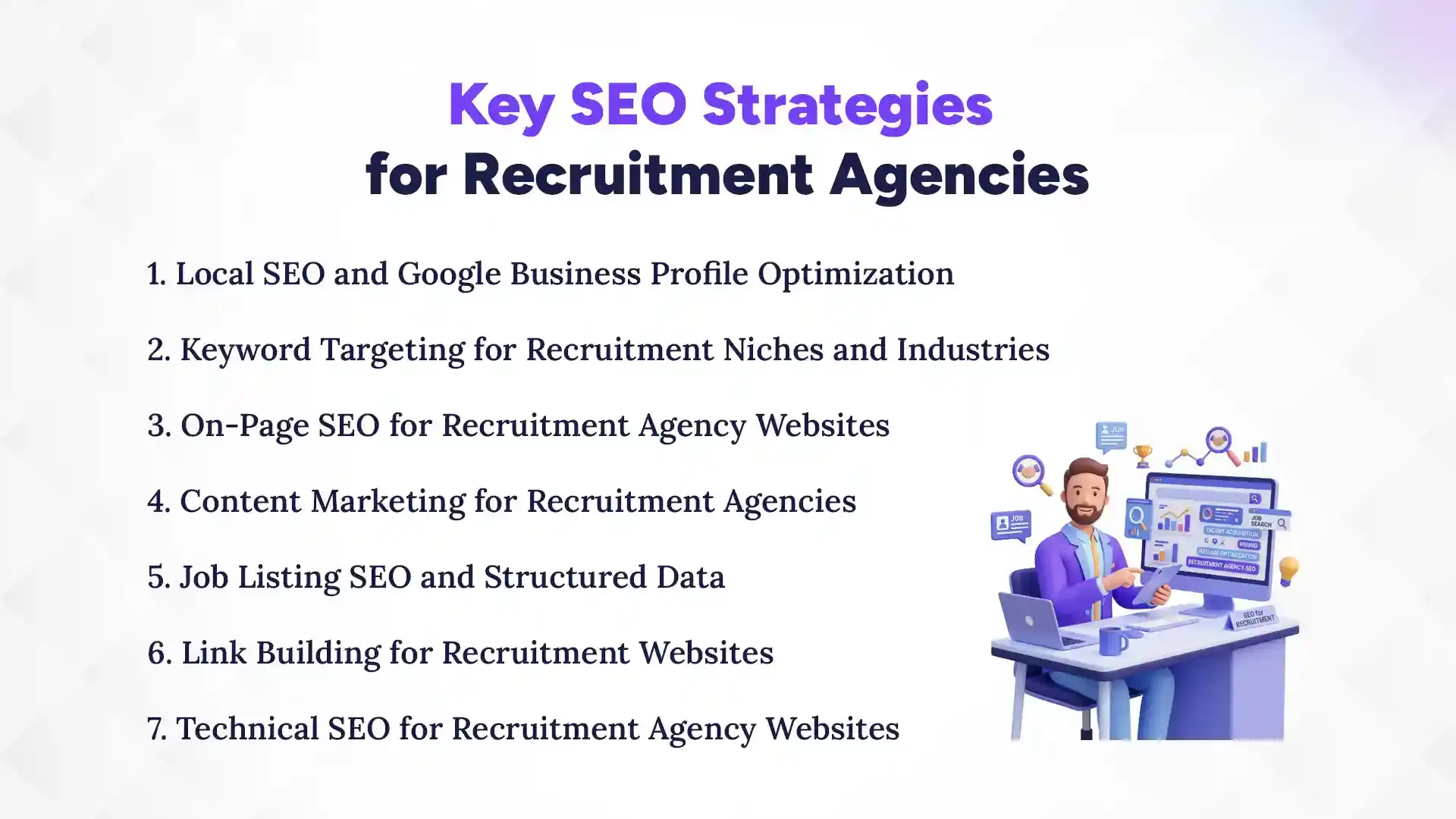
The key SEO strategies for recruitment agencies are local SEO and Google Business Profile optimization, niche keyword targeting, on-page SEO, content marketing, job listing SEO, link building, Off-page SEO, and technical SEO. Applying all seven consistently builds the organic visibility that attracts a steady stream of clients and candidates.
1. Local SEO and Google Business Profile Optimization
Local SEO is critical for recruitment agencies because most client searches include a location. "Staffing agency near me," "recruitment firm in Dallas," and "executive search Austin TX" are all location-based queries that require strong local SEO signals to rank for consistently.
Your Google Business Profile must be fully completed with your agency name, address, phone number, website, specializations, office hours, and professional photos. Categories must accurately reflect your primary recruitment focus. Client reviews directly influence your local ranking, making a consistent review strategy essential. Your name, address, and phone number must match exactly across every online directory where your agency is listed.
2. Keyword Targeting for Recruitment Niches and Industries
Effective recruitment SEO targets the specific terms clients and candidates use when searching for your specialization. Broad terms like "recruitment agency" or "staffing firm" are dominated by large national players. Niche-specific and location-specific combinations such as "cybersecurity staffing agency Austin," "nursing recruitment firm Texas," or "fintech executive search New York" give independent agencies a realistic path to page one rankings.
Research both client-facing and candidate-facing keywords for your niche. Clients search for "IT staffing partner" or "retained executive search firm." Candidates search for "best tech recruiter in Austin" or "marketing jobs through staffing agency." Both keyword types belong in your strategy.
3. On-Page SEO for Recruitment Agency Websites
Every page on your recruitment website needs to be structured so Google can understand and rank it effectively. Each industry specialization or job function you recruit for should have its own dedicated page with a keyword-optimized title tag and meta description, a clear H1 heading, content that addresses client and candidate needs, and internal links to related pages. This happens when you effectively optimize your On-page SEO.
Your homepage, industry specialization pages, about page, team bio pages, and contact page all need individual optimization. Content should speak directly to the problems your clients and candidates are trying to solve, demonstrating your agency's expertise and track record in specific industries.
4. Content Marketing for Recruitment Agencies
A consistent content strategy builds authority, attracts organic traffic, and establishes your agency as the go-to resource in your recruitment niche. Effective recruitment content addresses questions that both clients and candidates are actively searching for.
Client-focused content: "How to choose a recruitment agency for your fintech startup," "What to expect from an executive search process," and "How long does it take to fill a senior engineering role?"
Candidate-focused content: "How to work with a recruiter to find your next role," "What recruiters look for in a marketing candidate," and "How to prepare for a placement interview."
Publishing consistently in your niche builds the topical authority that helps Google understand your agency as a genuine expert in your specific recruitment market, improving rankings across all of your target keywords over time.
5. Job Listing SEO and Structured Data
Job listings are a significant but frequently overlooked SEO opportunity for recruitment agencies. Google for Jobs, Google's specialized job search feature, surfaces relevant job listings directly in search results when candidates search for specific roles. Optimizing your job listings with structured data markup, clear job titles, location data, salary ranges, and detailed job descriptions allows them to appear in Google for Jobs and capture candidate searches that bypass traditional recruitment directories.
Each job listing should target the exact search terms candidates use, include location details, and be updated regularly to signal freshness to Google. A well-optimized job listings page can drive substantial candidate traffic entirely through organic search.
6. Link Building for Recruitment Websites
Links from reputable external websites signal authority and trustworthiness to Google, improving rankings across your entire website. For recruitment agencies, effective link building includes listings on industry directories like the American Staffing Association and SHRM, local business directories, guest articles in HR and industry publications, partnerships with professional associations in your recruitment niche, and any media coverage your agency earns through thought leadership or community involvement.
Each quality link strengthens your domain authority and improves rankings for every page on your site. Consistent link building over time creates a compounding authority advantage that competitors without a similar strategy cannot easily overcome.
7. Technical SEO for Recruitment Agency Websites
Technical SEO ensures your website functions in a way that allows Google to crawl, index, and rank it effectively. The most critical factors for recruitment agencies are loading speed, mobile responsiveness, secure HTTPS connection, and clean site architecture.
Most job searches happen on mobile devices, making mobile optimization essential. A slow website loses candidates and clients before they engage with your content. Google's Core Web Vitals assess loading performance and visual stability, and poor scores suppress rankings. A logical site structure with clear navigation helps both users and Google understand how your content and specializations are organized.
How Long Does SEO Take for a Recruitment Agency?
SEO for recruitment agencies delivers results over time, not immediately. In months one through three, the focus is foundational: technical improvements, Google Business Profile optimization, keyword research, and on-page updates to existing pages. Small visibility gains may appear, but significant ranking changes are unlikely this early.
In months four through six, published content begins gaining traction, local SEO signals strengthen, and measurable improvements in rankings and organic traffic become visible. Client and candidate inquiries from organic search start appearing with increasing regularity as the agency's domain authority builds.
From month six onward, SEO compounds consistently. Rankings stabilize on page one for target keywords, organic traffic grows month over month, and the inquiry pipeline from search becomes one of the agency's most reliable and cost-effective growth channels.
Which Is the Best SEO Agency for Recruitment Firms in the US?
The best SEO agency for a US recruitment firm is one that understands both the technical requirements of modern SEO and the dual-audience nature of recruitment marketing, where you need to rank for client searches and candidate searches simultaneously within the same domain strategy.
When evaluating SEO partners, look for demonstrated experience with recruitment or professional services clients, a clear approach to both client-facing and candidate-facing keyword strategies, transparent reporting on rankings and traffic, and an honest assessment of realistic timelines rather than guaranteed rankings.
The Pace Infosys is a trusted digital marketing partner for recruitment agencies in the US looking to build sustainable organic visibility that attracts both new clients and qualified candidates. With a proven approach to recruitment SEO covering local optimization, niche keyword strategy, content marketing, job listing optimization, and technical performance, The Pace Infosys helps recruitment firms compete and grow organically in one of the most competitive professional services markets in the country.
Common SEO Mistakes Recruitment Agencies Make
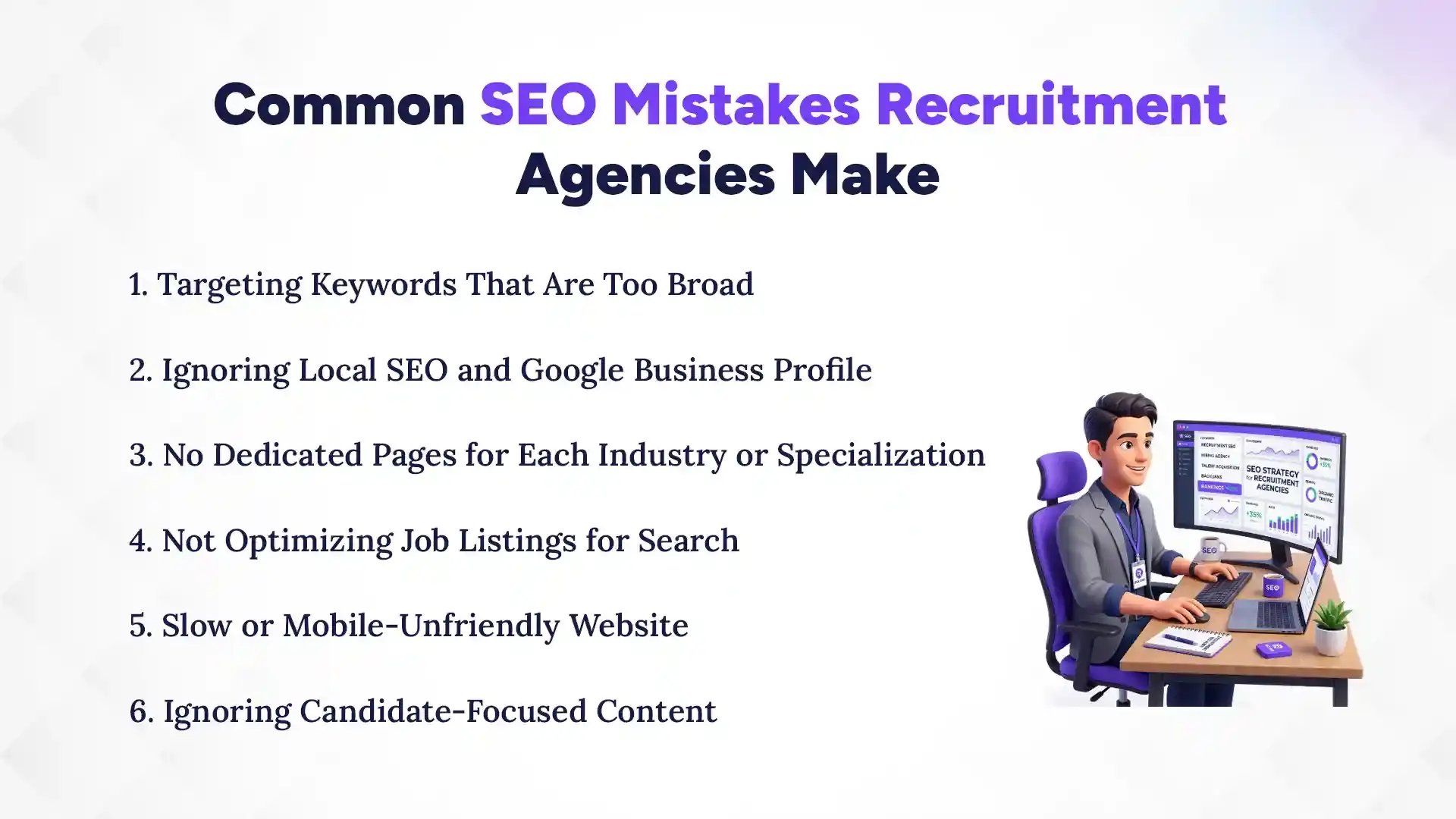
Common SEO mistakes recruitment agencies make are targeting keywords that are too broad, ignoring local SEO and Google Business Profile, having no dedicated pages for each industry or specialization, not optimizing job listings for search, running a slow or mobile-unfriendly website, and ignoring candidate-focused content. Each mistake costs your agency client inquiries and candidate registrations every day.
1. Targeting Keywords That Are Too Broad
Competing for terms like "recruitment agency" or "staffing firm" puts your website against national giants and job aggregators with far greater domain authority. Targeting niche-specific and location-specific keywords gives your agency a realistic and effective path to page one visibility where the competition is winnable.
2. Ignoring Local SEO and Google Business Profile
Many recruitment agencies do not have a fully optimized Google Business Profile, missing the local map pack entirely. For agencies that serve specific metro areas, local SEO is often the fastest and most direct path to new client inquiries from organic search.
3. No Dedicated Pages for Each Industry or Specialization
A single services page cannot rank effectively for multiple industries simultaneously. An agency that recruits for technology, healthcare, and finance needs separate, dedicated pages for each specialization, each targeting the keywords that clients and candidates in those industries actually use.
4. Not Optimizing Job Listings for Search
Job listings published without structured data markup, clear job titles, or location details miss the Google for Jobs opportunity entirely. Properly optimized listings drive substantial candidate traffic directly from search without requiring any additional advertising spend.
5. Slow or Mobile-Unfriendly Website
Most job searches happen on smartphones. A recruitment website that loads slowly or displays poorly on mobile loses candidates and clients before they read a single word about your agency, directly reducing both rankings and conversion rates simultaneously.
6. Ignoring Candidate-Focused Content
Many recruitment agencies publish only client-facing content about their services. Candidates are searching too, and content that addresses their questions, such as how to work with a recruiter, what to expect during placement, or how to find jobs in a specific field, drives significant organic traffic and builds the candidate pipeline that makes your agency more valuable to clients.
Above all, the costliest mistake a staffing firm can make is hiring a provider without fully understanding the actual cost of SEO services required for their market, only to abandon the campaign midway through. Because organic search takes time to mature, dropping out early means losing your initial investment right before the strategy begins generating high-value client leads and candidate placements.
Conclusion
SEO is the most sustainable way for US recruitment agencies to build a consistent pipeline of client inquiries and candidate registrations without paying for every placement platform listing or job board post. While paid advertising stops the moment you stop paying, SEO builds compounding authority that continues working for your agency around the clock.
The recruitment agencies investing in SEO now are building an organic advantage that becomes harder for competitors to close with every passing month. Every day without an SEO strategy is another day your competitors are capturing the clients and candidates who searched, found them first, and never knew you existed.
The right time to start is before that gap widens further. Contact Pace Infosys today and take the first step toward making your recruitment agency the first result businesses and candidates see when they search.