

Ever noticed how some training institutes run smoothly like a well-oiled machine, while others struggle with messy schedules, lost records, and confused learners? The real difference often comes down to one thing: the system they use to manage learning. In today’s fast-moving digital world, relying on manual processes feels like trying to run a marathon in slippers, possible, but painfully inefficient.
In this blog on LMS Software for Training Institutes in Nepal, we will explore how training institutes can choose the right LMS software in Nepal to simplify operations and improve learning outcomes. You’ll learn what features matter most, what mistakes to avoid, and how to compare different options effectively. By the end, you’ll have a clear roadmap to select an LMS that actually fits your institute’s needs, not just something that looks good on paper.
What is LMS Software for Training Institutes?
LMS software for training institutes is a digital platform used to manage, deliver, and track training programs in an organized and centralized way, which explains what is LMS in practical terms. It helps institutes handle courses, trainees, trainers, assessments, and certifications in one system. Instead of relying on manual records or scattered tools, everything is automated and easy to access. This makes training more structured, efficient, and scalable for growing institutes.
Key Features of LMS Software for Training Institutes in Nepal
LMS software for training institutes in Nepal comes with powerful features of LMS that help streamline training delivery and management. These features make it easier to handle batches, learners, trainers, and course materials in one centralized system. Instead of manual coordination, everything becomes automated and organized. This improves efficiency, reduces errors, and enhances the overall learning experience for both administrators and trainees.
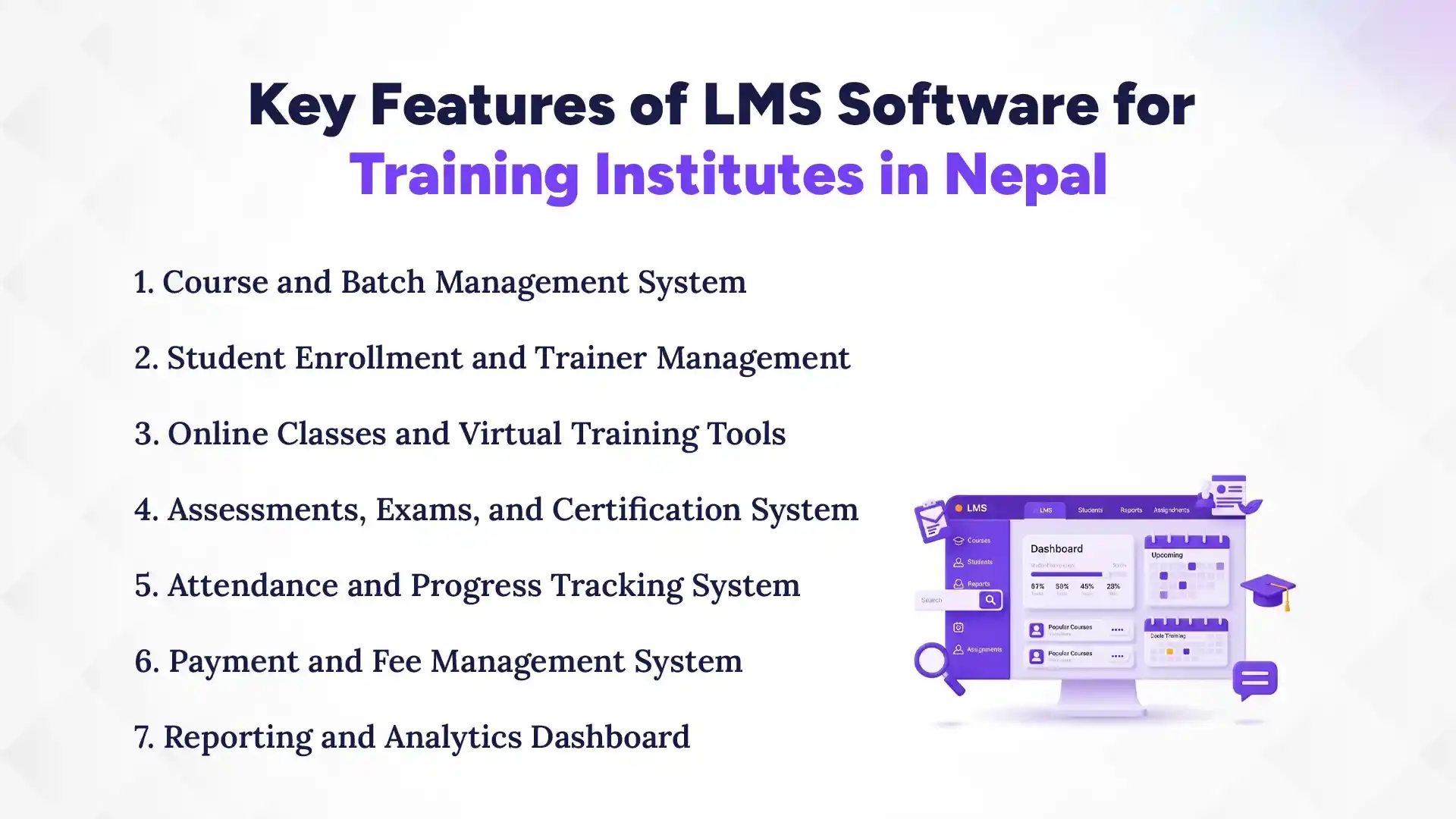
1. Course and Batch Management System
This feature allows institutes to create and manage multiple courses and batches easily. Trainers can organize content based on different skill levels and schedules. It helps in structuring training programs clearly and systematically. Students can be grouped into relevant batches for better learning outcomes. It also makes tracking each batch’s progress simple. Overall, it keeps training operations well organized.
2. Student Enrollment and Trainer Management
LMS software simplifies the process of enrolling students and managing trainers. Administrators can assign roles and permissions easily. It helps maintain a clear record of all participants in the system. Trainers can be assigned to specific courses or batches. This reduces confusion and improves coordination. It ensures smooth management of both learners and instructors.
3. Online Classes and Virtual Training Tools
This feature supports live classes and virtual training sessions through integrated tools. Trainers can conduct interactive sessions from anywhere. It also allows sharing of presentations, videos, and learning materials. Students can attend classes remotely, making learning more flexible. Recorded sessions can be accessed later for revision. This enhances accessibility and engagement in training.
4. Assessments, Exams, and Certification System
LMS platforms enable online tests, quizzes, and assignments for trainees. Automated grading reduces manual effort and errors. Trainers can evaluate performance quickly and accurately. Certificates can be generated automatically upon course completion. This ensures a smooth and professional assessment process. It also improves transparency in evaluation.
5. Attendance and Progress Tracking System
This feature helps track trainee attendance and learning progress in real time. Trainers can easily monitor participation levels. It provides insights into student performance and engagement. Weak learners can be identified early for support. Reports can be generated for better analysis. It ensures accountability in training programs.
6. Payment and Fee Management System
LMS software often includes tools for managing course fees and payments. Institutes can track payments and generate invoices easily. It reduces manual accounting errors and improves transparency. Students can make payments through integrated systems. This simplifies financial management for training institutes. It ensures smooth fee collection processes.
7. Reporting and Analytics Dashboard
The analytics dashboard provides detailed reports on training performance and operations. Institutes can track enrollment, completion rates, and performance trends. It helps in making data-driven decisions. Trainers can evaluate course effectiveness easily. Visual reports make data easy to understand. This improves overall planning and strategy.
How Does LMS Software Improve Training Institutes in Nepal?
LMS software improves training institutes in Nepal by digitizing and automating the entire training process, making it more efficient and organized. It helps institutes manage courses, students, trainers, and assessments in one centralized platform. This reduces manual workload and improves communication and coordination. Overall, it enhances training quality and helps institutes scale their operations smoothly.
- Centralized training management: All courses, learners, and materials are managed in one system
- Improved efficiency: Automates administrative tasks like enrollment, tracking, and reporting
- Better learner engagement: Interactive tools and online classes improve participation
- Real-time progress tracking: Monitors student performance and training outcomes instantly
- Cost and time savings: Reduces dependency on manual processes and physical resources
- Scalable training system: Easily supports growth in students, courses, and trainers
Why LMS Software is Essential for Training Institutes in Nepal?
LMS software is essential for training institutes in Nepal because it transforms traditional training methods into a more structured, efficient, and digital learning system. It helps institutes manage courses, learners, and assessments in one platform while improving overall training quality. With increasing demand for skill-based education, LMS platforms ensure better organization and scalability. They also make learning more accessible and measurable for both trainers and students.
1. Challenges Faced by Traditional Training Institutes
Traditional training institutes often struggle with manual record keeping and disorganized course management. Attendance, exams, and progress tracking are handled on paper or spreadsheets, which increases errors. Communication between trainers and students is often slow and inconsistent. Updating learning materials is also time-consuming. These limitations reduce efficiency and affect learning outcomes. Overall, manual systems cannot support modern training needs.
2. Shift from Manual Training to Digital Platforms
Training institutes are now moving from manual methods to digital LMS platforms for better efficiency. Digital systems help automate enrollment, scheduling, and assessments. This shift reduces workload for administrators and improves accuracy in operations. It also allows learners to access content anytime and anywhere. Institutes can manage larger batches without confusion. This transition is key to modern education growth.
3. Role of LMS in Modern Skill Development
LMS software plays a major role in improving skill development by offering structured and interactive learning. It supports online courses, assessments, and real-time feedback. Learners can track their progress and improve continuously. Trainers can customize content based on learner needs. It also helps institutes deliver industry-relevant training. Overall, LMS enhances both learning quality and employability.
Top Benefits of LMS Software for Training Institutes in Nepal
LMS software brings major improvements to training institutes in Nepal by making learning more structured, efficient, and scalable. It replaces manual processes with automated systems that handle courses, learners, assessments, and reporting in one place. This not only saves time but also improves accuracy and consistency. Overall, it helps institutes deliver better training experiences while growing smoothly in a competitive education environment, highlighting the key benefits of LMS.
1. Improved Training Efficiency and Organization
LMS software streamlines all training activities into a single organized system. Trainers can easily manage courses, schedules, and learning materials without confusion. It reduces time spent on manual administrative tasks. Students also get structured access to content, improving learning flow. Everything becomes more systematic and easy to track. This leads to smoother training operations overall.
2. Better Learner Engagement and Interaction
LMS platforms make learning more interactive through quizzes, videos, and live sessions. Students can actively participate instead of just listening passively. Communication tools allow better interaction between trainers and learners. This improves understanding and retention of knowledge. Engaged learners perform better in assessments. It creates a more dynamic training environment.
3. Centralized Training Management System
All training activities are managed from one centralized platform in an LMS. This includes course content, student data, attendance, and assessments. It eliminates the need for multiple disconnected tools. Trainers and admins can access everything easily. It improves coordination and reduces errors. Overall, it simplifies institute management significantly.
4. Cost-Effective Training Operations
LMS software reduces the need for physical materials and manual processes. Institutes can save money on printing, administration, and logistics. Online training reduces travel and infrastructure costs. Automated systems also reduce staff workload. This makes training more affordable in the long run. It improves financial efficiency for institutes.
5. Real-Time Performance Tracking and Insights
LMS platforms provide instant insights into learner performance and progress. Trainers can track attendance, scores, and participation easily. This helps identify weak areas early. Data-driven reports support better decision-making. It improves training quality through continuous monitoring. Everything becomes measurable and transparent.
6. Scalable for Growing Training Institutes
LMS software is designed to support growth without operational difficulties. Institutes can easily add more courses, learners, and trainers. It handles increasing workloads without losing performance. This makes expansion smooth and manageable. Scalability ensures long-term usability of the system. It supports both small and large training institutes effectively.
How to Choose the Best LMS Software for Training Institutes in Nepal?
You can choose the best LMS software for training institutes in Nepal by carefully evaluating your training goals, required features, usability, scalability, pricing, and long-term support. A good LMS should not only solve current needs but also support future growth without complications. It should be easy for trainers and learners to use while offering strong integration and reliable vendor support. A well-planned decision ensures better efficiency and long-term success for the institute.
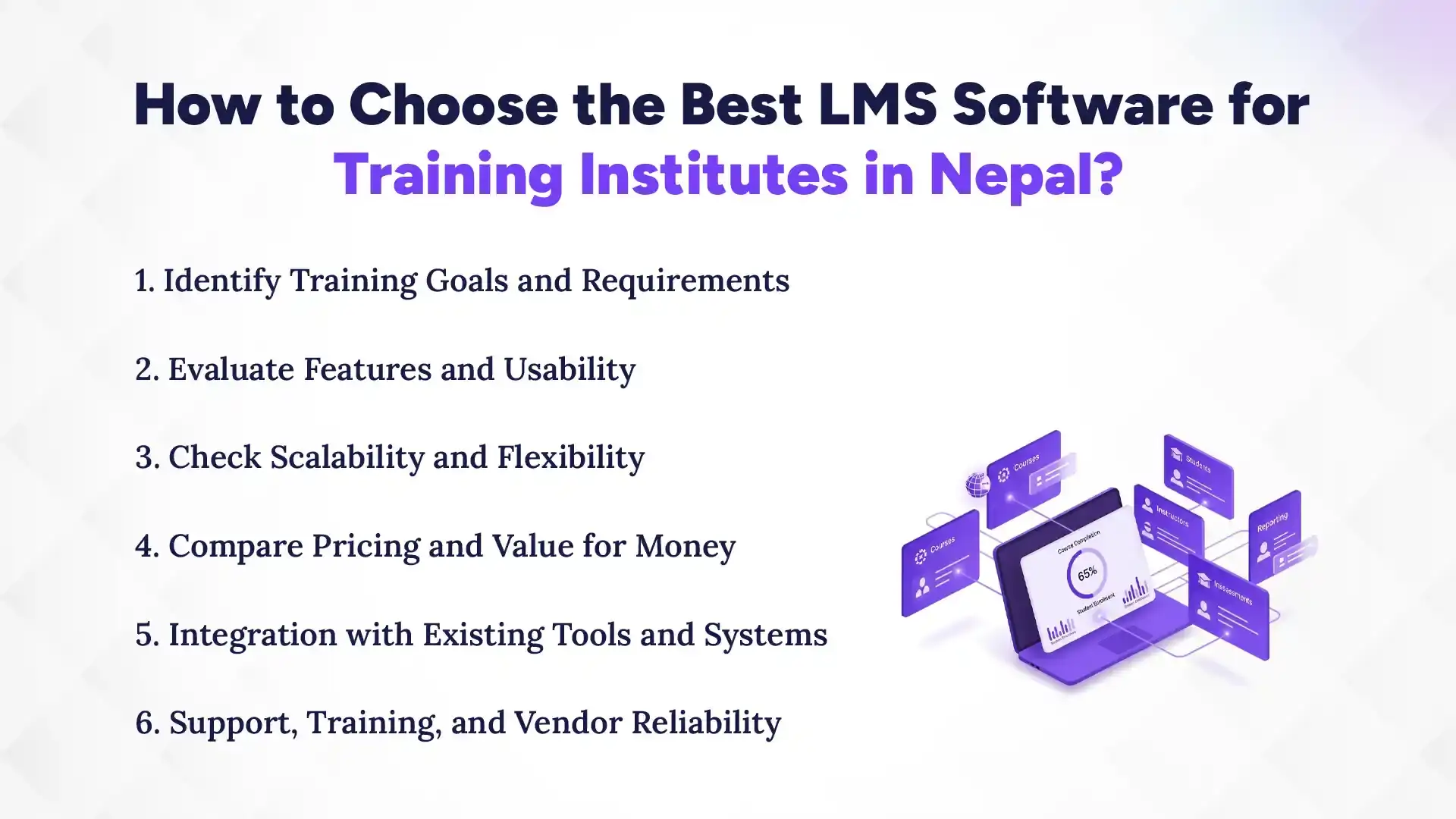
1. Identify Training Goals and Requirements
Start by clearly understanding what your institute wants to achieve with an LMS. This includes course types, number of learners, and training methods. Identifying goals helps narrow down suitable options. It also prevents unnecessary feature overload. A clear requirement plan ensures better decision-making. This step builds the foundation for choosing the right system.
2. Evaluate Features and Usability
Check whether the LMS offers essential features like course management, assessments, and tracking tools. Usability is equally important for both trainers and learners. A complicated system can reduce adoption rates. The platform should be simple and intuitive to use. Easy navigation improves daily efficiency. Good usability ensures smooth training operations.
3. Check Scalability and Flexibility
The LMS should be able to grow with your institute. As student numbers and courses increase, the system must handle higher demand. Flexibility allows customization based on training needs. Scalable systems prevent future migration issues. It ensures long-term stability and performance. This makes it a future-proof investment.
4. Compare Pricing and Value for Money
Evaluate different LMS options based on cost and features offered. The cheapest option is not always the best choice. Focus on long-term value rather than just initial price. Check for hidden costs like upgrades or maintenance. A balanced pricing model ensures sustainability. It helps institutes manage budgets effectively.
5. Integration with Existing Tools and Systems
A good LMS should easily integrate with tools already used by the institute. This includes payment systems, communication apps, or reporting tools. Integration reduces manual work and improves efficiency. It also ensures smooth data flow between systems. Lack of integration can create operational gaps. Seamless connectivity improves overall performance.
6. Support, Training, and Vendor Reliability
Reliable customer support is crucial for smooth LMS operation. Vendors should offer proper training and quick assistance when needed. Good support reduces downtime and technical issues. Training helps staff use the system effectively. Vendor reliability ensures long-term stability. This builds trust and confidence in the platform.
Common Mistakes to Avoid When Choosing LMS Software
Choosing LMS software for training institutes is a critical decision, but many organizations make avoidable mistakes that affect long-term performance. A wrong choice can lead to poor adoption, operational inefficiencies, and wasted investment. It is important to evaluate usability, scalability, and support before finalizing any system. Careful selection ensures smooth implementation and better training outcomes.
1. Ignoring User Experience and Simplicity
One of the biggest mistakes is ignoring how easy the LMS is to use. If the system is complicated, trainers and learners may avoid using it. A poor user experience reduces engagement and slows down adoption. Simple navigation and clean design are essential for daily use. Without usability, even powerful features go unused. A user-friendly system ensures better results and satisfaction.
2. Choosing Over-Complicated Systems
Many institutes choose LMS platforms with too many advanced features they don’t actually need. This makes the system harder to manage and understand. Over-complication leads to confusion among users. It also increases training time for staff and learners. Simple and focused systems often perform better in real scenarios. The goal should be efficiency, not complexity.
3. Not Planning for Future Growth
Some institutes only focus on current needs and ignore future expansion. As training programs grow, the LMS must handle more users and content. Without scalability, performance issues can occur later. This may force costly system migration in the future. Planning ensures long-term stability. A scalable LMS supports sustainable growth.
4. Overlooking Support and Training Needs
Good LMS software must come with reliable vendor support and training. Without proper guidance, users may struggle to use the system effectively. Lack of support can lead to downtime and frustration. Training ensures smooth adoption across the institute. Many organizations underestimate this factor during selection. Strong support is essential for long-term success.
Which is the Best LMS for Training Institutes in Nepal?
Pace LMS is the best LMS for training institutes in Nepal because it is designed to meet the real operational needs of Nepali training centers with simplicity and efficiency. It offers all essential features like course management, batch handling, assessments, and automation in one easy-to-use platform. Unlike complex global systems, it focuses on practical usability for trainers and learners. It also supports scalability, making it suitable for both small and growing institutes.
Conclusion
Choosing the right LMS software for training institutes in Nepal is not just a technical decision, it is a long-term investment in how effectively your institute delivers learning. A well-designed LMS from The Pace Infosys helps streamline training operations, improve learner engagement, and reduce manual workload. From course management to assessments and performance tracking, everything becomes more organized and efficient when the right system is in place. It ultimately transforms the way training institutes operate in a more structured and digital direction.
As the demand for skill-based education continues to grow in Nepal, institutes need systems that are scalable, easy to use, and reliable. The right LMS should align with your goals, support future expansion, and provide strong vendor support. When chosen wisely, it not only improves training quality but also enhances overall institutional growth and reputation in the long run. Also, explore LMS systems for schools and colleges in Nepal to ensure broader academic and administrative efficiency.