
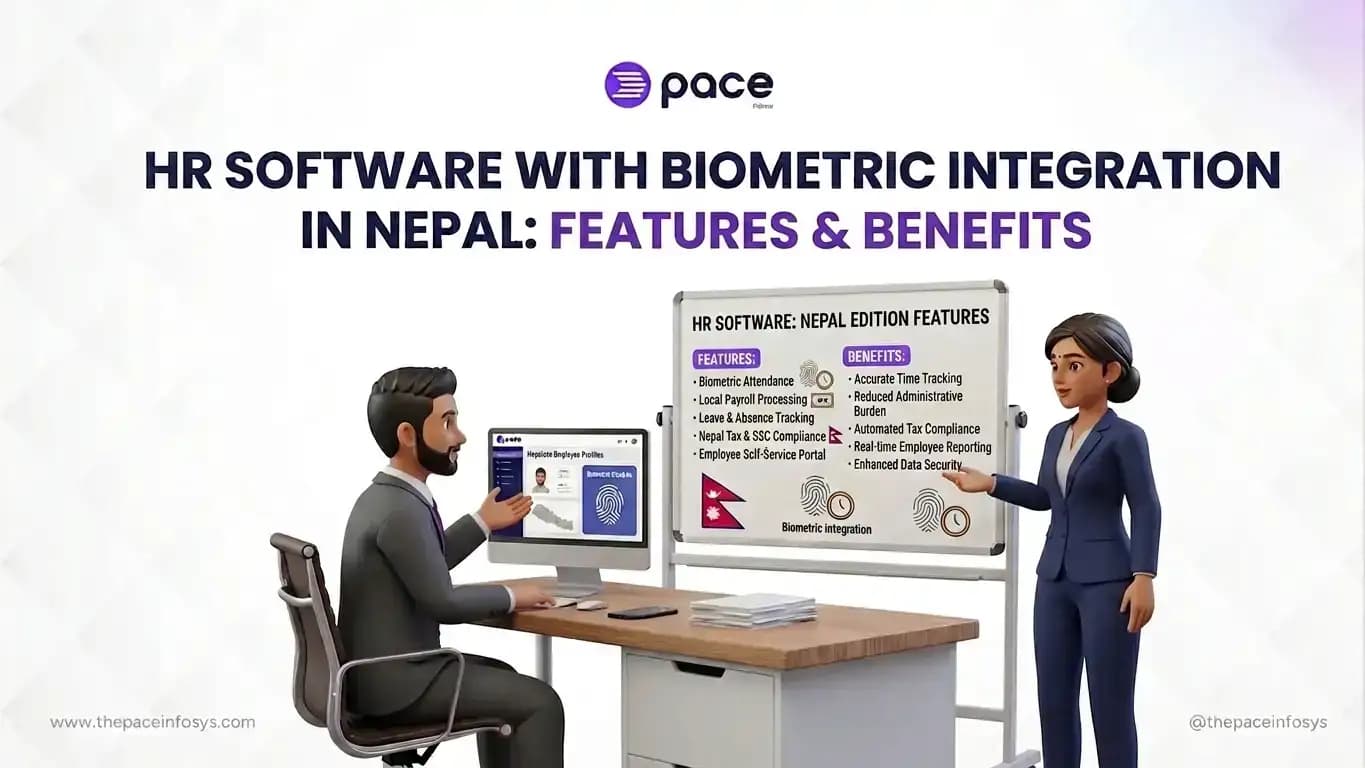

HR software with biometric integration is a connected system that captures employee attendance directly from fingerprint, face recognition, or card-based biometric devices and feeds that data automatically into HR modules for attendance tracking, leave management, payroll processing, and compliance reporting, eliminating manual entry at every step.
Most companies in Nepal currently manage attendance through paper registers, manual punch cards, or standalone biometric devices that store data in isolation. The result is proxy attendance, transcription errors when attendance data is transferred to payroll, and HR teams spending hours each month reconciling records that should update automatically.
This guide covers what HR software with biometric integration does, the specific challenges it solves for Nepali companies, the features that matter most, and how to choose the right platform for your organization.
What Is HR Software with Biometric Integration?
HR software with biometric integration is a centralized HR management system that connects directly to biometric attendance devices, fingerprint scanners, face recognition terminals, or RFID card readers so that every clock-in and clock-out is captured automatically, synced to the HR dashboard in real time, and used to calculate attendance, leaves, overtime, and payroll without any manual data entry.
It differs from a standalone biometric device because a device alone only stores raw punch data. Without integration, that data must be manually exported, cleaned, and entered into a separate payroll or HR system, a process that introduces errors and delays at every transfer point. HR software with biometric integration removes all manual steps by connecting the device directly to the HR platform so attendance, leave balances, shift records, and salary calculations update automatically from a single data source.
Companies in Nepal need the two systems connected because running biometric hardware and HR software as separate tools creates the same data gaps, errors, and reconciliation problems that manual attendance registers produce, just with more steps involved.
Why Companies in Nepal Need HR Software with Biometric Integration
Companies in Nepal need HR software with biometric integration because manual attendance systems and disconnected biometric devices create payroll errors, enable attendance fraud, and leave organizations without the audit-ready records required under Nepal's Labour Act 2074.
- Eliminating Buddy Punching and Proxy Attendance: Biometric verification confirms physical presence at the device, making it impossible for one employee to clock in on behalf of another, a common attendance fraud in Nepali workplaces with manual or card-based systems.
- Removing Manual Attendance Entry Errors: Direct integration eliminates the transcription step where HR staff manually transfer punch data into payroll spreadsheets, removing the calculation errors that cause overpayments, underpayments, and employee disputes every month.
- Connecting Attendance Data Directly to Payroll: When biometric data flows automatically into the payroll module, salary calculations reflect actual hours worked, overtime logged, and leaves taken with no manual reconciliation required before processing.
- Generating Audit-Ready Attendance Records: Integrated systems produce timestamped, device-verified attendance logs that satisfy Nepal's Labour Act 2074 requirements for documented working-hour records.
- Giving HR Managers Real-Time Staff Visibility: Live dashboards show who is present, who is late, and who is absent across every department and location at any moment without waiting for end-of-day manual reports.
Key Challenges Companies Face Without Biometric HR Integration
Key challenges companies face without biometric HR integration are proxy attendance, manual entry errors, payroll miscalculations, no real-time staff visibility, and non-compliance with Labour Act 2074 attendance record requirements.
1. Proxy Attendance and Buddy Punching
In companies using paper registers or card-based systems, employees can clock in on behalf of absent colleagues with no verification mechanism to detect or prevent it. This inflates salary costs, distorts attendance records, and creates an accountability gap that HR managers cannot close without biometric verification tied directly to the individual employee's physical identity.
2. Manual Attendance Entry Errors
Transferring attendance data from a standalone biometric device or paper register into a payroll spreadsheet manually introduces transcription errors at every step. A single digit entered incorrectly in an attendance total produces a payroll calculation error that HR teams must then trace, correct, and reprocess, consuming time that a direct integration would have eliminated entirely.
3. Payroll Miscalculations From Inaccurate Attendance Data
When payroll is calculated from manually transferred attendance data, errors in the attendance record produce errors in the salary output. Overpayments erode the payroll budget. Underpayments create employee disputes and, if repeated, constitute a violation of Nepal's Labour Act 2074 salary payment requirements. Integrated systems remove the manual transfer step and ensure payroll is always calculated from verified, device-captured attendance data.
4. No Real-Time Visibility Into Staff Presence
HR managers at companies without integrated biometric systems typically cannot answer a basic question, "Who is in the office right now?" without physically checking or calling department heads. Real-time biometric integration gives HR and management a live dashboard view of attendance status across every department and location, enabling faster decisions on shift coverage, overtime authorization, and absence follow-up.
5. Non-Compliance With Labour Act 2074 Attendance Requirements
Nepal's Labor Act 2074 requires employers to maintain accurate records of employee working hours. Paper registers and manual spreadsheets are difficult to verify, easy to alter, and produce no tamper-evident audit trail. Biometric attendance records integrated into HR software produce timestamped, device-verified logs that satisfy compliance requirements and protect the organization if working hour records are audited or disputed.
Key Features of HR Software with Biometric Integration
The key features of HR software with biometric integration are real-time biometric attendance capture, automated shift and schedule management, leave and absence tracking linked to biometric data, direct payroll integration, overtime calculation and compliance reporting, and multi-location device support.
1. Real-Time Biometric Attendance Capture
Real-time biometric attendance capture allows companies to record every employee clock-in and clock-out directly from fingerprint, face recognition, or RFID card devices and sync that data instantly to the HR dashboard, eliminating the batch exports and manual transfers that standalone devices require.
2. Automated Shift and Schedule Management
Automated shift and schedule management allows companies to assign employees to specific shifts within the HR platform and automatically flag late arrivals, early departures, and missed punches against the scheduled shift without manually comparing punch logs to shift rosters each day.
3. Leave and Absence Tracking Linked to Biometric Data
Leave and absence tracking linked to biometric data allows companies to automatically identify unplanned absences when an employee's expected punch does not arrive, cross-reference approved leave requests against actual attendance, and maintain accurate leave balances without separate manual reconciliation between the leave register and attendance record.
4. Direct Payroll Integration With Attendance Records
Direct payroll integration allows companies to calculate salaries, deductions, and overtime directly from verified biometric attendance data, so payroll processing reflects actual hours worked without any manual data transfer step between the attendance system and the payroll module.
5. Overtime Calculation and Compliance Reporting
Overtime calculation and compliance reporting allow companies to automatically identify hours worked beyond the standard shift, calculate overtime pay according to Nepal's Labour Act 2074 rates, and generate attendance and overtime reports that satisfy statutory record-keeping requirements without manual calculation.
6. Multi-Location and Multi-Device Support
Multi-location and multi-device support allows companies with offices, branches, or worksites across multiple locations in Nepal to connect all biometric devices to a single HR platform, giving HR managers a unified attendance view across every location without managing separate data files from each site.
Benefits of HR Software with Biometric Integration in Nepal
The core benefits of HR software with biometric integration in Nepal are eliminating attendance fraud, reducing payroll errors, improving employee accountability, and ensuring Labor Act 2074 compliance with audit-ready records.
1. Eliminates Attendance Fraud and Proxy Punching
Implementing biometric verification eliminates attendance fraud and proxy punching by tying every clock-in directly to an individual employee's fingerprint or face, making buddy punching physically impossible. Because these attendance records reflect actual physical presence rather than manually entered or card-based data, the information cannot be manipulated. Furthermore, HR managers receive automatic alerts whenever an expected punch is missing, allowing unplanned absences to be flagged in real time rather than discovered at the end of the month.
2. Reduces Payroll Errors and Processing Time
The integration also dramatically reduces payroll errors and processing time by calculating salaries directly from device-verified attendance data, eliminating the manual data transfer steps where mistakes usually happen. Overtime, late deductions, and leave without pay are computed automatically based on actual punch records and approved leave balances. As a result, HR teams spend significantly less time reconciling attendance discrepancies and spreadsheets before each salary processing cycle with the help of automated salary processing software.
3. Improves Employee Accountability Across Departments
This automated visibility naturally improves employee accountability across all departments, as staff members know their attendance is verified biometrically and recorded automatically, which directly reduces late arrivals and unplanned absences. Department managers gain access to real-time attendance dashboards for their specific teams without needing to request administrative reports from HR. This objective, device-verified shift adherence data gives department heads concrete records to reference during performance and attendance conversations.
4. Ensures Labour Act 2074 Compliance With Audit-Ready Records
Finally, utilizing biometric logs ensures strict compliance with Nepal's Labour Act 2074 by maintaining audit-ready records. The timestamped, device-verified attendance logs fully satisfy the statutory working hour documentation requirements, while overtime hours are calculated and stored automatically to eliminate the risk of underreporting liability. Ultimately, the complete, unalterable attendance history remains instantly searchable and retrievable whenever labor inspectors audit the company or an employment dispute requires official documentation.
How to Choose the Right HR Software with Biometric Integration in Nepal
Choose the right HR software with biometric integration in Nepal by evaluating four factors: device compatibility, real-time sync capability, payroll integration depth, and multi-location support.
1. Check Device Compatibility
Check device compatibility to confirm the HR software supports the biometric hardware brands and models already installed in your offices. It is crucial to verify whether the system integrates with fingerprints, facial recognition, and RFID card readers or if it is restricted to specific device types, allowing you to avoid unexpected hardware replacement costs.
2. Look for Real-Time Sync
Prioritize real-time synchronization capabilities so the HR dashboard updates instantly whenever an employee clocks in or out, rather than relying on scheduled batch exports that cause data gaps and delays. The system must also handle network interruptions gracefully by queuing punch data locally on the device and syncing it automatically once the connection is restored.
3. Verify Payroll Integration
Verify payroll integration to ensure attendance data flows directly into the payroll module without the need for manual exports or file import workarounds. The platform should automatically calculate overtime, leave without pay, and late deductions straight from those attendance records, applying them to payroll without requiring intervention from your HR team.
4. Confirm Multi-Location Support
Confirm multi-location support so the platform can seamlessly connect devices across different office branches to a single, centralized HR dashboard. The system needs to allow you to generate distinct location-level attendance reports for individual sites while also giving you the ability to consolidate all data for company-wide payroll and compliance purposes.
Which Is the Best HR Software with Biometric Integration in Nepal?
Pace HRMS is the best HR software with biometric integration in Nepal because it connects directly to leading biometric device brands, syncs attendance data to the HR dashboard in real time, calculates payroll automatically from verified attendance records, and supports multi-location deployments all within a platform built specifically for the Nepali business and compliance context.
Pace HRMS eliminates the manual attendance transfer, reconciliation, and payroll calculation steps that cost Nepali HR teams hours every month while producing the timestamped, device-verified attendance records that satisfy Nepal's Labour Act 2074 documentation requirements. For companies in Nepal looking to replace manual attendance systems or disconnected biometric devices with a fully integrated HR and attendance platform, Pace HRMS is the most practical and locally relevant solution available. Visit the Pace HRMS product page to see how the biometric integration module fits your organization's attendance and payroll workflow.
Conclusion
HR software with biometric integration in Nepal is the most direct solution to the attendance fraud, payroll errors, and compliance gaps that manual registers and standalone biometric devices cannot fix. When attendance data flows automatically from the biometric device into payroll, leave management, and compliance reporting, HR teams stop reconciling records manually and start managing people effectively.
The longer a company in Nepal runs attendance and payroll through disconnected systems, the more it pays in overpayments, dispute resolution, and compliance risk. Contact Pace Infosys today to see how Pace HRMS can connect your biometric devices to a fully integrated HR platform built for Nepal.