


Education in Nepal is rapidly shifting toward digital learning, and institutions that fail to adapt risk falling behind. But with so many Learning Management Systems (LMS) available today, choosing the wrong one can waste time, money, and effort while limiting learning outcomes. The right LMS, on the other hand, can transform how schools, colleges, and training centers deliver education. It improves accessibility, engagement, and overall academic performance.
In this blog on How to Choose the Right LMS in Nepal, we will guide you through everything you need to make the right decision with confidence. From understanding what an LMS is to evaluating key features, costs, and implementation strategies, we cover it all. You will also learn how to compare different LMS platforms and identify the best option for your institution through the best LMS in Nepal options available today. By the end, you’ll have a clear roadmap to select the perfect LMS that fits your needs and budget.
What is an LMS (Learning Management System)?
LMS (Learning Management System) is a digital platform used by schools, colleges, and training institutes to manage, deliver, and track online learning activities. If you want to understand it better, you can first learn about what is LMS before exploring its features and uses. It helps educators create courses, share study materials, conduct exams, and monitor student progress in one centralized system. LMS platforms make education more organized, accessible, and efficient. In Nepal, LMS is becoming essential for modern digital learning and remote education.
How Does an LMS Work?
- LMS allows teachers to create and upload digital courses, lessons, and learning materials
- Students can access content anytime using a computer or mobile device
- It supports online assignments, quizzes, and exams for easy evaluation
- The system tracks student progress, attendance, and performance automatically
- Communication tools like chat, forums, and announcements improve interaction
- Admins can manage users, courses, and reports from a single dashboard
Why LMS is Important for Schools and Institutions in Nepal?
LMS is important for schools and institutions in Nepal because it supports digital transformation, improves learning outcomes, enables flexible education, and reduces teachers’ administrative workload. It modernizes the education system by making learning more accessible and efficient. With growing demand for online education, LMS for schools and colleges has become essential for institutions to stay competitive and future-ready. They also improve communication between teachers and students, making the learning process more interactive and organized.
1. Supports Digital Learning Transformation
LMS helps schools shift from traditional classrooms to modern digital learning environments. It enables the use of online tools, videos, and interactive content for better understanding. This transformation improves education quality in Nepal. It also prepares institutions for future-ready learning systems. Digital learning becomes more structured and accessible. It bridges the gap between students and modern education technology.
2. Improves Student Engagement and Learning Outcomes
LMS platforms make learning more interactive through quizzes, videos, and assignments. Students stay more engaged compared to traditional methods. This improves understanding and academic performance. Teachers can track progress and give personalized feedback. It also encourages active participation in learning activities. Overall, it leads to better educational results.
3. Enables Remote and Flexible Education
LMS allows students to learn from anywhere at any time. This is especially useful in remote areas of Nepal with limited access to schools. Flexible learning schedules help students balance studies and other responsibilities. It ensures continuity of education during disruptions. Online access improves learning convenience. It supports distance and self-paced education effectively.
4. Reduces Administrative Workload for Teachers
LMS automates many administrative tasks like attendance, grading, and report generation. This reduces manual workload for teachers. They can focus more on teaching and student interaction. It also improves accuracy in record-keeping. Administrative efficiency increases significantly. Overall, it saves time and improves productivity.
How to Choose the Right LMS in Nepal?
You can choose the right LMS in Nepal by clearly identifying your institution’s needs, checking essential features, evaluating usability, selecting the right deployment type, ensuring tool integrations, comparing pricing, and assessing customer support. This structured approach helps institutions find an LMS that matches their educational goals and budget. A well-chosen LMS improves teaching efficiency, student engagement, and overall learning outcomes. Careful evaluation ensures long-term success and smooth digital transformation in education.
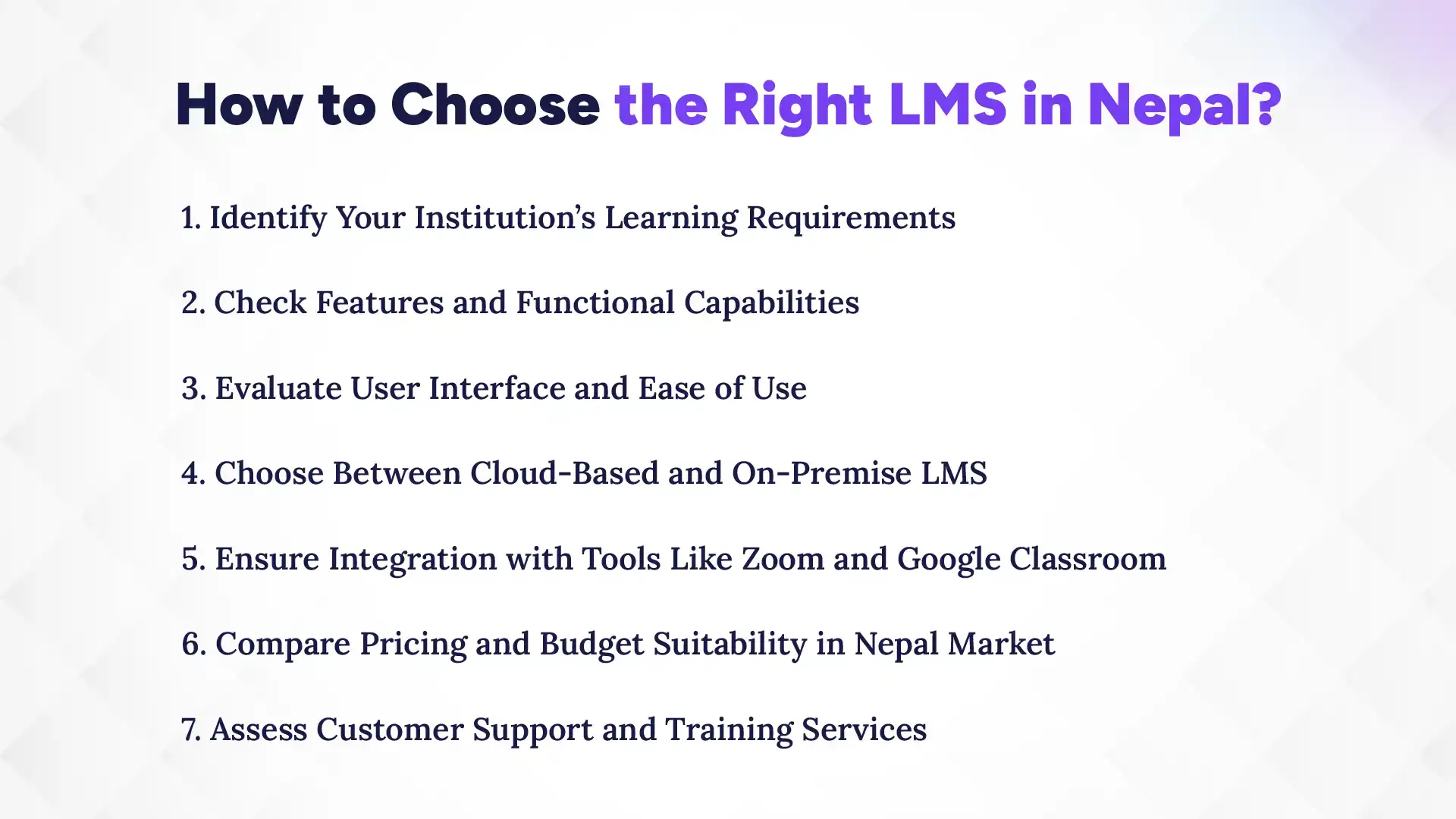
1. Identify Your Institution’s Learning Requirements
Start by understanding what your school or college actually needs from an LMS. Consider the number of students, type of courses, and teaching methods used. This helps you avoid unnecessary features and focus on essentials. Clear requirements make decision-making easier. It ensures the LMS supports your academic goals. Proper planning leads to better system selection.
2. Check Features and Functional Capabilities
Evaluate whether the LMS includes essential features like course management, assessments, and reporting tools. Advanced features like analytics and automation are also beneficial. The system should support both teachers and students effectively. Feature comparison helps identify the best fit. More features should align with actual needs. Functionality directly impacts learning quality.
3. Evaluate User Interface and Ease of Use
A simple and user-friendly interface is important for both teachers and students. Complex systems can reduce adoption and engagement. The LMS should be easy to navigate and understand. Good UI improves learning experience and efficiency. Ease of use reduces training time. A clean design ensures better usability.
4. Choose Between Cloud-Based and On-Premise LMS
Cloud-based LMS offers flexibility, remote access, and lower maintenance costs. On-premise LMS provides more control but requires higher infrastructure. Institutions must choose based on budget and technical capacity. Cloud solutions are more popular in Nepal. Each option has different advantages. Selection depends on long-term goals.
5. Ensure Integration with Tools Like Zoom and Google Classroom
The LMS should integrate with popular tools like Zoom, Google Classroom, and email systems. This improves communication and virtual learning experience. Integration allows smoother online classes and collaboration. It reduces manual work for teachers. Better connectivity enhances overall functionality. Integrated systems improve efficiency.
6. Compare Pricing and Budget Suitability in Nepal Market
Pricing plays a key role in LMS selection. Compare subscription models, licensing fees, and hidden costs. Choose a system that fits your institution’s budget. Affordable solutions are widely available in Nepal. Cost should match features and value. Proper comparison ensures better investment decisions.
7. Assess Customer Support and Training Services
Good customer support is essential for smooth LMS operation. Check if the provider offers training for teachers and staff. Technical support helps resolve issues quickly. Reliable assistance improves system usage. Training ensures proper adoption of the LMS. Strong support enhances long-term success.
What Features Should a Good LMS Have?
Good LMS should include course creation tools, student performance tracking, online assessment features, mobile accessibility, communication tools, and strong security systems. These features ensure smooth teaching, better student engagement, and efficient academic management. An effective LMS helps institutions deliver structured and interactive learning experiences. It also improves accessibility and simplifies administrative tasks. Overall, these features of good LMS are essential for a high-quality digital learning environment.
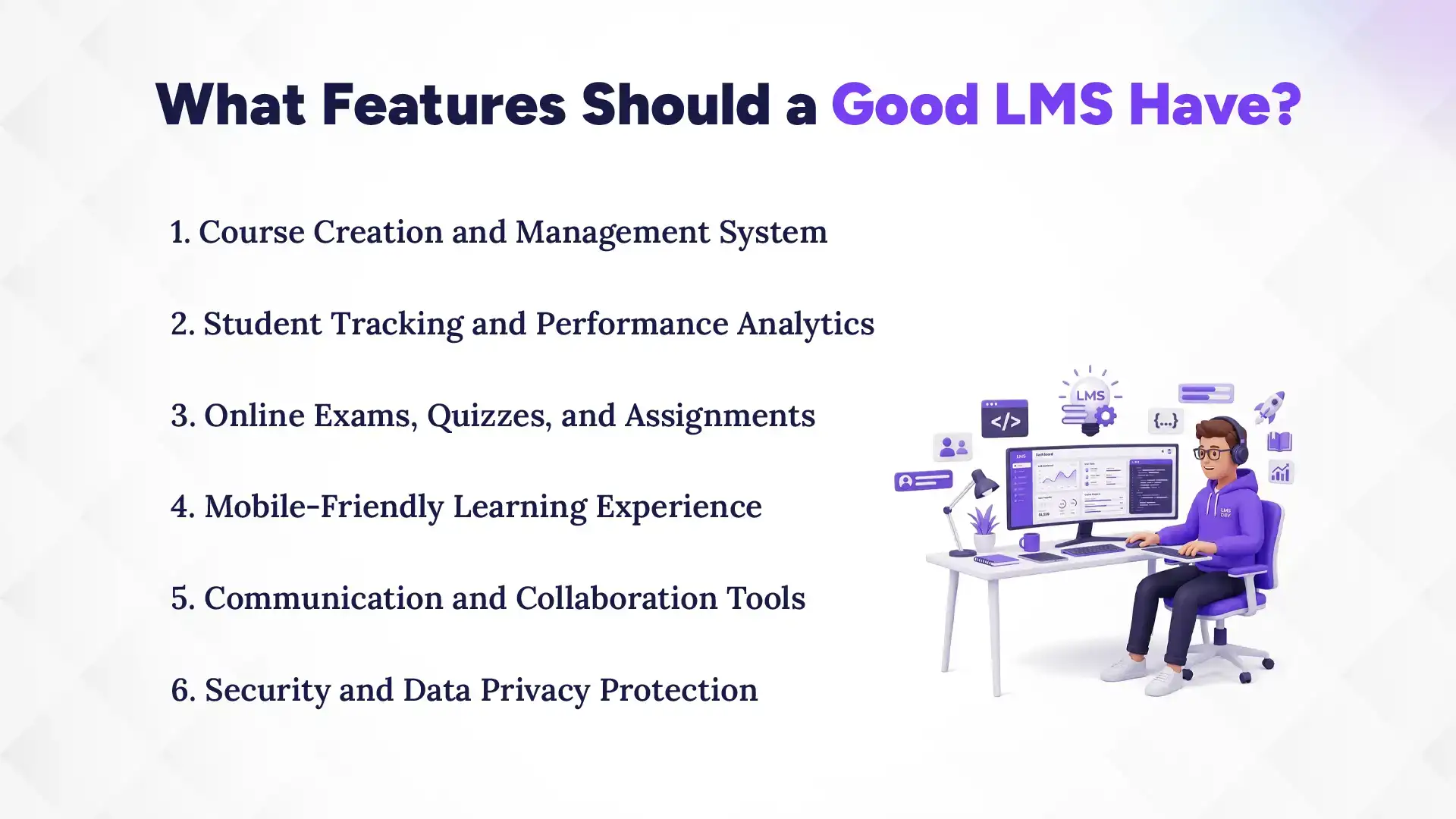
1. Course Creation and Management System
Good LMS should allow teachers to easily create, organize, and manage courses. It should support uploading videos, documents, and interactive content. This helps in delivering structured lessons to students. Teachers can update materials anytime for better learning. Course management improves teaching efficiency. It ensures smooth academic delivery.
2. Student Tracking and Performance Analytics
LMS should track student progress, attendance, and performance automatically. Analytics help teachers understand learning gaps and improvement areas. This allows personalized teaching approaches. Data-driven insights improve academic results. It also helps in monitoring student engagement. Performance tracking is essential for effective learning management.
3. Online Exams, Quizzes, and Assignments
Good LMS must support online exams, quizzes, and assignments. This makes evaluation faster and more efficient. Teachers can easily grade and provide feedback. Automated assessments save time and reduce errors. It also improves student participation. Online testing enhances learning effectiveness.
4. Mobile-Friendly Learning Experience
LMS should work smoothly on mobile devices for easy access. Students can learn anytime and anywhere using smartphones or tablets. Mobile compatibility improves learning flexibility. It ensures accessibility for all users. A responsive design enhances user experience. Mobile learning increases engagement.
5. Communication and Collaboration Tools
Communication features like chat, discussion forums, and announcements are essential. They help teachers and students interact effectively. Collaboration tools support group learning activities. Better communication improves understanding. It keeps everyone connected in real-time. This enhances the overall learning environment.
6. Security and Data Privacy Protection
Good LMS must ensure strong data security and privacy protection. It should safeguard student and institutional data from unauthorized access. Secure login and encryption are important features. Data protection builds trust in the system. It prevents information leaks and cyber threats. Security is crucial for reliable LMS usage.
Challenges of Using LMS in Nepal
Using an LMS in Nepal comes with several challenges despite its growing importance in the education sector. Many schools and institutions still face difficulties due to limited technical knowledge, budget limitations, and infrastructure issues. Poor internet connectivity in rural areas further affects smooth digital learning. Additionally, lack of proper training for teachers and staff reduces effective LMS adoption. These challenges slow down the full implementation of modern e-learning systems. However, with proper planning and support, these issues can be gradually improved.
1. Limited Technical Knowledge in Institutions
Many educational institutions in Nepal lack sufficient technical expertise to manage LMS platforms effectively. Teachers and staff may not be familiar with digital tools and systems. This creates difficulties in daily usage and management. It also slows down adoption of e-learning systems. Proper technical understanding is essential for smooth operation. Without it, LMS usage becomes less effective.
2. Budget Constraints for Schools and Colleges
Budget limitations are a major challenge for many schools and colleges in Nepal. Advanced LMS platforms can be expensive to implement and maintain. Institutions with low funding struggle to adopt digital systems. This restricts access to modern learning technologies. Cost becomes a deciding factor in LMS selection. Affordable solutions are often preferred.
3. Internet Connectivity Issues in Rural Areas
Poor internet connectivity in rural areas makes LMS usage difficult. Students and teachers may face interruptions during online learning. Slow or unstable internet affects performance and accessibility. This creates a gap between urban and rural education. Reliable internet is essential for effective LMS usage. Connectivity remains a major challenge in Nepal.
4. Lack of Training for Teachers and Staff
Many teachers and staff members are not properly trained to use LMS platforms. Without training, they struggle to use advanced features effectively. This reduces the overall efficiency of the system. Proper training programs are often missing in institutions. Skill development is necessary for successful implementation. Training improves confidence and system usage.
Which is the Best LMS in Nepal?
Pace LMS is the best LMS in Nepal because it is designed specifically for Nepalese educational institutions, offering an easy-to-use interface, affordable pricing, and all essential learning features in one platform. It helps schools, colleges, and training institutes manage courses, students, exams, and performance tracking efficiently while improving the overall digital learning experience.
- Built specifically for Nepal’s education system and local requirements
- Simple and user-friendly interface for teachers, students, and admins
- Supports course management, online exams, and student tracking features
- Cost-effective compared to many international LMS platforms
- Provides smooth performance with scalable architecture for growing institutions
- Offers better accessibility and easier implementation for Nepali schools and colleges
Best Practices for Implementing an LMS in Nepal
Implementing an LMS successfully in Nepal requires proper planning, training, and continuous improvement. Schools and institutions must ensure that teachers and administrative staff are well-prepared to use the system effectively. Starting with a small pilot program helps identify issues early. Continuous technical support and regular updates ensure smooth performance. Collecting feedback from users also helps improve the overall learning experience. Following these best practices ensures successful LMS adoption and long-term educational benefits, highlighting the key benefits of LMS for modern education systems.
1. Train Teachers and Administrative Staff Properly
Proper training is essential for effective LMS implementation. Teachers and staff should understand how to use all system features confidently. Training reduces errors and improves efficiency in daily operations. It also helps in better adoption of digital learning tools. Regular workshops can improve technical skills. Well-trained staff ensures smoother LMS usage.
2. Start with a Pilot Implementation Program
A pilot program allows institutions to test the LMS on a small scale first. This helps identify technical issues and user challenges early. It also provides time for adjustments before full implementation. Schools can evaluate system performance in real conditions. Pilot testing reduces risks of failure. It ensures smoother full-scale deployment.
3. Provide Technical Support and Maintenance
Ongoing technical support is crucial for smooth LMS operation. Institutions should ensure quick problem-solving and system updates. Regular maintenance helps prevent technical issues. Support teams assist teachers and students when needed. Reliable support improves user confidence. It ensures uninterrupted learning activities.
4. Collect Feedback and Improve System Usage
Collecting feedback from teachers and students helps improve LMS performance. User suggestions highlight areas that need improvement. Continuous updates make the system more effective. Feedback ensures the LMS meets real educational needs. It also increases user satisfaction. Improvement based on feedback leads to better learning outcomes.
Conclusion
Choosing the right LMS in Nepal is a crucial step for schools, colleges, and training institutions aiming to modernize their education system. A well-selected LMS improves teaching efficiency, enhances student engagement, and supports seamless digital learning. By carefully evaluating features, usability, pricing, and support, institutions can ensure they select a platform that truly meets their academic needs. Understanding challenges and following best practices also helps in successful implementation.
Overall, an LMS is no longer just an optional tool but a necessary part of modern education in Nepal. It bridges the gap between traditional and digital learning while making education more accessible and effective. With the right system in place, institutions can achieve better learning outcomes, improved administration, and long-term growth in the evolving education landscape.