
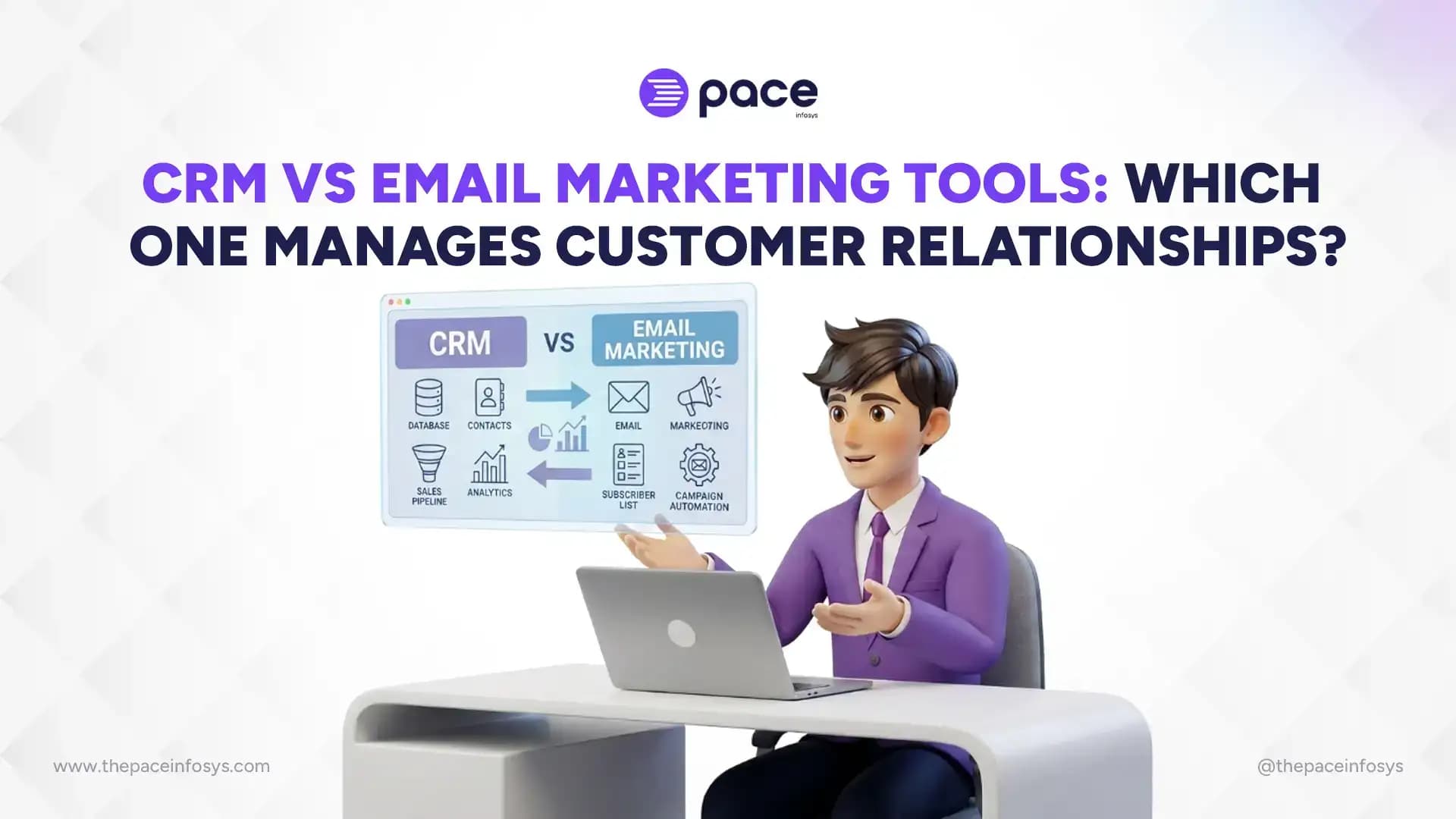

CRM manages customer relationships by tracking deal history, interactions, and pipeline data across every touchpoint, while email marketing tools focus narrowly on sending and measuring campaigns, which means relying on email marketing alone leaves most of the actual relationship untracked. A business can send beautifully designed, well-timed emails and still have no real record of where any individual customer relationship actually stands.
This guide covers the core difference between the two, why they get confused so often, what email marketing genuinely does well, what CRM tracks that email tools don't, what happens when a business relies on email alone, what to weigh before choosing, and how Nepali businesses can combine both effectively, closing with which CRM manages relationships best.
What's the Core Difference Between CRM and Email Marketing Tools?
Email marketing tools are built to send and measure campaigns to a list of contacts, while CRM is built to track the full relationship with each individual customer, including deals, interactions, and history.
Email marketing tools exist to send messages, at scale, to segments of a contact list and to measure how those messages perform in aggregate. CRM exists to track the relationship with each individual customer, not as part of a list, but as a specific account with its own deal history, communication log, and context. Where the two genuinely overlap is contact data itself; both systems store names, emails, and basic details, which is exactly why it's easy to assume one could substitute for the other.
| Factor | Email Marketing Tools | CRM |
|---|---|---|
| Primary Focus | Sending and measuring campaigns | Managing individual customer relationships |
| Data Depth | Contact info, campaign engagement | Full deal, interaction, and history data |
| Relationship Tracking | Aggregate, list-based | Individual, account-based |
| Typical User | Marketing team | Sales, support, and account teams |
Why Do Businesses Confuse Email Marketing With Relationship Management?
Businesses confuse email marketing with relationship management because both tools involve customer contact data, marketing language often overlaps with CRM terminology, and small businesses frequently start out using just one tool for everything.
1. Both Involve Customer Contact Data
Both systems store the same basic contact details, name, email, and company, which makes it easy to assume they're managing the same kind of relationship. The fact that both involve customer contact data is exactly why the distinction gets blurred in casual conversation.
2. Marketing Language Overlaps With CRM Terms
Terms like "customer relationship" and "engagement" get used loosely by both categories of software, even though what they actually track is quite different. Marketing language overlapping with CRM terms makes vendor positioning part of the confusion, not just user assumption.
3. Small Businesses Often Start With Just One Tool
A small business sending occasional newsletters might reasonably start with just an email tool, and that single tool ends up handling everything by default, whether or not it's actually suited for it. Small businesses often starting with just one tool means the distinction between the two categories doesn't get tested until the business grows.
What Does Email Marketing Actually Handle Well?
Email marketing tools handle campaign creation and automation, list segmentation for sending, open and click rate tracking, and bulk communication at scale well.
1. Campaign Creation and Automation
Email tools make it easy to design, schedule, and automate sequences of messages sent to large groups of contacts. Strong campaign creation and automation is genuinely what these tools are built for, and it's an area where CRM alone typically falls short.
2. List Segmentation for Sending
Contacts can be grouped into segments based on shared attributes or behavior, allowing more targeted messaging to different audiences. List segmentation for sending is a core strength of email tools, letting a business tailor content without manually managing each recipient.
3. Open and Click Rate Tracking
Email platforms track how many recipients opened a message or clicked a link, giving marketers a clear measure of campaign performance. Open and click rate tracking gives useful aggregate insight into content and messaging effectiveness.
4. Bulk Communication at Scale
Sending the same message to thousands of contacts simultaneously, reliably, and without triggering spam filters is something email marketing platforms are specifically built to handle. Bulk communication at scale is simply not something CRM systems are optimized to do well on their own.
What Does CRM Track That Email Marketing Tools Don't?
CRM tracks deal stage and sales pipeline data, full interaction history across every channel, and internal notes and team collaboration, none of which email marketing tools are built to capture.
1. Deal Stage and Sales Pipeline Data
CRM tracks exactly where a specific customer sits in the sales process, from initial contact through negotiation to close, information email tools have no concept of. Deal stage and sales pipeline data is central to CRM and completely absent from a typical email platform, which is why proper lead management in CRM requires this specific tool.
2. Full Interaction History Across Channels
CRM logs calls, meetings, support tickets, and messages across every channel a customer has used, not just email opens and clicks. Full interaction history across channels gives a complete picture of the relationship that email metrics alone can't provide, highlighting the core benefits of a CRM system.
3. Internal Notes and Team Collaboration
Sales and support teams can leave notes, tag colleagues, and coordinate directly within a customer's record inside a CRM. Internal notes and team collaboration keep everyone working from the same context, something email marketing tools simply aren't designed to support.
What Happens When a Business Relies on Email Marketing Alone?
When a business relies on email marketing alone, customer history stays fragmented, there's no visibility into the sales pipeline, follow-ups outside of email get missed, and tracking the relationship over time becomes difficult.
1. Fragmented Customer History
Without a central record, information about a customer ends up scattered across email threads, personal notes, and memory, with no single source of truth. Fragmented customer history makes it hard for anyone besides the original contact person to pick up the relationship smoothly, a problem solved by centralizing data in a cloud-based CRM.
2. No Visibility Into Sales Pipeline
Email marketing tools have no way to show where a specific deal or prospect actually stands in the buying process. No visibility into the sales pipeline means leadership can't get an accurate read on revenue in progress, a limitation that becomes obvious when looking at analytical types of CRM platforms.
3. Missed Follow-Ups Outside Email
Important follow-ups that happen over phone, in-person meetings, or other channels don't get tracked at all if email is the only system in use. Missed follow-ups outside email create gaps in the relationship that the business often doesn't notice until a customer disengages.
4. Difficulty Tracking Relationship Over Time
Without deal and interaction history, it's hard to see how a relationship has actually evolved, what's been discussed, what's been promised, and what's still outstanding. Difficulty tracking relationships over time is one of the clearest signs a business has outgrown email marketing as its only system.
What Should You Look for When Choosing Between the Two?
When choosing between the two, businesses should look at whether they actually need sales pipeline tracking, the volume and frequency of their customer communication, and how well the two tools could integrate if used together.
1. Whether You Need Sales Pipeline Tracking
If the business has an active sales process with deals moving through stages, that's a clear signal CRM is necessary, not optional. Determining whether you need sales pipeline tracking is usually the deciding factor in this comparison, which is a core part of how to choose the right CRM.
2. Volume and Frequency of Customer Communication
A business sending frequent, large-scale campaigns still needs strong email marketing capability, even after adopting a CRM. Weighing the volume and frequency of customer communication helps clarify that this often isn't an either-or decision, especially when evaluating advanced CRM features.
3. Integration Options Between Both Tools
Many CRM and email marketing platforms can connect directly, syncing contact and engagement data between the two systems. Checking integration options between both tools avoids having to choose one at the expense of the other entirely.
How Should Nepali Businesses Combine CRM and Email Marketing?
Nepali businesses should combine CRM and email marketing by using CRM as the central record, connecting email campaigns to actual deal activity, segmenting based on CRM data instead of static lists, and avoiding duplicate or conflicting tools.
1. Using CRM as the Central Record
CRM should hold the authoritative version of each customer's information and history, with email marketing operating as a connected tool rather than a separate system of record. Using CRM as the central record keeps the full picture in one place, even while campaigns run through a dedicated email platform.
2. Connecting Email Campaigns to Deal Activity
Linking email engagement data back to specific deals in the CRM shows sales teams which prospects are actually engaging with outreach. Connecting email campaigns to deal activity turns campaign metrics into something sales can actually act on.
3. Segmenting Based on CRM Data, Not Just Lists
Using CRM fields like deal stage or industry to build email segments produces far more relevant targeting than segmenting off a static contact list alone. Segmenting based on CRM data, not just lists, makes campaigns more precise without requiring separate manual list management.
4. Avoiding Duplicate or Conflicting Tools
Running overlapping tools without clear roles for each one leads to inconsistent data and confusion about which system is the source of truth. Avoiding duplicate or conflicting tools keeps the setup clean as a Nepali business scales its sales and marketing operations together.
Which CRM Offers the Best Customer Relationship Management in Nepal?
Pace CRM offers the best customer relationship management in Nepal, tracking full deal history, interactions, and pipeline data in one system built around how Nepali businesses actually sell. It's designed to reflect how Nepali businesses actually manage customer relationships.
For businesses in Nepal looking to move from fragmented inboxes to a central system, Pace CRM tracks the full picture, deal stage, interaction history, and internal notes in one connected system. It pulls together pipeline tracking, interaction history, and team collaboration into a single platform instead of scattered email threads. As one of the top 5 CRM software in Nepal, it's built to integrate cleanly with email marketing tools rather than trying to replace what they do well.
What sets Pace CRM apart is that it was designed around actual sales relationships, not campaign metrics, giving teams the pipeline visibility that email tools were never meant to provide. Between full interaction history, deal tracking, and team collaboration features, it gives businesses the relationship management depth that email marketing alone simply can't.
Conclusion
Email marketing and CRM solve different problems, sending messages versus managing relationships, and businesses relying on email marketing alone are missing the pipeline, history, and context that actually drive customer relationships forward. The two aren't competitors so much as complements, each doing the part of the job the other wasn't built for.
If your business is managing customer relationships through email alone, explore Pace CRM's relationship tracking features with a demo or contact Pace Infosys to see how it fits your team.