Managing customer relationships across multiple branches with spreadsheets and disconnected systems creates real problems. Loan inquiries slip through the cracks, KYC documents expire without warning, and relationship managers lack visibility into their customers' full history.
CRM software built for banking solves these challenges by centralizing customer data, automating follow-ups, and keeping compliance documentation organized in one place. In this guide, we'll cover the features Nepalese banks should prioritize, compare the top CRM solutions available, and walk through how to choose and implement the right system for your institution.
What is CRM Software for Banks in Nepal?
Banking CRM software is specialized technology designed for financial institutions to manage customer relationships, unify data across branches, automate workflows, and ensure regulatory compliance. In simple terms, a CRM acts as a central hub where every customer interaction, loan application, and service request lives in one place. Leading solutions like crm software in Nepal offer 360-degree customer views, personalized marketing capabilities, and analytics to boost loyalty and cross-selling opportunities.
For Nepalese banks specifically, a CRM goes beyond basic contact management. The software handles unique financial processes like loan pipeline tracking, Know Your Customer (KYC) document management, and features that help maintain compliance with Nepal Rastra Bank (NRB) regulations.
You might be wondering how a CRM differs from your existing core banking system. While your CBS handles transactions and account balances, a CRM focuses on the relationship side, tracking conversations, flagging opportunities, and ensuring no customer inquiry falls through the cracks.
Why Nepalese Banks Need CRM Software
Nepalese banks need CRM software to centralize fragmented customer data across branches, automate loan follow-ups, maintain KYC compliance with Nepal Rastra Bank regulations, and improve relationship manager productivity. Without a unified system, banks lose valuable leads, face compliance risks, and struggle to deliver consistent customer service, highlighting the benefits of crm software.
Many banks across Nepal still rely on scattered Excel sheets, paper-based records, and disconnected branch systems. Relationship managers often lack visibility into their customers' full history, and valuable loan leads disappear without follow-up. One small oversight in tracking a KYC renewal can lead to compliance issues during an NRB audit.
As your customer base grows, managing relationships manually only gets harder. That's where things start to change.
In this guide, we'll walk you through the key challenges CRM software solves, the features Nepalese banks can prioritize, and how to choose the right solution without overcomplicating things.
1. Fragmented Customer Data Across Branches
Customer records often live in different branch systems or personal spreadsheets. When a customer visits a new branch, the staff there has no context about previous loans, inquiries, or service requests. A CRM consolidates all of this into one accessible profile.
2. Lost Leads and Poor Follow-up on Loan Inquiries
Without a centralized tracking system, valuable loan and deposit inquiries slip through the cracks. A potential home loan customer might inquire at one branch, never receive a follow-up call, and take their business to a competitor.
3. Manual KYC and Compliance Tracking
The burden of paper-based KYC processes is immense. Tracking document expiry dates across thousands of customers and preparing for NRB audits becomes a time-consuming exercise that pulls staff away from serving customers.
4. Limited Visibility into Branch Sales Performance
Managers often lack real-time insight into which branches or relationship managers are successfully converting leads. Without this data, identifying what's working and replicating success across the organization becomes difficult.
5. Low Cross-Selling and Customer Retention Rates
Without a unified customer view, banks miss clear opportunities to offer relevant products. A customer with a healthy savings balance might be perfect for a fixed deposit or credit card, but nobody flags the opportunity.
CRM features Nepalese Banks Should Look For
While many CRM systems exist in the market, banking CRM requires specific capabilities designed for the financial industry's unique demands around security, compliance, and integration with existing systems.
1 Centralized Customer Data Management
A single, unified view of each customer across all branches consolidates account history, past transactions, all communications, and even family relationships into one accessible profile. Any authorized employee at any branch can instantly see the complete picture.
2. Lead and Loan Pipeline Tracking
A visual pipeline allows you to track loan applications from initial inquiry all the way to disbursement. Think of it like a Kanban board for your lending process—you can see exactly where each application sits and who's responsible for moving it forward.
3. Workflow and Task Automation
Automation handles repetitive tasks that currently eat up your staff's time. The system can automatically assign follow-ups to relationship managers, send payment reminders to customers, or trigger alerts when documents are approaching renewal dates.
4. KYC and Compliance Document Management
A dedicated module stores, tracks, and flags expiring KYC documents. It maintains a clear audit trail for all compliance-related activities, which simplifies preparations for NRB requirements significantly.
5. Core Banking System Integration
The CRM connects and syncs data with core banking systems commonly used by Nepalese banks, such as Pumori Plus, Finacle, or Flexcube. A two-way sync ensures that transactional data flows into the CRM and relationship data flows back.
6. Multi-Channel Communication Tracking
All interactions, calls, emails, SMS messages, and in-person branch visits, are logged in one chronological timeline for each customer. When a customer calls, your staff immediately sees the full context of previous conversations.
7. Reporting and Branch Performance Dashboards
Real-time dashboards display key metrics like lead conversion rates, relationship manager productivity, and branch-level sales performance. Instead of waiting for monthly reports, managers can check performance daily.
8. Mobile Access for Relationship Managers
A mobile app allows relationship managers in the field to update customer records, check account history, and log meeting notes directly from their smartphones. Field RMs who visit business customers on-site find this particularly valuable.
9. Security and Data Privacy Controls
Features like role-based permissions, data encryption, and audit logs ensure sensitive customer data is protected. Access is restricted based on job function, which aligns with Nepal's data protection expectations.
Feature
Why Banks Use It
Centralized data
Single customer view across branches
Loan pipeline
Track applications from inquiry to disbursement
KYC management
Maintain compliance and audit readiness
Core banking integration
Sync with Pumori Plus, Finacle, etc.
Mobile access
RMs can work from the field
Best CRM Software For Banks in Nepal
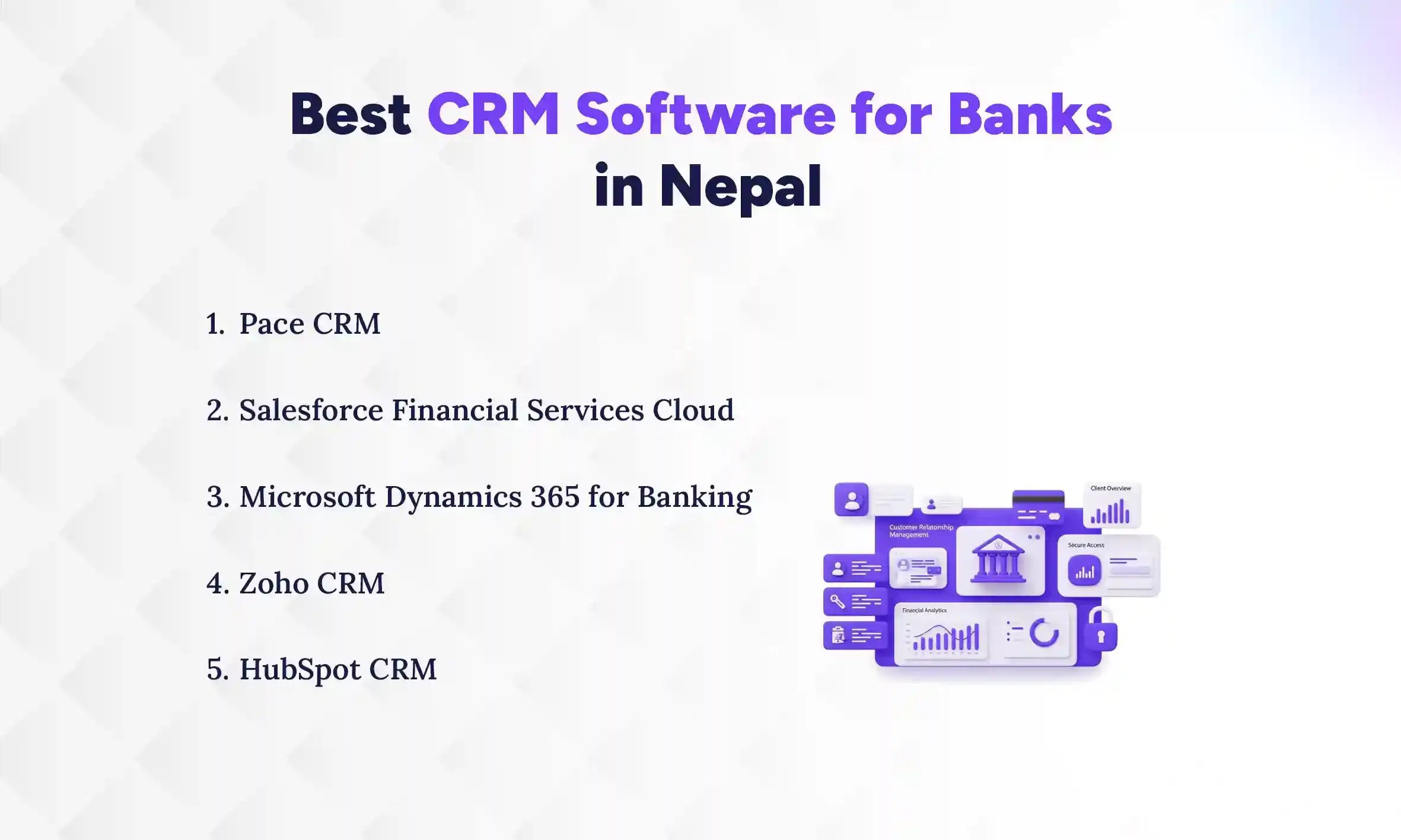
The following CRM solutions are well-suited for the unique operational and regulatory environment of Nepalese banking. Each has different strengths depending on your bank's size and existing technology stack. The top 5 crm in Nepal include options like Pace CRM, which stands out as a locally-built solution designed specifically for Nepalese financial institutions, while international platforms offer broader enterprise capabilities.
1. Pace CRM
Pace CRM is built specifically for the Nepalese market, with workflows designed around local banking processes and NRB compliance requirements. The system includes built-in KYC management and reporting features that align with how Nepalese banks actually operate.
Best for: Nepalese banks and financial institutions needing a locally-built solution
Key strength: Local support team and Nepal-specific compliance features
2. Salesforce Financial Services Cloud
Salesforce offers an enterprise-grade platform with powerful automation and advanced analytics. The 360-degree customer view is comprehensive, and the customization options are nearly unlimited.
Best for: Large commercial banks requiring extensive customization
Key strength: Powerful automation and AI-driven insights
Consideration: Higher cost and greater implementation complexity
3. Microsoft Dynamics 365 for Banking
If your bank already uses Microsoft products like Office 365 or Azure, Dynamics 365 integrates seamlessly with your existing ecosystem. The workflow automation and customizable dashboards are robust.
Best for: Banks heavily invested in the Microsoft ecosystem
Key strength: Native integration with familiar Microsoft tools
4. Zoho CRM
Zoho offers an affordable and scalable solution that works well for smaller institutions. The lead management and workflow automation features are solid, though banking-specific capabilities may require customization.
Best for: Smaller banks, cooperatives, and finance companies
Key strength: Cost-effective with good core functionality
5. HubSpot CRM
HubSpot provides a free tier that covers basic contact management and marketing automation. The interface is user-friendly, making adoption easier for teams new to CRM.
Best for: Banks needing basic contact management to start
Key strength: Easy to learn and free to begin
CRM Software
Best For
Nepal-Specific Support
Pace CRM
Banks need local compliance
Yes, local team
Salesforce FSC
Large commercial banks
Limited
Dynamics 365
Microsoft-ecosystem banks
Limited
Zoho CRM
Smaller finance companies
No
HubSpot CRM
Basic contact management
No
How to Choose CRM Software For Your Bank?
To choose CRM software for your bank, assess your branch network size, identify non-negotiable features like KYC tracking and loan pipeline management, verify core banking system compatibility, evaluate NRB compliance capabilities, compare total cost of ownership, and request demos with real banking scenarios before making a decision.
Selecting the right CRM involves more than comparing feature lists. Here's a practical framework to guide your decision.
1. Assess your bank size and branch network
Consider the number of branches, total users who will access the system, and whether you require seamless data synchronization across locations. A small cooperative has different requirements than a commercial bank with a nationwide network.
2. Identify Your Non-Negotiable Features
Create a list of requirements you absolutely cannot compromise on, KYC tracking, loan pipeline, and core banking integration. Separate non-negotiables from "nice-to-have" features to focus your evaluation.
3. Verify Core Banking System Compatibility
Confirm with vendors that their CRM integrates with your existing CBS. Ask for case studies or proof of successful integrations with systems like Pumori Plus or Finacle.
4. Evaluate Security and NRB Compliance
Check the vendor's security protocols, including data encryption and access controls. Ask specifically how their system helps meet Nepal Rastra Bank requirements.
5. Compare the Total Cost of Ownership
Look beyond monthly subscription fees. Account for implementation costs, data migration, staff training, customization, and ongoing support to understand the cost of CRM software as a true investment.
6. Request a Demo with Real Scenarios
Never commit without seeing the software handle your actual workflows. Ask the vendor to demonstrate a loan follow-up process or KYC renewal scenario during the demo.
How Much Does CRM Software for Banks in Nepal Cost?
CRM software for banks in Nepal typically starts from NPR 3000 per user per month for basic cloud solutions and can range up to NPR 10,000+ per user per month for enterprise platforms with advanced features. Pricing varies significantly based on deployment model, user count, and customization requirements.
Subscription-based: A recurring monthly or annual fee per user, common for cloud solutions
One-time license: A larger upfront cost followed by annual maintenance fees
Implementation costs: Fees for setup, data migration, and initial training
Hidden costs: Extra charges for advanced customization, integrations, and premium support
Local vendors like Pace CRM often provide more predictable pricing that bundles implementation and support together. Bundled pricing can be more cost-effective for Nepalese banks compared to international vendors who may charge separately for each service.
Benefits of CRM software for Nepalese Nanks
After implementation, a well-configured CRM delivers tangible results that transform daily operations. The improvements show up quickly, from faster loan approvals to better customer satisfaction scores.
1. Unified Customer View Across all Branches
Any authorized employee at any branch can instantly see a customer's complete history. Informed and consistent service becomes possible regardless of which branch the customer visits. This eliminates the frustration of customers having to repeat their information or explain their banking relationship every time they interact with a different staff member. Your team can pick up exactly where the last conversation left off.
2. Faster Loan Processing nd Lead Follow-up
Automated reminders and streamlined workflows ensure no loan inquiry goes unanswered. Processing times often decrease when manual handoffs are eliminated. Relationship managers receive automatic notifications when it's time to follow up, and approvals move through the pipeline without getting stuck on someone's desk. The result is happier customers and more closed deals.
3. Higher Customer Retention Rates
Proactive relationship management, enabled by timely alerts and full customer context, helps keep customers satisfied. You can address issues before they escalate. When your system flags a customer who hasn't been contacted in months or notices declining account activity, your team can reach out proactively. This kind of attention makes customers feel valued and less likely to switch to a competitor.
4. Increased Cross-Sell and Upsell Revenue
The system automatically flags opportunities to offer relevant products based on customer profiles and transaction history. A customer with regular salary deposits might be ideal for a credit card offer. Instead of relying on relationship managers to manually spot these opportunities, the CRM surfaces them automatically with data-driven recommendations. This turns every customer interaction into a potential revenue opportunity without feeling pushy.
5. Stronger NRB Compliance and Audit Readiness
Complete documentation trails and automated renewal alerts make regulatory reporting simpler. Audits become less stressful when all records are organized and accessible. Your compliance team can generate required reports in minutes instead of days, and you'll have confidence that nothing has been overlooked. The system maintains a clear audit trail that demonstrates your bank's adherence to NRB guidelines.
6. Improved Relationship Manager Productivity
By automating administrative tasks, the CRM frees relationship managers to spend less time on paperwork and more time building valuable customer relationships. Tasks that used to take hours, like compiling customer reports or tracking down information across multiple systems, now happen automatically. Your RMs can focus their energy on what they do best: understanding customer needs and providing personalized financial guidance.
Common Challenges Nepalese Banks Face Without CRM
Banks still relying on spreadsheets or disconnected legacy systems frequently encounter reinforcing problems:
Duplicate customer records: The same customer appears as multiple entries across branch systems
No follow-up accountability: Leads are assigned but never contacted, with no tracking
Manual reporting burden: Managers spend days compiling data for performance reviews
Customer complaints: Frustrated customers repeat their story at every touchpoint
How CRM Improves Customer Experience in Banking?
CRM improves customer experience in banking by providing personalized service, faster issue resolution, proactive communication, and consistent service across all branches. From the customer's perspective, a bank using CRM feels more personal and efficient.
Personalized service: Staff greet customers by name and already know their history
Faster resolution: Issues resolve in a single call when the full context is visible
Proactive communication: Customers receive notifications before documents expire or payments are due
Consistent experience: Service quality remains the same across all branches and channels
How to Implement CRM in a Nepalese Bank?
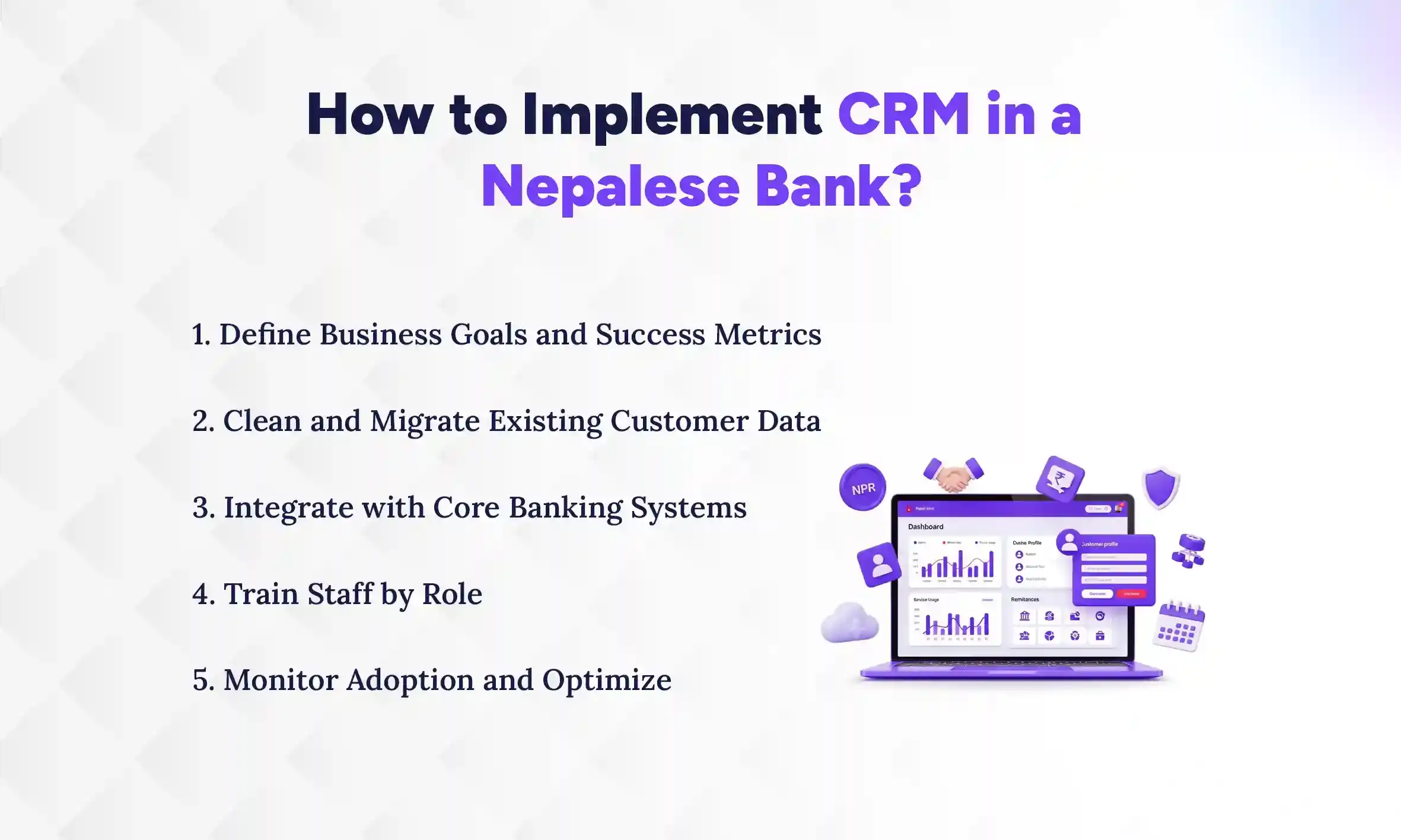
To implement CRM in a Nepalese bank, follow these five key phases: define business goals and success metrics, clean and migrate existing customer data, integrate with core banking systems, train staff by role, and monitor adoption while optimizing workflows. This clearly explains how does crm works. A successful implementation typically takes 2–6 months, depending on bank size and complexity.
A successful implementation requires a clear roadmap. Here are the key phases your team will navigate.
1. Define Business Goals and Success Metrics
Set measurable objectives before you begin. Examples include "reduce average lead response time by 50%" or "improve KYC compliance rate to 99%." Without clear goals, you won't know if the project succeeded. Involve stakeholders from different departments, lending, compliance, and branch operations, to ensure the goals reflect real business priorities. This alignment upfront prevents scope creep and keeps the implementation focused on what actually matters.
2. Clean and Migrate Existing Customer Data
De-duplicate records, standardize data formats, and validate information before importing. Migrating "dirty" data undermines the new system from day one, data cleaning is critical. Assign a dedicated team to review and correct inconsistencies in customer names, addresses, and contact details. Poor data quality at launch means your staff will spend months fixing problems instead of benefiting from the new system.
3. Integrate with Core Banking Systems
Work with both your CBS vendor and CRM provider to establish a secure, two-way data sync. Integration often requires specialized middleware and technical expertise, so plan accordingly. Test the integration thoroughly in a staging environment before going live, so you can catch sync errors and data mapping issues before they affect real customer records. Budget extra time for this phase, as integration challenges are the most common cause of implementation delays.
4. Train Staff by Role
Relationship managers require different training than branch managers or compliance officers. Generic training doesn't address each user's daily workflows and leads to poor adoption. Create role-specific training materials that show staff exactly how the CRM makes their specific job easier. Consider designating "CRM champions" in each branch who receive advanced training and can support their colleagues during the transition.
5. Monitor Adoption and Optimize
Track usage metrics after launch to see if staff are using the system correctly. Gather feedback and refine workflows in the first few months; successful adoption requires ongoing attention. Schedule weekly check-ins with department heads to identify bottlenecks or confusion points. The first 90 days are critical; address resistance quickly and celebrate early wins to build momentum across the organization.
Start using CRM software in your bank today
A CRM is a strategic tool that helps Nepalese banks manage relationships more effectively, improve compliance with NRB regulations, and drive sustainable revenue growth. By centralizing data and automating processes, you empower your team to deliver the fast, personal, and reliable service that modern customers expect.
For banks looking for a solution built specifically for the Nepalese business environment, Pace Infosys offers Pace CRM with local expertise and on-ground support.
Schedule a consultation to see how CRM software can transform your bank's customer relationships.
FAQs
Can CRM software integrate with Pumori Plus or Finacle core banking systems?
+
Yes, modern CRM platforms can integrate with major core banking systems used in Nepal through APIs or middleware. Confirm integration capability with your vendor before purchasing, and ask for examples of successful integrations.
Does CRM software help banks meet Nepal Rastra Bank reporting requirements?
+
A CRM with strong document management and audit trail features simplifies NRB compliance significantly. The system maintains complete, accurate records that can be used to generate required reports and documentation.
How long does CRM implementation take for a Nepalese bank?
+
Timelines vary based on bank size, data complexity, and integration depth. Basic deployments can complete within a few months, while more complex projects involving multiple branches and deep CBS integration take longer.
Is cloud-based CRM secure enough for banking data in Nepal?
+
Reputable cloud CRM providers use bank-grade security including end-to-end encryption, robust access controls, and regular security audits. When evaluating vendors, check their security certifications and data residency options.
Can bank relationship managers access CRM software on mobile devices?
+
Most modern CRM platforms offer dedicated mobile apps for iOS and Android. RMs can view customer data, update records, and log meeting notes while visiting clients or working remotely.
What training do bank employees require to use CRM software effectively?
+
Staff require role-specific training focused on their daily workflows and data entry standards. Plan for initial comprehensive training followed by periodic refresher sessions to ensure long-term adoption.
Do CRM vendors in Nepal offer on-site implementation support?
+
Local vendors like Pace CRM typically provide extensive on-site implementation, training, and support. International vendors may rely on local partners or remote assistance, clarify the support model before signing.
Ready to get started?
Book a 30-minute consultation call, and let's talk about your goals.