

Nepal's automotive industry has been growing fast. Vehicle registrations crossed 200,000 units annually in recent years, and with more brands, models, and showrooms entering the market, competition is only getting tighter.
But, most dealerships and auto businesses in Nepal are still running on WhatsApp messages, paper registers, and plain old memory to manage their customers. That means leads slip through, follow-ups get missed, and loyal customers quietly walk over to the competition.
The solution? A reliable CRM software for sure!
This guide covers everything you need to know about CRM software for the automotive industry in Nepal. Learn what it is, why your business needs it, which features matter in 2026, and how to pick the right one for your showroom or dealership.
What is CRM Software for the Automotive Industry?
At its core, CRM (Customer Relationship Management) software is a digital system that helps your business store, track, and manage every interaction with a customer or lead, all in one place. Think of it as a smart, organized digital assistant that remembers every inquiry, every test drive, every follow-up, and every service appointment so your team never has to.
Now, a generic CRM works fine for a clothing store or a consulting firm. But the automotive industry is different. An automotive-specific CRM software is built with features that actually match how car dealerships operate, from the first showroom visit all the way to post-sale service.
On the showroom floor, CRM helps your sales team track which customer is interested in which model and what their budget looks like. Behind the scenes, it sends automated service reminders, manages follow-up calls, and gives managers real-time visibility into every deal in the pipeline. It connects the dots between sales, service, and customer relationships. These notable features of CRM are exactly what growing automotive businesses in Nepal need right now.
Why Automotive Businesses in Nepal Need CRM Software
Automotive businesses in Nepal need CRM software to manage growing lead volumes, reduce missed follow-ups, and coordinate sales teams across showrooms, all without letting a single customer slip through the cracks. Without a proper system, even your best sales reps end up juggling too much manually, and that directly costs you sales. Here's a closer look at the specific reasons why CRM is so important, and no longer optional for auto businesses in Nepal.
1. Managing High-Volume Leads from Multiple Channels
Buyers today call, WhatsApp, fill out forms online, and message on Facebook. They learn about you, even before stepping into your showroom. Without CRM, each inquiry lands in a different place and gets missed. Research shows 37% of online automotive leads are lost through poor follow-up processes alone. CRM software like Pace CRM centralizes every lead into one dashboard so your team always knows what came in, from where, and what happens next.
2. Tracking Test Drives, Inquiries, and Booking Follow-Ups
In Nepal's automotive market, buying decisions can stretch over days or weeks, making consistent follow-up everything. Studies show responding within five minutes makes you 21 times more likely to qualify a lead, yet the average dealer response time is 42 hours in auto and other industries. CRM closes that gap by automatically scheduling follow-up reminders right after every test drive, so your reps call at exactly the right moment, not too late.
3. Coordinating Sales Reps Across Multiple Showroom Locations
When your dealership spans Kathmandu, Pokhara, or Biratnagar, keeping every rep aligned is a daily challenge. Without CRM, managers have no live view of who is handling which lead or how close a deal is to closing. CRM gives your entire team a shared, real-time pipeline, so managers can assign leads, monitor progress, and step in when needed, without chasing down individual reps for updates.
4. Retaining Customers Through Service Reminders and Loyalty Programs
Selling a vehicle is the start of the relationship, not the end. Returning customers for servicing, accessories, or their next vehicle cost far less to retain than new ones to acquire. CRM automatically sends service reminders, insurance alerts, and seasonal notifications at the right time. It also tracks purchase history so your team can run loyalty outreach that is actually relevant, not generic.
5. Reducing Missed Deals Due to Manual Tracking
Every auto business in Nepal has lost a deal this way: a hot lead called, the follow-up slipped, and they bought from a competitor. It is more common than most teams admit. Industry data shows 13.3% of leads never even enter a CRM system, representing pure wasted marketing spend. CRM eliminates that gap by auto-assigning leads, setting reminders, and alerting managers when a deal sits idle for too long.
Must-Have Features of Automotive CRM Software in 2026
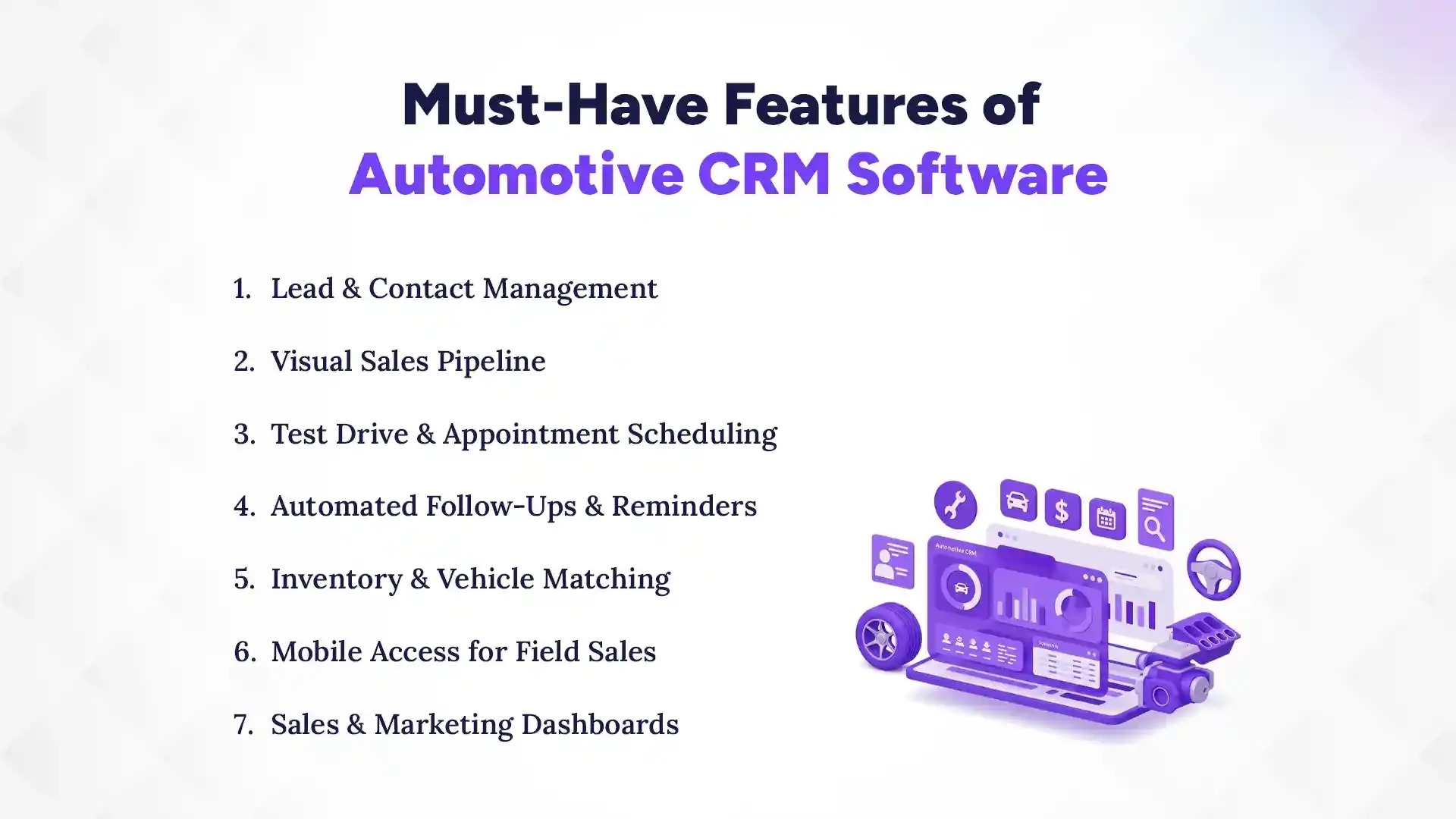
The right CRM for an auto dealership should include lead management, a visual sales pipeline, test drive scheduling, automated follow-ups, and mobile access, among other general CRM offers. These are not just nice-to-have features; they are the tools that keep your showroom running smoothly and your team focused on closing deals. Let's break down each one and why it matters for your business.
1. Lead & Contact Management
Every inquiry, a phone call, a walk-in, a website form, a social media message deserves to land in one place, and not get scattered across phones and notebooks. CRM stores each customer's details, vehicle preferences, budget range, and full conversation history in a single profile that your whole team can access. So when a customer calls back three weeks later, your rep can pull up exactly what was discussed, what vehicle they liked, and what their hesitation was, without asking them to repeat themselves. That kind of preparedness feels personal to the buyer, and personal interactions are what close deals.
2. Visual Sales Pipeline
Without visibility, your sales head is essentially guessing which deals are moving and which ones have quietly gone cold. A visual pipeline lets you see every deal's exact stage, from first inquiry, through test drive and negotiation, all the way to closing on a single drag-and-drop screen. Managers can reassign stalled leads, flag deals that need attention, and track each rep's workload without sitting in a daily status meeting. The result is a team that moves faster, wastes less time, and misses fewer opportunities.
3. Test Drive & Appointment Scheduling
CRM lets your team or the customer book directly into a shared calendar, with automatic confirmation messages and reminders sent to both sides before the appointment. It also logs which vehicle was driven, how long the drive was, and any feedback the customer shared, so the follow-up conversation is informed, not generic. Your rep walks in already knowing what that buyer cares about, and that changes the entire tone of the next call.
4. Automated Follow-Ups & Reminders
Consistent follow-up is what separates top dealerships from average ones, and doing it manually across 40 or 50 active leads simply does not scale. CRM automates the entire sequence. Once a lead enters the system, it triggers pre-set follow-up calls, messages, or emails at the right intervals, and logs the outcome when your rep completes each one.
Your team never has to remember who to call today because the system tells them, and escalates to the manager if something sits untouched for too long.
Research shows dealerships using automation are twice as likely to achieve higher ROI. And in Nepal's automotive market, where buyers need multiple touchpoints before deciding, that structured consistency is exactly what converts.
5. Inventory & Vehicle Matching
CRM with inventory integration lets your team match that customer's preferences to available vehicles in real time, right from their profile screen, and share options instantly. It also tracks which models and specs are getting the most inquiries. Hence, your leadership can make smarter purchasing and stocking decisions based on actual demand data. The conversation moves faster, your team looks prepared, and the customer feels like they are being genuinely helped.
6. Mobile Access for Field Sales
Your automobile team is not always at a desk. They are on the showroom floor, at delivery handovers, or out visiting corporate clients across the city. Mobile CRM lets them log a call, update a deal's stage, check a customer's full history, or schedule a follow-up right from their phone, the moment it happens. Nothing waits until they are back at the office, which means your pipeline data is always accurate and your managers are always working with a real picture. For dealerships spread across multiple locations in Nepal, that real-time connectivity is what keeps everyone truly on the same page.
7. Sales & Marketing Dashboards
Your sales head needs to know which reps are converting, which deals are at risk, and how the pipeline looks for the rest of the month, all without pulling data from three different places. Your marketing head needs to know which campaigns brought in the most qualified leads, at what cost, and which channels are worth doubling down on. CRM dashboards give both a live, customizable view of exactly these numbers, updated in real time and accessible from anywhere.
In Nepal's competitive automotive market, where every decision carries real cost, that clarity is not a luxury, it is how smart teams stay ahead.
How to Choose the Right CRM for Your Automotive Business in Nepal?
Choosing the right CRM comes down to evaluating cloud vs on-premise CRM, your budget, scalability, local support availability, and how well it integrates with your existing tools. Getting these factors right from the start saves you from costly switching later. Here's how to think through each one before making your decision.
1. Cloud-Based vs On-Premise CRM: Which Suits Nepali Dealers?
For most automotive businesses in Nepal, cloud-based CRM is the clearer choice. This eliminates your hardware investment, automatic updates, and provides you full access from any device, anywhere. On-premise systems sit on your own servers and give you more data control, but they need dedicated IT support to maintain. For dealerships with field teams or multiple showrooms, that flexibility cloud offers is not just convenient, it is essential.
Ready to Manage Leads Better?
Use Pace CRM to track leads, automate follow-ups, and close deals faster. Simple, powerful, and built for your growth.
2. Pricing and Budget Considerations
CRM pricing in Nepal ranges from free basic plans to NPR 3,000 or more, depending on features. But do not just compare subscription costs. Factor in onboarding, training, data migration, and ongoing support too. A cheaper plan that needs expensive consultants to set up and maintain will cost you more in the long run. The right CRM pays for itself through better conversions and stronger retention.
3. Scalability for Multi-Brand or Multi-Location Dealerships
Your CRM needs to grow with your business. Look for a system that handles multiple locations, teams, and growing lead volumes without slowing down or getting harder to manage. A scalable CRM lets you standardize your sales process across all branches while giving each manager clear visibility into their own team's performance.
4. Local Support and Nepal-Specific Compliance
When something breaks in your CRM, you need someone who responds fast and actually understands how your business works, not a global ticketing queue. International providers often have long wait times and no context for Nepal-specific compliance or business practices. A locally supported option like Pace CRM gives you a team based right here, in Nepal that can set up the system around your workflow and fix issues before they affect your sales day.
5. Integration with Existing Tools
Your CRM should connect cleanly with the tools your team already uses, such as HR payroll software, email, and calendar. A software tool is meant to waive you off the need of entering the same data in two places. Poor integration leads to duplicate records, manual errors, and staff quietly bypassing the CRM altogether because it creates more work than it saves. When evaluating options, ask specifically whether integrations are native or require paid third-party connectors. That distinction matters more than it seems.
Top 5 CRM Software for Automotive Businesses in Nepal
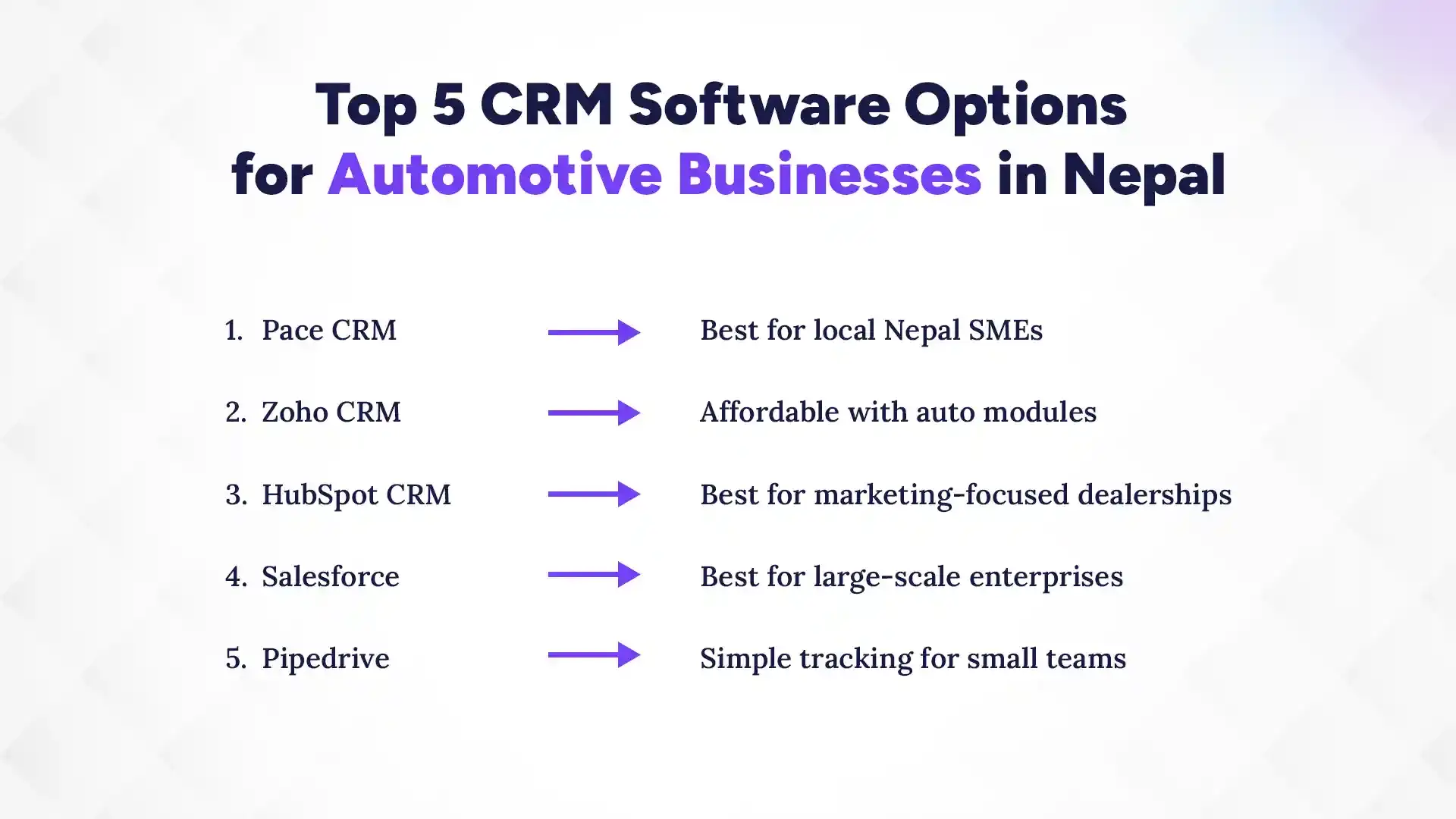
Pace CRM is currently the most relevant CRM for Nepal-based automotive businesses, while Zoho CRM, HubSpot, Salesforce, and Pipedrive also serve different needs depending on your business size and goals. Each platform has its own strengths, and the best fit depends on what your team actually needs day to day. Here's an honest breakdown of all five best CRM software for Nepalese businesses:
1. Pace CRM — Best for Nepal-Based Automotive SMEs
If you're running an automotive business in Nepal, whether it's a single showroom, a growing dealership network, or a multi-brand operation, Pace CRM is built with you in mind. Developed by The Pace Infosys, a digital company right here in Nepal, Pace CRM understands the local market in a way that international platforms simply can't. There's no language barrier, no disconnect between global features and local needs, and no waiting for overseas support when something needs fixing.
On the features side, Pace CRM gives your sales team everything they need to run a faster, smarter sales operation:
- Visual pipeline from first inquiry to final sale
- Automated follow-up reminders so no lead goes cold
- Lead scoring to prioritize the right opportunities
- Custom dashboards for real-time team performance tracking
- Email and calendar integration to keep everything connected
- Campaign reporting to track which leads are actually converting
What really sets Pace CRM apart for Nepali automotive businesses is the combination of local support, Nepal-aligned compliance, and a system that's been designed to scale alongside your growth.
With Pace CRM, you're not buying a global product and hoping it fits, you're working with a team that understands how business is done in Nepal and will make sure the CRM works the way your showroom actually operates. If you want a CRM that's practical, affordable, and backed by people you can actually talk to, Pace CRM is the clear first choice.
2. Zoho CRM — Affordable with Auto Modules
Zoho CRM is a popular choice for budget-conscious automotive businesses that want a wide range of features without a heavy price tag. It offers solid lead management, workflow automation, email integration, and a mobile app for field access. Zoho also has local partners in Nepal, which helps with setup and support. It's a strong option for small to mid-sized dealerships that need a capable, proven CRM and want to keep monthly costs manageable. The learning curve is moderate, but once set up, it handles core automotive CRM needs reliably.
3. HubSpot CRM — Best for Marketing-Focused Dealerships
HubSpot CRM is a great fit for automotive dealerships that put a strong emphasis on digital marketing, running ads, email campaigns, and lead generation through online channels. Its free tier includes core CRM features, email tracking, meeting scheduling, and marketing automation tools. For marketing heads who want tight alignment between their campaigns and the sales pipeline, HubSpot makes that connection very naturally. The limitation is that more advanced features require paid upgrades, and local support in Nepal is limited to online channels, which can be a challenge when you need fast help.
4. Salesforce — Best for Large-Scale Enterprises
Salesforce is the global leader in CRM and offers unmatched customization, powerful analytics, and enterprise-grade capabilities. For large automotive groups in Nepal with complex multi-location operations, large sales teams, and the budget to match, Salesforce is a serious contender. It can handle virtually any workflow you design and integrates with hundreds of third-party tools. However, it comes with significant setup complexity, high licensing costs, and typically requires dedicated IT resources or consultants to implement and maintain — making it less practical for most small to mid-sized Nepali auto businesses.
5. Pipedrive — Simple Tracking for Small Teams
Pipedrive is known for its clean, highly visual sales pipeline that makes deal tracking simple and intuitive. It's a great option for small automotive businesses or single-showroom dealerships that want to get organized quickly without a steep learning curve. The platform focuses on sales activity management, such as logging calls, scheduling follow-ups, and moving deals through stages rather than complex automation or marketing features. For a lean sales team that just needs structure and visibility into their pipeline, Pipedrive does the job well. It's not built for complex multi-location operations, but it's a solid starting point.
Here's a quick comparison of the abovementioned top 5 CRM software to help you see how these options stack up:
| CRM | Best For | Local Support | Starting Price |
|---|---|---|---|
| Pace CRM | Nepal automotive SMEs | Yes — Nepal-based | Free tier available |
| Zoho CRM | Budget-conscious dealers | Via local partners | Free tier available |
| HubSpot CRM | Marketing-led dealerships | Online only | Free tier available |
| Salesforce | Large enterprise dealers | Online only | Premium pricing |
| Pipedrive | Small sales teams | Online only | Per user/month |
What Are the Benefits of CRM Software for Automotive Businesses?
CRM software helps automotive businesses close more deals, retain more customers, and run more efficiently, and those are just the headline benefits. Beyond the obvious wins, it also improves team coordination, sharpens marketing decisions, and makes scaling your operations far less painful. Here's a closer look at the real-world impact CRM delivers for Nepal's auto industry.
1. Higher Lead Conversion Rates from Showroom Inquiries
Every inquiry gets assigned, logged, and followed up automatically, nothing slips through based on a rep's memory or mood. Dealerships using AI-powered CRM see up to 42% higher conversion rates from online lead to test drive. For Nepal's automotive market, where margins are tight and every unit counts, that kind of measurable lift translates directly into lakhs of additional monthly revenue.
2. Improved After-Sales Service and Customer Retention
The sale closes, but the relationship should not. CRM keeps customers engaged long after handover through automated service reminders, insurance renewal alerts, and anniversary follow-ups, all without your team manually tracking dates. Industry research shows that every 1% improvement in customer retention adds $150,000 annually per dealership. In Nepal's relationship-driven market, that kind of consistent post-sale attention is what turns one-time buyers into repeat customers.
3. Better Coordination Between Sales, Service, and Finance Teams
In most dealerships, the handoff between teams happens over calls and verbal updates that regularly get lost or miscommunicated. CRM gives all three teams a single shared record, updated in real time, so everyone knows exactly what was promised and what comes next. That alignment cuts errors, reduces duplicate work, and makes the overall customer experience far smoother.
4. Data-Driven Decisions for Marketing and Inventory Planning
CRM answers the questions your leadership team should be asking every month, which lead source converts best, which model gets the most inquiries, which campaign delivered the lowest cost-per-sale. Those insights shift decision-making from gut feel to real evidence, helping your marketing head spend smarter and your sales head coach better. Over time, that clarity compounds into a measurable competitive advantage.
5. Scalable Operations Across Multiple Branches
Growth brings complexity. More showrooms, more reps, more leads, more chances for things to fall apart. CRM scales with your business so that adding a new location means configuring a pipeline, not rebuilding your entire process from scratch. Leadership gets a consolidated view across all branches while individual managers see only their team's data. Your operations stay tight no matter how fast you grow.
How to Implement CRM Software in Your Automotive Business in Nepal?
Implementing CRM starts with auditing your current workflow, defining your requirements, selecting the right system, migrating your data, training your teams, and then continuously monitoring and improving adoption. Done right, most automotive businesses in Nepal can get a cloud-based CRM up and running within two to four weeks. Here's a step-by-step breakdown of how to approach it.
Step 1: Audit Your Current Sales and Service Workflow
Before touching any new system, map out exactly how your business handles leads right now. Evaluate where they come in, who picks them up, how follow-ups get triggered, and where deals typically fall apart. This audit shows you the real gaps, not the assumed ones. Without it, you risk building your CRM around a process that does not actually match how your team works.
Step 2: Define Your CRM Requirements and Budget
Once you know where your process breaks down, list exactly what you need the CRM to fix: lead tracking, follow-up automation, team visibility, reporting, or all of the above. That list becomes your filter when evaluating options. Then set a budget that covers not just the subscription, but also implementation, data migration, and training, because those costs are real and often underestimated. Be very clear, what is a CRM and why exactly you want it.
Step 3: Evaluate and Select a CRM Suited to Auto Dealerships
Request demos from your shortlisted options, and make sure each one walks through your actual automotive use cases: adding a lead, logging a test drive, setting a follow-up, moving a deal through the pipeline. Involve your sales reps in the evaluation, because a CRM that impresses in a boardroom but frustrates on the floor will never get adopted. Ease of use matters as much as features.
Step 4: Migrate Your Existing Customer and Lead Data
Pull together everything you currently have: spreadsheets, WhatsApp threads, notebooks, contact lists, and clean it up before importing. Remove duplicates, fill in missing details, and standardize how names and numbers are recorded across the board. Most CRM providers, including Pace CRM, offer migration support to make this smoother. Clean data from day one means your team starts productive, not spending their first weeks fixing errors.
Step 5: Train Your Sales, Service, and Marketing Teams
Start with the daily basics: logging a lead, updating a deal stage, checking reminders, recording a call, and keep early training short and hands-on inside the actual system. Build on that foundation gradually as your team gains confidence with the tool. For Nepal's automotive businesses, using real showroom examples during training makes a big difference in how quickly people actually retain and apply what they learn.
Step 6: Monitor Adoption and Optimize Over Time
Going live is the starting point, not the finish line. In the weeks after launch, check whether leads are being logged, pipelines reflect reality, and follow-ups are actually happening, and talk to your reps about what is working and what is not. Most CRMs, including Pace CRM, let you adjust workflows and pipelines as you learn. The businesses that treat CRM as a living system always get more out of it.
Conclusion
Nepal's automotive industry is growing, and the businesses that will lead that growth are the ones that get their sales process, customer relationships, and team coordination right. CRM software is the tool that makes all of that possible.
From capturing every lead and automating follow-ups to giving your managers real-time visibility and your marketing team data-driven insights, a good automotive CRM transforms how your dealership operates from the inside out.
If you're still managing your showroom on spreadsheets and WhatsApp, you already know the frustration. You don't have to keep running that way. The right CRM, set up properly and supported locally, can change the way your business works in a matter of weeks.
Schedule a free CRM demo with The Pace Infosys team today, and let's talk about building a CRM setup that actually works for your showroom.