

A CRM free trial matters more than a sales demo because a demo shows a curated, best-case scenario controlled by the vendor, while a trial lets you test the system against your own data, workflows, and team. A demo tells you what a CRM can do in theory; a trial tells you what it actually does once your team is the one using it.
This guide covers what actually separates a trial from a demo, why demos often fail to show the full picture, what you can genuinely test during a trial, how to structure that trial for accurate results, the risks of buying based on a demo alone, the features worth prioritizing, and how Nepali businesses should approach this closing with which CRM offers the best free trial.
What's the Difference Between a Free Trial and a Sales Demo?
A sales demo is a vendor-led walkthrough of curated features, while a free trial gives you direct, hands-on access to the actual product using your own data and workflows.
In a demo, the vendor controls the experience entirely, choosing what to show, in what order, and how each feature is framed. In a trial, that control shifts to you, since you're the one clicking through the system, entering your own data, and deciding what to test. This difference in control is what determines how much you actually learn: a demo shows you a curated slice of the product, while a trial shows you the whole thing, rough edges included.
Access depth follows the same pattern. A demo typically only shows features the rep chooses to highlight, often in a clean, pre-built sample environment, while a trial gives full access to explore parts of the product no one thought to walk you through. Time frame matters too: a demo lasts thirty minutes to an hour with a rep guiding the pace, while a trial runs over days or weeks, giving you time to form a real opinion instead of a first impression shaped by someone else's pacing and, often, sales pressure to decide quickly.
| Factor | Sales Demo | Free Trial |
|---|---|---|
| Control | Vendor-led | User-led |
| Access Depth | Curated feature set | Full product access |
| Time Frame | 30–60 minutes | Days to weeks |
| Purchase Pressure | Often high, immediate | Lower, self-paced |
Why Do Sales Demos Often Fail to Show the Full Picture?
Sales demos often fail to show the full picture because they follow curated scenarios chosen by the vendor, avoid real data complexity, give you too little time to judge actual usability, and are led by a rep whose job is to keep things looking smooth.
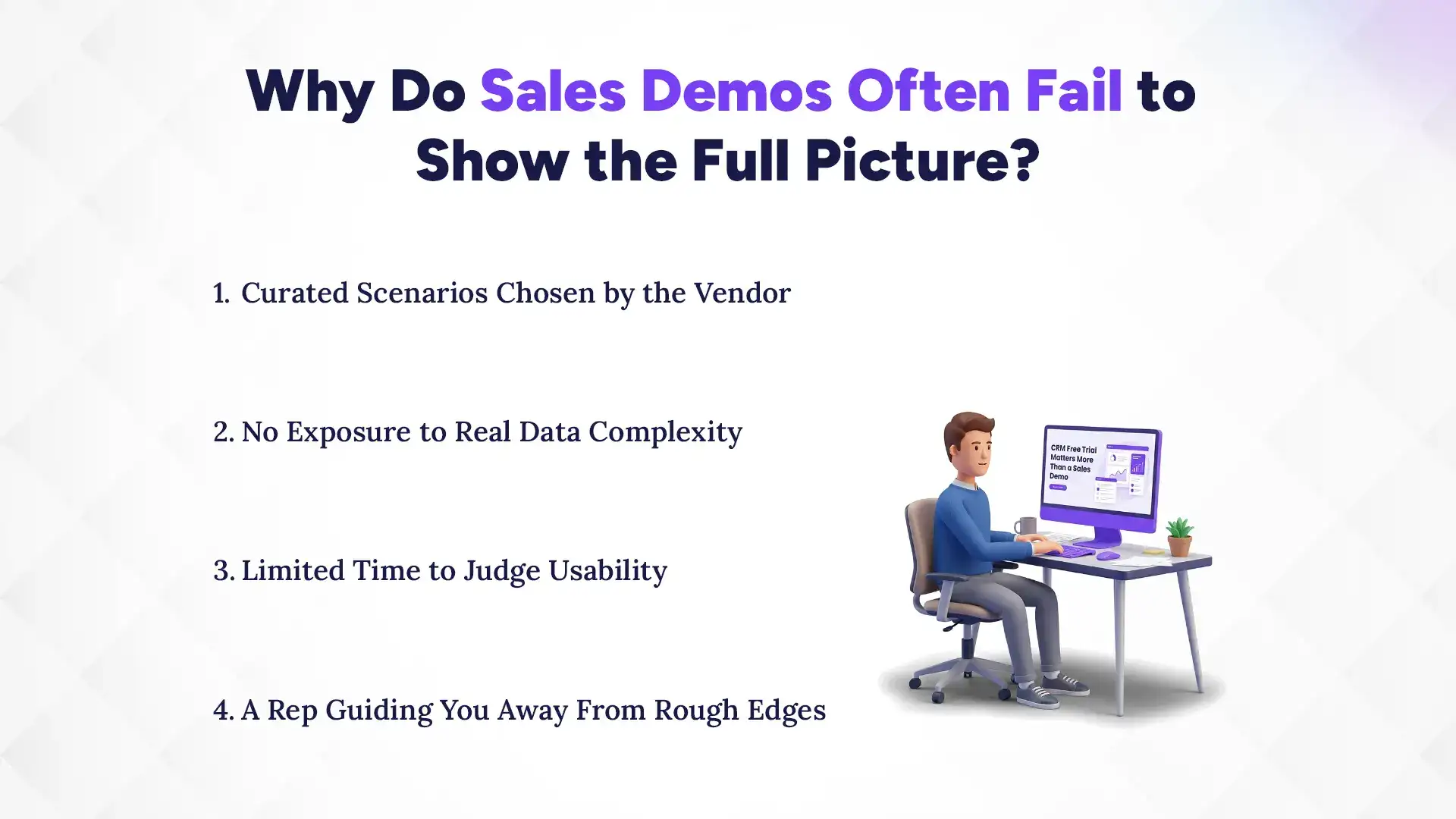
1. Curated Scenarios Chosen by the Vendor
Demos typically follow a script built around the product's strongest features, walking through scenarios specifically chosen to look impressive. Relying on curated scenarios chosen by the vendor means you're seeing the product's best case, not a representative one.
2. No Exposure to Real Data Complexity
Demo environments almost always use clean, simplified sample data instead of the messy, inconsistent data real businesses actually work with. This lack of exposure to real data complexity hides exactly the kind of friction that shows up once your own data is loaded in and you see how CRM works in a real-world environment.
3. Limited Time to Judge Usability
Thirty to sixty minutes isn't enough time to judge whether a system genuinely feels intuitive once the novelty wears off. Limited time to judge usability means most demo impressions are based on presentation quality, not actual day-to-day usability.
4. A Rep Guiding You Away From Rough Edges
A skilled rep naturally steers the conversation away from clunky workflows or confusing menus, whether intentionally or just out of habit. Having a rep guiding you away from rough edges means the parts of the product that would actually frustrate your team often never come up.
What Can You Actually Test During a CRM Free Trial?
During a CRM free trial, you can actually test real data import and migration, how well the system fits your team's actual workflow, integration with your existing tools, and day-to-day usability under real conditions.
1. Real Data Import and Migration
A trial lets you import actual records and see firsthand how smoothly, or roughly, the migration process actually goes. Testing real data import and migration during a trial surfaces issues that a clean demo environment would never reveal.
2. Actual Team Workflow Fit
You can walk through your team's real sales or support process inside the system, rather than a generic workflow the vendor assumes fits every business. Confirming actual team workflow fit, especially regarding lead management in CRM, is one of the most valuable things a trial can tell you that a demo simply can't.
3. Integration With Existing Tools
A trial gives you the chance to connect the CRM to the other tools your business already relies on and see whether the integration actually works as advertised. Verifying integration with existing tools during a trial avoids discovering connection issues only after you've already committed.
4. Day-to-Day Usability Under Real Conditions
Using the system for actual daily tasks over several days reveals whether it feels intuitive or clunky once the initial novelty fades. Judging day-to-day usability under real conditions is something no thirty-minute walkthrough can substitute for.
How Should You Structure a CRM Trial for Accurate Results?
A CRM trial should be structured around clear evaluation goals set in advance, involvement from the team that will actually use the system, and testing with real data instead of generic sample records.
1. Setting Clear Evaluation Goals First
Before starting, decide exactly what you're trying to confirm, whether that's workflow fit, integration reliability, or ease of use for a specific role. Setting clear evaluation goals first keeps the trial focused instead of turning into unstructured exploration.
2. Involving the Team That Will Actually Use It
The people who'll use the CRM daily should be the ones testing it, not just a manager evaluating it from a distance. Involving the team that will actually use it surfaces usability concerns that leadership alone might never notice.
3. Testing With Real, Not Sample, Data
Loading in real customer records, even a limited set, gives a far more accurate picture than working with the vendor's pre-built sample data. Testing with real, not sample, data is what actually validates whether the system will hold up once it's live.
What Risks Come From Buying a CRM Based on a Demo Alone?
Buying a CRM based on a demo alone risks hidden usability issues, poor fit with existing workflows, unexpected integration problems, and a costly switch later once those issues surface.
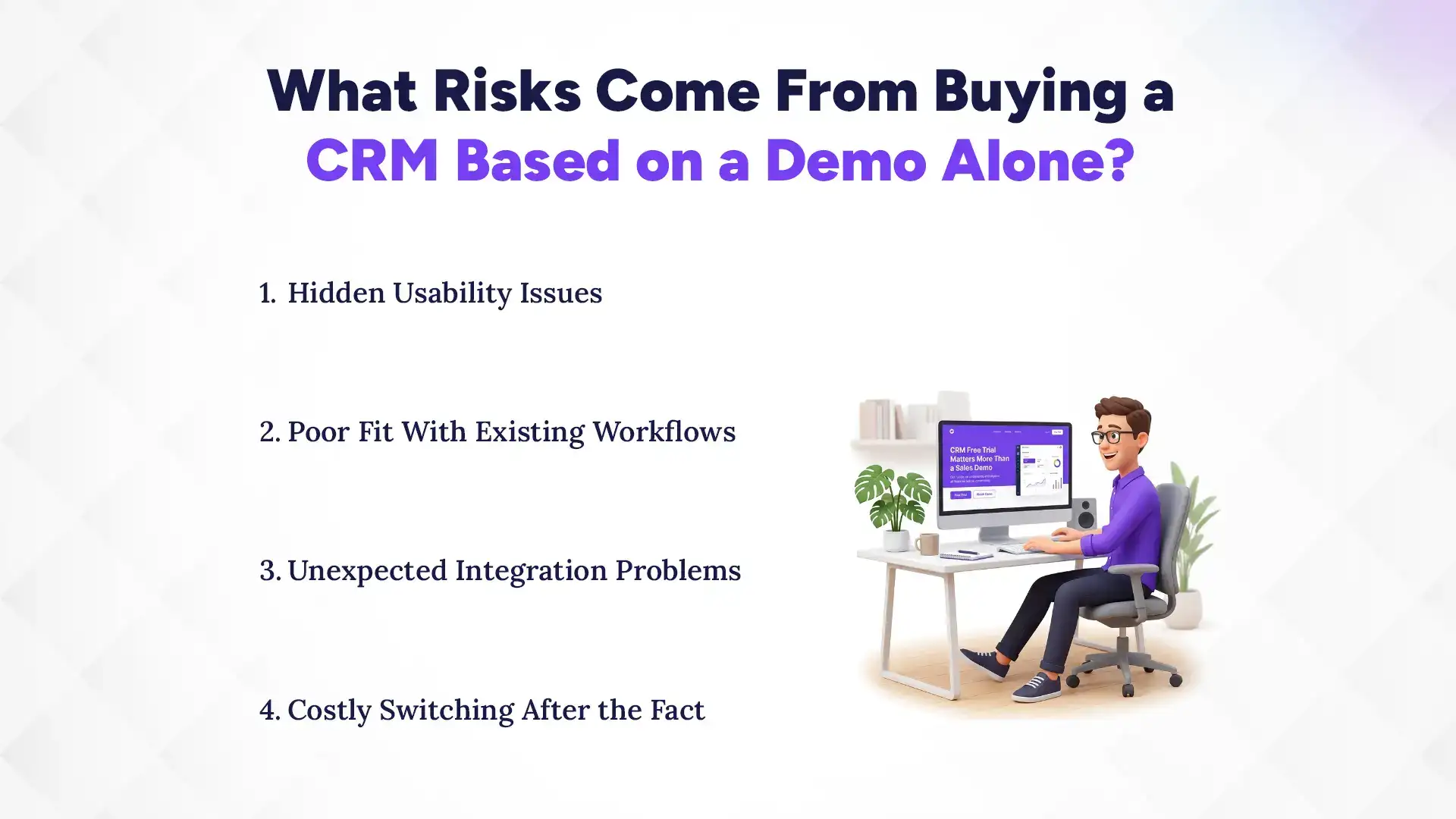
1. Hidden Usability Issues
Problems that never came up during a curated demo often surface immediately once the whole team starts using the system daily. Discovering hidden usability issues after purchase is far more disruptive than catching them during a trial.
2. Poor Fit With Existing Workflows
A CRM that looked flexible in a demo can turn out to fight against how your team actually sells or supports customers. Poor fit with existing workflows often isn't obvious until real deals are being worked inside the system.
3. Unexpected Integration Problems
Integrations that were described as seamless during a sales pitch can turn out to require workarounds or simply not function as promised. Unexpected integration problems are one of the most common surprises businesses face after skipping a proper trial.
4. Costly Switching After the Fact
Realizing a CRM doesn't fit after data, workflows, and training are already built around it makes switching expensive in both time and money. Costly switching after the fact is exactly the outcome a proper trial is meant to prevent, completely negating the expected benefits of a CRM system.
What Features Should You Look for in a CRM's Free Trial Offering?
The features to look for in a CRM's free trial offering include full feature access rather than a limited version, a reasonably long trial period, and real support availability throughout the trial.
1. Full Feature Access, Not a Limited Version
A trial that locks out key features doesn't actually let you evaluate the product you'd be buying. Insisting on full feature access, not a limited version, ensures your evaluation reflects the real product, not a stripped-down preview.
2. Reasonable Trial Length
A trial needs enough time for your team to actually build workflows and test real usage, not just click around for a day. A reasonable trial length gives you the room to form a genuine opinion instead of a rushed first impression.
3. Support Availability During the Trial
Access to real support during the trial, not just after purchase, lets you evaluate how the vendor actually responds when you run into a problem. Support availability during the trial is often a preview of what post-purchase support will actually look like.
How Should Nepali Businesses Approach CRM Free Trials?
Nepali businesses should approach CRM free trials by involving the actual sales team early, testing with real Nepali customer data, evaluating local support responsiveness, and setting a clear evaluation checklist before starting.
1. Involving the Actual Sales Team Early
Getting the sales team hands-on with the trial from day one, rather than involving them only after a decision is made, surfaces real feedback while it can still influence the outcome. Involving the actual sales team early is especially important for growing Nepali businesses making their first serious CRM investment.
2. Testing With Real Nepali Customer Data
Loading in actual customer records reflecting how business is really conducted locally shows whether the CRM genuinely fits, rather than just looking good with generic sample data. Testing with real Nepali customer data reveals fit issues that a global demo environment wouldn't surface.
3. Evaluating Local Support During the Trial
Checking how responsive and knowledgeable support is during the trial gives a realistic sense of what to expect after signing on, particularly for issues specific to doing business in Nepal. Evaluating local support during the trial is one of the most practical steps a Nepali business can take before committing.
4. Setting a Clear Trial Evaluation Checklist
Going into the trial with a written checklist of what needs to be confirmed keeps the evaluation focused and makes it easier to compare against other options. Setting a clear trial evaluation checklist turns the trial period into a structured decision process, which is a core part of how to choose the right CRM for your needs.
Which CRM Offers the Best Free Trial in Nepal?
Pace CRM offers the best free trial in Nepal, with full feature access, real data testing, and local support available throughout the trial period. It's designed to reflect how Nepali businesses actually evaluate and adopt software.
For businesses in Nepal looking to move from curated demos to hands-on testing, Pace CRM offers a trial with full feature access from day one, letting teams test real workflows and real customer data instead of a limited preview. Support is available throughout the trial itself, not just after signing a contract. It pulls together full access, real data testing, and responsive local support into a single trial experience instead of a restricted preview. As one of the top 5 CRM software in Nepal, it's designed to reflect how Nepali businesses actually evaluate and adopt software.
What sets Pace CRM's trial apart is that it's designed to be genuinely evaluated, not just quickly demoed and forgotten. Between full access, a reasonable trial length, and responsive local support, it gives businesses everything they need to judge fit honestly before committing.
Conclusion
A polished demo can make almost any CRM look good for thirty minutes, but only a free trial reveals whether the system actually fits how your team works day to day. Testing real data, real workflows, and real support during a trial are what actually protect you from a costly mismatch after you've already committed.
If you're evaluating a CRM, start with Pace CRM's free trial or contact Pace Infosys to see how it fits your team's actual workflow.