
.webp&w=3840&q=75)
Companies that manage client relationships without CRM software rely on a mix of WhatsApp chats, Excel sheets, and individual memory to track leads and close deals. This works when the client list is small but breaks down irreversibly as the business grows.
Eventually, your sales team manages more leads than any spreadsheet can track, follow-ups are missed because there is no reminder system, and client data is scattered across personal phones. At that point, the business isn't just inconvenienced; it is actively losing revenue to a client management process that cannot keep up with its own growth, highlighting exactly what CRM is designed to fix.
This guide covers what happens when companies manage clients without CRM software, the specific challenges that result, why common alternatives fail, and why a CRM is the most direct solution.
What Happens When Companies Manage Clients Without CRM Software?
When companies manage clients without CRM software, leads fall through the gaps, follow-ups happen late or not at all, and leadership has zero reliable view of the sales pipeline. This is the exact opposite of how CRM works in a structured, growth-oriented environment.
Most Nepali businesses currently track clients through saved WhatsApp contacts, inconsistent Excel sheets, and verbal updates in meetings. These tools are familiar and free, but none were designed to manage a growing client pipeline with accountability and visibility.
The damage isn't always visible. Missed follow-ups look like a slow month. Lost leads look like quiet marketing. But the cumulative effect of these invisible losses compounds over time, and by the time a business owner recognizes the pattern, years of recoverable revenue are already lost.
Key Challenges Companies Face Without CRM Software in Nepal
The key challenges companies face without CRM software in Nepal are lost leads, no pipeline visibility, disorganized client information, poor team coordination, weak retention, inaccurate forecasting, inability to scale, client relationships walking out with departing staff, and zero sales accountability.
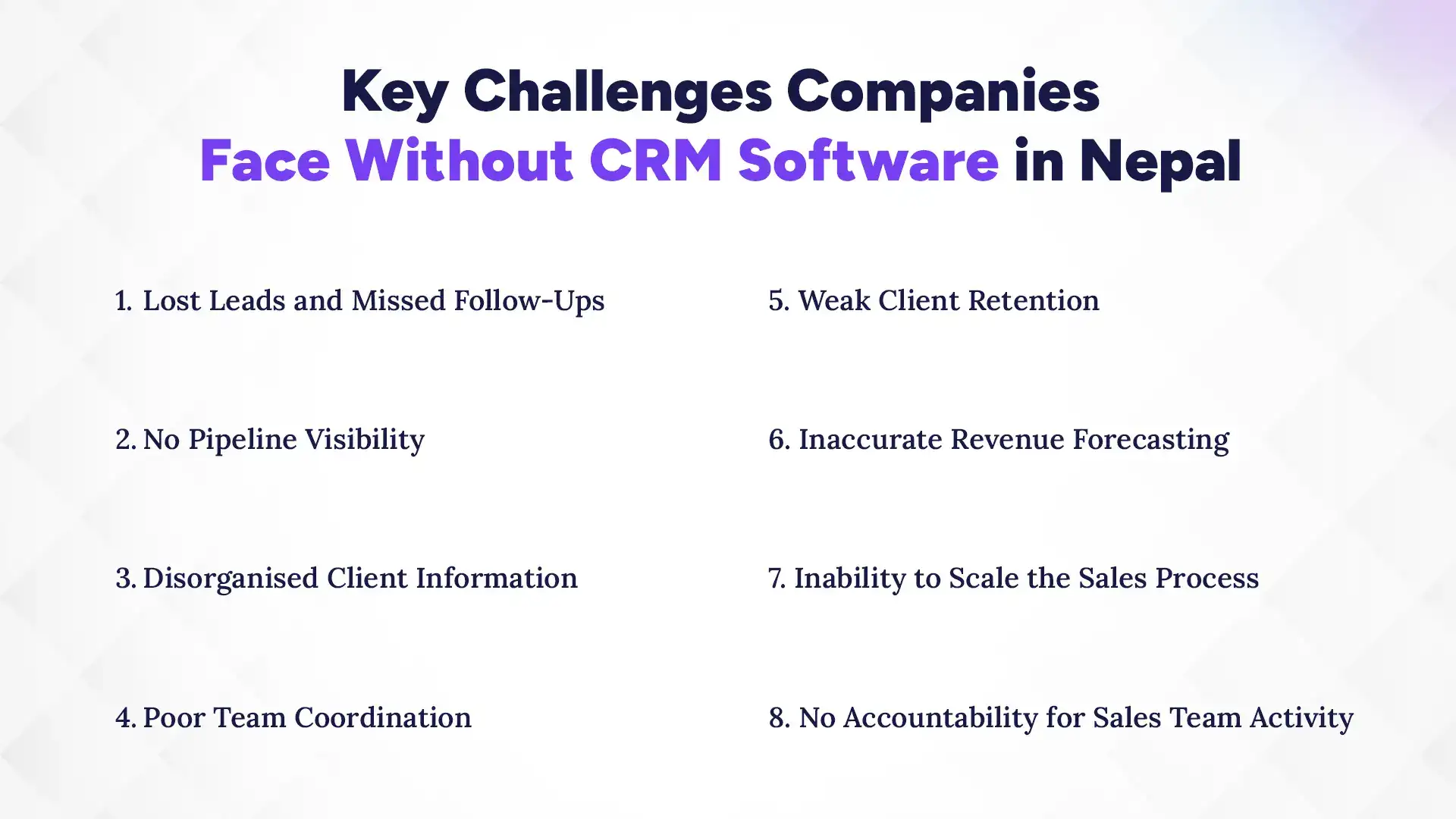
1. Lost Leads and Missed Follow-Ups
Without lead management in CRM, every lead depends on an individual remembering to follow up at the right time. In Nepal's fast-paced sales environment, where prospects evaluate multiple vendors simultaneously, a follow-up arriving three days late usually means the contract is already lost to a faster competitor.
2. No Pipeline Visibility
Without CRM software, a sales manager cannot answer basic pipeline questions like how many proposals are pending, which leads are cold, or what revenue is expected this month without making phone calls or checking multiple files. Leadership decisions made on this incomplete picture carry unnecessary risk.
3. Disorganised Client Information
Client details, communication histories, and contract terms stored across personal phones and notebooks are not company assets; they are personal records. Every client interaction that relies on individual memory rather than a shared system is a potential failure point.
4. Poor Team Coordination
Without CRM software, sales, accounts, and support teams operate in separate silos. A client may receive completely different messages from different team members because neither has access to a shared record of past discussions. In Nepal's relationship-driven market, this directly damages trust.
5. Weak Client Retention
Retaining clients requires consistent communication between transactions, check-ins, and renewal reminders. Without CRM software, these touchpoints depend entirely on memory. The benefits of using CRM software clearly show how automated reminders solve this, but without them, client communication becomes active only when a deal is closing and silent between contracts, exactly when competitors make their move.
6. Inaccurate Revenue Forecasting
Forecasting without CRM software is estimation dressed as planning. Deals gone cold are counted as active, while close deals are missed entirely. Leadership using this bad pipeline data to make hiring and budgeting decisions compounds planning errors across every business cycle.
7. Inability to Scale the Sales Process
A sales process managed through WhatsApp and personal spreadsheets only scales by adding more people doing the same disorganized work. The result is a sales operation that grows in headcount but not in capability or revenue.
8. No Accountability for Sales Team Activity
Without CRM software, managers have no reliable way to track actual team activity, such as how many calls were made and how many proposals are sitting unacted on. Getting answers requires asking team members who have an incentive to present their activity in the best possible light.
How These Challenges Affect Business Growth in Nepal
The challenges of operating without CRM software do not stay contained; they compound with every new client, new hire, and new market entry. In Nepal's competitive landscape, these invisible inefficiencies result in lost deals to faster competitors, hidden costs from missed touchpoints, and leadership decisions built on inaccurate data.
- Deals lost to faster competitors: A competitor using CRM automated reminders will consistently outpace a team relying on memory.
- Hidden costs: Every missed follow-up is a lost deal. Every missed renewal is recurring revenue handed to a competitor.
- Damage scales with growth: Manual management fails harder with every new hire and client added. More people doing disorganized work produces chaos, not growth.
- Businesses plateau: Companies that grow headcount without building a structured client process find revenue doesn't grow proportionally.
How CRM Software Solves These Challenges
CRM software solves these challenges by replacing disconnected tools with a centralized system that tracks leads through visual pipelines, automates follow-ups to prevent drop-offs, aligns team communication for better coordination, and provides real-time dashboards to ensure sales accountability and improve client retention.
- Replaces fragmented tools: It doesn't add another app to your workflow; it replaces WhatsApp, Excel, and notebooks with one unified, connected system.
- Tracks pipelines to prevent lost leads: Every inquiry is captured and monitored in a visual funnel, ensuring no opportunity slips through the cracks.
- Automates follow-ups to drive retention: Scheduled reminders and consistent touchpoints happen automatically without relying on an individual's memory.
- Makes performance visible for accountability: Managers get real-time, system-recorded data on team activity, replacing guesswork and self-reporting with measurable insights.
- Builds scalable infrastructure: For companies in Nepal that have outgrown manual tracking, it provides the foundational system needed to scale revenue without adding chaos.
What Companies in Nepal Use Instead of CRM Software (And Why It Fails)
Most companies in Nepal rely on a mix of WhatsApp, Excel sheets, email threads, and physical notebooks to manage client relationships. While these tools are familiar and free, they fundamentally fail because they lack pipeline tracking, automated follow-up systems, and shared team visibility. Ultimately, these manual workarounds trap critical client data in personal silos and collapse under the weight of business growth.
1. WhatsApp and Phone Calls
WhatsApp works for individual chats but fails as a management system. There is no pipeline view, no shared team access, no reminders, and no record that survives a staff departure.
2. Excel and Google Sheets
Spreadsheets give a shared list of names but cannot send reminders, show a visual pipeline, or track communication history. Most client tracking spreadsheets in Nepal are accurate for one month, partially updated for three, and abandoned within six.
3. Email Threads
Using inboxes as makeshift CRMs fails because email is for communication, not pipeline management. There is no stage tracking, no shared client view, and no way to see the full pipeline without reading every thread.
4. Notebooks and Physical Registers
Notebooks are completely inaccessible to anyone except the writer, cannot be searched, cannot trigger reminders, and are permanently lost the moment the staff member leaves.
Ultimately, these familiar tools create a false sense of control. While they may suffice for a handful of early clients, they actively prevent a business from scaling by locking vital information in inaccessible, personal silos. The moment a company requires cross-team coordination and consistent follow-ups, these manual methods break down, proving they are temporary band-aids rather than sustainable business infrastructure.
Why Should Companies in Nepal Use CRM Software?
Companies in Nepal should use CRM software because it replaces broken manual tools with a single, structured system that utilizes core CRM features to capture leads, follows up consistently, stores data centrally, coordinates teams, and gives leadership an accurate view of revenue.
- Captures every lead: Inquiries enter a structured pipeline the moment they are logged.
- Follows up consistently: Automated reminders trigger at the right time, removing reliance on memory.
- Stores data as a company asset: Communication and proposal records belong to the company database, not individual devices.
- Connects teams: All departments share one client view for informed interactions.
- Protects recurring revenue: Automated renewal reminders keep relationships active and prevent silent churn.
- Produces accurate reports: Leadership sees real-time forecasts built from system data, not estimates.
- Scales without chaos: CRM handles ten clients or ten thousand with the same structured process.
Which Is the Best CRM Software for Companies in Nepal?
Pace CRM is the best CRM software for companies in Nepal because it combines lead capture, visual pipeline tracking, automated follow-ups, centralized client records, and real-time revenue dashboards in one platform built specifically for the Nepali context, featuring local support, NPR-denominated tracking, and pricing that reflects local business scales.
Powered by a cloud-based CRM architecture, Pace CRM directly addresses these challenges: leads are tracked from first contact to close, automated reminders ensure timely follow-ups, and all client data is stored in a shared database that survives staff departures.
Conclusion
Operating without a centralized CRM creates a structural barrier to your growth. Lost leads, invisible pipelines, and the risk of client relationships walking out with departing staff are not just operational hiccups; they represent compounding revenue loss. As the Nepali market becomes more competitive, the longer your company relies on WhatsApp and spreadsheets, the more ground it cedes to competitors who follow up faster and retain clients longer.
Transitioning to a structured CRM is not just a software upgrade; it is the essential infrastructure needed to protect your revenue and scale reliably. Contact Pace Infosys today to see how Pace CRM can replace your scattered manual processes with a unified platform designed to grow with your business.