

Every business reaches a point where their website is no longer enough. Customers expect fast, app-like experiences on their phones, but building a separate native app for iOS and Android is expensive, time-consuming, and hard to maintain. That is exactly where Progressive Web Apps come in.
A PWA gives your customers an app-like experience directly through their browser; no App Store download is required. It loads fast, works offline, sends push notifications, and feels native on any device. Businesses that have switched to PWAs report higher engagement, lower bounce rates, and significantly better mobile conversion numbers.
But here is the problem: PWA development is a specialized skill. Not every web development company understands service workers, caching strategies, Web App Manifests, or Lighthouse performance scoring. Choosing the wrong company means paying for a product that looks like a PWA but performs like a slow website.
This guide walks you through everything you need to know to find and choose the right PWA development company, one that builds something that actually performs, converts, and grows with your business.
What Is a PWA Development Service?
A PWA development service is a professional setup where technical experts build progressive web applications, websites engineered to behave like native mobile apps. These are not just mobile-friendly websites. A true PWA uses specific technologies, including service workers, web app manifests, and HTTPS protocols, to deliver offline functionality, push notifications, fast load times, and home screen installation without requiring a download from an app store.
PWA developers do not just write code. They make strategic decisions about caching behavior, offline data handling, API integrations, and performance optimization that directly affect how your customers experience your product. The best PWA development companies combine technical engineering with UX thinking, building something that is not only functional but genuinely enjoyable to use.
You can access PWA development services in three main ways: hiring a freelance PWA developer for smaller projects, working with a specialized PWA development agency for end-to-end delivery, or bringing a developer in-house for long-term product work. Each option suits different business sizes, budgets, and timelines.
Why Choosing the Right PWA Development Company Matters
Choosing the right PWA development company matters because your PWA is not just a technical product; it is a direct extension of your brand and your customer's primary touchpoint with your business. A poorly built PWA loads slowly, breaks offline, drains battery life, and frustrates users into leaving. A well-built PWA keeps customers engaged, drives repeat visits, and converts better than a standard mobile website.
The difference between a good and bad PWA development partner is not always visible in a proposal or a price quote. It shows up months later in your Google Lighthouse scores, your Core Web Vitals data, and your actual conversion numbers. Choosing the right company from the start protects you from that outcome.
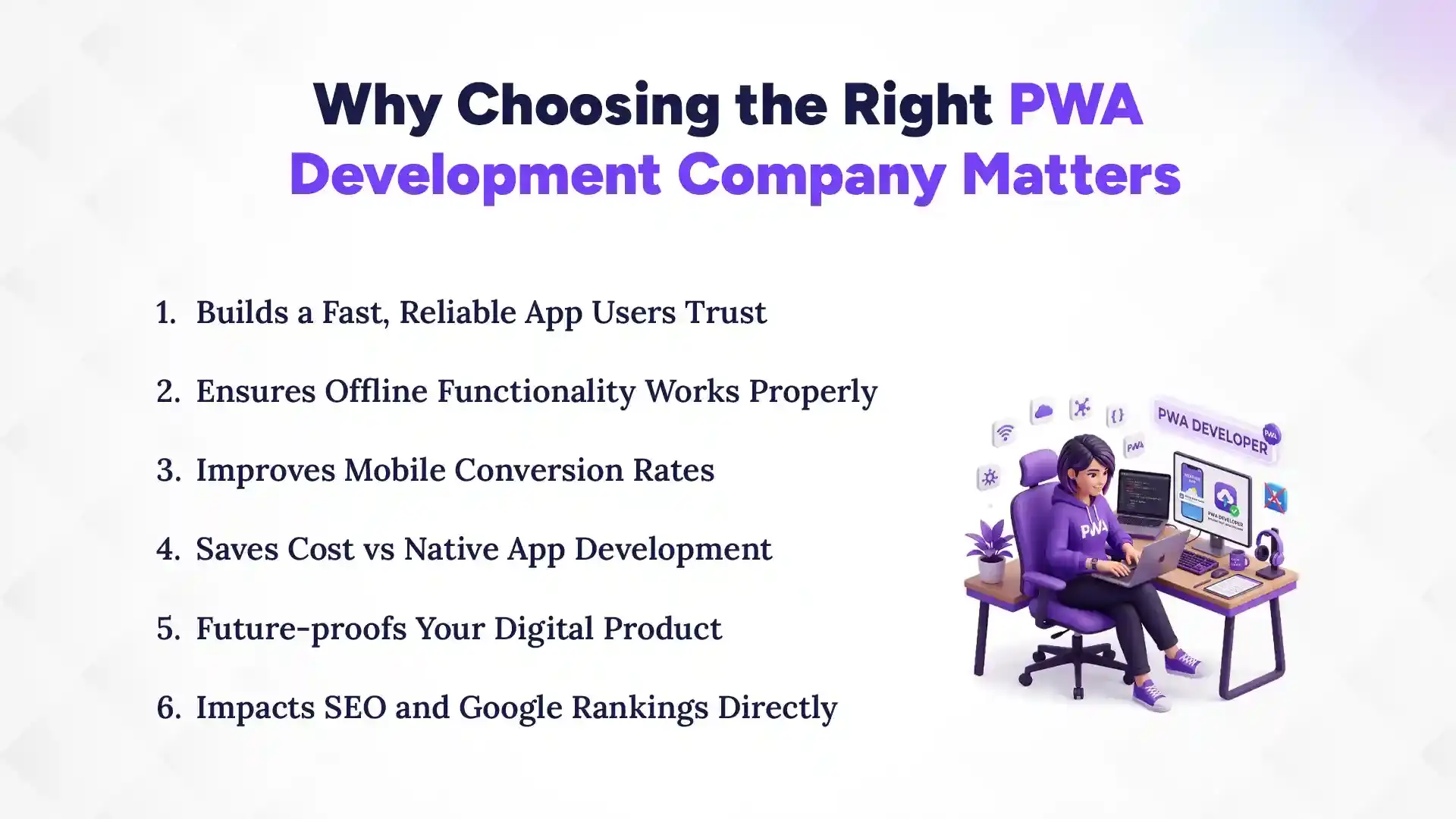
Here is what the right PWA development partner delivers:
- Builds a fast, reliable app that users trust and return to
- Ensures offline functionality actually works when users lose connection
- Improves mobile conversion rates through better UX and load speed
- Saves significant cost compared to building separate iOS and Android native apps
- Improves your SEO rankings through better Core Web Vitals scores
- Future-proofs your digital product with scalable, maintainable code
- Delivers measurable business results, not just a working build
Types of PWA Development Services
The six most common PWA development services are strategy and consulting, design and UX, core development and engineering, migration from existing products, post-launch maintenance, and third-party integration, each requiring a different type of expertise and a different kind of development partner.
1. PWA Strategy and Consulting
Before any code is written, a strategy consultation helps you determine whether a PWA is the right solution for your specific business problem. A good consultant will assess your current website performance, your target users' device and connectivity habits, your budget, and your long-term digital roadmap. This stage prevents expensive mistakes later by making sure you are building the right thing before committing to a full development engagement.
2. PWA Design and UX
This service focuses on the visual and experiential layer of your PWA: the app shell design, navigation structure, offline UI states, loading animations, and mobile-first interface. PWA UX is different from standard web design because designers must account for scenarios that do not exist on regular websites: what the user sees when they are offline, how the install prompt appears, and how push notifications are presented. Skipping proper UI UX design at this stage produces a technically functional PWA that users find confusing or unpleasant to use.
3. PWA Development and Engineering
This is the core technical build implementing service workers for offline functionality and background sync, configuring the web app manifest for home screen installation, setting up push notification systems, optimizing caching strategies, and ensuring the app scores well on Google Lighthouse. This is where the real technical expertise separates good PWA companies from average ones. Any developer can build a website. Not every developer understands how to architect a service worker that handles complex offline scenarios without breaking the user experience.
4. PWA Migration Services
If you already have a website or a native app, migration services convert your existing product into a PWA without rebuilding everything from scratch. This is often the most cost-effective route for established businesses. A good migration partner will audit your current codebase, identify what can be retained, and layer PWA capabilities on top rather than charging you for a complete rebuild when it is not necessary.
5. PWA Maintenance and Support
A PWA is not a build-and-forget product. Browser APIs evolve, security vulnerabilities emerge, and your business requirements change. Ongoing maintenance services cover regular performance audits, security patches, feature updates, and compatibility testing across new browser versions and devices. Businesses that skip post-launch support often find their PWA degrading in performance over 12 to 18 months as the underlying technology landscape shifts around it.
6. PWA Integration Services
Most business PWAs need to connect to external systems: payment gateways, CRM platforms, inventory management tools, authentication providers, and third-party APIs. Integration services ensure these connections are secure, reliable, and performant. A PWA that looks great but has an unreliable payment integration or a broken CRM sync is a business liability, not an asset.
How to Choose a PWA Development Company in 2026?
Key Factors to Consider are their actual technical work, how they communicate under pressure, what their process looks like behind the scenes, and what accountability they take for the product after it launches. The eight factors below are the ones that consistently separate development partners who deliver genuine business value from those who deliver a working build that underperforms six months later.
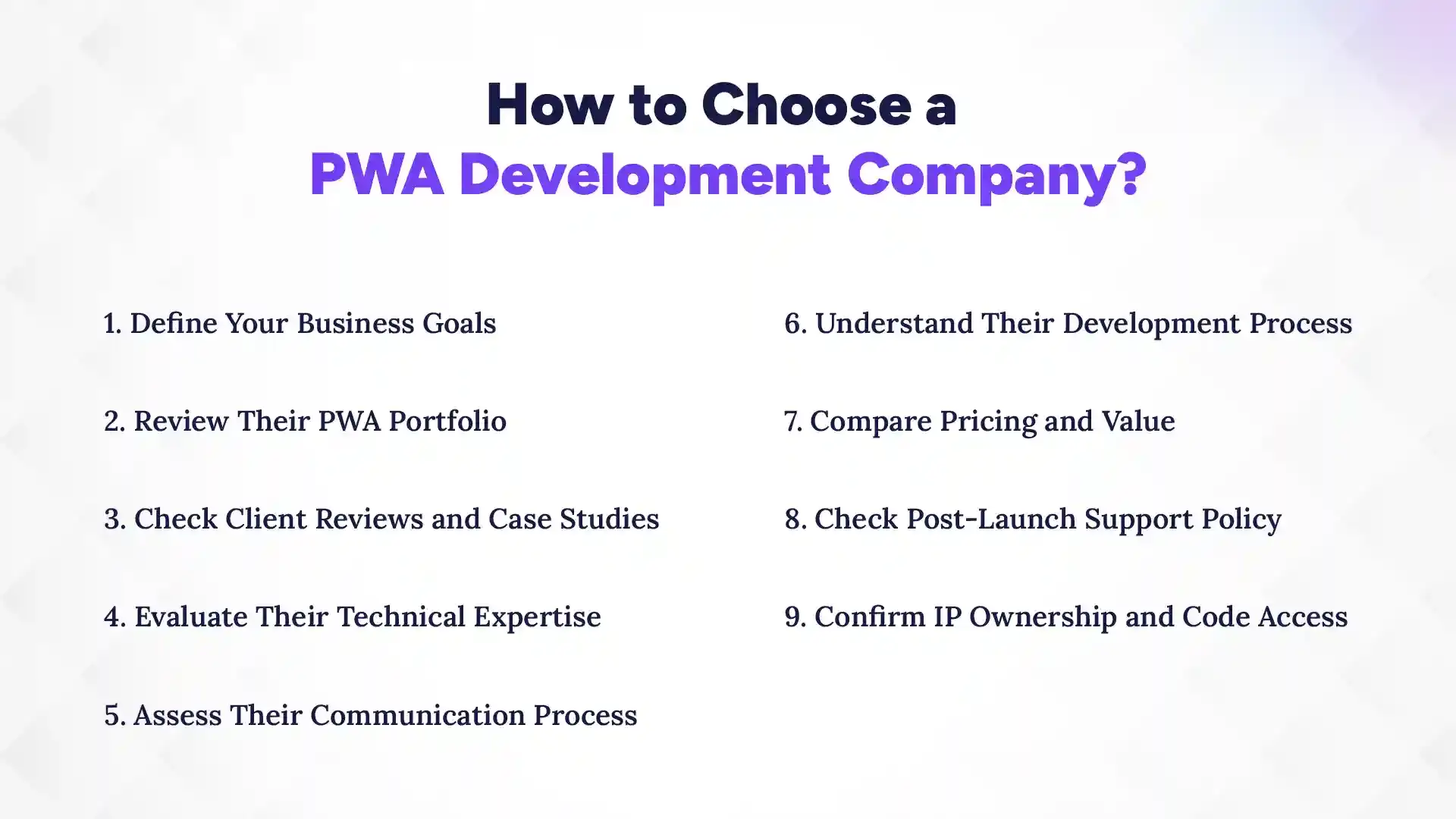
1. Define Your Business Goals First
Before you contact a single company, be clear about what you want your PWA to achieve. Are you trying to reduce your app store dependency? Improve mobile load speed? Reach users in low-connectivity areas? Increase push notification engagement? Different goals require different technical approaches, and the right company for an e-commerce PWA is not necessarily the right company for an enterprise SaaS PWA. Clarity about your goals helps you evaluate whether a company's experience is genuinely relevant to your problem.
2. Review Their PWA Portfolio With Live Examples
A portfolio of screenshots is not enough. Ask for live URLs of PWAs they have built and test them yourself. Open them on your phone, add them to your home screen, turn off your WiFi, and see what happens. Check the Lighthouse score in Chrome DevTools. A company that has built real, performant PWAs will have no hesitation giving you live links. A company that deflects this request with mockups and case study PDFs is telling you something important.
3. Check Client Reviews and Case Studies
Reviews tell you about the working relationship. Case studies tell you about results. You want both. Look for reviews that mention specific qualities: did they communicate proactively? Did they deliver on time? Did they handle problems professionally? For case studies, look for measurable outcomes: load time improvements, conversion rate increases, bounce rate reductions, not just descriptions of what was built.
4. Evaluate Their Technical Depth
Ask direct technical questions during your evaluation. How do they handle background sync for offline form submissions? What caching strategy do they use for dynamic content? How do they manage push notification permission prompts to avoid user opt-out? What is their process for achieving a Lighthouse performance score above 90? A company with genuine PWA expertise will answer these questions specifically and confidently. Vague or evasive answers are a clear signal that their team does not have deep PWA knowledge.
5. Assess Their Communication and Project Management
Good PWA development happens through consistent, transparent communication. Pay attention to how a company communicates during the sales process: response time, quality of questions they ask about your business, and clarity of their proposals. If communication is slow or unclear before you have paid them, it will be worse after. Ask what project management tools they use, how often you will receive progress updates, and who your primary point of contact will be throughout the project.
6. Understand Their Development Process
A professional PWA company should have a clearly defined process: discovery and requirements gathering, technical architecture planning, design, development sprints, testing across devices and browsers, performance optimization, and launch. Ask them to walk you through this process specifically. A structured workflow indicates an organized team that has delivered multiple PWA projects successfully. A company that skips straight to "we'll start building next week" without a proper discovery phase is likely to produce something misaligned with your actual needs.
7. Compare Pricing and Value
PWA development pricing varies significantly based on complexity, the company's location, and what is included in the engagement. The cheapest quote is rarely the best value. Look at what each quote actually includes: does it cover design, testing, performance optimization, and post-launch support or just the development build? A slightly higher price from a company with a proven PWA track record is almost always a better investment than the lowest quote from a team that has built two PWAs before.
8. Confirm Post-Launch Support Policy
Ask every company you evaluate what happens after launch. Do they offer a warranty period for bug fixes? Do they provide ongoing maintenance packages? Will they be available if a critical issue appears in the first month? A company that disappears after handing over the build is a risk you do not need. Post-launch support is not optional; it is a core part of a responsible PWA development engagement.
9. Confirm Code Ownership and Access
Make sure your contract clearly states that you own the source code after project completion and that you will receive full access to all repositories, assets, and documentation. Some development companies retain ownership of code or infrastructure in ways that create dependency. You should be able to take your codebase to any developer in the future without restriction.
Red Flags to Avoid When Choosing a PWA Development Company
Red flags to avoid when choosing a PWA development company include a poor portfolio, vague terms of usage, no post-launch support, and a cheaper price. Below is the Detailed Breakdown of it.
1. Poor Portfolio
If a company claims PWA expertise but cannot show you a single live, working PWA they have built, keep looking. Screenshots and mockups are not evidence of technical capability.
2. Cannot Explain PWA Concepts in Plain Language.
A company that becomes evasive or overly technical when you ask basic questions about how their PWAs work offline or how they handle push notifications likely does not have the depth of expertise they claim.
No discovery or planning phase.
Any company that wants to start building immediately without a proper requirements and architecture phase is setting you up for expensive rework later.
3. Unrealistically Low Quotes.
A full PWA with proper offline functionality, push notifications, and performance optimization takes serious engineering effort. A quote that seems dramatically cheaper than everyone else's usually means corners are being cut somewhere on testing, performance optimization, or security.
4. No post-launch Support Offered.
A company that ends the engagement at launch and offers no maintenance or support pathway does not stand behind the quality of what they build.
5. Vague Contract With No Milestones.
A professional development company will provide a contract with clearly defined deliverables, timelines, payment milestones, and revision policies. Working without this structure is a significant financial and operational risk.
Freelancer vs PWA Development Agency: Which Is Better?
The right choice depends on your project size, budget, and long-term needs.
1. Hiring a Freelancer
A freelance PWA developer is a strong option for smaller, well-defined projects, like a PWA for a single-location business, a simple e-commerce PWA, or adding PWA capabilities to an existing website. Freelancers typically charge less than agencies, and you work directly with the person building your product, which can produce a more personal and responsive collaboration. The main limitation is capacity: a freelancer working alone cannot handle large, complex projects with tight deadlines, and if they become unavailable mid-project, your timeline suffers.
2. Hiring a PWA Development Agency
An agency brings a full team of a project manager, UX designer, frontend developer, backend developer, and QA engineer to your project. This is the right choice for complex PWAs, enterprise-level products, or businesses that need design, development, and strategy handled under one roof. Agencies have more resources to meet demanding timelines and provide structured post-launch support. The tradeoff is cost. Agencies charge more, but for projects where the PWA is a core business product rather than a supplementary feature, the investment is justified.
| Factor | Freelancer | Agency |
|---|---|---|
| Cost | Lower | Higher |
| Team size | Individual | Full team |
| Best for | Small, defined projects | Complex, long-term products |
| Communication | Direct and personal | Structured, via PM (Project Manager) |
| Post-launch support | Limited | Comprehensive |
| Risk if unavailable | High | Low |
How Much Does PWA Development Cost?
PWA development pricing varies based on complexity, feature set, the company's location, and what services are included in the engagement. Here is a realistic overview of what to expect:
| Service Type | Estimated Cost (USD) | Best For |
|---|---|---|
| Basic PWA (informational) | $1,500 – $5,000 | Small businesses, landing pages |
| Mid-level PWA (e-commerce) | $5,000 – $15,000 | Online stores, booking platforms |
| Complex PWA (enterprise) | $15,000 – $50,000+ | Large platforms, SaaS products |
| PWA Migration | $2,000 – $8,000 | Converting existing website to PWA |
| Monthly Maintenance | $300 – $1,500/month | Ongoing support and updates |
Several variables affect where your project lands within these ranges. The number of offline features, the complexity of third-party integrations, the depth of UX design work, and the level of performance optimization required all push costs upward. Companies based in North America and Western Europe typically charge more than equally skilled teams in Eastern Europe or Asia. Always ask for a detailed scope breakdown rather than a single lump-sum figure; it makes comparison between quotes meaningful.
Tips for Working Successfully With a PWA Development Company
Finding the right company is only half the equation. Being a good client produces better results. Some tips for working successfully with a PWA development company are:
Document your requirements clearly before the first meeting.
Know your target users, the devices they use, the connectivity conditions they operate in, and the core features your PWA must have at launch versus features that can come later. The more specific your brief, the more accurate and comparable the quotes you receive will be.
Request a technical discovery session before development starts.
A proper discovery session where the development team audits your current systems, maps your technical requirements, and plans the architecture prevents expensive surprises mid-build. Treat this as a non-negotiable first step, not an optional extra.
Ask for regular progress updates with working builds.
Do not wait until the end of the project to see what has been built. Request access to a staging environment early and test the PWA on real devices throughout development, not just at the end. Problems caught early cost a fraction of problems caught at launch.
Test on real devices, not just browsers.
PWA behavior varies across different phones, operating systems, and browser versions. A PWA that works perfectly in Chrome on a desktop may behave differently on an older Android device or Safari on iOS. Make sure your development partner tests across a realistic range of real devices before signing off on any milestone.
Plan for performance monitoring after launch.
Agree upfront on what success looks like: specific Lighthouse scores, load time targets, and Core Web Vitals benchmarks. Having defined performance targets creates accountability and gives you an objective basis for evaluating whether the delivered product meets the standard you paid for.
Build a long-term relationship.
A PWA is a living product, not a one-time delivery. The development company that built it understands its architecture better than anyone else. Maintaining that relationship for ongoing improvements, feature additions, and performance monitoring produces better long-term outcomes than treating the initial build as the end of the engagement.
Conclusion
Choosing the right Progressive Web App development company is one of the most consequential technology decisions a business can make. A well-built PWA reduces your dependence on app stores, delivers a faster and more engaging mobile experience than a standard website, and costs significantly less than maintaining separate native apps for iOS and Android. But only if it is built properly.
The companies that deliver genuinely performant PWAs share common traits: a portfolio of live, testable examples, the technical depth to answer hard questions confidently, a structured development process with proper discovery and testing phases, and a commitment to post-launch support. The companies to avoid share equally common traits: vague portfolios, evasive technical answers, no planning process, and contracts without clear milestones.
Take your time with this decision. Test their live work. Ask the hard technical questions. Get clarity on what post-launch support looks like before you sign anything. Your PWA will be serving your customers for years; the effort you invest in choosing the right partner at the start pays dividends throughout that entire period.