Financial advisors in Nepal often struggle to manage client follow-ups, meeting schedules, policy renewals, and important financial records in one place. When everything is handled manually or across different tools, it becomes easy to miss opportunities, delay responses, and weaken client trust.
That is where using the right CRM software becomes important. In this blog, you will learn how CRM software for financial advisors in Nepal helps organize client data, improve daily workflow, strengthen relationships, and support long-term business growth in a more efficient way.
What is CRM Software for Financial Advisors in Nepal?
CRM software for financial advisors in Nepal is a tool that helps advisors manage client information, track communication, schedule follow-ups, and organize their sales and service process in one place. It is designed to make client management easier and more structured. Instead of using notebooks, spreadsheets, or separate apps, financial advisors can keep everything inside one system. This includes contact details, meeting notes, financial goals, reminders, and past interactions.
For financial advisors in Nepal, CRM software helps improve daily work by keeping client relationships organized. It makes it easier to follow up with leads, schedule meetings, track pending tasks, and manage the sales pipeline without missing important steps. This is especially useful for advisors who handle multiple clients and need a clear view of where each client stands. CRM software also plays an important role in financial planning and wealth management. Advisors can use it to maintain proper records, monitor client needs, and deliver more personalized service over time. In Nepal, where trust and long-term relationships matter a lot in financial services, a good CRM helps advisors improve client retention, offer better support, and grow their business more efficiently.
Financial advisors in Nepal need CRM software to organize client data, improve follow-ups, automate routine work, and maintain accurate records for better service and business growth. It helps advisors manage daily tasks more efficiently while reducing missed meetings, delayed responses, and scattered client information. For firms that want to build trust and keep long-term clients, CRM software creates a more professional and reliable system.
1. Centralized Client Data Management
Financial advisors handle a large amount of client information every day. This often includes contact details, financial goals, policy records, investment preferences, meeting notes, and important documents. When this information is stored in different places, it becomes difficult to access and manage properly. A CRM solves this problem by keeping everything in one organized system. This makes it easier to view complete client profiles and respond quickly with the right information.
2. Better Follow-Ups and Relationship Building
Strong client relationships depend on timely and consistent follow-ups. A CRM helps financial advisors track appointments, reminders, renewals, portfolio reviews, and other important client interactions. Instead of relying on memory or manual notes, advisors can set alerts and manage follow-up schedules in a structured way. This reduces the chance of missing important opportunities or client needs. In Nepal, where trust and long-term connections matter a lot, this can help advisors build stronger relationships over time.
3. Improved Workflow Automation
Many daily tasks in financial advisory work are repetitive and time-consuming. CRM software can automate processes such as client onboarding, task assignments, email follow-ups, and regular client check-ins. This saves time and allows advisors to focus more on consultation and relationship management. It also creates a smoother workflow for teams by making sure tasks are completed on time. As a result, productivity improves, and the business can handle more clients without losing efficiency.
4. Enhanced Compliance and Record Keeping
Keeping clear records is important for every financial advisor. A CRM helps store communication history, activity logs, internal notes, and client-related updates in one place. This creates a more reliable record management process and makes it easier to review past interactions when needed. It also supports better internal control by reducing confusion and missing information. For financial advisors in Nepal, this leads to more organized operations and a more professional client service system.
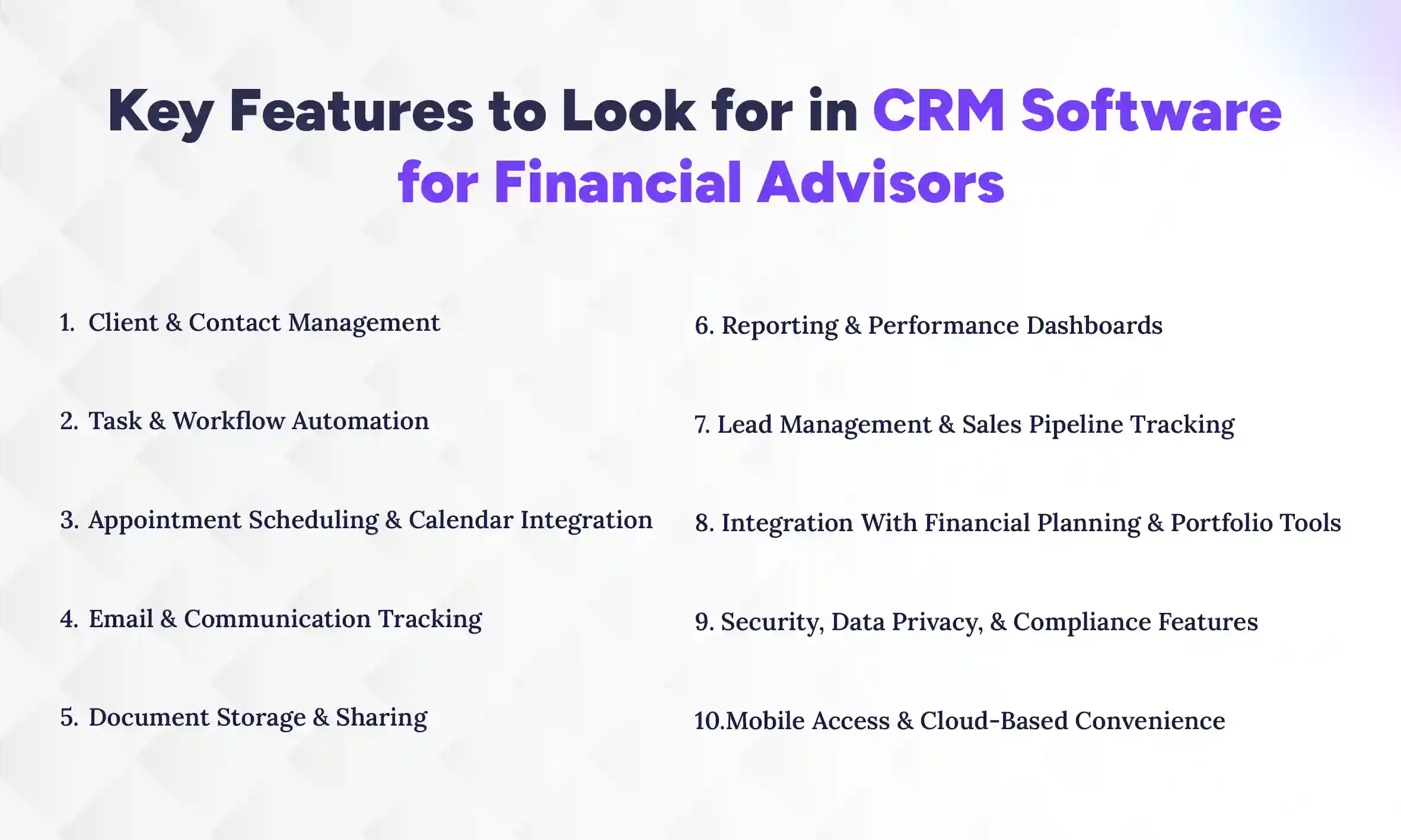
Key Features to Look for in CRM Software for Financial Advisors
The best CRM software for financial advisors should help manage clients, automate tasks, track communication, and keep business operations organized and secure. For financial advisors in Nepal, the right CRM improves productivity, client service, and daily workflow.
1. Client and Contact Management
Client and contact management is one of the most important features in any CRM. It allows financial advisors to store client names, phone numbers, email addresses, financial goals, meeting history, and important notes in one place. This makes it easier to access complete client information whenever needed. Instead of searching through emails or spreadsheets, advisors can quickly view a full profile and provide better service. It also helps teams stay updated on every client interaction.
2. Task and Workflow Automation
A good CRM should reduce manual work by automating daily tasks and business processes. Financial advisors can automate actions such as assigning tasks, sending follow-up reminders, updating lead stages, and scheduling regular client check-ins. This helps save time and reduces the risk of forgetting important tasks. Workflow automation also creates more consistency in how clients are managed. As the business grows, this feature becomes even more valuable.
3. Appointment Scheduling and Calendar Integration
Managing meetings is easier when the CRM includes appointment scheduling and calendar integration. Advisors can book client meetings, set reminders, and sync schedules with tools like Google Calendar or Outlook. This helps avoid double bookings and missed appointments. It also makes it simpler to plan daily and weekly activities in a more structured way. For busy financial advisors, this feature improves time management and keeps meetings organized.
4. Email and Communication Tracking
Communication tracking helps financial advisors stay updated on every client conversation. A CRM with this feature can record emails, notes, follow-up messages, and communication history in one system. This is useful when handling multiple clients because it gives a clear view of what was discussed and what action is needed next. It also helps improve response time and client service. When communication is properly tracked, advisors can build more trust and avoid confusion.
5. Document Storage and Sharing
Financial advisors often deal with many important documents, including client forms, proposals, reports, and agreements. A CRM with document storage and sharing makes it easier to keep these files secure and accessible. Advisors can upload, organize, and find documents without using many separate systems. This also improves teamwork because team members can access the same information when needed. For firms that want smoother operations, this feature adds both convenience and control.
6. Reporting and Performance Dashboards
Reporting tools help advisors understand how their business is performing. A CRM dashboard can show client activity, sales progress, follow-up status, conversion rates, and team productivity in a simple format. This helps financial advisors make better decisions based on real data. Instead of guessing what is working, they can identify strengths and areas that need improvement. Clear reporting also supports better planning and business growth.
Insights
Did You Know?
Financial advisors using CRM systems can increase client retention by up to 27%, helping build stronger long-term relationships and recurring revenue streams.
7. Lead Management and Sales Pipeline Tracking
Lead management is important for turning potential clients into long-term customers. A CRM helps advisors track leads from the first inquiry to final conversion through a clear sales pipeline. This makes it easier to know which leads need follow-up, which opportunities are active, and where deals may be slowing down. It creates more control over the sales process and improves conversion chances. For financial advisors in Nepal, this feature is useful for growing a stable client base.
8. Integration With Financial Planning and Portfolio Tools
Financial advisors often use different tools for planning, reporting, investment tracking, and portfolio management. A CRM becomes more useful when it integrates with those systems. This allows data to move more smoothly between platforms and reduces the need for repeated manual entry. It also gives advisors a more complete view of client needs and financial activities. Strong integration helps save time and improves overall workflow efficiency.
9. Security, Data Privacy, and Compliance Features
Financial advisors handle sensitive client information, so security should never be ignored. A reliable CRM should include features such as user access control, secure data storage, backups, and privacy protection. These tools help keep client data safe and reduce the risk of unauthorized access. Good security also supports better record management and internal control. In financial services, protecting client information is essential for trust and professionalism.
10. Mobile Access and Cloud-Based Convenience
A cloud-based CRM with mobile access gives financial advisors more flexibility in their work. They can check client details, update notes, track tasks, and respond to leads even when they are outside the office. This is helpful for advisors who travel, attend meetings, or work from different locations. Mobile access also improves response speed and keeps work moving without delay. For modern financial advisory businesses, this feature adds both convenience and efficiency.
Top 5 CRM Software for Financial Advisors in Nepal
There are many CRM software options in Nepal, but the best one for financial advisors depends on your budget, business size, and feature needs. Some are better for local support and affordability, while others offer stronger automation, customization, and advanced financial-service tools.
1. Pace CRM
Pace CRM is a practical option for financial advisors in Nepal who want a local system for managing leads, follow-ups, and customer records. Its current positioning focuses on centralizing customer interactions and automating lead assignments and follow-ups, which fits advisors who need better day-to-day organization. It is most suitable for small to mid-sized firms that want simple CRM functionality without heavy complexity. Its main limitation is that its public product information does not clearly show finance-specific tools for wealth management or advisory compliance.
Best use case: Small and mid-sized financial firms in Nepal
Strengths: Local relevance, lead tracking, follow-up automation, centralized customer data
Limitations: Not clearly positioned as a finance-specific CRM publicly
2. Kumari Job CRM
Kumari Job CRM is a Nepal-focused CRM designed for local businesses that want affordable pricing, local support, and an easy interface. It can work well for financial advisors who mainly need lead tracking, client management, and a simple system that is easy to adopt. Its biggest advantage is local market fit, which can be helpful for firms that prefer Nepali support and a straightforward setup. Its limitation is that it appears to be a general business CRM rather than a specialized platform for financial advisory work.
Ready to Manage Leads Better?
Use Pace CRM to track leads, automate follow-ups, and close deals faster. Simple, powerful, and built for your growth.
Salesforce Financial Services Cloud is one of the strongest choices for large advisory firms because it is built specifically for wealth, banking, and insurance workflows. Salesforce says it unifies data from core financial platforms and supports personalized engagement with industry-specific automation, which makes it highly relevant for complex advisory operations. It is best for firms that need advanced customization, integration, and enterprise-level scalability. Its main drawback is that it can be more complex and expensive than what many small firms in Nepal need.
4. HubSpot CRM
HubSpot CRM is a strong option for financial advisors who want a simple CRM setup with good sales and marketing tools. HubSpot highlights features such as contact, deal, and task management, plus email tracking, document sharing, and meeting scheduling, which are useful for advisors handling leads and follow-ups. Its biggest strength is ease of use and a solid free starting option for smaller teams. Its limitation is that more advanced automation and support usually require higher-priced plans.
5. Zoho CRM
Zoho CRM is a flexible and affordable option for small financial firms in Nepal that want useful CRM features without a high starting cost. Zoho offers a free edition for up to three users and includes essentials such as leads, documents, and mobile apps, which can be helpful for smaller advisory teams. Its main strength is good value, flexibility, and a wide feature set for growing businesses. Its limitation is that some advanced tools and deeper reporting features can take more time to learn or require higher plans.
How to Choose the Best CRM Software for Financial Advisors in Nepal
To choose the best CRM software for financial advisors in Nepal, focus on your business needs, required features, ease of use, integrations, pricing, and long-term support. The right CRM should match your daily workflow and help you manage clients more efficiently. A careful comparison can help you avoid wasting money on tools that do not fit your business.
1. Define Your Business Size and Team Needs
Start by understanding how big your business is and how your team works. A solo financial advisor may need a simple CRM, while a larger firm may need advanced collaboration features. You should also consider how many users will need access to the system. Choosing based on team size helps you avoid paying for features you do not need.
2. Identify Must-Have Features
Make a list of the features that are most important for your business. This may include contact management, follow-up reminders, lead tracking, document storage, or workflow automation. When you know your priorities, it becomes easier to compare CRM options. This also helps you choose a system that supports your daily work properly.
3. Check Integration With Your Existing Tools
A good CRM should work well with the tools you already use. This can include email platforms, calendars, financial planning tools, or reporting systems. Strong integration reduces manual work and makes your workflow smoother. It also helps keep all business information connected in one process.
4. Compare Ease of Use and User Experience
The CRM should be simple enough for you and your team to use every day. If the system feels too complex, it can slow down work and create confusion. Look for a clean dashboard, clear navigation, and easy access to important features. A user-friendly CRM saves time and improves team adoption.
5. Review Pricing, Scalability, and Customer Support
Pricing should match your budget, but you should also think about future growth. A CRM that works for your business today should still support you as your client base expands. Good customer support is also important when you need help with setup or technical issues. Always compare both cost and long-term value before making a decision.
6. Test the CRM With a Free Trial or Demo
Before making a final decision, try the CRM through a free trial or live demo. This gives you a chance to check how the system works in real use. You can explore the features, test the dashboard, and see whether it fits your workflow. A trial helps you make a more confident and practical choice.
What Is the Best CRM Software for Financial Advisors in Nepal?
Pace CRM is one of the best CRM software options for financial advisors in Nepal because it offers practical client management, follow-up tracking, and local business relevance in one system. It is especially suitable for firms that want an easy-to-use CRM to manage leads, client relationships, and daily operations without the complexity of large enterprise platforms.
The best CRM for financial advisors in Nepal depends on your firm's size, workflow, budget, and required features. A small advisory firm may need a simple and affordable CRM, while a growing team may need stronger automation, reporting, and collaboration tools. Larger financial companies usually look for advanced customization, deeper integrations, and more control across teams.
For small firms in Nepal, Pace CRM or Zoho CRM can be a practical choice because they are easier to manage and more budget-friendly. For growing teams, HubSpot CRM can work well due to its sales and automation features. For large financial companies, Salesforce Financial Services Cloud is often more suitable because of its advanced customization and enterprise-level capabilities.
Benefits of Using the Best CRM Software for Financial Advisors in Nepal
The best CRM software for financial advisors in Nepal helps improve client relationships, organize daily work, increase productivity, and support better business growth. It gives advisors a more structured way to manage clients, tasks, and follow-ups. This leads to better service and smoother operations.
1. Stronger Client Relationships
A CRM helps financial advisors keep full client information in one place. This makes it easier to understand client needs, past communication, and future follow-up requirements. With better access to client history, advisors can provide more personal and timely service. Over time, this helps build stronger trust and long-term relationships.
2. More Organized Daily Operations
Daily work becomes easier when tasks, meetings, reminders, and client records are managed inside one system. Advisors do not need to depend on scattered notes or multiple tools. This creates a more organized workflow and reduces confusion. It also helps teams work in a more structured and professional way.
3. Higher Team Productivity
A good CRM saves time by reducing manual work and simplifying routine processes. Team members can quickly update records, track tasks, and follow up with clients without wasting time. This improves efficiency across daily operations. As a result, the team can handle more work with better consistency.
4. Better Lead Conversion and Retention
CRM software helps advisors track leads from the first contact to final conversion. It shows which leads need attention and which clients require follow-up. This improves conversion opportunities and reduces missed chances. It also supports better retention by helping advisors stay connected with existing clients.
5. Better Reporting and Business Insights
A CRM gives financial advisors access to reports and dashboards that show business performance more clearly. They can track sales progress, follow-up activity, team productivity, and client trends in one place. This helps them make better decisions based on actual data. Better insights also support planning and long-term growth.
Common Challenges Financial Advisors in Nepal Face Without a CRM
Without a CRM, financial advisors in Nepal often struggle with scattered client data, missed follow-ups, manual work, and poor visibility into business growth. These issues can reduce efficiency, affect client service, and make it harder to manage operations properly.
Lost client information: Important contact details, notes, and documents can get scattered across files, emails, or spreadsheets.
Missed follow-ups and appointments: Without reminders and tracking, advisors may forget meetings, renewals, or client check-ins.
Time-consuming manual work: Handling tasks manually takes more time and increases the chance of errors.
Poor visibility into leads and client pipelines: It becomes difficult to track which leads need action and where each client stands.
Difficulty growing the business: As the number of clients increases, managing everything without a CRM becomes harder and less efficient.
How CRM Software Improves Client Experience for Financial Advisors
CRM software improves client experience by helping financial advisors respond faster, communicate better, and deliver more consistent service. It gives advisors a clear view of each client’s history, needs, and next steps. This helps create a smoother and more professional client journey.
Faster response times: Advisors can quickly access client details, past conversations, and pending tasks in one place.
More personalized communication: A CRM helps track client preferences, goals, and past interactions for better follow-up.
Better client onboarding: New client information, documents, and tasks can be managed in a more organized way.
Consistent service throughout the client journey: Advisors can maintain regular follow-ups and provide a more reliable experience at every stage.
How Much Does CRM Software for Financial Advisors in Nepal Cost?
CRM software for financial advisors in Nepal can cost anywhere from free plans to high monthly enterprise pricing, depending on features, users, and customization needs. Small firms can start with low-cost or free tools, while larger financial companies usually pay much more for advanced automation, integrations, and industry-specific features.
For example, HubSpot offers a free CRM and also has paid starter options, while Zoho CRM has a free plan for up to three users and paid plans that scale by features and billing type. Salesforce Financial Services Cloud sits at the premium end, with pricing starting in the hundreds of dollars per user per month, which makes it more suitable for large firms with complex needs.
In Nepal, the total cost also depends on how many team members will use the CRM, whether you need setup help, and if you want extra tools like reporting, integrations, or advanced automation. That is why financial advisors should compare not only the starting price, but also the long-term value and features included in each plan.
Conclusion
Choosing the right CRM software for financial advisors in Nepal is important because it helps manage clients better, improve follow-ups, and keep daily operations more organized. The best CRM always depends on your business goals, firm size, budget, and the features you need most.
If you are planning to invest in a CRM, compare the top options carefully and start with a demo or free trial to find the best fit for your business.
FAQs
What is the best CRM software for financial advisors in Nepal?
+
Pace CRM is one of the best options for financial advisors in Nepal because it helps manage leads, client follow-ups, and daily operations in one place. The right choice also depends on your business size, budget, and feature needs.
Why do financial advisors in Nepal need CRM software?
+
Financial advisors need CRM software to organize client data, track follow-ups, and improve daily workflow. It also helps build better client relationships and reduce manual work.
What features should CRM software for financial advisors in Nepal include?
+
It should include client management, task automation, follow-up tracking, document storage, reporting, and calendar integration. Security, mobile access, and lead tracking are also important features.
How does CRM software help financial advisors manage clients better?
+
CRM software keeps client details, communication history, and follow-up tasks in one system. This helps advisors respond faster and manage relationships more effectively.
Is there CRM software made specifically for financial advisors?
+
Yes, some CRM platforms are designed for financial services and advisory businesses. Others are general CRMs that can still work well if they offer the right features and customization.
How much does CRM software for financial advisors in Nepal cost?
+
The cost can range from free plans to expensive monthly subscriptions, depending on features and users. Small firms can start with affordable options, while larger firms may need premium tools.
Can CRM software help with compliance and record-keeping?
+
Yes, CRM software helps store client notes, communication history, and activity records in an organized way. This supports better record-keeping and more professional client management.
What is the difference between a general CRM and a financial advisor CRM?
+
A general CRM is built for broad business use, while a financial advisor CRM is more focused on client relationships, financial workflows, and industry-specific needs. Advisor-focused CRMs may also offer better integrations for financial services.
How do I choose the right CRM software for my financial advisory business in Nepal?
+
Choose a CRM based on your business size, budget, required features, and ease of use. It is also smart to test the software through a demo or free trial before making a final decision.
Ready to get started?
Book a 30-minute consultation call, and let's talk about your goals.