
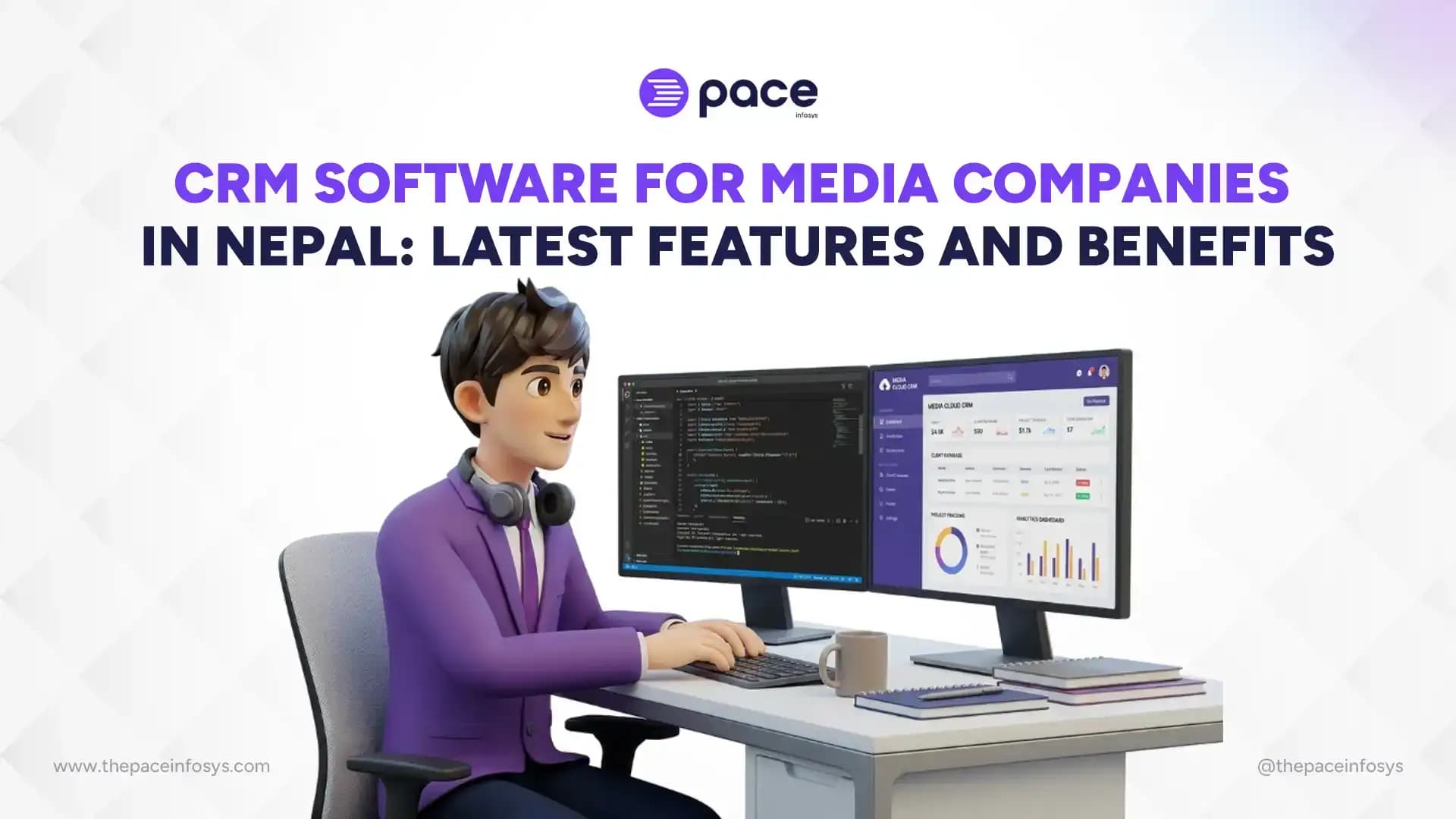

CRM software for media and publishing companies in Nepal is a centralized platform that manages advertiser relationships, ad sales pipelines, subscription renewals, and client communication for news portals, print publishers, broadcasters, and digital content agencies in one organized system.
Media and publishing companies in Nepal operate with a client structure that most generic CRM tools were never designed to handle. An online news portal manages dozens of advertisers with varying campaign durations and renewal dates. A print newspaper coordinates advertising sales teams, editorial staff, and distribution partners simultaneously. A television station tracks sponsorship deals, agency clients, and direct advertiser contacts across multiple show formats. Managing all of these relationships manually through spreadsheets, notebooks, and WhatsApp creates the kind of disorganization that quietly costs revenue every single week.
Generic CRM tools built for retail or software sales do not account for ad campaign tracking, subscription renewal cycles, or the coordination between editorial and commercial teams that defines how media businesses operate. This guide covers what CRM software does for media and publishing companies in Nepal, the specific challenges it solves, the features that matter most, and how to choose the right platform for your organization.
What Is CRM Software for Media and Publishing Companies?
CRM software for media and publishing companies is a client relationship management platform built to track advertiser contacts, manage ad sales pipelines, monitor subscription renewals, and coordinate communication between sales, editorial, and distribution teams in one centralized system.
There are different types of CRM, and CRM for Media Companies differs from generic CRM tools in how it handles the revenue structures unique to media businesses. A standard CRM tracks product sales from lead to close. A media-focused CRM tracks ad campaigns from pitch to publication, subscription clients from onboarding to renewal, and sponsorship deals from negotiation to broadcast, all within the same platform.
Media and publishing companies in Nepal need this specialized approach because their revenue depends on the health of ongoing client relationships, not one-time transactions. A missed renewal, a forgotten follow-up with an advertiser, or a miscommunication between the sales and editorial teams directly translates into lost revenue that a well-configured CRM prevents.
Why Do Media and Publishing Companies in Nepal Need CRM Software?
Media and publishing companies in Nepal need CRM software because managing advertiser relationships, subscription renewals, and editorial coordination manually leads to missed revenue, inconsistent client communication, and an inability to track commercial performance across multiple channels and platforms.
Managing advertiser relationships and ad sales pipelines is the first reason. A Nepali media company with twenty active advertisers running campaigns across print, digital, and social channels needs a system that tracks each relationship's history, campaign status, renewal date, and outstanding communication. Without it, sales teams rely on memory and fragmented notes that fail the moment someone is busy or absent.
Tracking subscription clients and renewal cycles is the second reason. Publishing companies with subscription-based revenue models lose clients not because those clients are unhappy, but because nobody reminded them that renewal was due. A CRM with automated renewal reminders and subscription status tracking prevents this churn without requiring manual follow-up for every account.
Key CRM Challenges Media and Publishing Companies Face in Nepal
Key CRM challenges media and publishing companies face in Nepal are disorganized advertiser and client data, no clear ad sales pipeline visibility, missed subscription renewals, poor coordination between sales and editorial teams, and difficulty tracking revenue across multiple media channels.
1. Disorganized Advertiser and Client Data
Most media companies in Nepal store advertiser information across a combination of sales team phones, shared spreadsheets, email threads, and printed booking forms. When a salesperson needs to know which advertisers are due for renewal this month or which campaigns are currently running, finding that information requires searching across multiple disconnected sources. A CRM centralizes all of this into one searchable database where every advertiser's history, campaign status, and contact details are always current and accessible.
2. No Clear Ad Sales Pipeline Visibility
Without a CRM, a media sales manager in Nepal typically cannot answer basic commercial questions with confidence. How many advertisers are currently in negotiation? Which campaigns are confirmed for next month? Which accounts have not been contacted in the last three weeks? Getting these answers requires manually reviewing spreadsheets and asking individual salespeople for updates, a process that takes time and produces answers that are already out of date. A CRM gives management a live pipeline view that answers all of these questions instantly.
3. Missed Subscription Renewals and Follow-Ups
Subscription-based publishing companies in Nepal lose renewal revenue not through dissatisfaction but through oversight. When renewal follow-up depends on a salesperson remembering to call, it happens inconsistently. A CRM with automated renewal reminders ensures that every subscription account receives a follow-up at the right time, every time, regardless of how many other accounts the team is managing.
4. Poor Coordination Between Sales and Editorial Teams
When a client books a sponsored content piece or an advertorial campaign, the sales team, editorial team, and sometimes the design and production team all need accurate information about what was promised, when it is due, and what the client approved. Without a shared system, this coordination happens through informal messages and verbal handovers that create errors, missed deadlines, and client dissatisfaction.
5. Difficulty Tracking Revenue Across Multiple Media Channels
Media companies in Nepal increasingly generate revenue across print, digital, video, social, and events simultaneously. Tracking which clients are spending on which channels and what the total commercial value of each relationship is requires a system that aggregates data across all of these sources. Manual tracking in separate spreadsheets per channel makes this impossible to do accurately.
Key Features of CRM Software for Media and Publishing Companies
The key features media and publishing companies need from CRM software are advertiser contact management, ad sales pipeline tracking, subscription and renewal management, revenue and campaign reporting, team collaboration tools, and integration with billing systems.
1. Advertiser and Client Contact Management
Advertiser and client contact management allows media and publishing companies to store complete profiles for every commercial relationship, including contact details, campaign history, spending levels, renewal dates, and communication records, in one centralized database that every authorized team member can access in real time.
2. Ad Sales Pipeline Tracking
Ad sales pipeline tracking allows media and publishing companies to see every advertiser deal at every stage of the sales process, from initial pitch through proposal, negotiation, booking, and campaign delivery, in a single dashboard that gives sales managers immediate visibility into current commercial activity and upcoming revenue.
3. Subscription and Renewal Management
Subscription and renewal management allows media and publishing companies to track every subscription client's status, renewal date, and payment history and to send automated renewal reminders at configurable intervals so that no renewal opportunity is missed due to oversight or manual tracking failure.
4. Revenue and Campaign Reporting
Revenue and campaign reporting allows media and publishing companies to generate real-time reports on advertising revenue by client, channel, time period, and salesperson, giving leadership the data they need to make informed decisions about pricing, channel investment, and sales team performance.
5. Team Collaboration and Task Management
Team collaboration and task management allow media and publishing companies to assign client-related tasks to specific team members, share campaign briefings across sales and editorial, and track completion status within the CRM so that every department involved in delivering a client commitment has the same accurate information.
6. Integration with Billing and Invoicing Tools
Integration with billing and invoicing tools allows media and publishing companies to connect their CRM directly with their financial systems so that confirmed bookings automatically generate invoices, payment status is visible within the client record, and outstanding payments are flagged for follow-up without manual cross-referencing between systems.
Benefits of CRM Software for Media and Publishing Companies in Nepal
The core benefits of CRM software for media and publishing companies in Nepal are increasing advertiser revenue through better pipeline management, reducing subscription churn through timely renewals, improving coordination between sales and editorial teams, and giving leadership real-time visibility into commercial performance.
1. Increases Advertiser Revenue Through Better Pipeline Management
When every advertiser relationship is tracked systematically and every sales opportunity is visible in a pipeline dashboard, sales teams close more deals because fewer opportunities fall through the cracks and follow-ups happen consistently. Media companies using CRM consistently report higher advertiser retention and more predictable monthly revenue than those managing relationships manually.
2. Reduces Subscription Churn Through Timely Renewals
Automated renewal reminders ensure that subscription clients receive follow-up contact at the right time rather than only when a salesperson happens to remember. This systematic approach to renewal management directly reduces churn by turning what was previously an inconsistent manual process into a reliable, automated workflow.
3. Improves Team Coordination Between Sales and Editorial
A shared CRM gives every team involved in delivering a client commitment access to the same accurate information. When the sales team logs a booking, the editorial and production teams can see the brief, the deadline, and the approval status immediately. This eliminates the miscommunications that create missed deadlines and client complaints.
4. Gives Leadership Real-Time Revenue Visibility
CRM reporting dashboards give media company leadership a live view of commercial performance across every channel, client, and salesperson. Instead of waiting for weekly reports compiled manually by the sales team, management can see current pipeline value revenue trends, and outstanding renewals at any moment, supporting faster and better-informed business decisions.
How CRM Software Helps Different Types of Media and Publishing Companies in Nepal
CRM software helps different types of media and publishing companies in Nepal by addressing the specific client management and revenue tracking needs of each format and distribution model.
1. Online News Portals
Online news portals in Nepal manage multiple advertisers running banner campaigns, sponsored content, and newsletter placements simultaneously. CRM tracks each campaign's status, duration, and renewal date and ensures that sales teams follow up proactively before campaigns expire rather than after revenue is already lost.
2. Print Newspapers and Magazines
Print publications in Nepal coordinate advertising bookings, editorial schedules, and distribution logistics with multiple external clients. CRM connects the commercial and editorial sides, ensuring that confirmed ad bookings are reflected in production planning and that no client commitment is missed due to a communication gap between departments.
3. Television and Radio Stations
Television and radio stations manage sponsorship deals, agency relationships, and direct advertiser accounts across different show formats and time slots. CRM tracks each relationship's history, contract terms, and renewal schedule in one place, giving the commercial team a complete view of every account without relying on individual memory or fragmented files.
4. Digital Content and Social Media Agencies
Digital content agencies in Nepal manage multiple client campaigns across platforms, including YouTube, Facebook, Instagram, and TikTok, simultaneously. CRM provides a centralized hub for tracking deliverables, client approvals, payment status, and renewal conversations for every client in the agency's portfolio.
5. Book and Academic Publishers
Book and academic publishers in Nepal manage relationships with authors, distributors, institutional buyers, and retail stockists. CRM Contact Management tracks each relationship's contact history, order status, and communication records, giving publisher teams a complete view of every commercial relationship without the gaps that manual tracking creates.
How to Choose the Right CRM Software for Media and Publishing Companies in Nepal
Choosing the right CRM software for a media and publishing company in Nepal means evaluating four factors: ad sales pipeline management, subscription and renewal tracking, billing integration, and ease of use for both sales and editorial teams.
1. Look for Ad Sales Pipeline Management
The CRM must support a pipeline view that reflects how media advertising sales actually work, from initial pitch through booking and campaign delivery, not just a generic lead-to-close model. Confirm that deal stages can be customized to match your specific sales process.
2. Check Subscription and Renewal Tracking Features
If your business has a subscription revenue stream, the CRM must track renewal dates and trigger automated reminders at configurable intervals. Manual renewal tracking is one of the most common sources of avoidable churn in Nepali publishing companies.
3. Confirm Integration with Billing and Invoicing Tools
A CRM that connects directly with your billing system eliminates the manual data transfer between sales and finance that creates errors and delays. Confirm which accounting or invoicing platforms the CRM integrates with before making a commitment.
4. Evaluate Ease of Use for Sales and Editorial Teams
A media CRM that only the sales team uses is only half as effective as one that the editorial and production teams also access regularly. The platform must be intuitive enough for non-technical staff across departments to use consistently from day one.
Which Is the Best CRM Software for Media and Publishing Companies in Nepal?
Pace CRM is the best CRM software for media and publishing companies in Nepal because it combines advertiser contact management, ad sales pipeline tracking, subscription renewal automation, and real-time revenue reporting in one affordable platform built specifically for the Nepali business context.
Pace CRM gives media sales teams a complete view of every advertiser relationship, from first contact through campaign delivery and renewal, without the spreadsheet complexity that most Nepali media companies currently rely on. Subscription renewal reminders are automated so that every client receives follow-up at the right time.
Revenue reports are generated on demand, giving leadership accurate commercial visibility without waiting for manually compiled summaries. Different CRMs work differently, so knowing the basic work mechanism of how a CRM works is beneficial to any company before committing to a CRM software.
Conclusion
Media and publishing companies in Nepal are losing advertiser revenue, subscription renewals, and editorial coordination efficiency every day by managing client relationships through spreadsheets, phones, and informal communication. CRM software replaces this fragmented approach with a centralized, organized system that tracks every commercial relationship, automates renewal follow-ups, and gives leadership real-time visibility into performance across every channel.
The media companies in Nepal that invest in CRM now build stronger advertiser relationships, retain more subscription clients, and operate with the commercial clarity that drives consistent revenue growth. The right time to make the switch is before missed renewals and disorganized pipelines start costing more than the solution. Contact The Pace Infosys today and discover how Pace CRM can transform client management for your media or publishing business.