

.webp&w=3840&q=75)
In today's mobile-first world, businesses are under growing pressure to reach users on every device and operating system simultaneously. With millions of apps competing for attention on both iOS and Android, the development strategy a business chooses can make or break its digital presence. Building separate native apps for every platform is no longer practical for most companies, especially when speed, cost, and consistency matter. This is where cross-platform app development has emerged as a powerful and strategic modern solution.
In this blog on the benefits of cross-platform app development, we will explore how it helps businesses save costs, launch faster, and deliver consistent experiences across all devices. You will learn what cross-platform development is, how it works, which frameworks lead the industry, and how to build a successful cross-platform app. We will also compare it with native development and cover the best frameworks to use. By the end, you will have a clear understanding of why cross-platform app development is the right choice for modern businesses.
What is Cross-Platform App Development?
Cross-platform app development is the process of building a single mobile application that runs on multiple operating systems, including iOS, Android, and the web, using one shared codebase. Instead of writing separate code for each platform, developers use frameworks that allow a single version of the app to be deployed across all major platforms simultaneously. Popular frameworks used in cross-platform development include Flutter, React Native, and Xamarin, each offering unique strengths for different project types.
What Are the Benefits of Cross-Platform App Development?
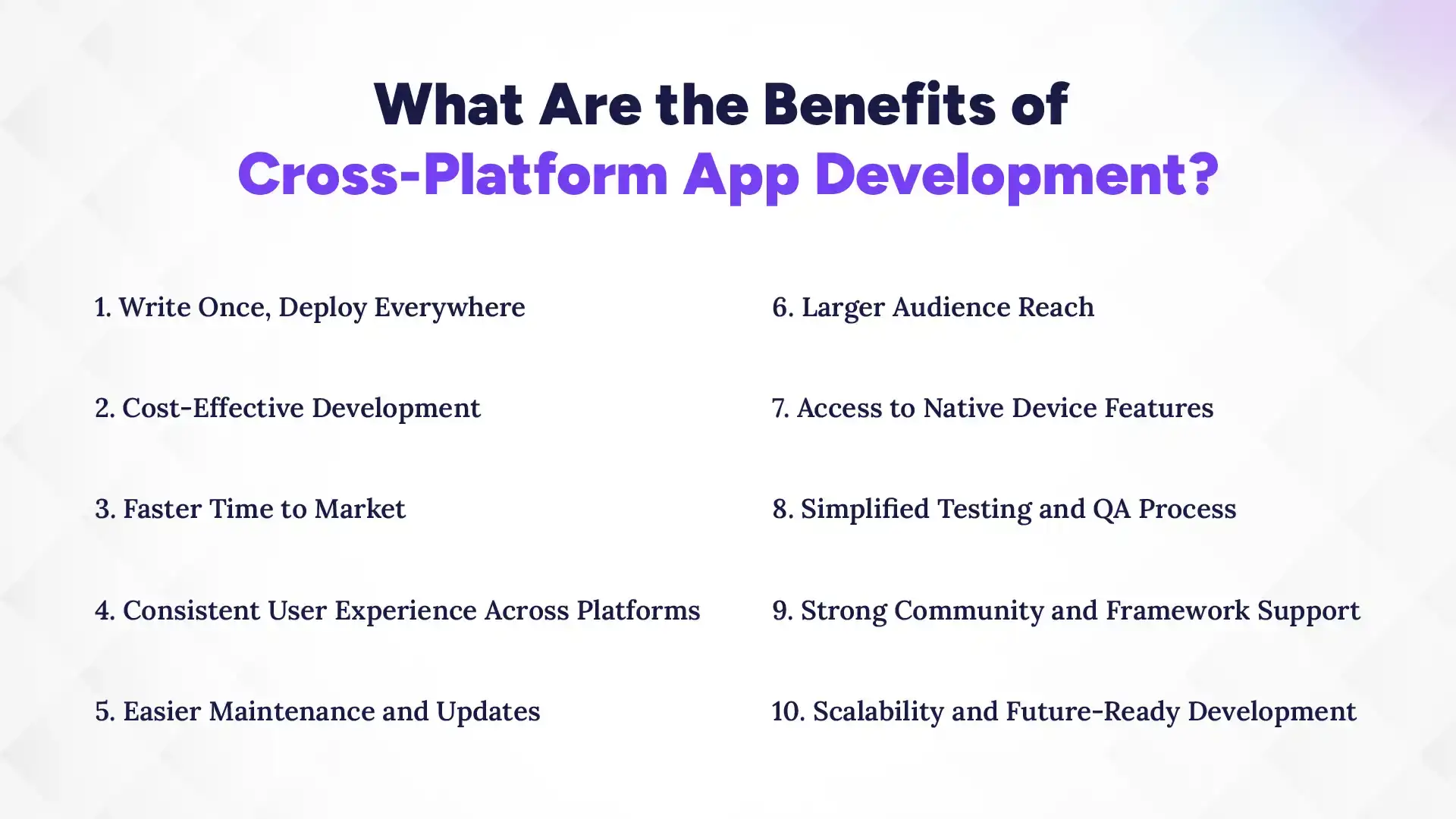
The benefits of cross-platform app development include reduced costs, faster delivery, consistent user experience, and broader audience reach from a single codebase. It allows businesses to build and maintain apps more efficiently while reaching users on both iOS and Android simultaneously. With the right framework and strategy, cross-platform apps deliver near-native performance without the overhead of separate development teams. Overall, it is one of the most practical and cost-effective approaches to modern mobile app development.
1. Write Once, Deploy Everywhere
One of the most significant advantages of cross-platform development is the ability to write a single codebase and deploy it across multiple platforms at once. Developers do not need to build separate versions of the app for iOS and Android, which drastically reduces development time and effort. This unified approach ensures that every platform receives the same features, functionality, and updates simultaneously. It simplifies the entire development lifecycle from planning and coding to testing and release.
2. Cost-Effective Development
Cross-platform development significantly reduces the overall cost of building a mobile application. Businesses do not need to hire separate iOS and Android development agencies, which cuts payroll and resource costs considerably. A single team can handle the entire project using one shared codebase, which also reduces project management complexity. For startups and small businesses with limited budgets, this cost advantage is often the deciding factor.
3. Faster Time to Market
Speed is a critical competitive advantage in the mobile app industry, and cross-platform development delivers it consistently. Because developers work from a single codebase, the overall development cycle is significantly shorter compared to building separate native apps. Features are built once and tested across platforms simultaneously, which reduces the overall project timeline. Businesses can launch their products faster and start capturing market share before competitors.
Faster time to market also allows businesses to gather real user feedback earlier and iterate more quickly. Instead of waiting for two separate native apps to be built and tested, teams can release a single cross-platform version and start learning from user behavior immediately.
4. Consistent User Experience Across Platforms
Delivering a consistent user experience across iOS and Android is one of the most important factors in building a trusted app. Cross-platform development ensures that the UI, features, and performance remain uniform across all devices and operating systems. Users on both platforms see the same design language, navigation patterns, and functionality, which eliminates confusion and strengthens brand identity. Consistency builds trust and makes the app feel polished and professional regardless of the device being used.
5. Easier Maintenance and Updates
Managing and maintaining a mobile app becomes far simpler when there is only one codebase to work with. Any bug fix, security patch, or feature update needs to be applied only once, and it automatically reflects across all platforms. This eliminates the need to track and manage separate version histories for iOS and Android, which reduces the risk of inconsistencies between platforms. Teams spend less time on maintenance and more time building new features that add value.
6. Larger Audience Reach
By targeting iOS, Android, and sometimes the web with a single application, businesses can reach a significantly larger audience from the very beginning. There is no need to choose one platform over another or delay the launch on a secondary platform due to resource constraints. Every user, regardless of their device preference, can access and use the app simultaneously. This broad reach maximizes the potential user base and increases the opportunity for downloads, engagement, and revenue.
7. Access to Native Device Features
A common misconception about cross-platform development is that apps built this way cannot access native device features. Modern frameworks like Flutter and React Native have largely eliminated this limitation through plugin systems and platform channels that allow developers to integrate native capabilities directly. Features like the device camera, GPS, push notifications, biometric authentication, and Bluetooth can all be accessed within a cross-platform app. The gap between cross-platform and native functionality has narrowed dramatically in recent years.
This access to native features ensures that cross-platform apps do not feel limited or restricted compared to their native counterparts. Developers can deliver full-featured applications that leverage the complete power of the device while still benefiting from a shared codebase.
8. Simplified Testing and QA Process
Testing a mobile app is one of the most time-consuming parts of the development process, and cross-platform development makes it significantly more manageable. With a single codebase, QA teams can write tests once and apply them across both platforms simultaneously. This reduces the total testing effort, speeds up the release cycle, and lowers the cost of quality assurance. Automated testing tools integrate smoothly with popular cross-platform frameworks, further streamlining the process.
9. Strong Community and Framework Support
Cross-platform development benefits from some of the strongest developer communities and corporate backing in the technology industry. Flutter is maintained by Google, React Native is supported by Meta, and Xamarin is backed by Microsoft, ensuring long-term framework reliability and regular updates. These communities produce a vast ecosystem of plugins, libraries, tutorials, and third-party tools that accelerate development and reduce the need to build everything from scratch. Developers can find solutions to common problems quickly and
10. Scalability and Future-Ready Development
Cross-platform apps are built with scalability in mind, making them well-suited for businesses that plan to grow their product over time. New features can be added to the shared codebase and deployed across all platforms simultaneously, which keeps scaling efforts efficient and cost-effective. As the app grows in complexity, the modular architecture supported by modern cross-platform frameworks makes it easier to manage and expand without accumulating significant technical debt. Scalability is built into the foundation of cross-platform development.
Why is Cross-Platform App Development Important for Businesses?
Cross-platform app development is important for businesses because it allows them to reach more users, reduce costs, and maintain a consistent brand presence across all major platforms from a single investment. In a market where users expect seamless experiences on every device, businesses that limit themselves to a single platform risk losing significant portions of their potential audience.
The ability to build once and deploy everywhere gives companies a strategic edge in speed, budget efficiency, and market coverage. Understanding why cross-platform development matters is essential for any business planning a long-term mobile strategy.
1. Growing Multi-Device User Behavior
Today's users do not stick to a single device or operating system. They switch between smartphones, tablets, and computers throughout the day and expect the apps they use to work consistently across all of them. This multi-device behavior means that businesses must maintain a presence across platforms to stay relevant and accessible. Cross-platform development ensures that no segment of the target audience is excluded due to device preferences or operating system limitations.
Multi-device presence also increases the number of touchpoints a business has with its audience, which improves engagement opportunities. Users who encounter a brand on both iOS and Android are more likely to interact consistently, which strengthens loyalty and drives repeat usage. Businesses that ignore multi-device behavior risk losing users to competitors who offer a more universally accessible experience.
2. Competitive Advantage in App Markets
In competitive app markets, speed and cost efficiency are decisive advantages. Cross-platform development allows businesses to launch on both major platforms simultaneously, giving them an immediate edge over competitors who build native apps sequentially. The cost savings from a single codebase can be reinvested into product features, marketing, and user acquisition, which further strengthens the competitive position. Businesses that adopt cross-platform development can move faster, spend smarter, and reach more users than those tied to slower native development cycles.
Broader platform reach also improves app store visibility and download potential. An app available on both iOS and Android immediately doubles its addressable market, which is a meaningful advantage in markets where every download counts. The combination of faster launches, lower costs, and wider reach makes cross-platform development a strong competitive
3. Budget Efficiency for Startups and Enterprises
For startups operating with limited funding, cross-platform development offers a way to build a professional, full-featured mobile app without the financial burden of separate native development teams. A single development team, one codebase, and unified maintenance all contribute to a dramatically lower total cost of ownership. This budget efficiency allows startups to allocate more resources to product refinement, customer acquisition, and business growth rather than duplicating development effort across platforms.
4. Unified Brand Experience
A consistent brand experience across all platforms is one of the most valuable outcomes of cross-platform development. When users see the same design, tone, and functionality regardless of whether they are on iOS or Android, it reinforces brand identity and builds trust. Inconsistencies between platform versions can confuse users and weaken brand perception, especially for businesses where visual identity and user experience are central to their value proposition. Cross-platform development eliminates these inconsistencies by design.
5. Simplified Long-Term App Management
Managing a mobile app over its lifetime involves ongoing updates, security patches, feature additions, and performance improvements. With a single cross-platform codebase, all of this work happens in one place, which dramatically simplifies long-term app management. Development teams do not need to context-switch between separate iOS and Android codebases, which reduces errors and improves development velocity. Onboarding new developers is also faster because there is only one codebase to learn.
Lower total cost of ownership over the long term is one of the most compelling arguments for cross-platform development from a business perspective. The savings compound over time as each update, patch, and new release requires only one round of work instead of two. Businesses that plan for multi-year product roadmaps will find that cross-platform development consistently delivers better financial and operational outcomes compared to maintaining separate native applications.
How Does Cross-Platform App Development Work?
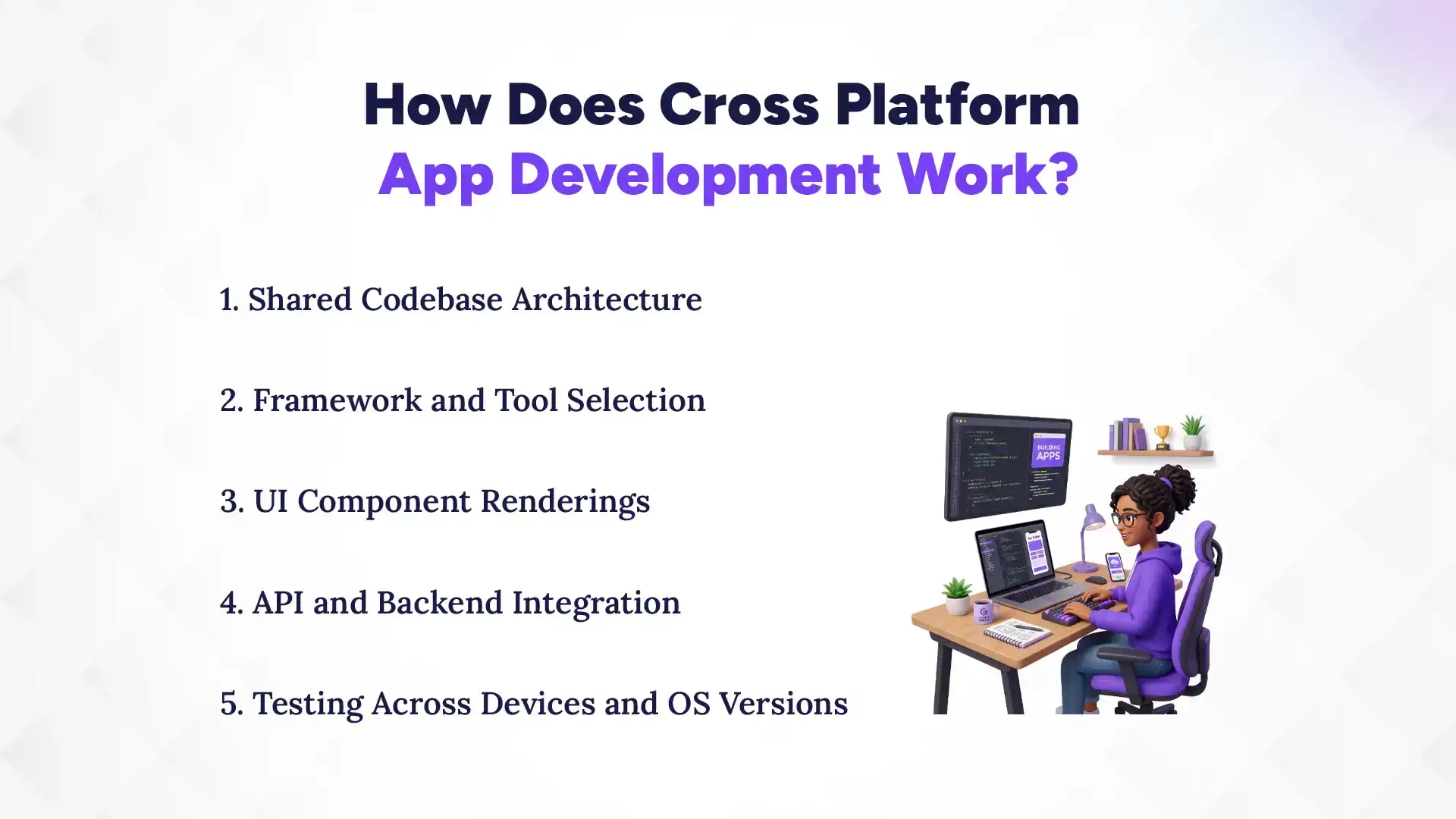
Cross-platform app development works by using specialized frameworks that allow a single codebase to compile and run natively across multiple operating systems. The process involves writing shared application logic and UI components that the framework translates into platform-compatible code or renders using its own engine. Businesses and development teams rely on a combination of strategic planning, the right framework selection, and consistent testing to ensure the app performs well across all target platforms. Understanding how cross-platform development works helps businesses make informed decisions about their mobile strategy and choose the right tools for their specific needs.
1. Shared Codebase Architecture
At the heart of cross-platform development is a shared codebase that contains the application's logic, UI components, and business rules. This single codebase is written in a language supported by the chosen framework, such as Dart for Flutter or JavaScript for React Native. The framework then compiles or bridges this code to run on iOS and Android without requiring platform-specific rewrites. The shared architecture is what makes cross-platform development efficient, as changes made in one place propagate across all supported platforms automatically.
2. Framework and Tool Selection
Choosing the right framework is one of the most critical decisions in cross-platform app development, and it often goes hand in hand with how to choose a mobile app development agency that aligns with your project goals. The choice depends on factors including the team's existing skills, the app's performance requirements, the complexity of the UI, and the long-term maintenance strategy.
Flutter is ideal for teams that want a rich, visually consistent UI with near-native performance. React Native suits teams with JavaScript expertise who want access to a large ecosystem of libraries and community support. Xamarin is the preferred choice for enterprise teams working within the Microsoft ecosystem.
3. UI Component Rendering
Different cross-platform frameworks handle UI rendering in different ways, and this distinction has a significant impact on the app's visual performance and consistency. Flutter uses its own rendering engine, Skia, to draw every UI element directly on the canvas, which gives it full control over the visual output and ensures pixel-perfect consistency across platforms. React Native, on the other hand, maps its components to the platform's native UI elements, which means the app looks and feels native on each platform by default.
Understanding how a framework renders UI components helps developers make informed decisions about design flexibility and performance trade-offs.
4. API and Backend Integration
Cross-platform apps connect to backend services, databases, and third-party APIs in much the same way as native apps. REST APIs, GraphQL endpoints and real-time services like Firebase integrate smoothly with both Flutter and React Native. The shared codebase handles all API calls, authentication logic, and data management in one place, which simplifies backend integration and reduces duplication. Platform-specific APIs, such as iOS HealthKit or Android-specific system services, can be accessed through native modules or platform channels when needed.
5. Testing Across Devices and OS Versions
Testing a cross-platform app involves validating its behavior across multiple devices, screen sizes, and operating system versions. Emulators and simulators allow developers to test on virtual iOS and Android devices during development, while real-device testing is essential for catching performance issues and hardware-specific behaviors. Automated testing frameworks like Flutter's built-in test suite and React Native's Jest integration help teams write and run tests efficiently across both platforms simultaneously.
How to Build a Cross-Platform App Successfully?
To build a cross-platform app successfully, start by defining your objectives and designing UI/UX guidelines that account for platform-specific attributes like screen size and navigation metaphors. Choose a mature framework such as React Native, Flutter, or .NET MAUI to write a single codebase for iOS and Android, leveraging pre-built components to maintain visual consistency.
1. Define Clear App Goals and Target Platforms
Before writing a single line of code, businesses must define what they want the app to achieve and which platforms it needs to run on. Clear goals might include increasing customer engagement, reducing service response times, or expanding into mobile markets for the first time. These objectives should directly inform the features to be built, the platforms to target, and the performance benchmarks to aim for. Without clear goals, development teams risk building features that do not align with business needs or user expectations.
2. Choose the Right Cross-Platform Framework
Framework selection should be driven by the specific requirements of the project rather than trend or familiarity alone. Flutter is an excellent choice for apps that require a custom, visually rich UI and strong performance across platforms. React Native is ideal when the team has strong JavaScript skills and the project benefits from a large library ecosystem. Xamarin is best suited for enterprise projects that need deep integration with Microsoft services and Azure infrastructure.
3. Design a Platform-Agnostic UI/UX
Designing for cross-platform means creating a UI that works well on both iOS and Android without feeling out of place on either, and partnering with the right UI/UX design agency from the start can make a significant difference in how polished and consistent the final product feels across all platforms.
This requires following design principles that are universal enough to be respected across both platforms while still meeting the usability expectations of each operating system's user base. Using flexible component libraries that adapt to platform conventions helps strike this balance effectively. The goal is a design that feels familiar and comfortable to users regardless of the device they are using.
4. Plan for Performance Optimization
Performance is one of the most important factors in determining whether users will continue using a mobile app. Cross-platform apps can achieve near-native performance, but this requires deliberate optimization throughout the development process. Developers should minimize unnecessary bridge calls between JavaScript and native modules in React Native, optimize rendering pipelines in Flutter, and avoid heavy synchronous operations on the main thread. Images, animations, and network calls should all be handled efficiently to keep the app fast and responsive.
5. Implement CI/CD for Streamlined Deployment
Continuous integration and continuous deployment pipelines are essential for managing cross-platform app releases efficiently. Tools like Fastlane, Bitrise, and GitHub Actions allow teams to automate the build, test, and release process for both iOS and Android simultaneously. This eliminates manual deployment steps, reduces the risk of human error, and ensures that every release goes through a consistent, validated pipeline. Automated deployment also makes it easier to release updates frequently, which is important for maintaining app quality and responding to user feedback quickly.
Which is the Best Cross-Platform App Development Company?
When it comes to reliable and results-driven cross-platform app development, The Pace Infosys stands out as a trusted partner for businesses of all sizes. With deep expertise in Flutter, React Native, and Xamarin, The Pace Infosys delivers high-performance mobile applications that work seamlessly across iOS, Android, and the web. Their team combines strong technical knowledge with a clear understanding of business goals, ensuring that every app they build is aligned with the client's vision and audience expectations. From initial strategy and UI/UX design to development, testing, and post-launch support, The Pace Infosys provides a complete end-to-end development experience.
Best Cross-Platform App Development Frameworks
Flutter and React Native are currently the leading cross-platform frameworks, offering the best balance of performance, community support, and development speed. Flutter, built on Dart, excels in delivering near-native performance and pixel-perfect UI consistency through its own rendering engine, making it ideal for design-heavy applications. React Native, using JavaScript/TypeScript, leverages a massive ecosystem and allows teams to share code with web projects, making it the preferred choice for startups and MVPs. Below is the breakdown of other popular cross-platform app development frameworks.
1. Flutter: Best for High-Performance UI
Flutter, developed and maintained by Google, is currently one of the most popular cross-platform frameworks in the world. It uses the Dart programming language and its own rendering engine to draw UI components directly, which ensures pixel-perfect consistency across iOS, Android, web, and desktop from a single codebase.
Flutter's rich library of customizable widgets makes it the preferred choice for teams that want full control over the visual appearance of their app. Its near-native performance and fast development cycle, supported by hot reload, make it a strong option for both startups and large enterprises.
Flutter is an excellent choice for apps that require a custom, visually rich UI and strong performance across platforms, while teams exploring iOS app development as a dedicated alternative will find React Native bridges that gap effectively with its strong JavaScript ecosystem.
2. React Native: Best for JavaScript Developers
React Native, created by Meta, allows developers to build cross-platform mobile apps using JavaScript and React. It maps UI components to native platform elements, which gives apps a native look and feel on both iOS and Android. React Native's massive community and extensive library ecosystem make it one of the most resource-rich frameworks available. Teams with existing JavaScript or web development experience can transition to React Native quickly, which reduces onboarding time and leverages existing skills.
React Native is an excellent choice for projects that require rapid development, a large library of pre-built components, and strong community support. Major companies, including Facebook, Instagram, and Shopify, use React Native in production, which is a strong endorsement of its capabilities at scale.
3. Xamarin: Best for Microsoft Ecosystem
Xamarin, backed by Microsoft, allows developers to build cross-platform apps using C# and the .NET framework. It is the preferred choice for enterprise development teams that are already invested in the Microsoft technology stack and want seamless integration with Azure cloud services and other Microsoft tools. Xamarin provides full access to native APIs on both iOS and Android, which means developers can implement any platform-specific feature without limitations. It is particularly strong for enterprise applications that require deep integration with existing Microsoft infrastructure.
Xamarin's tight integration with Visual Studio and Azure makes it a natural choice for teams building enterprise-grade mobile applications. While it has a smaller community compared to Flutter and React Native, its enterprise focus and Microsoft backing ensure reliable long-term support and security.
4. Ionic: Best for Web-Based Apps
Ionic is a cross-platform framework that uses standard web technologies, including HTML, CSS, and JavaScript, to build mobile applications. It is ideally suited for teams with strong web development backgrounds who want to build mobile apps without learning a new language or framework. Ionic apps run in a WebView wrapper and can also be deployed as progressive web apps, which makes them highly versatile across web and mobile environments. Its large library of pre-built UI components speeds up development for teams prioritizing delivery speed over raw performance.
5. KMM (Kotlin Multiplatform Mobile): Best for Shared Logic
Kotlin Multiplatform Mobile, developed by JetBrains, takes a different approach to cross-platform development by sharing only the business logic layer of an app between iOS and Android while keeping the native UI for each platform. This means developers write the core logic once in Kotlin but implement the user interface using SwiftUI for iOS and Jetpack Compose for Android. The result is an app that has a fully native feel on each platform while still benefiting from shared backend and logic code.
KMM is ideal for teams that want the best of both worlds: shared code efficiency for business logic and full native UI quality for each platform. It is particularly well-suited for teams that already have native iOS and Android expertise and want to reduce code duplication without fully committing to a single cross-platform UI framework.
Cross-Platform vs Native App Development
When deciding between cross-platform and native development, businesses must weigh the trade-offs between cost, speed, performance, and long-term maintainability.
Native development delivers the highest possible performance and full access to platform-specific features, but it requires separate codebases, teams, and timelines. If you are considering Android app development as a standalone path, it is worth understanding what that investment fully entails before committing.
Cross-platform development offers a more efficient path to market with lower costs and consistent experiences across platforms, though it may involve minor performance compromises in highly demanding use cases. For the vast majority of business applications, cross-platform development delivers results that are functionally indistinguishable from native.
| Factor | Cross-Platform | Native |
|---|---|---|
| Cost | Lower (Single codebase for iOS & Android) | Higher (Separate teams required) |
| Time to Market | Faster | Slower |
| Performance | Near-native (Excellent for 95% of use cases) | Full native (Best for heavy graphics/hardware access) |
| Maintenance | Easier (Fix once, deploy to both stores) | Complex (Independent updates required) |
| UI Consistency | Unified experience across devices | Platform-specific (Adheres strictly to Apple/Google guidelines) |
The right choice depends on the specific requirements of the project.If the app involves complex graphics rendering, augmented reality, or deep hardware integration, native development may be the better option in which case exploring a dedicated iOS app development company is worth considering before making a final decision.
Conclusion
Cross-platform app development has fundamentally changed the way businesses approach mobile strategy. From cost savings and faster launches to consistent user experiences and easier long-term maintenance, the benefits are clear and compelling for businesses of every size and industry. Whether you are a startup building your first MVP or an enterprise managing a global mobile presence, cross-platform development offers a proven path to reaching more users efficiently and effectively. The frameworks available today, including Flutter, React Native, and Xamarin, have matured to the point where the gap between cross-platform and native has become negligible for most real-world use cases.
As mobile usage continues to grow and user expectations rise, businesses that invest in cross-platform development are positioning themselves for sustainable digital success, especially when it is paired with a strong digital marketing services strategy that amplifies the app's reach and drives consistent user acquisition.
If your business is ready to build a mobile app that works seamlessly across every platform without doubling your budget or timeline, The Pace Infosys has the expertise to make it happen. From framework selection and UI/UX design to development, testing, and post-launch support, our team handles every stage of the process with precision and purpose. Contact The Pace Infosys today and let us help you build a cross-platform app that drives real results for your business.