Customer management problems often show up before a business realizes it needs a dedicated CRM. As leads, customers, employees, and branches increase, spreadsheets, notebooks, email, and messaging apps become harder to manage consistently, not because anyone is doing their job poorly, but because the process itself was not built to scale.
What worked when one person handled every customer relationship can start breaking down as more people, leads, and locations become involved. This guide covers the practical signs that your existing process is no longer keeping up, what continuing to rely on it can cost, and when it may be time to consider a more structured approach.
What Does It Mean to Outgrow Your Customer Management Process?
A business has outgrown its customer management process when its existing tools and workflows can no longer reliably organize customer information, track leads, manage follow-ups, or provide clear visibility into customer and sales activity.
This is not necessarily determined by company size. A smaller business can outgrow its process just as easily as a larger one when customer interactions, sales activity, or team coordination become too complex for spreadsheets, notebooks, email, or messaging apps to manage effectively. The real trigger is increasing complexity, not headcount.
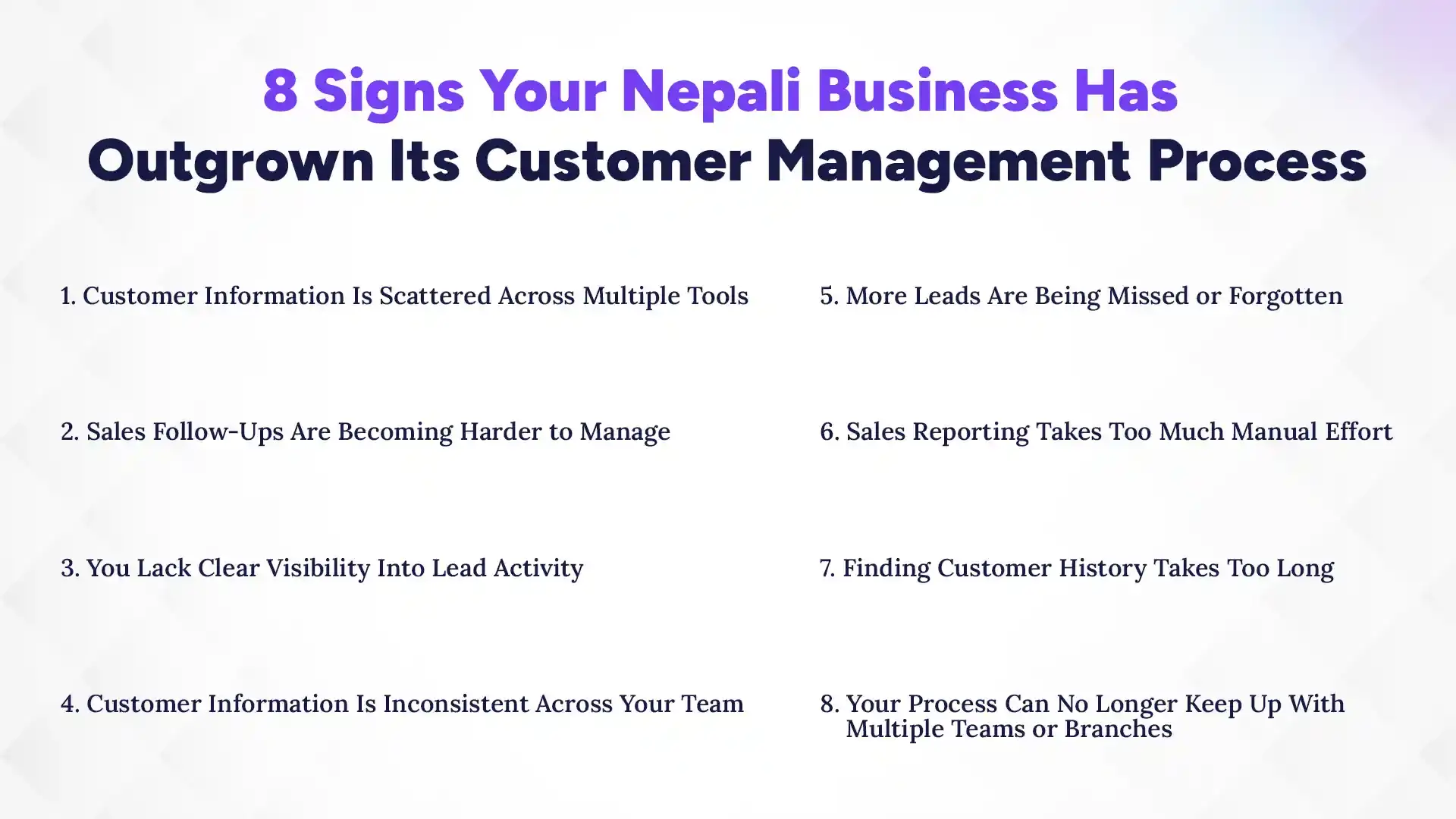
8 Signs You've Outgrown Your Current Process
Businesses usually outgrow their customer management process when growing sales activity makes their existing tools harder to use consistently. The signs often appear in everyday work, such as scattered customer information, missed follow-ups, limited sales visibility, and increasing difficulty managing customers across teams or branches.
These problems may seem manageable individually, but recurring issues can indicate that the current process is no longer keeping up with the business. The following signs can help you determine whether it is time to consider a more structured approach.
1. Customer Information Is Scattered Across Multiple Tools
Customer details may be stored across spreadsheets, notebooks, email, messaging apps, or individual employees' records. When information is scattered across different tools, it becomes difficult to maintain a complete and reliable customer history.
2. Sales Follow-Ups Are Becoming Harder to Manage
Salespeople may rely on memory, personal reminders, or separate lists to manage calls and follow-ups. As lead volume increases, missed or delayed follow-ups become more likely without a proper lead management in CRM strategy in place.
3. You Lack Clear Visibility Into Lead Activity
Managers may know how many leads exist but struggle to see which ones have been contacted, qualified, followed up with, or moved forward. Without clear visibility, it becomes harder to identify stalled opportunities and take action.
4. Customer Information Is Inconsistent Across Your Team
Different employees may maintain different versions of customer details or interaction history. This can lead to repeated questions, delays, and an inconsistent customer experience.
5. More Leads Are Being Missed or Forgotten
More inquiries create more sales opportunities, but they also increase the risk of leads being overlooked. This can happen across phone calls, website inquiries, social media, and messaging platforms when there is no single system for tracking them, which is why website-to-CRM integration is essential to capture leads automatically.
6. Sales Reporting Takes Too Much Manual Effort
Managers may need to collect information from multiple employees or combine several spreadsheets to understand current sales activity. As sales operations grow, this becomes increasingly time-consuming and difficult to maintain.
7. Finding Customer History Takes Too Long
Employees may struggle to find previous conversations, quotations, purchases, complaints, or follow-up details. This becomes especially difficult when another employee needs to take over the customer relationship.
8. Your Process Can No Longer Keep Up With Multiple Teams or Branches
Customer management becomes more complicated when multiple branches or sales teams maintain separate records. Without a consistent structure, keeping customer information accessible and up to date becomes increasingly difficult without using a CRM for multiple branches to fix scattered records.
What Happens If You Continue Using an Outgrown Process?
An outgrown customer management process can affect sales, customer experience, and team efficiency. These problems often become more difficult as the business grows.
1. Missed Sales Opportunities
Leads may be forgotten or followed up with too late when no one has clear responsibility for the next action. Over time, these missed follow-ups can result in lost sales opportunities.
2. Inconsistent Customer Experiences
Customers may receive different information or have to repeat their details to different employees. This can make the business appear less organized and affect customer satisfaction.
3. More Time Lost to Administrative Work
Teams may spend more time searching for information and updating records manually. This leaves less time for sales activities and customer relationships.
4. Limited Visibility Into Sales Performance
Management may struggle to track lead activity, follow-ups, and pipeline progress across the team. Without clear visibility, it becomes harder to identify where sales opportunities are being lost.
When these problems become recurring, a more structured approach may be needed. A CRM can help centralize customer information, manage follow-ups, and provide the benefits of a CRM system to give teams better visibility as the business grows.
When Should You Consider CRM Software?
A CRM may be worth considering when your current customer management process is becoming difficult to maintain. Knowing how and when to choose the right CRM for your business in Nepal is the first step if two or more of the following problems occur regularly.
Customer information is difficult to centralize.
Follow-ups regularly depend on memory or spreadsheets.
Managers rely on manual updates to track sales activity.
Multiple employees need access to the same customer history.
Lead volume is becoming difficult to manage manually.
The business is expanding across teams or branches.
Two or more recurring problems do not automatically mean you need a CRM. They are a useful warning that your current process may not scale well with the business.
How Pace CRM Can Help Nepali Businesses
Pace CRM System can help Nepali businesses address common customer management problems as they grow. It centralizes customer information, tracks leads and sales activity, and manages follow-ups so teams do not have to rely on scattered records or individual memory.
For businesses managing multiple branches, field sales, and customer communication through phone, email, and WhatsApp, Pace CRM provides shared visibility into customer and sales activity. This can help teams work more consistently while giving managers a clearer view of leads and sales performance.
Conclusion
Outgrowing a customer management process is a normal part of business growth. When scattered records, missed follow-ups, inconsistent information, and limited visibility start affecting daily operations, it may be time to consider a more structured approach.
For Nepali businesses, recognizing these signs early can make the transition easier and help create a more scalable customer management process. If two or more of these problems occur regularly, explore Pace CRM with a demo or speak with the Pace Infosys team to see how it can fit your business.
FAQs
How do I know if my business has outgrown its customer management process?
+
Your business may have outgrown its process if customer data is scattered, follow-ups are missed, or reporting requires too much manual work.
Can a small business in Nepal benefit from CRM software?
+
Yes. Small businesses can benefit from CRM as lead volumes grow, more employees handle customers, and interactions become harder to manage.
What is the biggest sign that a business has outgrown spreadsheets?
+
A major sign is when employees keep separate customer records and management must manually combine spreadsheets for accurate information.
Can CRM help businesses with multiple branches?
+
Yes. A centralized CRM helps teams access customer information and gives management better visibility across branches.
Is CRM only useful for sales teams?
+
No. CRM can also support marketing, customer service, and other teams that interact with customers.
When should a business switch from spreadsheets to CRM software?
+
Consider switching when spreadsheets cause missed follow-ups, inconsistent data, manual reporting, or difficulty sharing customer history.
Ready to get started?
Book a 30-minute consultation call, and let's talk about your goals.