

Choosing a CRM is not just about finding the platform with the most features. It is about choosing a system that fits how your business operates, from sales workflows and communication channels to pricing and customer support.
A local CRM is designed around the needs of Nepali businesses, while an international CRM is built for a broader global market and may offer more advanced enterprise features. The better choice depends on factors such as your budget, team structure, field sales operations, support needs, and existing workflows. If you're still getting familiar with what is CRM and what it actually does for a business, starting with this comparison can help clarify which type fits your situation.
This guide compares local and international CRMs across eight practical factors to help you decide which option fits your business best.
What Is a Local CRM?
A local CRM is a platform built around the needs, workflows, and support expectations of businesses in a specific market rather than designed as a one-size-fits-all global product. In Nepal, this means the CRM is designed with local business practices and customer communication habits in mind.
A local CRM may prioritize communication channels commonly used by Nepali businesses, such as phone calls, WhatsApp, and SMS. It can also be designed around the needs of field sales teams working across different cities and territories, with pricing and support that are more practical for Nepali SMEs.
The main advantage of a local CRM is its market-specific focus. While it may not offer the extensive feature set or global integrations available with some international platforms, its features can be more closely aligned with how local businesses actually operate.
This focus can also make implementation, employee training, and ongoing support easier. Teams may spend less time adapting their workflows to the software, while local support teams can provide assistance with a better understanding of the business environment. Understanding how CRM works in a local context helps explain why this market alignment matters for daily usage.
What Is an International CRM?
An international CRM is a platform built for a global market, typically offering broad integrations, advanced features, and support for businesses operating across multiple countries. These systems are designed to serve a wide range of industries and business sizes, from growing companies to large multinational organizations.
International CRMs such as Salesforce, HubSpot, and Zoho often provide extensive integrations, advanced customization, automation, and tools for managing complex sales and customer workflows. They can also support businesses that expand across borders, making it easier to maintain the same CRM system as operations grow into markets such as India or Southeast Asia.
These platforms can be a strong choice for multinational businesses or companies that need sophisticated integrations and enterprise-level capabilities. However, the additional features can also make them more expensive and complex to implement, with a steeper learning curve for employees.
For businesses operating primarily in Nepal, an international CRM may sometimes offer more functionality than they actually need. Support can also be less familiar with local business practices, which may make implementation and troubleshooting more difficult.
How Do Local and International CRMs Compare for Nepali Businesses?
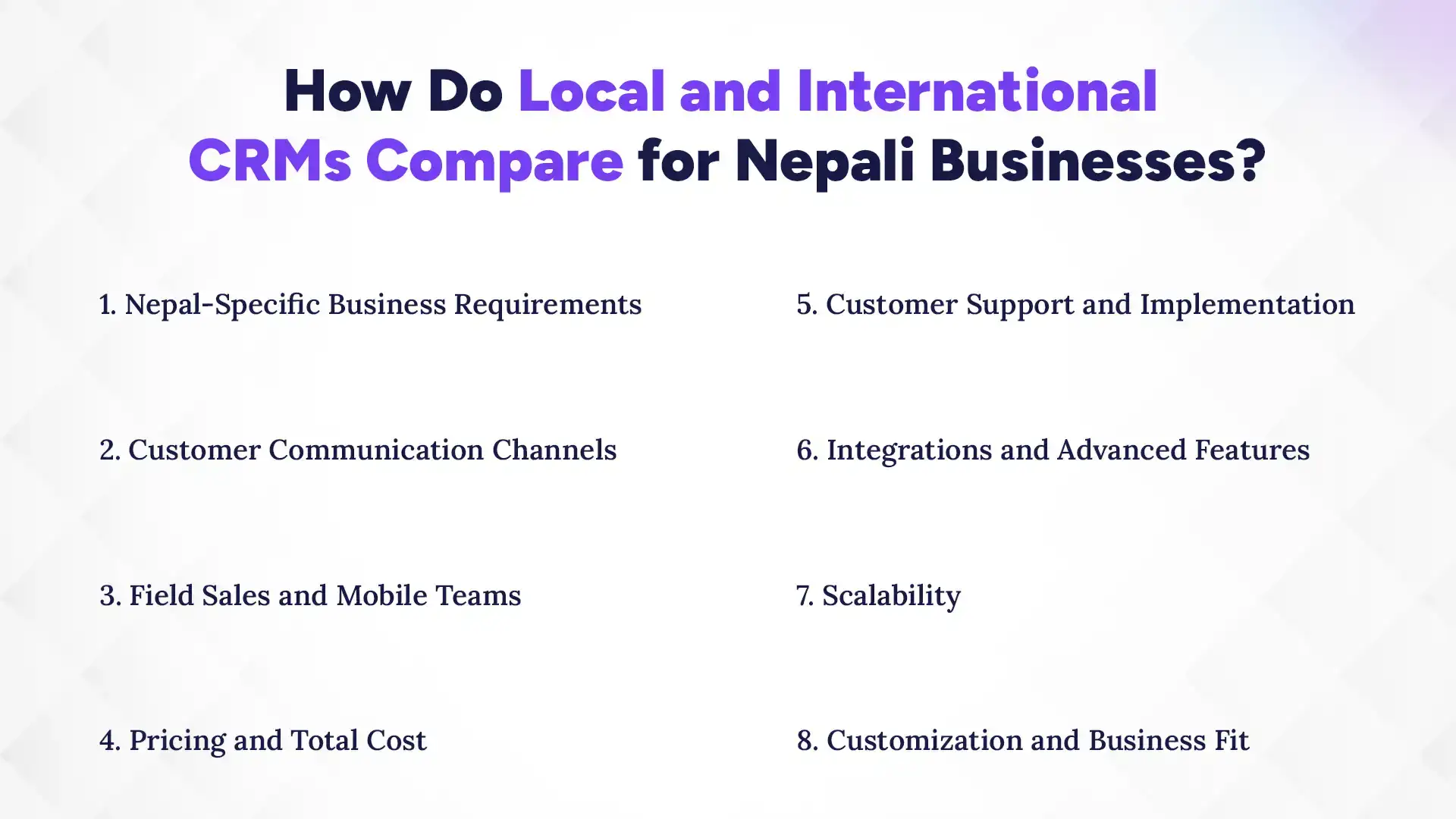
The comparison between local and international CRMs comes down to eight practical factors that can affect how well each platform fits a Nepali business. These include local business requirements, communication channels, field sales, pricing, support, integrations, scalability, and customization. Among the different types of customer relationship management systems available, the distinction between locally focused and globally focused platforms is one of the first decisions a Nepali business should make.
1. Nepal-Specific Business Requirements
A local CRM is more likely to reflect the workflows and terminology used by Nepali businesses from the beginning. This can be particularly useful for sales teams managing customers across different cities, territories, and field locations.
An international CRM can support these workflows too, but businesses may need to customize fields, processes, and workflows before the system matches their existing way of working.
2. Customer Communication Channels
Nepali businesses often depend on a mix of phone calls, WhatsApp, SMS, email, and face-to-face communication when managing customers. A CRM that brings these interactions together can make it easier for sales teams to maintain a complete customer history.
International CRMs often have extensive communication integrations, but some locally important channels may require third-party tools or additional setup. This can add complexity if those channels are central to your sales process.
3. Field Sales and Mobile Teams
For businesses with field sales teams, the CRM needs to work effectively outside the office. Sales representatives should be able to access customer information, record visits, update leads, and manage follow-ups directly from their phones.
Local CRMs may place greater emphasis on these mobile and field workflows, while international platforms can offer broader mobile functionality alongside features designed for many different types of businesses.
4. Pricing and Total Cost
The actual cost of a CRM goes beyond the monthly subscription. Businesses also need to consider the number of users, implementation, customization, training, integrations, and ongoing support.
A local CRM may be more accessible for Nepali SMEs because its pricing is designed around the local market. International platforms can become more expensive as businesses add users or require advanced features and additional services.
5. Customer Support and Implementation
Getting a CRM implemented properly can be just as important as choosing the right software. Local providers can offer support that is familiar with Nepali businesses, local workflows, and common operational challenges.
International CRM providers often have extensive documentation and structured support systems, but assistance may be delivered through global teams or require additional implementation specialists for more complex setups.
6. Integrations and Advanced Features
International CRMs generally have an advantage when it comes to integrations and advanced functionality. Businesses can find connections with a wide range of global software and access features such as advanced automation, AI tools, forecasting, and predictive analytics.
A local CRM may offer fewer integrations, but that can be enough for businesses that do not require a large enterprise software ecosystem. Having the right features can be more valuable than having the largest possible feature list.
7. Scalability
The right CRM should be able to grow alongside the business. A local CRM can provide sufficient scalability for companies expanding their teams, branches, customer base, and operations within Nepal.
International CRMs are designed for businesses that may eventually operate across multiple countries. If international expansion is part of your long-term strategy, that global infrastructure may become more valuable.
8. Customization and Business Fit
International CRMs often provide extensive customization, allowing businesses to build complex workflows around their specific requirements. However, taking full advantage of that flexibility may require technical expertise or external consultants.
A local CRM may offer a more straightforward approach by providing workflows that already align with common local business needs. For Nepali SMEs without dedicated technical teams, a system that works effectively with minimal customization can be easier to implement and maintain.
Which CRM Is Better for a Nepal-Focused Business?
For businesses that primarily operate in Nepal, a local CRM can be the better fit when local workflows, communication channels, pricing, implementation, and support are important. An international CRM may be the better choice for businesses with multinational operations, complex enterprise requirements, or a strong need for global integrations. This isn't about which CRM is objectively superior. It's about which one matches your business.
If most of your operations are in Nepal, your team includes field sales staff, you communicate with customers through phone and WhatsApp, and your budget is calculated in Nepali rupees, a local CRM may offer a more practical fit. You can benefit from workflows designed around your market while avoiding unnecessary complexity. When reviewing the best CRM software in Nepal, prioritize options that demonstrate this kind of local alignment rather than just feature breadth.
If your business operates across multiple countries, relies heavily on global software, or has complex enterprise workflows, an international CRM may be worth the additional investment. Its broader integrations, scalability, and advanced features can become more valuable as your operations grow.
The mistake is choosing based on brand recognition or feature count alone. Choose based on how your business actually operates.
Why Consider Pace CRM for Your Nepali Business?
For businesses that decide a local CRM is the better fit, the Pace CRM software is designed around the needs of Nepali sales teams and businesses. Pace CRM can be particularly relevant for businesses that manage customers through phone and WhatsApp, have sales representatives working across different territories, and want their teams to manage customer information from one system. Its focus on these everyday workflows can reduce the need for extensive customization and make adoption easier for local teams.
If your business operates primarily in Nepal and you want a CRM that fits your existing sales processes rather than requiring your team to completely change how it works, Pace CRM is worth considering.
Conclusion
Choosing between a local and international CRM depends on how your business operates, not which platform has more features. A local CRM can be a better fit for Nepal-focused businesses that need local workflows, phone and WhatsApp communication, field sales support, practical pricing, and accessible support.
International CRMs may be more suitable for multinational businesses that need global integrations, advanced features, and international scalability. For businesses operating mainly in Nepal, a local option such as Pace CRM can offer a more practical balance of functionality, cost, and ease of use.
Still figuring out whether a local or international CRM makes more sense for your setup? Leave a message with Pace Infosys, and we'll walk you through what fits your situation. No pressure, just a straightforward conversation.