

Good design is not decoration; it is the difference between a user who stays and a user who leaves. Businesses that invest in professional UI/UX design consistently see better engagement, higher conversion rates, and stronger brand loyalty. Yet many businesses struggle when it comes to choosing the right UI/UX design agency, often ending up with a partner that does not understand their users, their goals, or their industry.
The wrong agency can cost you more than money. It can cost you time, missed product launches, poor user reviews, and a product that needs to be redesigned from scratch. The right agency, on the other hand, becomes a strategic partner that helps you build digital products your users actually want to use.
This guide covers everything you need to know about how to choose a UI/UX design agency, from understanding what these agencies do to evaluating their process, pricing, and portfolio to asking the right questions before you sign any agreement.
What Is a UI/UX Design Agency?
A UI/UX design agency is a professional team that specializes in designing digital products, websites, mobile apps, software platforms, and other digital interfaces with a focus on how they look and how they work for the people using them.
UI (User Interface) design refers to the visual layer of a product: the colors, typography, buttons, icons, layouts, and everything a user sees on screen.
UX (User Experience) design refers to the overall experience of using the product: how easy it is to navigate, how logically information is organized, how quickly a user can complete a task, and how the product makes them feel.
What Services a UI/UX Agency Typically Provides
A well-rounded UI/UX design agency typically provides end-to-end design services covering user research, wireframing, prototyping, visual UI design, usability testing, mobile and responsive design, interaction design, and developer handoff support. The goal is to deliver a complete design solution that is visually polished, user-centered, and ready for seamless development.
A well-rounded UI/UX design agency typically offers the following services:
- User research and persona development
- Wireframing and interactive prototyping
- Visual UI design and brand-aligned interface design
- UX audits and usability testing
- Mobile and responsive design
- Interaction design and micro-animations
- Design system creation
- Handoff documentation and developer collaboration support
Difference Between a Freelancer and a Full-Service Agency
A freelancer is a single designer who typically handles one or two aspects of design, such as visual UI work or basic wireframing. Freelancers can be cost-effective for small, well-defined projects but may lack the capacity to handle research, strategy, prototyping, testing, and handoff all at once.
A full-service UI/UX design agency brings together a team of specialists: UX researchers, UI designers, interaction designers, usability testers, and project managers who work together to cover every stage of the design process. For complex products or growing businesses, an agency provides more depth, consistency, and scalability than a single freelancer can offer.
Why Choosing the Right UI/UX Design Agency Matters
Choosing the right UI/UX design agency matters because design is not just an aesthetic decision; it is a business decision that directly affects how users interact with your product, how likely they are to convert, and how strongly they associate your brand with quality and trust.
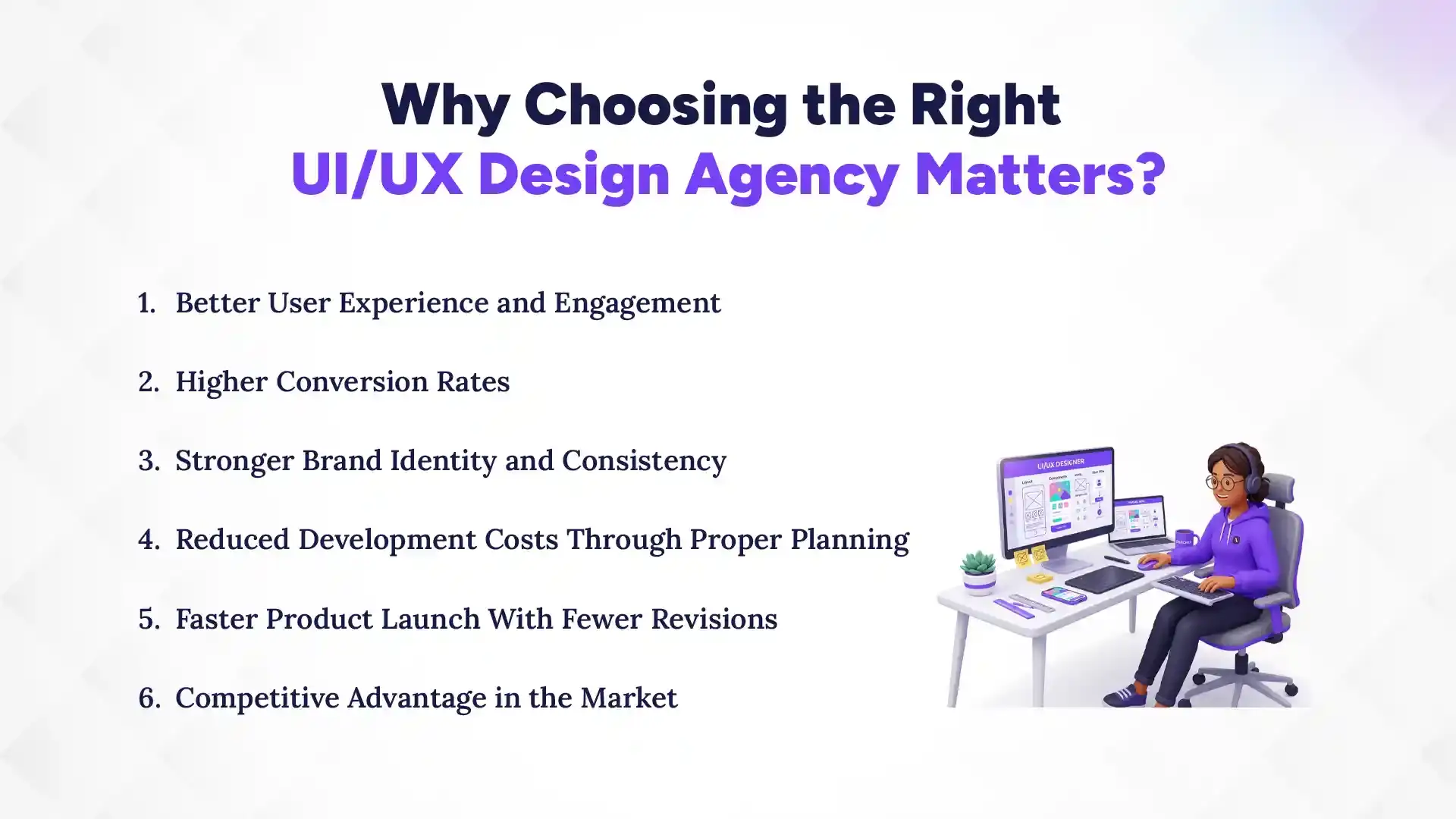
1. Better User Experience and Engagement
A well-designed product makes it easy for users to find what they need, complete key actions, and enjoy the process. When users have a smooth, intuitive experience, they stay longer, engage more deeply, and return more often. Poor UX, on the other hand, frustrates users and drives them away, often to a competitor.
2. Higher Conversion Rates
Every friction point in a user journey is a potential drop-off point. A skilled UI/UX agency identifies and removes those friction points, simplifying checkout flows and improving call-to-action visibility and structuring information in ways that guide users toward conversion. Even small design improvements can produce measurable increases in sign-ups, purchases, or inquiries.
3. Stronger Brand Identity and Consistency
Design communicates trust. A consistent, professional visual identity across all screens and touchpoints signals that a business is credible, reliable, and attentive to detail. The right agency builds design systems and style guides that ensure your product looks and feels cohesive everywhere.
4. Reduced Development Costs Through Proper Planning
Poor design decisions caught late in the development process are expensive to fix. A good UI/UX agency invests in research, wireframing, and prototyping before a single line of code is written. This front-loaded planning reduces the number of costly revisions during development and minimizes the risk of building something that does not work for users.
5. Faster Product Launch With Fewer Revisions
When the design process is thorough and well-structured, development teams receive clear, detailed specifications that reduce back-and-forth. Fewer misunderstandings mean fewer delays, which means faster time to market.
6. Competitive Advantage in the Market
In most industries, users have multiple options. A product that is easier, faster, and more enjoyable to use than its competitors holds a significant advantage. Investing in great UI/UX design is one of the most reliable ways to differentiate your product in a crowded market.
7. It Is a Long-Term Business Investment
Good UI/UX design does not just improve your current product. It creates a foundation, a design system, a documented user research base, and a set of tested interaction patterns that your team can build on for years. The right agency is not just solving today's problem; it is helping you build something that scales.
How to Choose the Right UI/UX Design Agency in 2026?
To choose the right UI/UX design agency, evaluate their experience, design process, portfolio, client reviews, pricing transparency, user research approach, and communication style before making your decision. Below is a detailed breakdown of each factor to consider
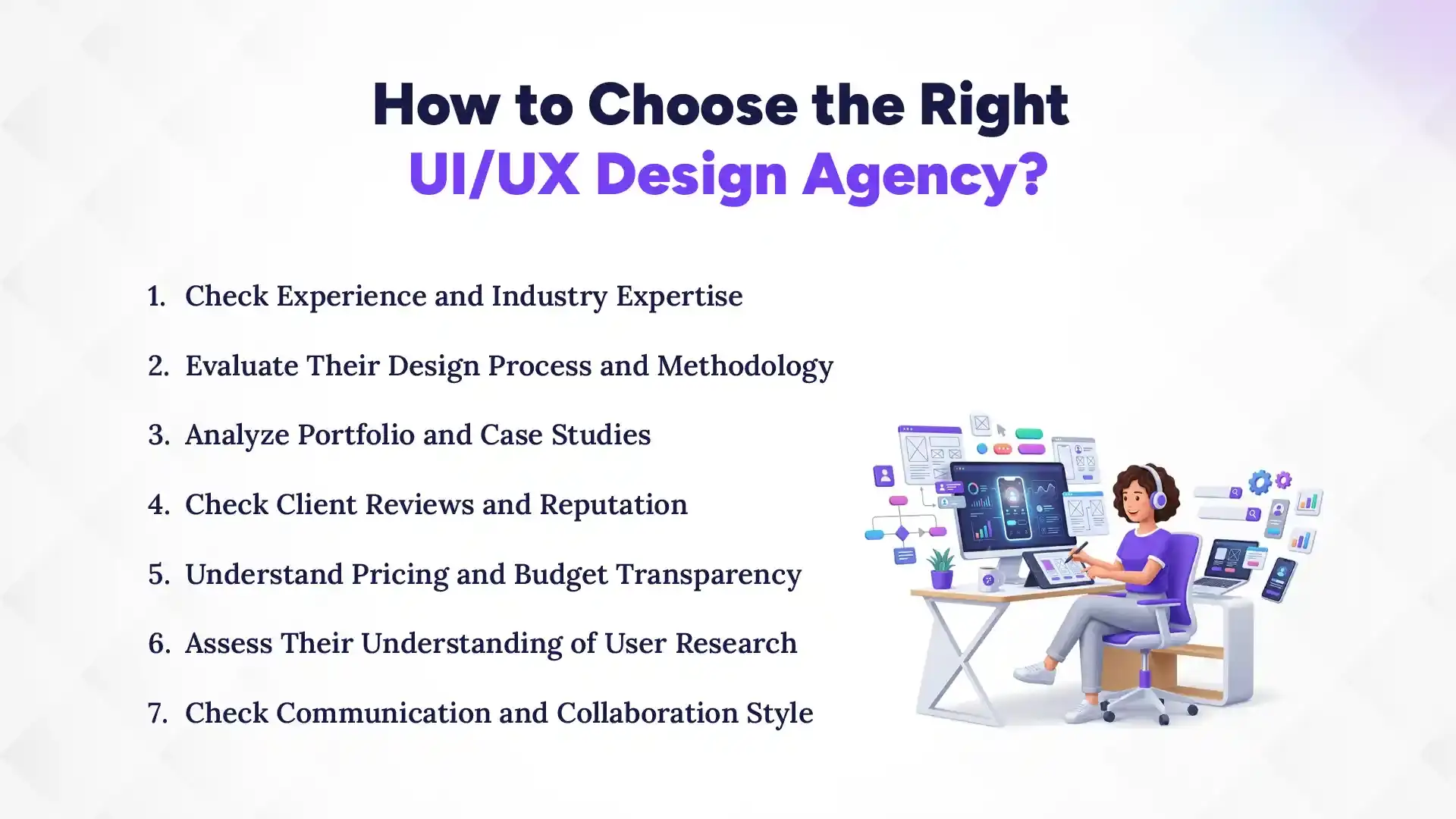
1. Check Experience and Industry Expertise
Experience matters because design challenges vary significantly across industries. An agency that has designed healthcare platforms understands patient privacy and accessibility requirements. One that has worked on e-commerce knows how to optimize product discovery and checkout flows.
Ask how long the agency has been operating, what industries they have worked in, and whether they have handled projects similar in scale and complexity to yours. Relevant experience shortens the learning curve and reduces the risk of fundamental misunderstandings.
2. Evaluate Their Design Process and Methodology
A strong agency follows a structured, repeatable design process that includes discovery, research, ideation, prototyping, testing, and handoff. Ask them to walk you through their process step by step. Agencies that skip research or jump straight to visual design often produce work that looks good but does not perform well for real users.
Look for agencies that use established methodologies such as design thinking, human-centered design, or Lean UX and that can clearly explain how each stage of their process benefits your project.
3. Analyze Portfolio and Case Studies
A portfolio shows what an agency has built. Case studies show how they think. Always go beyond screenshots and ask for detailed case studies that explain the problem they were solving, the research they conducted, the decisions they made, and the measurable outcomes they delivered.
Look for variety, quality, and relevance. An agency whose portfolio closely resembles your type of product is a stronger candidate than one whose work looks impressive but is entirely unrelated to your industry.
4. Check Client Reviews and Reputation
Third-party reviews on platforms like Clutch, Google, or LinkedIn give you an unfiltered view of what it is actually like to work with an agency. Look for patterns; consistent praise for communication and delivery timelines are a strong positive signal. Recurring complaints about responsiveness or quality are warning signs worth taking seriously.
Ask the agency for references you can contact directly. A confident, reputable agency will have no hesitation in connecting you with past clients.
5. Understand Pricing and Budget Transparency
Pricing in UI/UX design varies widely depending on agency size, location, project scope, and experience level. What matters is not just the number but the transparency behind it. A trustworthy agency provides a clear breakdown of costs, explains what is included and what is not, and discusses how changes in scope affect the budget.
Avoid agencies that give vague estimates without a discovery phase or that are unwilling to explain their pricing structure in detail.
6. Assess Their Understanding of User Research
Design without research is guesswork. A skilled UI/UX agency invests in understanding real users before making any design decisions. Ask how they gather user insights; what research methods they use, such as interviews, usability testing, surveys, or analytics review; and how that research directly informs their design work.
Agencies that skip this step tend to produce designs based on assumptions rather than evidence, which increases the risk of building something users do not actually want.
7. Check Communication and Collaboration Style
You will be working closely with this agency throughout the project. Evaluate how responsive they are during the proposal stage, how clearly they explain their ideas, and whether they ask thoughtful questions about your business and users. Strong communication during the sales process usually reflects how they will communicate throughout the project.
Confirm who your primary point of contact will be, how frequently they provide updates, and what tools they use for collaboration and file sharing.
What Services Should a Good UI/UX Design Agency Offer?
A good UI/UX design agency should provide end-to-end design services that cover research, strategy, visual design, testing, and developer handoff. The goal is to deliver a product that is not just visually polished but genuinely usable, accessible, and aligned with real user needs. Here is a breakdown of the core services to look for.
1. User Research and Persona Development
User research involves gathering real insights about the people who will use your product: their goals, behaviors, pain points, and mental models. This includes methods such as user interviews, contextual observation, competitor analysis, and analytics review.
Persona development turns that research into clear, actionable representations of your target users. These personas guide every subsequent design decision and ensure the team is building for real people rather than assumptions.
2. Wireframing and Prototyping
Wireframes are structural blueprints of a product's screens, low-fidelity layouts that define where elements go and how users move through the product, without the distraction of color or visual styling.
Prototypes are interactive, clickable versions of those wireframes that simulate the real user experience. Testing prototypes before development begins saves significant time and money by identifying usability issues early, when they are cheap to fix.
3. UI Design and Visual Identity
UI design brings the product to life visually. It covers color systems, typography, iconography, spacing, component libraries, and the overall visual language of the product. A strong agency ensures the visual design is not just attractive but also consistent, accessible, and aligned with the brand's existing identity.
Many agencies also develop or contribute to a design system, a reusable component library that keeps the visual language consistent as the product grows.
4. UX Audits and Usability Testing
A UX audit is a structured evaluation of an existing product to identify usability problems, inconsistencies, and areas for improvement. It is particularly valuable for businesses that already have a live product but are experiencing high drop-off rates, low engagement, or poor user feedback.
Usability testing involves observing real users as they interact with the product to surface issues that analytics alone cannot reveal. Both services help businesses make evidence-based improvements rather than relying on guesswork.
5. Mobile and Responsive Design
With the majority of digital interactions now happening on mobile devices, every product must be designed to work seamlessly across screen sizes and devices. A good agency designs with a mobile-first mindset, ensuring layouts, touch targets, navigation patterns, and content hierarchy are optimized for smaller screens before scaling up.
6. Interaction Design and Micro-Animations
Interaction design defines how elements on screen respond to user actions, button hover states, loading animations, transition effects, scroll behaviors, and error messages. When done well, these details make a product feel polished, intuitive, and alive.
Micro-animations, in particular, provide visual feedback that guides users through interactions and reinforces that their actions have been registered. They are small details that have a significant impact on how professional and trustworthy a product feels.
7. Handoff and Developer Collaboration Support
Great design is only valuable if it is implemented correctly. A professional agency provides detailed handoff documentation, annotated design files, component specifications, interaction notes, and asset packages that give developers everything they need to build the product accurately.
The best agencies remain available during the development phase to answer questions, clarify design intent, and review implementations to ensure the final product matches the approved designs.
Which Is the Best UI/UX Design Agency?
The Pace Infosys is one of the best UI/UX design agencies in Austin, offering user-focused design, modern interfaces, seamless user experiences, and conversion-driven digital solutions for businesses of all sizes. Their team combines creative design strategy with practical usability to build websites and applications that look impressive and perform smoothly. Here is why many businesses choose them for professional UI/UX design services.
Why Choose The Pace Infosys for Professional UI/UX Design Services
The Pace Infosys stands out for professional UI/UX design services through its custom design approach, intuitive user experiences, responsive interfaces, and business-focused design strategies. Their designers focus on creating visually appealing and easy-to-use digital products that improve engagement, usability, and customer satisfaction. Below are some major reasons businesses trust their UI/UX expertise.
- User-Centered Design That Converts
- Modern, Clean, Professional Interfaces
- Mobile-First Responsive Design Approach
- Seamless Navigation And User Flow
- Strong Focus On User Experience
- Custom Designs Tailored To Brands
- Conversion-Driven Design Strategies
- Experienced Creative Design Team
- Consistent Branding Across Platforms
- Fast, Collaborative Project Execution
Common Mistakes to Avoid When Choosing a UI/UX Design Agency
Many businesses make avoidable mistakes when selecting a UI/UX design agency, often because they are focused on short-term cost savings or surface-level impressions. These mistakes can lead to poor product quality, misaligned expectations, and expensive rework. Here is what to watch out for.
1. Choosing Only Based on Low Price
Price is an important consideration, but it should never be the primary one. Agencies that offer significantly lower rates than the market average often do so by cutting corners skipping research, using generic templates, or assigning junior designers without senior oversight.
The cost of poor design is almost always higher than the cost of good design. Factor in the expense of redesigning a failed product, the lost revenue from poor conversion rates, and the damage to brand reputation, and a cheap agency quickly becomes the most expensive decision you made.
2. Ignoring the Agency's Design Process
An agency's process reveals far more about its capabilities than its portfolio does. A portfolio shows the output; the process shows the thinking. Agencies that cannot clearly articulate how they move from discovery to research to design to testing to handoff are likely to deliver inconsistent, poorly validated work.
Always ask for a detailed walkthrough of their process before committing. The best agencies explain each stage confidently and connect it clearly to the outcomes it is designed to produce.
3. Not Reviewing Their Portfolio Carefully
Scrolling through a portfolio is not the same as reviewing it carefully. Look for projects that are similar to yours in type, scale, and industry. Examine the case studies behind the visuals. Ask what problem each project was solving, what constraints the agency was working within, and what the measurable outcomes were.
A portfolio full of beautiful visuals without any context or results is a warning sign. Great design agencies document their thinking and their impact.
4. Overlooking Post-Project Support
Design does not end at launch. User behavior changes, business requirements evolve, and issues emerge in live environments that were not present in testing. An agency that disappears after delivery leaves you without the expertise you need to address these issues effectively.
Before signing any agreement, clarify what post-launch support looks like, how long it lasts, and what it costs. A reliable agency builds long-term relationships, not one-time transactions.
5. Skipping the Discovery or Briefing Phase
Some businesses want to move straight to design without investing time in a proper discovery phase. This is one of the most costly mistakes you can make. The discovery phase is where the agency learns about your business, your users, your competitors, and your goals. Without it, the entire project is built on assumptions.
A reputable agency will insist on a thorough briefing or discovery engagement before beginning any design work. If an agency is willing to skip this phase to start faster, treat that as a red flag.
6. Not Clarifying Ownership of Design Files
Who owns the design files when the project is complete? This is a critical question that many businesses forget to ask until it becomes a problem. Some agencies retain ownership of source files and charge additional fees for access, or restrict your ability to work with other agencies on future updates.
Before signing any contract, confirm in writing that you will receive full ownership of all design files, assets, and documentation upon final payment. This protects your business and gives you the flexibility to grow and adapt your product independently.
Key Questions to Ask Before Hiring a UI/UX Design Agency
Before committing to a UI/UX design agency, asking the right questions helps you assess their capabilities, working style, and fit for your specific project. These questions move the conversation beyond surface-level impressions and give you genuine insight into how the agency thinks and operates.
1. What Is Your Design Process From Start to Finish?
This question reveals how structured, strategic, and user-centered the agency actually is. A strong agency will walk you confidently through each phase from discovery and research through to design, testing, and handoff and explain the purpose of each stage. Vague or incomplete answers suggest a process that is not well-defined or consistently applied.
2. How Do You Conduct User Research?
This question separates agencies that design based on real user insights from those that design based on assumptions or personal preference. Ask specifically what research methods they use, how they recruit participants, how research findings are documented, and how directly those findings influence design decisions.
3. What Tools Do You Use for Design and Prototyping?
Industry-standard tools include Figma, Sketch, Adobe XD, InVision, and Miro. The specific tools matter less than whether the agency uses tools that support collaboration, version control, and clean developer handoff. This question also opens a conversation about how you will access and review work in progress throughout the project.
4. How Do You Handle Revisions and Feedback?
Understand how many rounds of revisions are included in the project scope, how feedback is collected and incorporated, and what happens when revision requests fall outside the agreed scope. Clear revision policies prevent misunderstandings and protect both parties from scope creep.
5. Who Will Own the Final Design Files?
As discussed above, this is non-negotiable. The answer should be unambiguous: you own all source files, assets, and documentation upon project completion. If there is any hesitation or qualification in the answer, push for clarity before signing the contract.
6. Do You Provide Support After the Project Is Delivered?
Ask specifically what post-delivery support looks like, whether it is a defined support period, a retainer model, or ad-hoc availability. Understanding this upfront helps you plan for the ongoing evolution of your product and ensures you are not left without expert support when you need it most.
Conclusion
Choosing the right UI/UX design agency is one of the most important decisions you can make for your digital product. The agency you choose will directly shape how your users experience your product, how your brand is perceived, and how effectively your product achieves its business goals.
The key is to look beyond visual portfolios and evaluate the things that actually predict success: a structured design process, genuine user research capabilities, transparent pricing, clear communication, and a track record of delivering measurable results.
Do not rush the decision. Take time to review portfolios carefully, ask the right questions, check references, and ensure the agency you choose truly understands your users and your goals. The right partner will not just deliver a design; they will help you build something your users genuinely love to use.
If you are ready to work with a team that takes design seriously from research to handoff, reach out to discuss your project today.