Choosing between CRM and CEM often feels more confusing than it should. You invest in customer tools expecting better sales, happier customers, and clearer insights, yet you end up with scattered data, frustrated teams, and experiences that still fall short. Many businesses struggle because they adopt the wrong system for the wrong problem, mistaking relationship management for experience management.
Understanding the difference between CRM vs CEM is not just a technical decision; it is a strategic one that directly impacts growth, retention, and customer loyalty. In this guide, you will clearly learn how CRM and CEM differ, when to choose one over the other, and how to make a confident decision that aligns with your business goals and customer expectations.
What is CRM (Customer Relationship Management)?
Customer Relationship Management, commonly known as CRM, is a strategy and technology used by businesses to manage, track, and optimize interactions with customers and prospects throughout the entire customer lifecycle. At its core, CRM is designed to help companies build stronger relationships, improve sales efficiency, and create more personalized communication at scale.
A CRM system acts as a centralized hub where all customer information is stored and updated in real time. This includes contact details, communication history, purchase behavior, and sales activity. Instead of relying on spreadsheets, emails, or disconnected tools, teams use CRM software to gain a clear, shared view of every customer.
CRM is especially valuable for sales-driven and growth-focused organizations because it turns raw customer data into actionable insights. Sales teams can prioritize high-quality leads, marketing teams can run targeted campaigns, and support teams can resolve issues faster because all customer interactions are visible in one place.
Key Functions of a CRM System
Centralized customer and prospect database
Lead tracking and sales pipeline management
Sales forecasting and performance reporting
Marketing automation and campaign tracking
Customer support and case management
Task automation and follow-up reminders
Beyond technology, CRM is also a business mindset. It emphasizes long-term relationship building rather than one-time transactions. By understanding customer needs, preferences, and behaviors, companies can deliver more relevant offers, improve conversion rates, and increase customer lifetime value.
In the CRM vs CEM discussion, CRM focuses primarily on managing relationships and interactions, not emotions or experiences. It answers questions like who the customer is, what they bought, and when the last interaction occurred. For many businesses, CRM is the foundation of an organized, scalable customer strategy.
What is CEM (Customer Experience Management)?
Customer Experience Management, or CEM, is a strategic approach focused on understanding, measuring, and improving how customers perceive and feel about every interaction they have with a brand. Unlike systems that manage customer data or transactions, CEM concentrates on the quality of the customer journey and the emotions that shape satisfaction, loyalty, and trust.
CEM brings together feedback, behavior, and sentiment across multiple touchpoints such as websites, mobile apps, customer support, in-store visits, and post-purchase surveys. The goal is to identify experience gaps, reduce friction, and design journeys that meet or exceed customer expectations at every stage.
A CEM platform helps businesses move from assumptions to evidence-based decisions. Instead of guessing why customers churn or disengage, teams use real-time feedback and experience insights to understand what customers are thinking and feeling. This allows organizations to fix problems proactively, personalize experiences, and create stronger emotional connections.
Key Functions of a CEM System
Customer journey mapping across channels
Feedback collection through surveys and reviews
Sentiment and emotion analysis
Net Promoter Score and satisfaction tracking
Omnichannel experience monitoring
Experience-driven personalization
CEM is most valuable for customer-centric organizations that compete on experience rather than price alone. It supports long-term growth by improving retention, advocacy, and brand perception.
In the CRM vs CEM comparison, CEM focuses on why customers behave the way they do, not just what they do. It answers questions about customer feelings, expectations, and pain points, making it a critical complement to relationship management systems.
CRM vs CEM: Key Differences Explained
Choosing between CRM and CEM can directly impact how effectively your business attracts, retains, and grows customers. While both systems focus on customers, they solve very different problems and serve different strategic purposes. Understanding these differences is essential for making the right technology and growth decisions.
CRM vs CEM Comparison Table
Aspect
CRM (Customer Relationship Management)
CEM (Customer Experience Management)
Primary Focus
Managing customer relationships and transactions
Managing customer perceptions and experiences
Core Objective
Improve sales efficiency, lead management, and customer retention
Improve satisfaction, loyalty, and emotional connection
Type of Data
Structured data such as contacts, deals, purchase history, and interactions
Experiential data such as feedback, sentiment, emotions, and expectations
Key Users
Sales teams, marketing teams, and customer support
Customer experience teams, product teams, and UX and CX leaders
Customer View
Answers who the customer is and what they did
Answers how the customer feels and why they behaved that way
Main Tools
Sales pipelines, contact management, automation, and reporting
Short to medium-term revenue and relationship growth
Long-term loyalty, advocacy, and brand perception
Business Impact
Higher conversion rates, improved productivity, and organized customer data
Reduced churn, improved satisfaction, and stronger customer loyalty
Role in CRM vs CEM Strategy
Foundation for managing customer relationships
Layer that optimizes and enhances customer experiences
How CRM and CEM Work Better?
CRM and CEM work better together because CRM captures customer actions and data, while CEM reveals customer emotions and experiences, creating a complete and actionable customer understanding.
1. A Unified View of the Customer
CRM and CEM complement each other by filling in critical gaps. CRM provides structured data such as contact details, purchase history, and interaction records. CEM adds experience-based insights like satisfaction levels, sentiment, and feedback. Together, they give businesses a 360-degree view of each customer, combining what customers do with how they feel.
2. Faster and More Proactive Responses
When CRM and CEM are integrated, customer feedback can trigger immediate action. For example, a poor experience score collected through CEM can automatically create a follow-up task in the CRM. This allows sales and support teams to respond quickly, resolve issues early, and prevent churn before it happens.
3. Smarter Personalization Across Touchpoints
CRM enables segmentation based on behavior, lifecycle stage, and purchase patterns. CEM enhances this by adding emotional context, such as satisfaction or frustration levels. This combination allows businesses to deliver personalized messaging, offers, and support that feel relevant and timely rather than generic or automated.
4. Balancing Short-Term Revenue and Long-Term Loyalty
CRM focuses on driving immediate outcomes like conversions, pipeline growth, and deal closure. CEM supports long-term success by improving loyalty, advocacy, and brand perception. Together, they help businesses optimize both revenue and retention across the entire customer lifecycle.
5. Stronger Customer-Centric Strategy
In the CRM vs CEM approach, the real advantage comes from alignment. Businesses that use both systems together make better decisions, create consistent experiences, and build stronger, more resilient customer relationships over time.
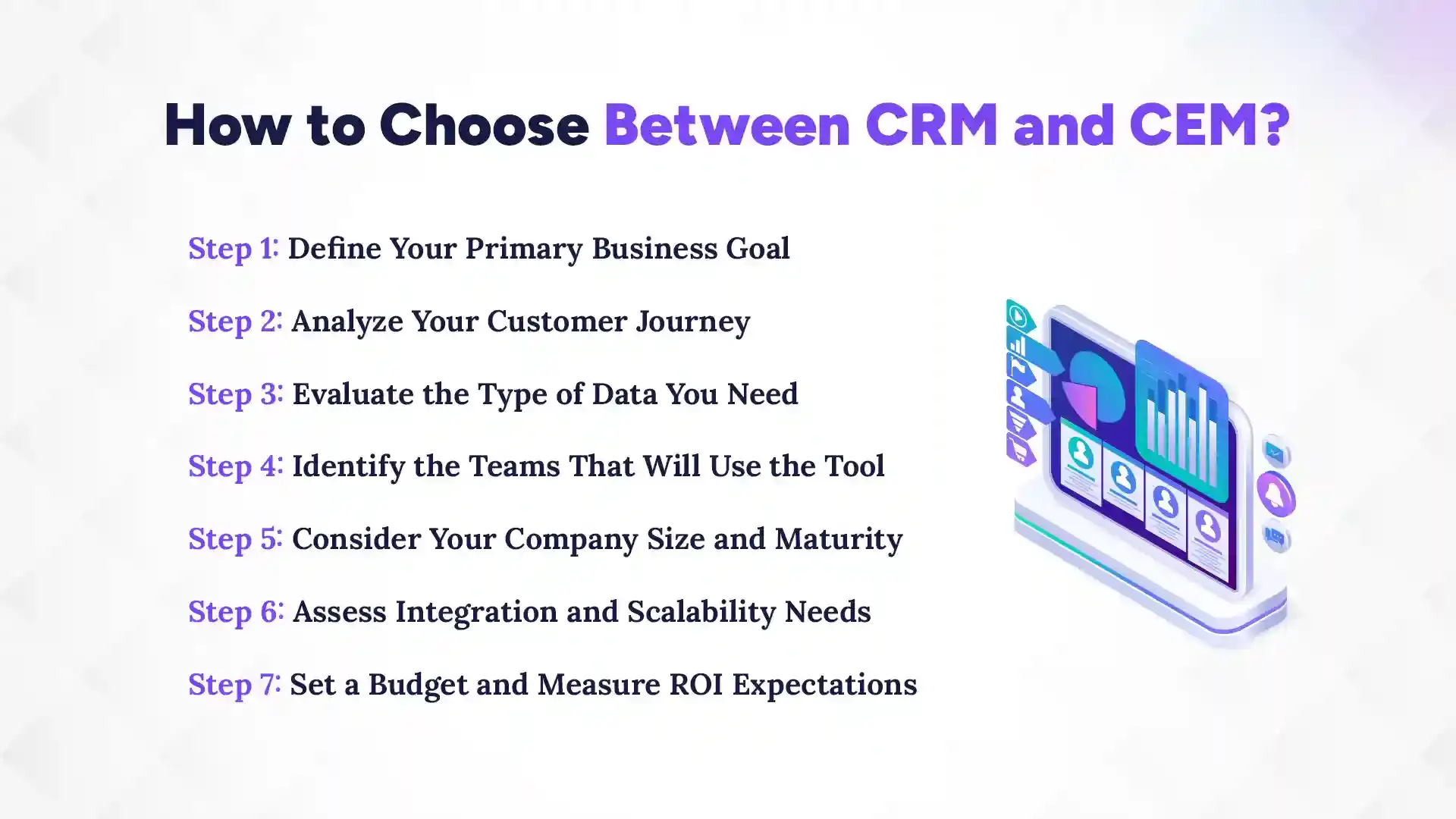
How to Choose Between CRM and CEM?
If your immediate focus is on organizing customer relationships and driving sales efficiency, CRM is often the practical starting point. But, CEM becomes crucial as you scale and prioritize experiences. For most businesses, starting with CRM provides a clear structure to manage leads, track interactions, and optimize revenue processes. However, understanding customer emotions and experiences with CEM adds a layer of insight that drives long-term loyalty. By following a structured approach, you can evaluate your needs, teams, and resources to decide whether CRM, CEM, or a combination of both will best support your business goals.
Step 1: Define Your Primary Business Goal
Start by clearly identifying what you want to achieve. Are you aiming to improve sales efficiency, organize leads, and track customer interactions? If so, CRM is likely the right choice. If your goal is to enhance customer satisfaction, reduce churn, and create memorable experiences, CEM will be more effective. Knowing your main objective helps prevent investing in the wrong system and ensures alignment with broader business strategy. It is also important to understand how CRM works and how CRM complements your team operations.
Step 2: Analyze Your Customer Journey
Map out the steps your customers take from first contact to repeat purchase. Fewer touchpoints that focus on sales and support suggest CRM may suffice. Multiple touchpoints across channels, website, mobile app, in-store, or support, signal the need for CEM. Understanding where customers interact and experience friction helps determine which system will deliver the most actionable insights.
Step 3: Evaluate the Type of Data You Need
Consider what information will drive decisions. CRM relies on structured data like contact details, purchase history, and interaction logs. CEM focuses on experiential data such as feedback, sentiment, and emotional responses. Knowing whether your priority is operational metrics or experience insights guides the choice between CRM and CEM.
Step 4: Identify the Teams That Will Use the Tool
Different teams benefit from different systems. Sales, marketing, and support teams primarily use CRM to track interactions and close deals. Customer experience, UX, and product teams rely on CEM to optimize journeys and gather feedback. Understanding which teams will actively use the system ensures adoption and ROI.
Step 5: Consider Your Company Size and Maturity
The company stage affects tool selection. Small or early-stage businesses often start with CRM to manage relationships efficiently. Larger, customer-focused organizations with multiple touchpoints may need CEM to scale experiences and improve loyalty. Matching the tool to organizational maturity prevents wasted resources.
Step 6: Assess Integration and Scalability Needs
Consider whether the system will need to connect with other platforms. Integrated CRM and CEM allow feedback and behavior data to work together, creating a unified view. Scalability is crucial for growing companies to ensure the system can handle increased users, customers, and channels over time.
Step 7: Set a Budget and Measure ROI Expectations
Determine how much you can invest and what results you expect. CRM typically shows ROI through improved sales productivity and conversions. CEM demonstrates ROI through retention, loyalty, and enhanced customer satisfaction. Aligning the budget with expected outcomes ensures a practical and strategic decision.
Which is the Best CRM in Nepal?
Pace CRM is widely recognized as one of the best CRM solutions for businesses in the region. It is tailored for local market needs, offering features that suit SMEs, startups, and larger organizations alike.
Here’s why Pace CRM stands out:
Key Features of Pace CRM
Lead and Contact Management: Centralized database for all customer interactions, making it easy to track prospects and existing clients.
Sales Pipeline Management: Visual dashboards help teams monitor deals, forecast revenue, and prioritize high-value opportunities.
Automation Tools: Automates follow-ups, emails, and reminders to improve efficiency and reduce manual work.
Reporting and Analytics: Real-time reports provide actionable insights to improve decision-making.
Local Support: Strong support for Nepali businesses, including training, onboarding, and localized customization.
Integration Capabilities: Connects with popular tools like email platforms, accounting software, and marketing apps.
Why Pace CRM Is Best for Nepal
Designed with the local business environment in mind, including compliance with Nepali regulations.
Affordable pricing for SMEs and startups, making it accessible without compromising on features.
Proven adoption across industries such as retail, education, healthcare, and service businesses.
Offers multi-language support, including Nepali, which enhances usability for local teams.
For businesses in Nepal seeking an effective, user-friendly, and locally supported CRM, Pace CRM offers a reliable, scalable solution that balances robust features with cost-effectiveness.
Conclusion
When deciding CRM vs CEM, the answer isn’t about choosing one over the other; it’s about prioritizing based on immediate business needs. If your focus is on organizing customer relationships, simplifying sales, and improving operational efficiency, CRM should be your first investment. It provides structure, actionable insights, and measurable results that drive revenue growth. CEM, on the other hand, becomes essential as your business scales and the quality of customer experiences directly impacts loyalty and advocacy.
For most businesses, starting with a strong CRM like Pace CRM in Nepal allows you to manage relationships effectively while laying the groundwork for integrating CEM later. Ultimately, the smartest approach combines both: CRM to manage relationships today, and CEM to optimize experiences tomorrow.
FAQs
What is the main difference between CRM and CEM?
+
CRM focuses on managing customer relationships and data, while CEM focuses on managing customer experiences and emotions. Together, they give a complete view of both behavior and perception.
Which is more important for a small business: CRM or CEM?
+
For most small businesses, CRM is more practical as it organizes customer data and improves sales efficiency. CEM becomes more valuable as the business grows and focuses on customer loyalty.
Can CRM and CEM be used together effectively?
+
Yes, integrating CRM and CEM creates a unified view of both customer behavior and experiences. This allows faster responses, better personalization, and stronger long-term relationships.
How do CRM and CEM impact customer loyalty and retention?
+
CRM improves retention by managing relationships and follow-ups efficiently. CEM enhances loyalty by improving satisfaction and creating memorable customer experiences.
What types of businesses benefit most from CRM?
+
Businesses with sales-driven operations, structured customer interactions, or multiple leads benefit most from CRM. It helps organize data, track pipelines, and optimize revenue.
What types of businesses benefit most from CEM?
+
Customer-centric organizations with multiple touchpoints and high focus on satisfaction benefit most from CEM. It helps measure feedback, improve journeys, and reduce churn.
How do I choose the right CRM or CEM tool for my company?
+
Evaluate your primary business goal, customer touchpoints, team needs, and budget. Start with CRM for relationship management and add CEM as experience optimization becomes a priority.
Is Pace CRM suitable for businesses in Nepal?
+
Yes, Pace CRM is designed for Nepalese businesses with local support, affordable pricing, and features tailored for SMEs and larger companies. It effectively manages leads, sales, and customer data.
Ready to get started?
Book a 30-minute consultation call, and let's talk about your goals.