
.webp&w=3840&q=75)
Payroll errors remain one of the most common operational problems in Nepali companies, especially when teams rely on spreadsheets or manual calculations. A single mistake in salary tax deduction can lead to compliance issues, employee dissatisfaction, and financial penalties that are difficult to correct later.
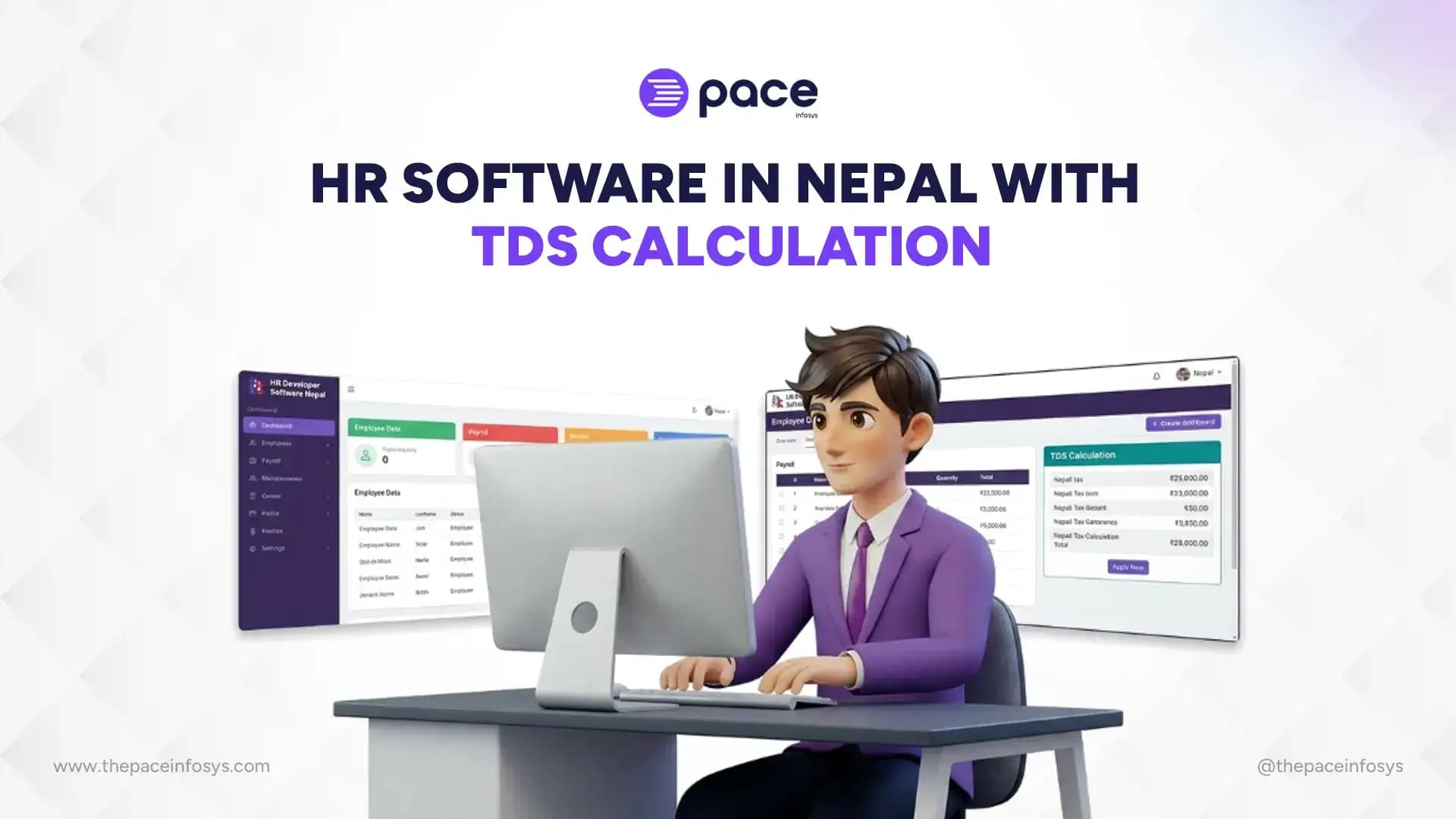
As businesses grow, managing payroll and Tax Deducted at Source (TDS) manually becomes unsustainable due to changing tax slabs and increasing employee data complexity. This article explains how HR software with TDS calculation works in Nepal, why it matters, and what features businesses should look for to ensure compliance and efficiency.
What is HR Software with TDS Calculation?
HR software with TDS calculation is a payroll management system that automates employee salary processing while accurately computing income tax deductions based on Nepal’s tax regulations. It ensures that salary processing, tax deductions, and compliance reporting are handled in a single integrated system. This reduces dependency on manual tax calculations and improves accuracy in payroll operations.
Why TDS Calculation is Important in the Nepal Payroll System
TDS calculation is a legal requirement under Nepal’s income tax system for salaried employees. It ensures companies deduct the correct amount of tax from employee salaries and submit it to the government on time, reducing compliance risks and penalties. Accurate TDS management also helps maintain transparent payroll records and simplifies annual audits.
Key Features of HR Software for TDS Management
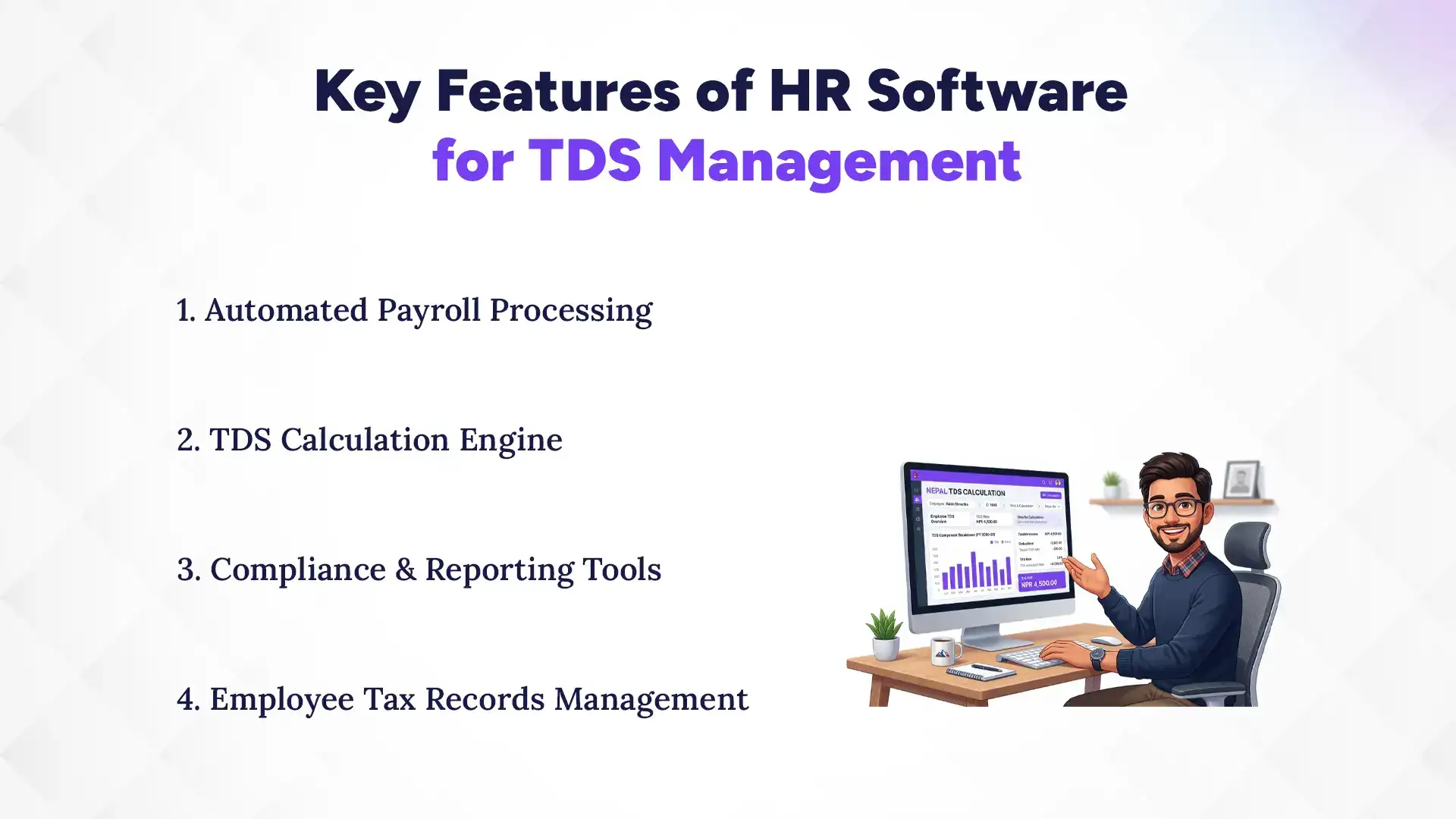
HR software for TDS management includes automated payroll processing, income tax calculation, compliance reporting, and employee tax record management. These features help businesses calculate Tax Deducted at Source (TDS) accurately, stay compliant with Nepal's tax regulations, reduce payroll errors, and simplify payroll administration.
1 Automated Payroll Processing
Automated payroll processing ensures salaries are calculated and distributed without manual intervention, reducing human error in monthly payroll cycles. It handles basic salary, allowances, bonuses, and statutory deductions in a structured workflow. This improves payroll accuracy and consistency across all employee records. It also reduces the time required for monthly salary processing significantly.
2 TDS Calculation Engine
The TDS calculation engine automatically applies Nepal’s income tax slabs to employee salaries. It continuously updates deductions based on changes in income structure or tax regulations. This ensures accurate monthly tax deduction without manual recalculation. It also minimizes compliance risks related to incorrect tax reporting.
3 Compliance & Reporting Tools
Compliance tools generate tax reports and audit-ready financial documents automatically. These reports help businesses meet Nepal’s tax authority requirements without additional manual effort. It also simplifies internal audits and financial reviews. The system ensures all payroll data remains transparent and traceable.
4 Employee Tax Records Management
Employee tax records management stores complete digital tax histories for each staff member. It allows HR teams to access past deductions and generate tax certificates easily. This improves transparency between employers and employees. It also supports faster year-end tax reconciliation processes.
How HR Software Calculates TDS in Nepal (Step-by-Step)
HR software calculates TDS in Nepal by automatically computing each employee's taxable income based on their salary, allowances, bonuses, and eligible deductions. It applies the latest Nepal income tax slabs, calculates the annual tax liability, and divides it into monthly TDS deductions. The software also recalculates TDS whenever there are salary revisions, bonuses, or changes in tax rules, ensuring accurate payroll processing and compliance with Nepal's tax regulations.
1 Employee Salary Input & Structure Setup
Employee salary details are entered into the system, including basic pay, allowances, and benefits. The software organizes this data into a structured payroll profile for each employee. This ensures accurate tax computation from the start. It also reduces errors caused by incomplete salary records.
2 Tax Slab Application
The system applies the Nepal government income tax slabs based on employee earnings. It automatically determines the applicable tax rate for each salary bracket. This removes the need for manual tax table referencing. It ensures consistency across all payroll calculations.
3 Monthly Deduction Automation
Monthly payroll runs automatically to calculate and deduct TDS from employee salaries. The system updates deductions in real time based on salary changes. This ensures employees are taxed correctly every month. It also reduces HR workload significantly.
4 Year-End Tax Adjustment
At the end of the fiscal year, the system performs final tax reconciliation. It adjusts overpayments or underpayments based on total annual earnings. This ensures accurate tax compliance before issuing final reports. It also generates employee tax clearance documents automatically.
Benefits of Using HR Software for TDS Calculation
HR software reduces payroll errors, ensuring accurate salary and tax processing every month. It saves significant time for HR teams by automating repetitive payroll tasks. It also ensures full compliance with Nepal tax laws, reducing the risk of penalties and audits. Businesses gain better financial control through accurate payroll forecasting and reporting.
Challenges of Manual TDS Calculation in Nepal
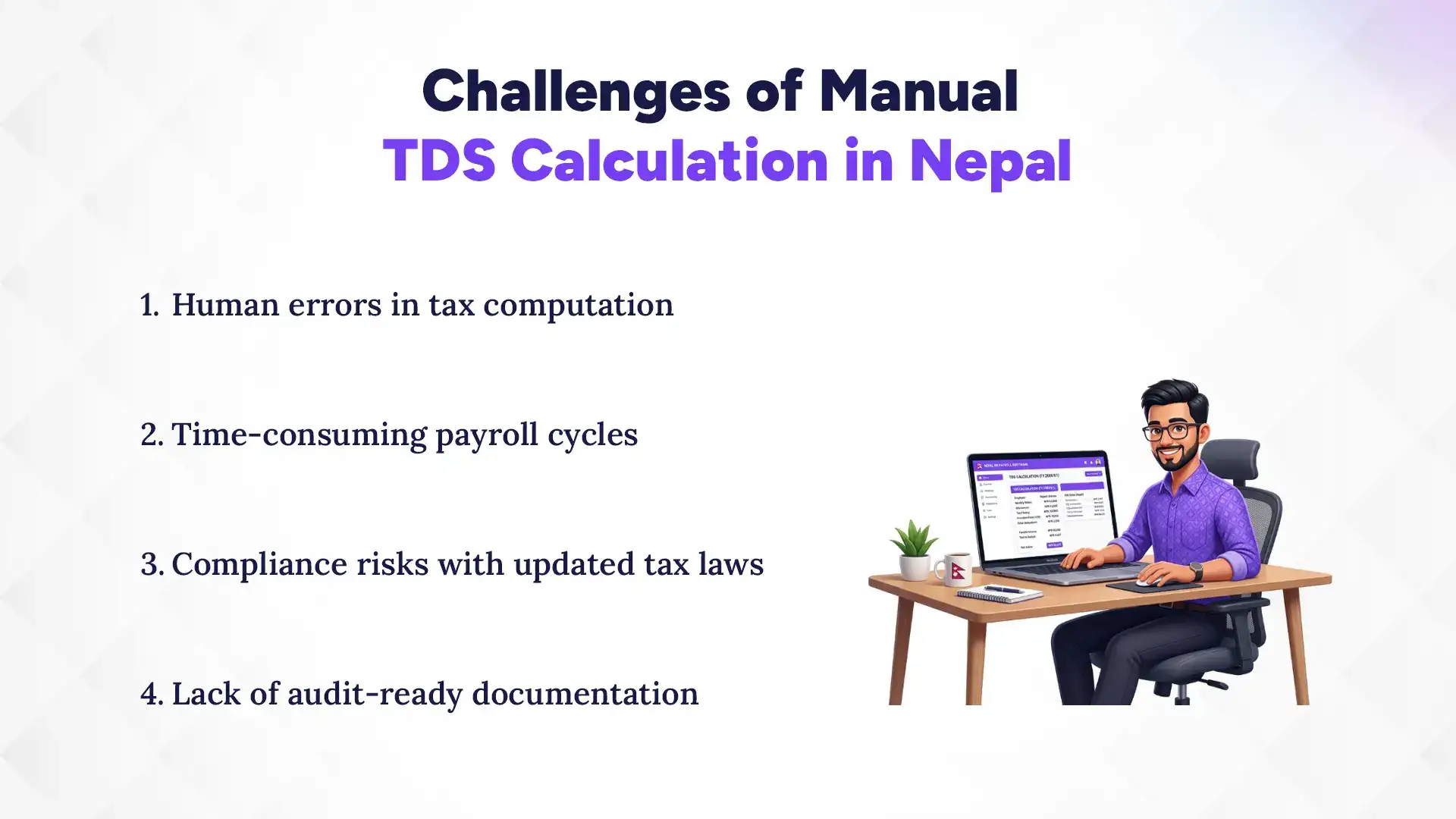
Manual TDS calculation often leads to human errors in tax computation, especially when handling multiple employees. These errors can result in compliance issues and financial penalties. It also consumes a large amount of HR time due to repeated calculations and updates in tax laws. Additionally, manual systems lack proper audit trails and structured reporting mechanisms.
Software vs Manual Payroll System (Comparison Table)
| Feature | HR Software | Manual Payroll System |
|---|---|---|
| Accuracy | High | Low |
| Speed | Fast | Slow |
| Compliance | Automated updates | Prone to errors |
| Reporting | Instant reports | Manual preparation |
| Cost Efficiency | Long-term savings | Higher operational cost |
How to Choose the Right HR Software in Nepal
The right HR software should support Nepal tax compliance and automatically update income tax slabs. It must include strong payroll automation features to reduce manual workload. It should also integrate with accounting systems for better financial management and scalability. Local compliance support ensures long-term reliability for growing businesses. For Nepali companies, Pace HRMS by The Pace Infosys is designed specifically to meet these requirements, offering built-in payroll automation, TDS calculation, and full compliance with Nepal’s tax regulations.
Conclusion
Manual payroll systems are no longer practical for growing businesses in Nepal due to increasing compliance complexity. HR software with TDS calculation ensures accuracy, efficiency, and legal compliance in every payroll cycle. Businesses that adopt automated payroll systems gain better control over financial operations and reduce compliance risks significantly. Pace HRMS by The Pace Infosys offers a complete HR and payroll automation solution designed for Nepali businesses. It simplifies TDS calculation, ensures tax compliance, and streamlines end-to-end payroll management for organizations of all sizes.