

Managing employee salaries, tax deductions, and statutory contributions manually often creates unnecessary stress for HR and finance teams. Even a small mistake in income tax calculations, Provident Fund deductions, or payroll records can lead to compliance issues, employee complaints, and additional administrative work. Many Nepali businesses still rely on spreadsheets, making payroll processing slower and more prone to human error.
HR software for tax calculation in Nepal solves these challenges by automating payroll, tax deductions, and compliance-related tasks. This guide explains how HR software works, its key features, benefits, compliance requirements, and how businesses can choose the right solution to simplify payroll management and improve accuracy.
What Is HR Software for Tax Calculation in Nepal?
HR software for tax calculation in Nepal is a digital system that automates payroll processing, employee tax calculations, and statutory deductions such as Provident Fund (PF), Citizen Investment Trust (CIT), and Social Security Fund (SSF). It helps businesses calculate salaries and taxes accurately while reducing manual payroll work.
The software also generates payslips, maintains employee payroll records, and supports compliance with Nepal's tax regulations. By automating tax and payroll management, organisations can save time, minimise errors, and improve overall operational efficiency.
Why Businesses in Nepal Need HR Software for Tax Calculation
Businesses in Nepal need HR software for tax calculation because it improves payroll accuracy, automates tax deductions, and simplifies compliance with Nepal's tax regulations. Automated systems reduce manual payroll errors, save time for HR and finance teams, enhance payroll transparency, and build employee trust through accurate salary processing.
By using HR software, organisations can ensure consistent tax calculations, maintain proper payroll records, and reduce the risk of compliance issues. This allows businesses to process salaries more efficiently while improving overall operational efficiency and workforce management.
Key Features of HR Software for Tax Calculation in Nepal
HR software for tax calculation in Nepal includes features that automate payroll processing, tax deductions, statutory contributions, and compliance management. These tools help businesses improve payroll accuracy, reduce administrative workload, and ensure compliance with Nepal's tax regulations.
Key features typically include automated income tax calculation, payroll processing and salary management, Provident Fund (PF) calculation, Citizen Investment Trust (CIT) management, TDS and tax deduction tracking, employee tax reports and payslip generation, and automatic compliance updates. Together, these features streamline payroll operations and help organisations manage employee taxes efficiently.
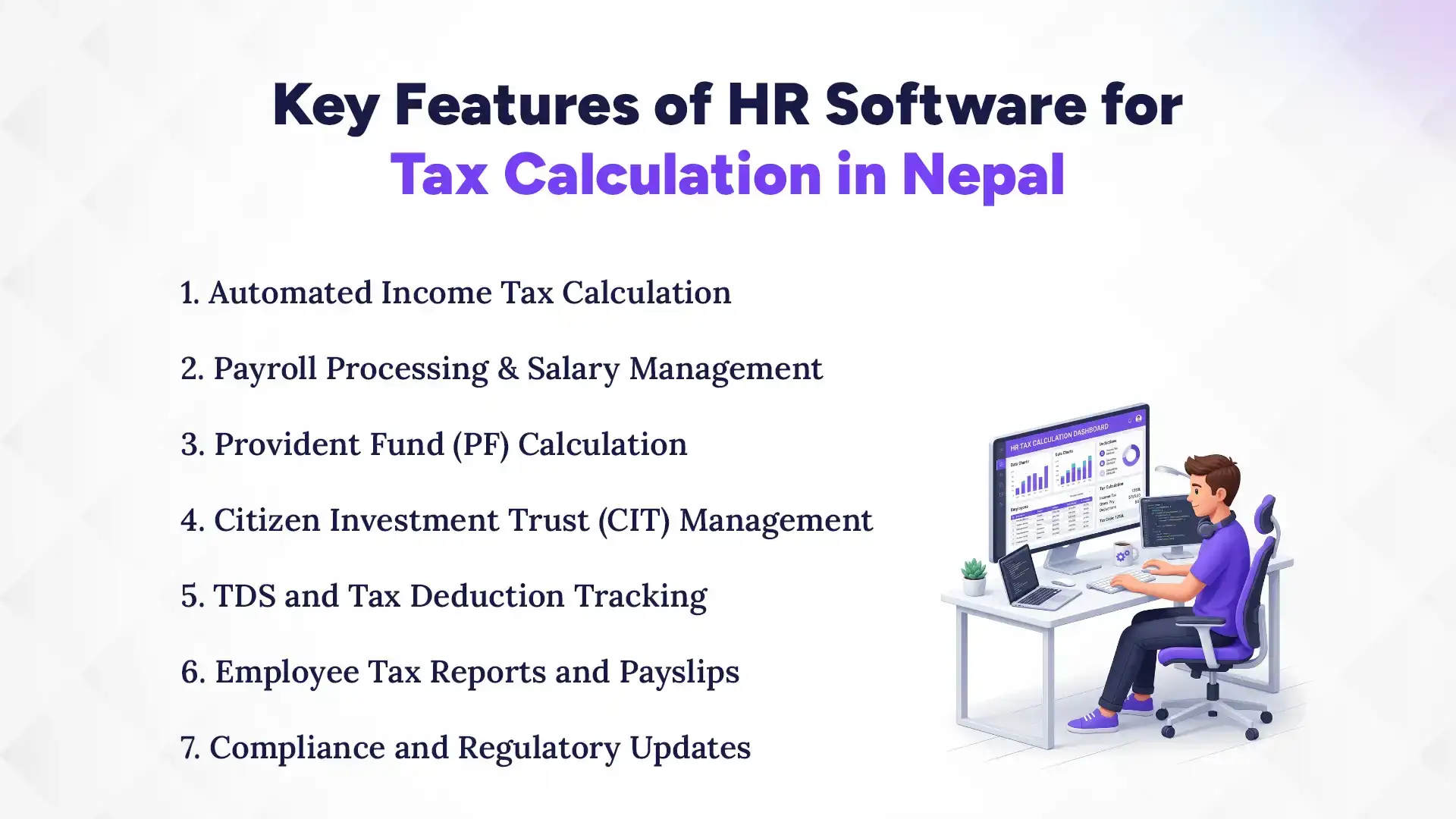
1. Automated Income Tax Calculation
Automated income tax calculation allows HR software to compute employee taxes based on salary structures and applicable tax slabs. The system automatically applies deductions, exemptions, and taxable income rules without requiring manual calculations. This reduces payroll errors and improves consistency across the organisation. Businesses can process payroll faster while maintaining tax compliance.
2. Payroll Processing and Salary Management
Payroll processing tools automate salary calculations, deductions, allowances, and final payouts. HR teams can manage monthly payroll cycles through a centralised platform instead of relying on spreadsheets. The software records payroll history and maintains accurate employee compensation data. This improves operational efficiency and payroll transparency.
3. Provident Fund (PF) Calculation
PF calculation features automatically determine employee and employer contributions according to organisational policies. The software updates payroll records whenever contribution amounts change. Automated tracking helps reduce errors associated with manual calculations. Businesses can generate PF reports whenever required for internal or regulatory purposes.
4. Citizen Investment Trust (CIT) Management
CIT management features track employee participation and contribution amounts throughout the payroll cycle. The software applies deductions accurately and records contribution histories for future reference. Automated processing minimises calculation mistakes and reporting inconsistencies. Employees also gain better visibility into their contribution records.
5. TDS and Tax Deduction Tracking
TDS and tax deduction tracking help organisations maintain accurate records of all employee tax obligations. The software stores deduction details and generates reports for payroll reviews and audits. Automated tracking reduces administrative workload and improves financial accuracy. Organisations can monitor tax liabilities more effectively throughout the year.
6. Employee Tax Reports and Payslips
Employee tax reporting tools generate detailed payroll summaries and digital payslips automatically. Staff members can access tax-related information without requesting manual reports from HR departments. The software improves recordkeeping and document accessibility. Businesses benefit from faster reporting and greater transparency.
7. Compliance and Regulatory Updates
Compliance management features help organisations stay aligned with changing tax regulations and payroll requirements. Modern HR software incorporates updated rules into payroll calculations automatically. This reduces compliance risks and prevents outdated payroll practices. Businesses can respond more effectively to regulatory changes.
Benefits of Using HR Software for Tax Calculation in Nepal
HR software provides faster, more accurate, and more compliant payroll management for organisations in Nepal. Automated processes eliminate repetitive tasks and improve operational efficiency. Businesses gain better control over payroll records and tax reporting.
- Improved payroll accuracy
- Faster salary processing
- Reduced compliance risks
- Better employee data management
- Simplified year-end tax reporting
- Reduced administrative workload
- Increased productivity for HR teams
- Better payroll transparency
How HR Software Calculates Employee Taxes in Nepal
HR software calculates employee taxes by collecting payroll data, applying tax rules, and generating accurate reports automatically. The process follows a structured workflow that minimises human errors and ensures compliance. Organisations benefit from consistent and reliable tax calculations.
1. Employee Salary Data Collection
The software gathers employee salary details, allowances, bonuses, and deductions from the payroll database. This information forms the foundation for tax calculations and payroll processing. Automated data collection reduces the risk of missing or inaccurate records. HR teams can manage employee information from a centralised system.
2. Taxable Income Determination
The system evaluates total earnings and identifies taxable income according to applicable regulations. It considers salary components, benefits, and eligible deductions before calculating tax obligations. Automated calculations ensure consistency across all employees. This process reduces the likelihood of payroll discrepancies.
3. Deduction and Exemption Calculation
The software applies deductions related to PF, CIT, SSF, and other approved exemptions automatically. It calculates eligible reductions before determining the final taxable amount. This improves accuracy and simplifies payroll administration. Employees receive more transparent tax records.
4. Automatic Tax Computation
Once taxable income is finalised, the software calculates tax liabilities using predefined tax structures. The process occurs automatically during payroll execution without requiring manual intervention. Automated computation reduces processing time and payroll errors. Organisations can maintain consistent tax calculations throughout the year.
5. Payroll and Reporting Generation
After calculations are completed, the system generates payslips, payroll summaries, and tax reports. These documents help HR teams review payroll information and maintain compliance records. Automated reporting improves accessibility and reduces administrative work. Businesses can quickly retrieve payroll data whenever required.
Tax Compliance Requirements HR Software Should Support in Nepal
HR software should support all major payroll and tax compliance requirements applicable to businesses operating in Nepal. Compliance-ready systems help organisations reduce regulatory risks and maintain accurate reporting. Automated compliance management simplifies payroll administration.
- Income tax calculation and reporting
- Provident Fund contribution management
- Citizen Investment Trust deductions
- Social Security Fund compliance
- Employee payroll record maintenance
- Regulatory reporting support
- Audit-ready documentation
- Secure payroll data storage
Best HR Software Features for Payroll and Tax Management
The best HR software combines payroll automation, compliance tools, and workforce management capabilities. Organisations should evaluate features that improve accuracy and operational efficiency. A comprehensive solution supports both HR and finance departments.
- Real-time tax calculations
- Multi-branch payroll management
- Attendance and leave integration
- Employee self-service portals
- Automated payslip generation
- Regulatory compliance tracking
- Advanced reporting and analytics
- Secure cloud-based access
How to Choose the Right HR Software for Tax Calculation in Nepal
Choosing the right HR software requires evaluating compliance capabilities, automation features, usability, and long-term scalability. Businesses should select a solution that aligns with organisational needs and payroll complexity. A structured evaluation process helps organisations make informed decisions.
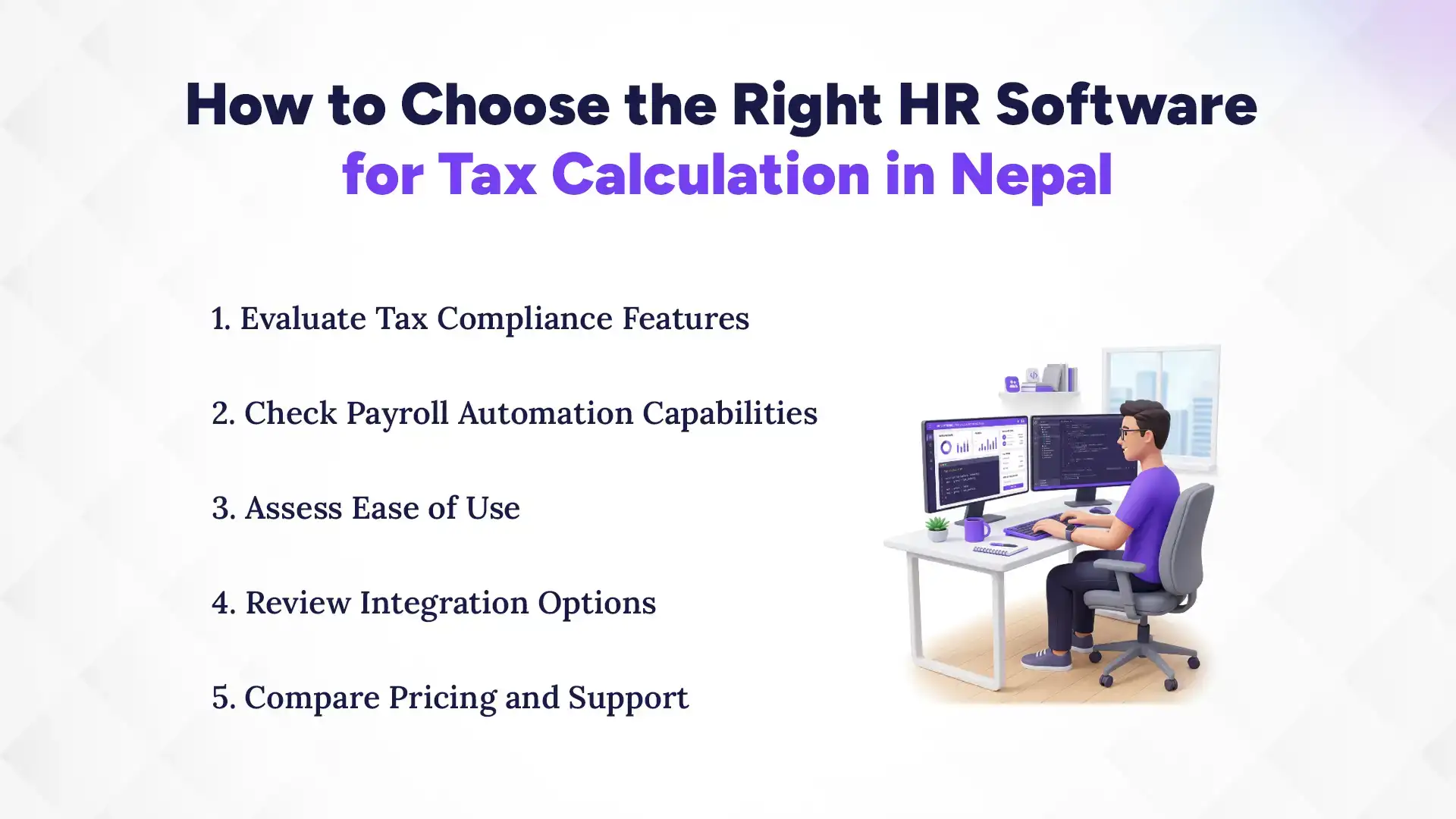
1. Evaluate Tax Compliance Features
Businesses should verify whether the software supports Nepal's payroll and tax requirements. Compliance features must handle tax deductions, statutory contributions, and reporting obligations accurately. Automated updates are also important for adapting to regulatory changes. Strong compliance functionality reduces operational risks.
2. Check Payroll Automation Capabilities
Payroll automation features determine how efficiently the system processes salaries and deductions. Organisations should assess payroll workflows, calculation accuracy, and reporting functions. Automated processing saves time and reduces administrative burdens. A strong payroll engine improves overall efficiency.
3. Assess Ease of Use
User-friendly software simplifies daily HR and payroll operations for administrators and employees. Intuitive navigation reduces training requirements and improves adoption rates. Easy-to-use systems increase productivity across departments. Businesses benefit from smoother implementation and ongoing management.
4. Review Integration Options
Integration capabilities allow HR software to connect with attendance, accounting, and financial systems. Connected workflows reduce duplicate data entry and improve information accuracy. Organisations can streamline operations across multiple departments. Strong integration support enhances overall business efficiency.
5. Compare Pricing and Support
Businesses should evaluate software costs alongside implementation, maintenance, and support services. Reliable customer support helps organisations resolve issues quickly and maintain payroll continuity. Cost-effective solutions provide long-term value without sacrificing essential functionality. A balanced evaluation supports better purchasing decisions.
Conclusion
Accurate tax calculation and payroll management are essential for every organisation operating in Nepal. HR software simplifies these processes by automating tax deductions, payroll calculations, compliance tracking, and employee reporting while reducing manual effort and administrative risks.
Businesses that invest in a reliable HR solution can improve efficiency, maintain compliance, and provide a better payroll experience for employees. If your organisation is looking for a smarter way to manage payroll and tax calculations, Infosys HR Software offers tools designed to streamline HR operations and support business growth.