A missed sale is the visible cost of a lost lead. The bigger cost can include wasted marketing spend, slower revenue growth, and an inconsistent customer experience when leads are handled differently by different team members.
Most lead management problems don't come from a lack of sales effort. They often result from disconnected, manual processes: a lead recorded in a notebook, a follow-up remembered or forgotten, or customer information spread across different channels with no central place to manage it.
This is especially relevant for businesses in Nepal, where leads can come through phone calls, WhatsApp messages, field visits, social media, and email. Without a centralized system, leads can easily be missed, follow-ups can be delayed, and sales teams may lack visibility into the full customer journey.
This guide covers the most common lead management problems in Nepal and explains how a CRM can help businesses organize leads, improve follow-ups, and create a more consistent sales process.
What Counts as a Lead Management Problem?
A lead management problem is any breakdown in capturing, tracking, following up with, or converting a potential customer. These problems can result from lost information, inconsistent processes, duplicate records, or limited visibility into where each lead stands. Lead management problems generally fall into four categories:
Capture problems: A lead reaches out but is never recorded or assigned to someone.
Follow-up problems: A lead is recorded, but no one follows up with them on time.
Data problems: The same lead exists as multiple or disconnected records.
Visibility problems: The information exists, but sales teams cannot easily see the lead's status or history.
Most businesses can experience more than one of these problems at the same time. Identifying which areas are causing lead loss makes it easier to determine where a CRM can improve the sales process.
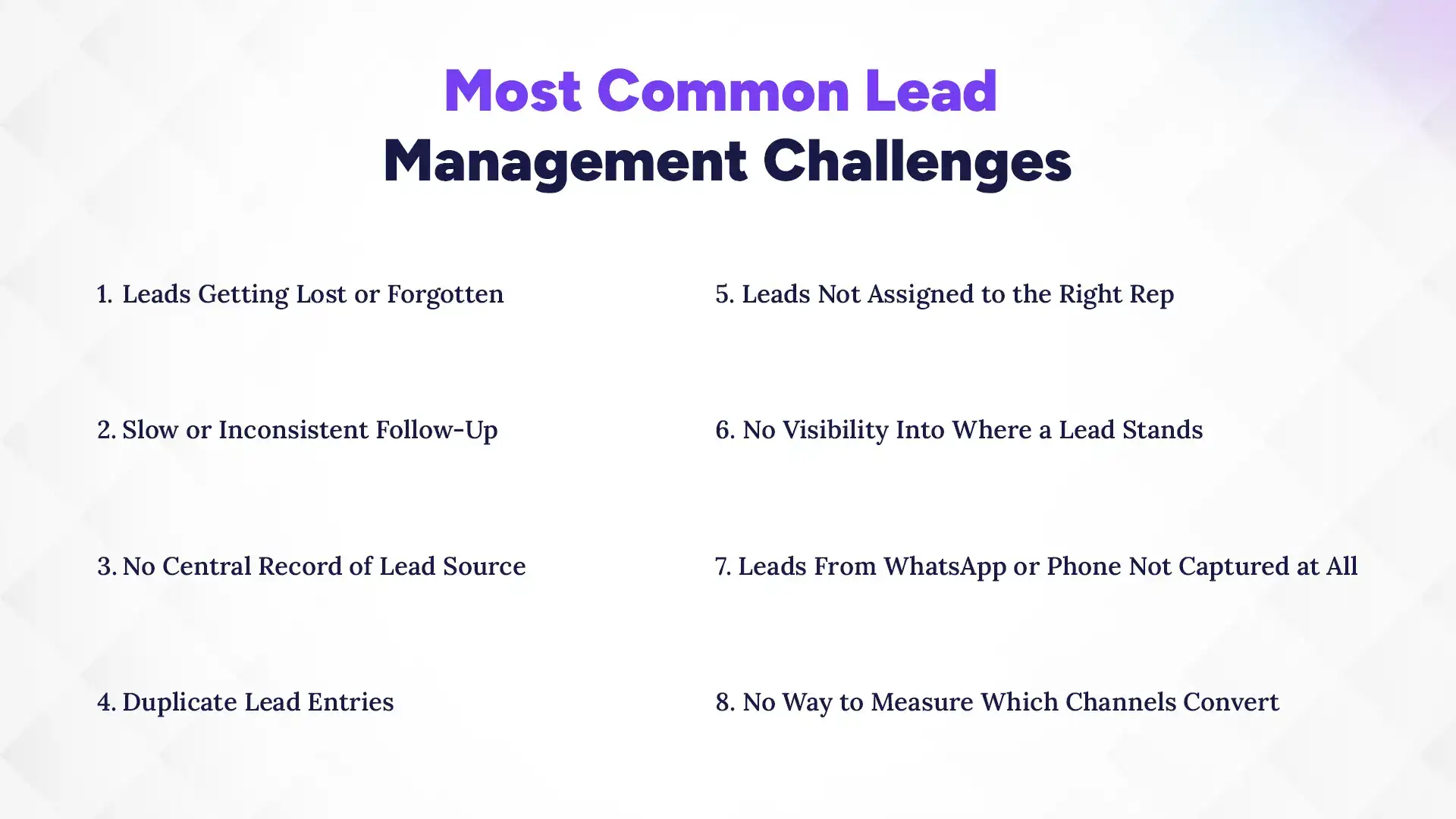
Most Common Lead Management Challenges
The most common lead management challenges include lost leads, slow follow-ups, duplicate records, unclear ownership, limited visibility, and difficulty tracking lead sources and conversions. A CRM can help address these challenges by centralizing lead information, streamlining follow-ups, assigning ownership, and giving sales teams a clearer view of each lead's progress.
1. Leads Getting Lost or Forgotten
Leads can easily be forgotten when inquiries arrive through different channels and there is no central system to record them. A CRM gives each lead a dedicated record, making it easier to capture, assign, and track inquiries throughout the sales process.
2. Slow or Inconsistent Follow-Up
Some leads receive a quick response while others may wait days, especially when follow-ups depend on individual sales representatives remembering to act. The CRM system benefits become most visible when automated reminders and follow-up tasks replace reliance on individual memory.
3. No Central Record of Lead Source
Without reliable source information, businesses may struggle to determine whether leads are coming from Facebook, referrals, walk-ins, WhatsApp, or other channels. A CRM can record the source of each lead, helping businesses understand which channels generate valuable opportunities.
4. Duplicate Lead Entries
A prospect who contacts a business through multiple channels may end up with several separate records. This can lead to duplicate follow-ups and a fragmented view of the customer's history. CRM duplicate detection and centralized records can help businesses maintain a clearer record for each lead.
5. Leads Not Assigned to the Right Rep
A lead can be overlooked when it arrives in a shared inbox or group chat without a clearly assigned owner. A CRM can assign leads to specific sales representatives based on the business's workflow, making responsibility clear from the beginning. Understanding different types of CRM helps clarify which CRM structure best supports clear lead ownership and assignment.
6. No Visibility Into Where a Lead Stands
Sales managers can struggle to determine whether a lead has been contacted, quoted, followed up with, or moved closer to a sale when information is stored in individual notes or conversations. A CRM provides a shared view of lead status, interactions, and next steps so the sales team can see where each opportunity stands.
7. Leads From WhatsApp or Phone Not Captured
Phone calls and WhatsApp inquiries can become difficult to track when they are handled outside the main sales process. Recording these inquiries in a CRM can help businesses keep lead information and follow-up activities in one place, depending on the available integrations and workflows. For businesses already using automatic lead capture through CRM, connecting these incoming leads to the same CRM is the next step.
8. No Way to Measure Which Channels Convert
Generating a high volume of leads does not necessarily mean a marketing channel is producing customers. By connecting lead sources with sales outcomes, a CRM can help businesses compare channels and understand which sources generate leads that move through the sales pipeline and convert. When selecting the right CRM for your business, lead source tracking and conversion reporting should be among the features evaluated.
How Do You Spot Lead Management Problems Before They Cost You Sales?
You can spot lead management problems by checking for untouched leads, inconsistent tracking, missing lead sources, gaps between marketing and sales data, and unclear ownership of follow-ups. Regularly reviewing these signals can help businesses identify weaknesses in their lead management process before they result in missed opportunities or lost sales.
Check for untouched leads: Look for leads that have not received a follow-up within your expected response time.
Ask sales reps how they track leads: If representatives are keeping leads in personal notes, spreadsheets, or messaging apps instead of the CRM, important information may be getting lost.
Look for missing lead sources: Leads without a recorded source can indicate gaps in the capture or tracking process.
Compare marketing and sales data: Check whether the leads reported by marketing are actually appearing in the sales system.
Watch for unclear ownership: Questions such as “Did anyone follow up with this person?” can indicate that lead ownership or visibility is unclear.
CRM data can help identify some of these warning signs automatically, but regular review is still important for finding gaps in the overall lead management process.
What Should You Do If You Discover Leads Have Been Falling Through the Cracks?
If you discover that leads are falling through the cracks, you should identify the affected leads, reconnect with those who may still be interested, find the source of the breakdown, and fix the process that caused it. Acting quickly can help recover potential opportunities while preventing the same problem from affecting future leads.
Identify the scope: Determine how far back the issue goes and how many leads may have been affected.
Reach out directly: Contact affected leads rather than assuming they are no longer interested. Some may still be open to continuing the conversation.
Trace the breakdown: Determine whether the issue occurred during lead capture, assignment, follow-up, or another stage of the process.
Add a temporary check: Put a manual review or follow-up check in place while the underlying process is being fixed.
Document what happened: Record the cause and resolution so the findings can guide future CRM and workflow configuration.
Fixing the immediate gap is important, but addressing the underlying process is what helps prevent the same leads from being missed again. Understanding the ERP vs. CRM comparison is relevant here because ERP handles internal operations while CRM handles customer-facing activities. Mixing up the two can lead to confusion about where lead data lives and who is responsible for it.
Lead Management Checklist for Businesses
A lead management checklist helps businesses regularly assess whether leads are being captured, assigned, followed up with, and tracked properly. Use it as a recurring check rather than a one-time audit to identify gaps before they result in missed sales opportunities. Use these checks regularly:
Every lead source is captured automatically or consistently recorded
Leads are assigned to a sales representative within a defined time window
No lead remains untouched beyond the agreed follow-up window
Duplicate leads are identified and consolidated where appropriate
Sales representatives can access the relevant lead history and interactions
Marketing and sales teams can see which channels are generating conversions
WhatsApp and phone inquiries are recorded consistently with other lead sources
Regularly reviewing these areas can help businesses identify weaknesses in their lead management process and address them before they become recurring problems.
How Pace CRM Helps Nepali Businesses Manage Leads Better
Pace CRM software helps businesses manage leads more effectively by centralizing lead information, simplifying follow-ups, and giving sales teams better visibility into each opportunity. It can help businesses organize leads from different channels, assign ownership, track interactions, and monitor lead sources in one place.
With lead information and follow-up activities organized in a central system, sales teams can spend less time searching for customer details and more time engaging with potential customers. Pace CRM helps reduce the gaps that cause leads to be forgotten, delayed, or poorly tracked.
Conclusion
Most lead management problems come from disconnected processes, not a lack of sales effort. For Nepali businesses, where leads can arrive through phone, WhatsApp, field visits, and email, keeping those inquiries organized and properly followed up is essential.
The goal isn't simply to capture more leads. It's to make sure the leads already coming in don't get lost along the way. CRM can close many of the structural gaps that cause leads to fall through, while consistent follow-up remains essential to turning opportunities into sales.
Want to manage leads more effectively. Leave a message with Pace Infosys to explore how Pace CRM can help your business keep every opportunity on track.
FAQs
What's the most common reason leads get lost in a growing business?
+
Leads are often lost because inquiries come from multiple channels without a centralized system, making follow-up responsibility unclear.
Can CRM really capture WhatsApp and phone leads automatically?
+
A CRM can capture and organize WhatsApp and phone inquiries when the appropriate integrations or workflows are available, giving them the same follow-up visibility as other leads.
How do you know if your business already has a lead management problem?
+
Look for delayed follow-ups, missing lead sources, and reps relying on personal notes instead of a shared system.
What should a business do first if leads have clearly been falling through the cracks?
+
A business should identify where leads are being lost, contact affected leads, and establish a clear follow-up process.
Does CRM guarantee leads won't be missed?
+
No. CRM reduces the chances of missed leads through centralized tracking and reminders, but employees still need to act on them.
How long should a lead go before follow-up is considered overdue?
+
A business should set a clear follow-up timeframe based on its lead source and sales process and apply it consistently.
Ready to get started?
Book a 30-minute consultation call, and let's talk about your goals.