Are you confused about ERM and CRM and wondering which system your business actually needs to grow and scale efficiently? You’re not alone; many businesses struggle to understand how these two powerful systems differ and where each one fits. This confusion often leads to wrong software choices and missed opportunities for optimization. Understanding the basics early can save both time and cost.
In this blog, we explain ERM vs CRM in a simple, practical way, breaking down their key differences, use cases, and benefits. You’ll learn how ERM supports internal operations, how CRM strengthens customer relationships, and which solution aligns best with your business goals. By the end, you’ll be able to make an informed decision with confidence.
What is ERM (Enterprise Resource Management)?
ERM is an integrated enterprise system that helps organizations manage core internal processes like finance, HR, operations, and supply chain through a single centralized platform. It focuses on improving efficiency, coordination, and control across all departments within a business.
Enterprise Resource Management is designed to simplify how resources are planned, used, and monitored across the organization. Instead of managing separate systems for accounting, human resources, or inventory, ERM brings everything together into one unified system. This reduces data duplication, improves accuracy, and enables better decision-making.
The purpose of ERM is to support day-to-day operations while also helping management plan for long-term growth. It provides real-time insights into business performance, resource utilization, and operational costs. As a result, companies can optimize workflows, reduce waste, and maintain better compliance and reporting standards.
Finance and Accounting: Manages budgeting, financial reporting, accounts payable and receivable, and compliance.
Human Resources (HR): Handles payroll, employee records, recruitment, attendance, and performance management.
Operations Management: Supports production planning, workflow optimization, and quality control processes.
Supply Chain Management: Oversees procurement, inventory, logistics, and vendor management.
Inventory and Asset Management: Tracks stock levels, assets, and equipment usage in real time.
Reporting and Analytics: Provides dashboards and insights for informed strategic and operational decisions.
What is CRM (Customer Relationship Management)?
CRM is a software system that helps businesses manage customer interactions, sales activities, and long-term relationships across the entire customer lifecycle. It focuses on organizing customer data, improving communication, and increasing sales and customer satisfaction.
Customer Relationship Management plays a key role in tracking every interaction a business has with its customers, from the first inquiry to post-sale support. By storing customer information in one place, CRM helps sales, marketing, and support teams work more efficiently and stay aligned. This leads to faster responses, personalized communication, and stronger customer relationships.
The main purpose of CRM is to support business growth by improving customer engagement and retention. It allows companies to understand customer behavior, identify sales opportunities, and deliver better service experiences. With clear insights and automation, CRM systems help teams close more deals and build lasting customer trust.
Key CRM Features
Sales Management: Tracks leads, opportunities, pipelines, and sales performance in real time.
Marketing Automation: Supports email campaigns, lead nurturing, segmentation, and customer targeting.
Customer Support: Manages support tickets, complaints, and service requests efficiently.
Contact and Account Management: Stores detailed customer profiles and interaction histories.
Analytics and Reporting: Provides insights into sales trends, customer behavior, and campaign performance.
The core difference between ERM and CRM lies in what each system is designed to manage and optimize. ERM focuses on internal business operations, while CRM concentrates on external customer relationships. Both systems are essential, but they serve very different purposes within an organization.
Aspect
ERM (Enterprise Resource Management)
CRM (Customer Relationship Management)
Primary Focus
Managing internal business operations and resources
Managing customer relationships and interactions
Core Purpose
Improve operational efficiency, cost control, and resource planning
Increase sales, customer satisfaction, and retention
Medium to large enterprises with complex operations
Small to large businesses focused on growth and sales
Examples of Use Cases
Payroll processing, inventory control, and procurement planning
Lead management, customer retention, upselling, and cross-selling
Insights
Did You Know?
ERM and CRM serve different sides of a business. Pace CRM helps businesses organize customer data, manage sales activities, and build stronger customer relationships.
How Do ERM and CRM Work Together in a Business?
ERM and CRM work together in a business by connecting internal operations with customer-facing activities through shared data and integrated workflows. When both systems are aligned, businesses can move smoothly from sales and customer acquisition to order fulfillment, billing, and ongoing support. This creates a continuous flow of information across departments without delays or data gaps.
For example, once a sale is closed in the CRM, the ERM system can automatically handle inventory updates, invoicing, resource allocation, and delivery planning. This integration reduces manual work, avoids data silos, and ensures every department works with accurate, real-time information. As a result, teams operate more efficiently, and customers receive faster, more reliable service.
1. Integration Between ERM and CRM Systems
ERM and CRM integration allows data to flow seamlessly between customer-facing and operational teams. Customer orders, payment details, and service requests captured in CRM are synced with ERM modules like finance, inventory, and supply chain. This creates a single source of truth, improves collaboration, and minimizes errors caused by duplicate data entry. It also helps leadership gain a complete view of business performance.
2. Benefits of Unified Business Software
Unified ERM and CRM software improves overall business visibility and efficiency. Teams can track the full customer journey, from first contact to final delivery and support, without switching systems. This leads to faster decision-making, better customer experiences, reduced operational costs, and stronger alignment between sales goals and operational capacity across the organization.
Key Benefits of ERM Systems
ERM systems help organizations manage internal operations more efficiently by integrating finance, HR, operations, and supply chain into one platform. They improve coordination between departments, reduce manual work, and provide better control over resources. With centralized data and automated processes, ERM supports smarter decision-making and long-term business growth.
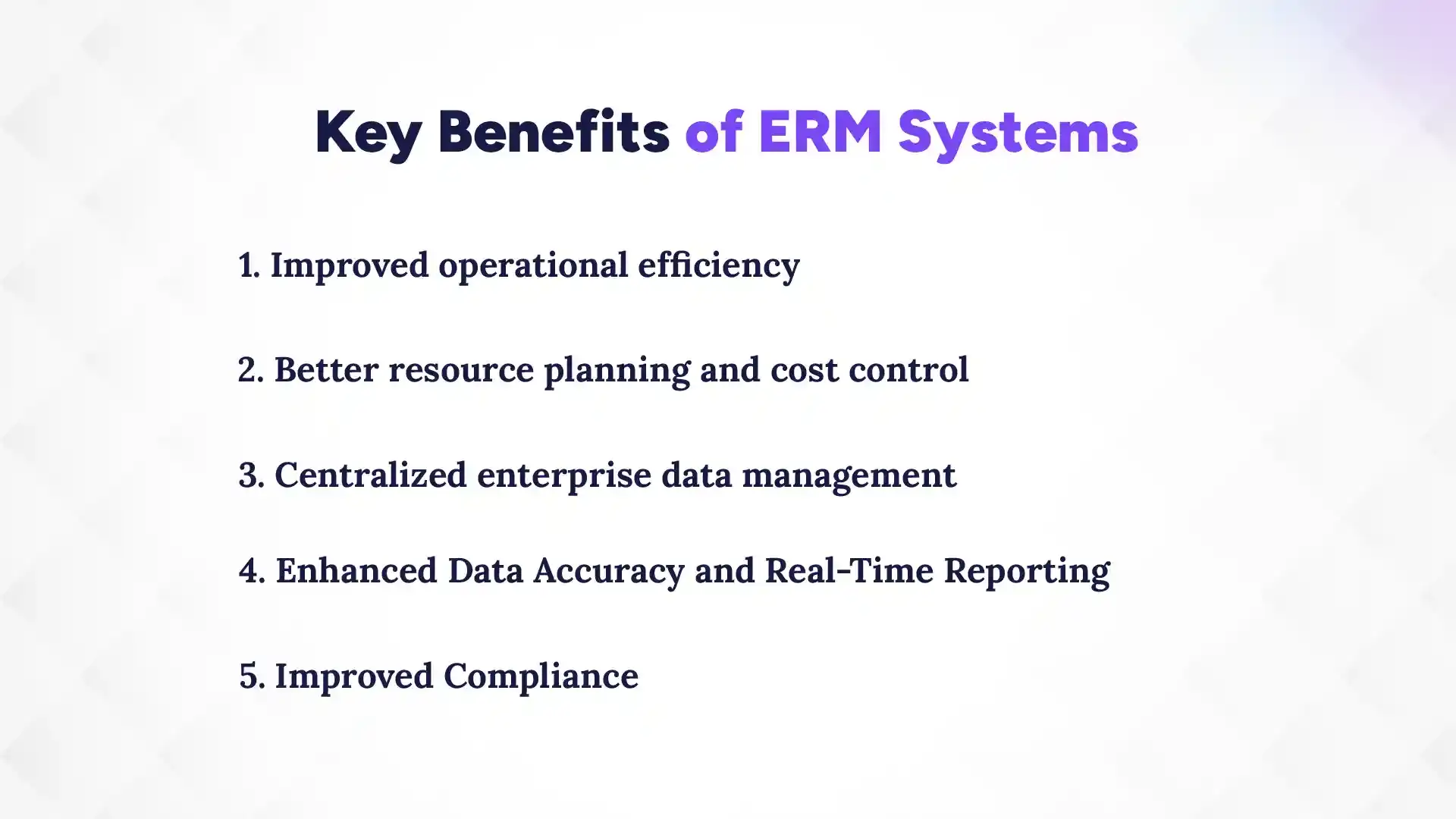
1. Improved Operational Efficiency
ERM systems automate routine tasks and streamline workflows across departments. This reduces repetitive manual work and minimizes process delays. Employees can collaborate more effectively because data is shared in real time. Fewer errors and faster execution lead to higher productivity. Overall, businesses can operate smoothly with less operational friction. This consistency also improves employee performance and accountability.
2. Better Resource Planning and Cost Control
ERM allows businesses to track expenses, inventory, and workforce usage accurately. Managers can plan resources based on real-time data instead of assumptions. This helps prevent overstaffing, underutilization, and budget overruns. Forecasting becomes more reliable, supporting better financial planning. As a result, companies gain stronger cost control. This leads to healthier cash flow management.
3. Centralized Enterprise Data Management
ERM stores all business data in a single, unified system. This eliminates data silos and reduces duplication across departments. Employees can access consistent and updated information when needed. Centralized data improves transparency and accountability. It also makes reporting and audits much easier. Teams spend less time searching for information.
4. Enhanced Data Accuracy and Real-Time Reporting
ERM systems capture and process data automatically, reducing human errors. Real-time dashboards and reports provide instant insights into business performance. Decision-makers can identify issues early and respond quickly. Accurate data supports better operational and strategic decisions. This leads to improved business outcomes. Timely insights help businesses stay competitive.
5. Improved Compliance
ERM helps organizations follow internal policies and external regulations consistently. Built-in controls, approval workflows, and audit trails reduce compliance risks. Financial and regulatory reports can be generated easily. This ensures accountability across departments. Compliance becomes more manageable as the business grows. It also strengthens trust with stakeholders and regulators.
Ready to Manage Leads Better?
Use Pace CRM to track leads, automate follow-ups, and close deals faster. Simple, powerful, and built for your growth.
CRM systems play a crucial role in helping businesses manage customer relationships effectively and strategically. They centralize customer data, streamline sales and marketing processes, and improve communication across teams. By using CRM software, organizations gain better visibility into customer behavior and preferences. This leads to stronger relationships, higher customer satisfaction, and sustainable business growth. Below, we discuss the prime benefits of using a CRM system:
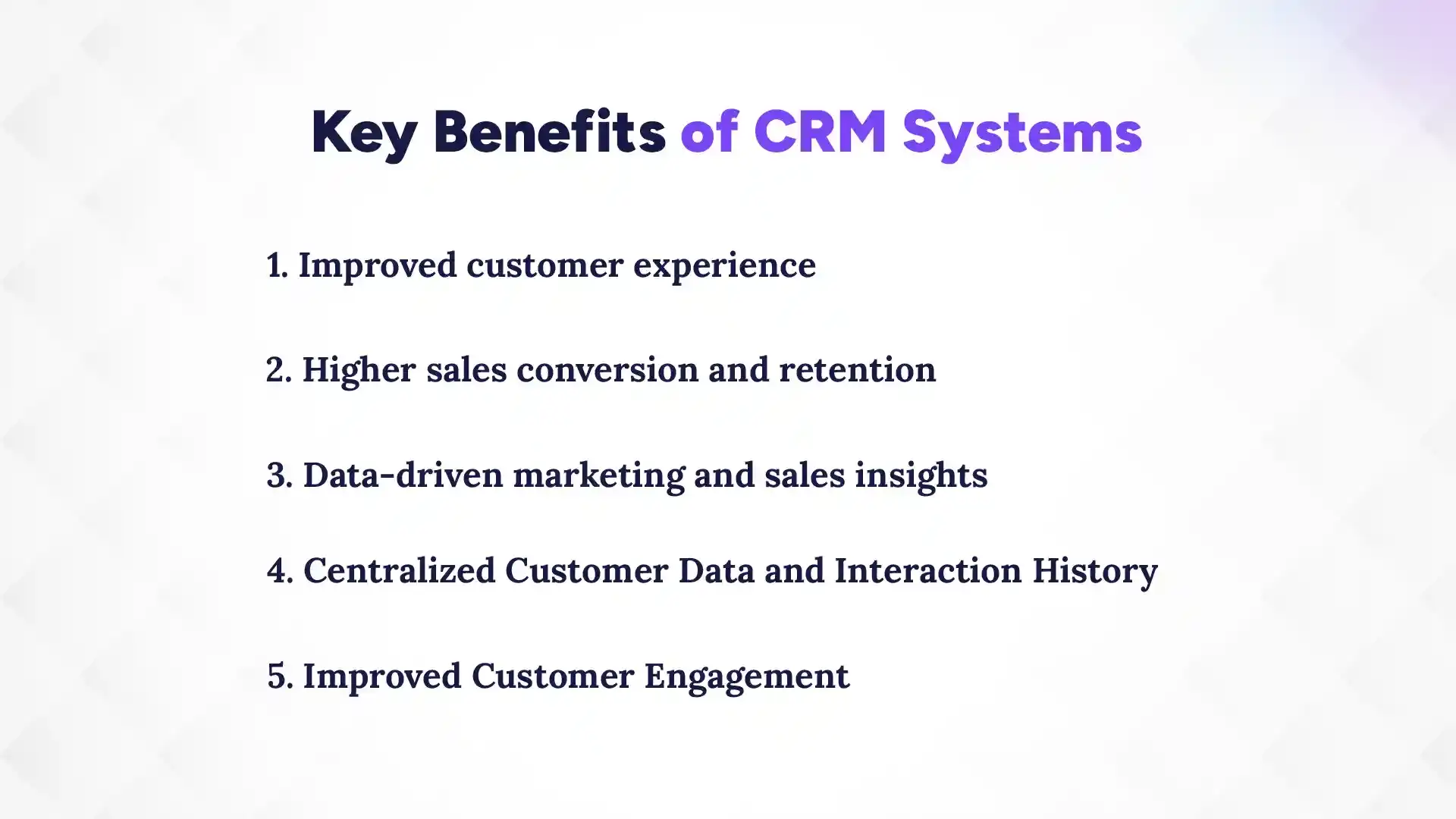
1. Improved Customer Experience
CRM systems help businesses deliver personalized and consistent customer interactions across all touchpoints. They allow teams to track customer preferences, history, and inquiries in one place. This ensures faster responses and more relevant communication. As a result, customers feel valued and understood. A better experience directly increases trust and long-term loyalty.
2. Higher Sales Conversion and Retention
CRM tools enable sales teams to track leads, follow up efficiently, and manage the entire sales pipeline. Automated reminders and insights help close deals faster and reduce missed opportunities. CRM systems also support upselling and cross-selling strategies. Retaining existing customers becomes easier with timely engagement. This leads to higher revenue and improved customer lifetime value.
3. Data-Driven Marketing and Sales Insights
CRM software provides detailed analytics on customer behavior, campaign performance, and sales trends. Businesses can use this data to refine marketing strategies and target the right audience. It helps identify high-performing channels and customer segments. Decisions become more accurate and measurable. This improves ROI and overall business performance.
4. Centralized Customer Data and Interaction History
All customer information, including emails, calls, purchases, and support tickets, is stored in one system. This eliminates data silos and improves collaboration between teams. Employees always have access to updated and accurate customer records. It also reduces duplication and manual errors. Centralized data ensures consistent communication across departments.
5. Improved Customer Engagement
CRM systems enable proactive communication through automated emails, reminders, and follow-ups. Businesses can engage customers at the right time with relevant messages. This keeps customers informed and involved throughout their journey. Regular engagement strengthens relationships and brand loyalty. Over time, it helps build long-term customer trust and advocacy.
INSIGHTS
Did You Know?
CRM systems can increase sales productivity by up to 34%. With Pace CRM, your sales team spends less time on manual work and more time closing deals.
ERM vs CRM: Which One Does Your Business Need?
You should choose ERM when your primary focus is managing internal operations such as finance, HR, inventory, and supply chain processes. ERM is useful for organizations dealing with complex workflows, large-scale resource planning, and compliance requirements. It helps improve operational control and efficiency across departments. However, ERM mainly looks inward and does not directly support customer engagement or sales growth. For businesses aiming to scale operations internally, ERM can be supportive but not growth-driven.
You should choose CRM when your business growth depends on customers, sales, and long-term relationships. CRM is much better than ERM for improving customer experience, increasing conversions, and retaining clients. It helps sales and marketing teams understand customer behavior, personalize communication, and close deals faster. CRM directly impacts revenue by strengthening customer relationships. For most modern businesses, CRM delivers faster and more visible business value than ERM.
Businesses need both ERM and CRM when they want strong internal operations along with powerful customer engagement. CRM should lead the front end by managing customers, sales, and marketing, while ERM supports backend operations. CRM is often the priority because it drives revenue, while ERM ensures smooth execution. When integrated, CRM insights help ERM teams plan resources better. This combination creates a balanced, scalable, and customer-focused business system.
Which is the best CRM in Nepal?
Pace CRM is the best CRM in Nepal because it is designed to help Nepali businesses manage customer relationships more effectively with a strong focus on sales, lead tracking, and client communication. Its interface is user-friendly, allowing sales and marketing teams to adapt quickly without heavy technical training. The system centralizes customer data, tracks interactions, and automates follow-ups, which directly improves sales productivity.
It also provides detailed reports and real-time dashboards to analyse customer behaviour and sales performance. With reliable local support and customization options tailored to Nepali business needs, it becomes a cost-effective and scalable CRM solution. This makes it ideal for startups, SMEs, and growing enterprises aiming to strengthen customer engagement and long-term relationships.
Future Trends in ERM and CRM Systems
The future of ERM and CRM systems is being shaped by rapid digital transformation and evolving business expectations. Organizations are increasingly looking for smarter, faster, and more integrated platforms to manage both internal operations and customer relationships. Technologies like AI, cloud computing, and advanced analytics are driving this change. These trends are helping businesses become more data-driven, agile, and customer-centric. As competition grows, adopting modern ERM and CRM solutions will be essential for long-term growth.
1. AI and Automation in ERM and CRM
AI and automation are transforming how ERM and CRM systems operate by reducing manual work and improving decision-making. In ERM, automation streamlines processes like inventory planning, financial forecasting, and workforce management. In CRM, AI helps with lead scoring, chatbots, personalized customer interactions, and sales predictions. These capabilities improve efficiency while minimizing human error. Over time, AI-driven systems enable businesses to respond faster to both operational and customer needs.
2. Cloud and SaaS-Based Solutions
Cloud and SaaS-based CRM and ERM solutions are becoming the preferred choice for businesses of all sizes. They offer flexibility, scalability, and lower upfront costs compared to on-premise systems. Cloud platforms allow teams to access data anytime and from anywhere, supporting remote and hybrid work models. Regular updates and security enhancements are handled by providers, reducing IT burden. This trend makes enterprise-grade software more accessible to growing businesses.
3. Data Analytics and Predictive Insights
Advanced data analytics is a key future trend in both ERM and CRM systems. ERM platforms use analytics to optimize resources, reduce costs, and improve operational planning. CRM systems analyze customer data to predict buying behaviour, improve targeting, and increase retention. Predictive insights help businesses make proactive decisions rather than reactive ones. As data volume grows, analytics will become a core competitive advantage.
In conclusion, understanding the differences between ERM and CRM is crucial for choosing the right business software. ERM focuses on improving internal operations, resource planning, and overall organizational efficiency, while CRM is designed to strengthen customer relationships and drive sales growth. In today’s competitive market, CRM often delivers faster and more visible returns by improving customer experience, engagement, and retention. Businesses that prioritize customers tend to grow more consistently and sustainably.
However, ERM and CRM are not competitors but complementary systems when used together. While CRM helps attract and retain customers, ERM ensures the business has the internal structure to support that growth. For many organizations, especially growing ones, starting with a strong CRM and later integrating ERM can be a smart, scalable approach for long-term success.
FAQs
What is the main difference between ERM and CRM?
+
ERM focuses on internal operations and resources, while CRM focuses on managing customer relationships, sales, marketing, and customer engagement activities.
Is CRM better than ERM for business growth?
+
CRM is better for business growth because it directly improves customer acquisition, sales conversion, retention, and overall customer experience.
Can small businesses use CRM instead of ERM?
+
Yes, small businesses often benefit more from CRM because it supports sales and customer management without the complexity of full enterprise operations.
Do businesses need both ERM and CRM?
+
Yes, businesses need both when they want strong customer growth supported by efficient internal operations and smooth backend processes.
Is ERM only suitable for large enterprises?
+
ERM is mainly suitable for medium to large businesses with complex internal processes, multiple departments, and advanced resource management needs.
Can ERM and CRM be integrated?
+
Yes, ERM and CRM can be integrated to share data, improve workflows, and provide a complete view of both operations and customers.
Which system should a startup choose first?
+
Startups should choose CRM first because it helps generate revenue, manage leads, and build customer relationships quickly.
What industries benefit most from CRM systems?
+
CRM systems benefit industries like sales, real estate, IT services, finance, healthcare, and e-commerce that rely heavily on customer interaction.
Ready to get started?
Book a 30-minute consultation call, and let's talk about your goals.