

Running an oil and gas business without a centralized customer management system often leads to missed sales opportunities, delayed customer responses, scattered records, and inefficient field operations. As your customer base grows, managing leads, contracts, service requests, and communication through spreadsheets or manual processes becomes difficult and increases the risk of errors.
CRM software for oil and gas companies helps solve these challenges by organizing customer information, streamlining sales activities, improving field service coordination, and supporting business growth. This guide explains how CRM software works, its key features, benefits, available types, and how to choose the right solution for your oil and gas business in Nepal.
What Is CRM Software for Oil and Gas Companies?
CRM software for oil and gas companies is a customer relationship management system that helps businesses manage customer information, sales activities, field service operations, and communication from a single platform. It centralizes customer data, making it easier to track interactions, manage contracts, monitor sales opportunities, and provide better customer support throughout the business relationship.
In the oil and gas industry, CRM software helps improve operational efficiency by connecting sales teams, field staff, customer service representatives, and management. It supports faster decision-making, better collaboration, automated workflows, and stronger customer relationships while helping companies deliver reliable services and achieve long-term business growth.
Why Do Oil and Gas Companies Need CRM Software?
Oil and gas companies need CRM software to manage customer relationships more effectively, streamline sales activities, improve field service coordination, and increase overall operational efficiency. A centralized CRM system helps businesses organize customer information, track sales opportunities, automate routine tasks, and provide faster responses to customer inquiries.
CRM software also helps companies retain customers by improving communication, scheduling timely follow-ups, and delivering consistent service. With real-time data, automated workflows, and better collaboration between office and field teams, oil and gas businesses can make informed decisions, improve productivity, and support long-term growth.
Key Features of CRM Software for Oil and Gas Companies
CRM software for oil and gas companies includes essential features that help businesses manage customer relationships, improve sales performance, automate operations, and increase overall efficiency. These features enable companies to streamline daily workflows, enhance collaboration, and make better business decisions with accurate data.
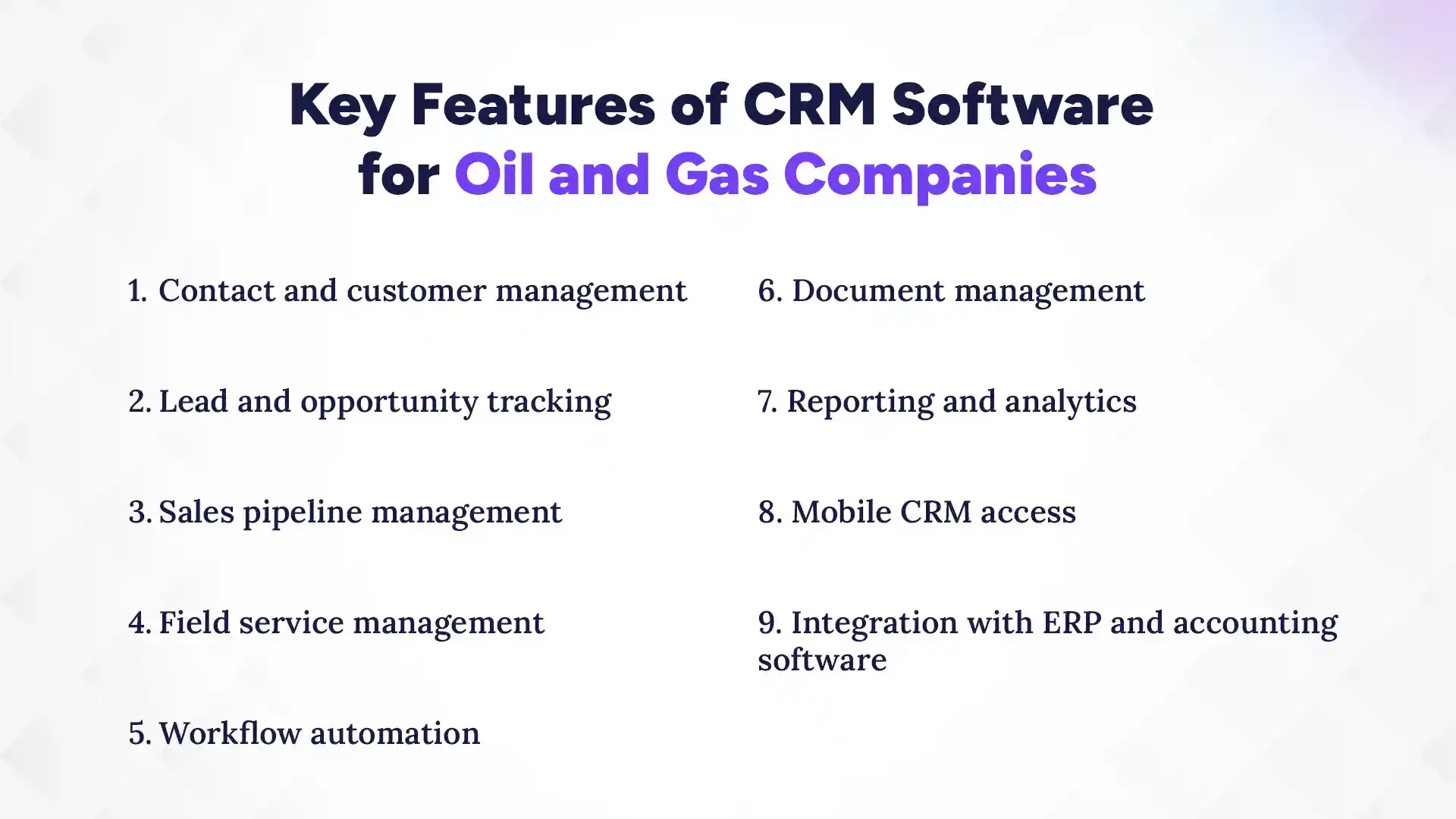
1. Contact and Customer Management
Contact and customer management stores customer profiles, communication history, contracts, and account information in one centralized system.
2. Lead and Opportunity Tracking
Lead and opportunity tracking helps businesses capture, monitor, and convert potential customers into paying clients more efficiently.
3. Sales Pipeline Management
Sales pipeline management allows sales teams to track deals through every stage and improve sales forecasting and conversion rates.
4. Field Service Management
Field service management helps schedule technicians, assign service requests, and monitor field operations in real time.
5. Workflow Automation
Workflow automation reduces manual tasks by automating approvals, reminders, follow-ups, and routine business processes.
6. Document Management
Document management securely stores contracts, quotations, invoices, and other important business files for easy access.
7. Reporting and Analytics
Reporting and analytics provide real-time dashboards and performance reports that support data-driven business decisions.
8. Mobile CRM Access
Mobile CRM access enables employees to access customer information and update records anytime using smartphones or tablets.
9. Integration with ERP and Accounting Software
Integration with ERP and accounting software connects different business systems to improve data accuracy and operational efficiency.
Types of CRM Software for Oil and Gas Companies
Oil and gas companies can choose from different types of CRM software based on their business size, operational needs, budget, and deployment preferences. The right CRM solution helps improve customer management, streamline business processes, and support long-term growth. Common options include cloud-based, on-premise, industry-specific, enterprise, and CRM solutions designed for small and medium-sized oil and gas businesses.
1. Cloud-Based CRM Software
Cloud-based CRM software stores business data online, allowing employees to access information from anywhere with an internet connection. It offers automatic updates, lower infrastructure costs, and faster deployment than traditional systems. Businesses can easily scale users and storage as operations grow without purchasing additional servers. This option is ideal for companies with multiple branches, remote sales teams, or field service operations.
2. On-Premise CRM Software
On-premise CRM software is installed on a company's own servers and managed internally. It provides greater control over data, system configuration, and security policies. Organizations with strict compliance requirements often choose this deployment model for complete infrastructure control. However, it usually requires higher upfront investment, dedicated IT support, and ongoing maintenance.
3. Industry-Specific CRM Software
Industry-specific CRM software includes features developed specifically for oil and gas operations. It supports fuel distribution, contract management, equipment servicing, field workforce coordination, and customer account management. Businesses spend less time customizing the software because many industry workflows are already available. This helps improve implementation speed and operational efficiency.
4. Enterprise CRM Software
Enterprise CRM software is designed for large organizations with multiple departments and complex operational requirements. It supports advanced automation, detailed reporting, role-based permissions, and integration with enterprise systems. Large oil and gas companies benefit from centralized management across regional offices and business units. The platform also scales efficiently as customer volumes and operational demands increase.
5. CRM for Small and Medium Oil and Gas Companies
CRM solutions for small and medium businesses provide essential customer management features without unnecessary complexity. They help manage leads, customer records, quotations, and service activities using affordable subscription plans. Smaller companies can improve productivity without investing in expensive enterprise systems. Many cloud-based CRM platforms allow businesses to add advanced features as they expand.
What Are the Benefits of CRM Software for Oil and Gas Companies?
CRM software helps oil and gas companies improve customer relationships, increase operational efficiency, and make better business decisions using centralized customer data.
The platform supports every stage of the customer journey while reducing manual administrative work. Businesses also gain valuable insights through real-time reporting and analytics.
- Better customer satisfaction
- Faster sales cycle
- Improved team collaboration
- Accurate reporting and forecasting
- Increased productivity
- Better compliance and data security
- Enhanced decision-making
- Improved customer retention
- Higher sales performance
- Better service quality
How to Choose the Best CRM Software for Oil and Gas Companies?
Choose the best CRM software for your oil and gas company by evaluating your business requirements, industry-specific features, integration capabilities, scalability, data security, pricing, and vendor support. Selecting a CRM that aligns with your current operations and future growth ensures better efficiency, higher user adoption, and long-term value. A careful evaluation before implementation helps reduce costly upgrades, improves productivity, and supports successful digital transformation.
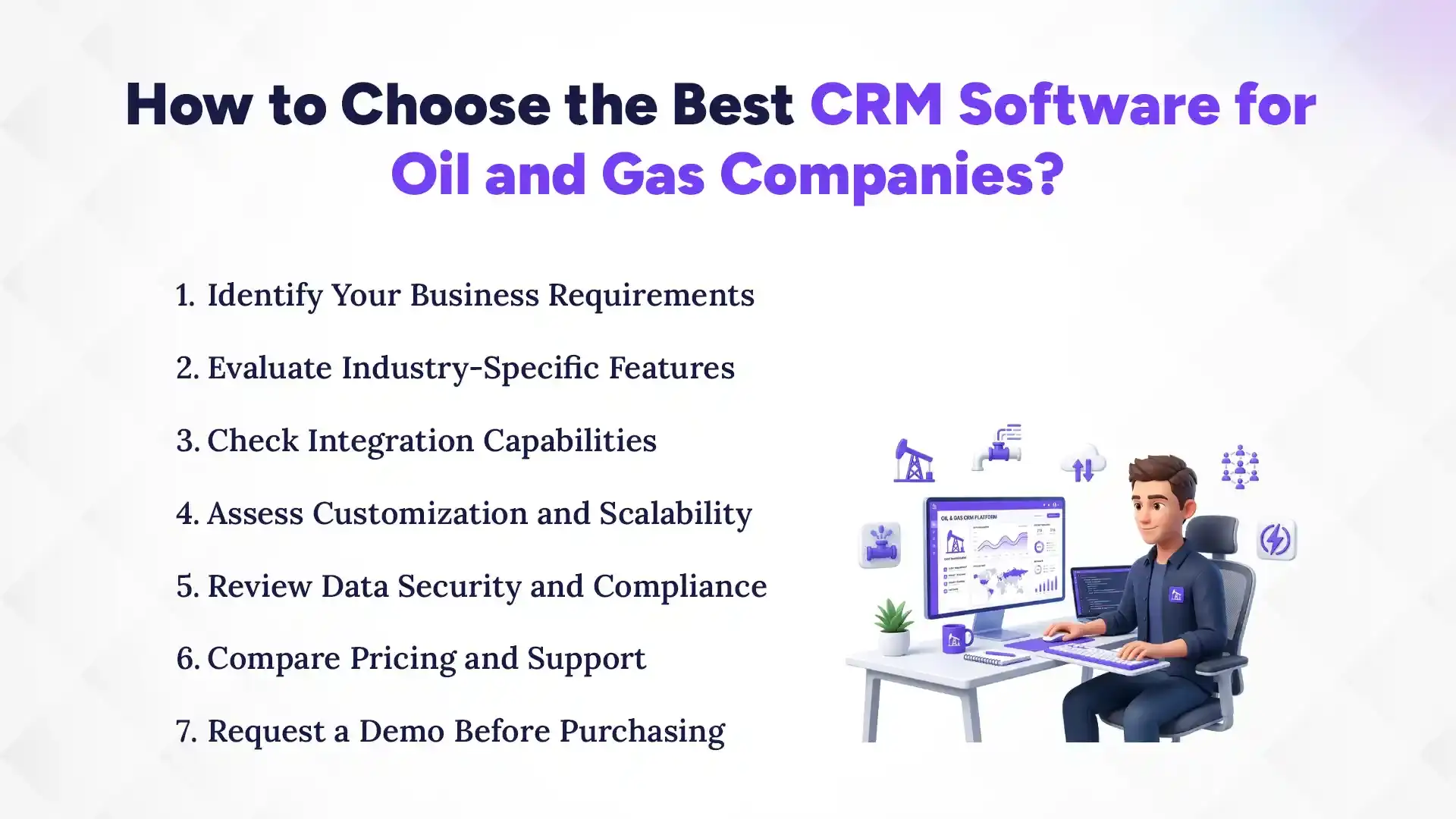
1. Identify Your Business Requirements
Start by documenting your current business processes, operational challenges, and long-term goals. Identify which departments will use the CRM and determine the features they need most. Prioritize essential functions instead of selecting software with unnecessary complexity. A clear requirement list makes vendor comparisons faster and more accurate.
2. Evaluate Industry-Specific Features
Choose CRM software that supports oil and gas workflows instead of relying only on general CRM functions. Look for contract management, service scheduling, field workforce coordination, and customer account management capabilities. Industry-specific features reduce customization costs and implementation time. They also improve daily productivity by matching existing operational processes.
3. Check Integration Capabilities
The CRM should integrate with ERP systems, accounting software, email platforms, and inventory management applications. Connected systems eliminate duplicate data entry and improve information accuracy across departments. Integration also allows employees to access business information from one centralized platform. This improves reporting and supports faster decision-making.
4. Assess Customization and Scalability
Select software that can grow with your business without requiring a complete replacement. Flexible customization allows companies to create workflows, reports, and dashboards that match operational requirements. Scalable solutions support increasing customer volumes and expanding business operations. This protects long-term technology investments.
5. Review Data Security and Compliance
Customer and business information should be protected through strong security controls and regular backups. Review user permissions, encryption methods, audit logs, and compliance certifications before purchasing. Secure CRM systems reduce operational risks and improve customer confidence. Data protection should remain a top priority throughout implementation.
6. Compare Pricing and Support
Evaluate subscription costs alongside implementation, training, maintenance, and future upgrade expenses. Compare customer support availability, response times, and onboarding services between vendors. A lower purchase price does not always provide the best long-term value. Reliable support often determines implementation success.
7. Request a Demo Before Purchasing
Always request a live demonstration before making a final decision. A demo allows your team to evaluate usability, reporting capabilities, automation features, and overall workflow compatibility. Encourage employees from multiple departments to participate in the evaluation process. Their feedback helps identify potential challenges before implementation.
Essential CRM Integrations for Oil and Gas Companies
Essential CRM integrations for oil and gas companies connect customer relationship management software with other business systems to improve efficiency, automate workflows, and ensure accurate data across departments. These integrations eliminate duplicate data entry, enhance collaboration, and provide a unified view of business operations.
1. ERP Software Integration
ERP software integration connects CRM with enterprise resource planning systems to synchronize customer, inventory, procurement, and operational data.
2. Accounting Software Integration
Accounting software integration automatically shares invoices, payments, financial records, and customer billing information between CRM and accounting systems.
3. Email and Communication Tools
Email and communication tool integration allows businesses to manage customer emails, meetings, follow-ups, and communication history directly within the CRM platform.
4. Marketing Automation Platforms
Marketing automation platform integration helps businesses automate email campaigns, lead nurturing, customer segmentation, and marketing performance tracking.
5. Inventory and Asset Management Systems
Inventory and asset management system integration enables companies to monitor equipment, inventory levels, product availability, and asset utilization through the CRM system.
Who Should Use CRM Software for Oil and Gas Companies?
CRM software is suitable for any oil and gas business that manages customers, sales activities, field operations, or long-term service contracts.
Organizations of all sizes can improve efficiency by centralizing customer information and automating routine business processes.
- Oil exploration companies
- Drilling contractors
- Fuel distributors
- Gas suppliers
- Energy service providers
- Equipment suppliers
- Lubricant distributors
- Industrial fuel providers
Why Choose CRM Software for Your Oil and Gas Business?
Choose CRM software for your oil and gas business to improve customer relationships, increase operational efficiency, support business growth, and deliver better customer service. A CRM system provides industry-focused features that streamline daily operations, enhance team collaboration, and help businesses make informed decisions for long-term success.
Conclusion
The right CRM software helps oil and gas companies organize customer information, improve sales performance, automate routine processes, and strengthen customer relationships. Whether your business manages fuel distribution, industrial clients, equipment services, or energy operations, a reliable CRM creates a more connected and efficient workflow.
If your organization is planning to modernize customer management and improve operational performance, choosing a CRM solution designed for the oil and gas industry is a smart long-term investment. Pace Infosys provides CRM software solutions tailored to the needs of oil and gas companies in Nepal, helping businesses improve productivity, customer service, and sustainable growth.