Choosing the right HR software sounds simple, until you’re stuck between HRIS and HRMS and everyone around you uses the two terms like they mean the same thing. They don’t. And picking the wrong one can secretly create payroll errors, compliance risks, and reporting gaps that slow your business down.
If you’re a growing company in Nepal trying to streamline HR operations, this decision matters more than you think. The difference between HRIS and HRMS isn’t just technical, it affects how efficiently your team works every single day.
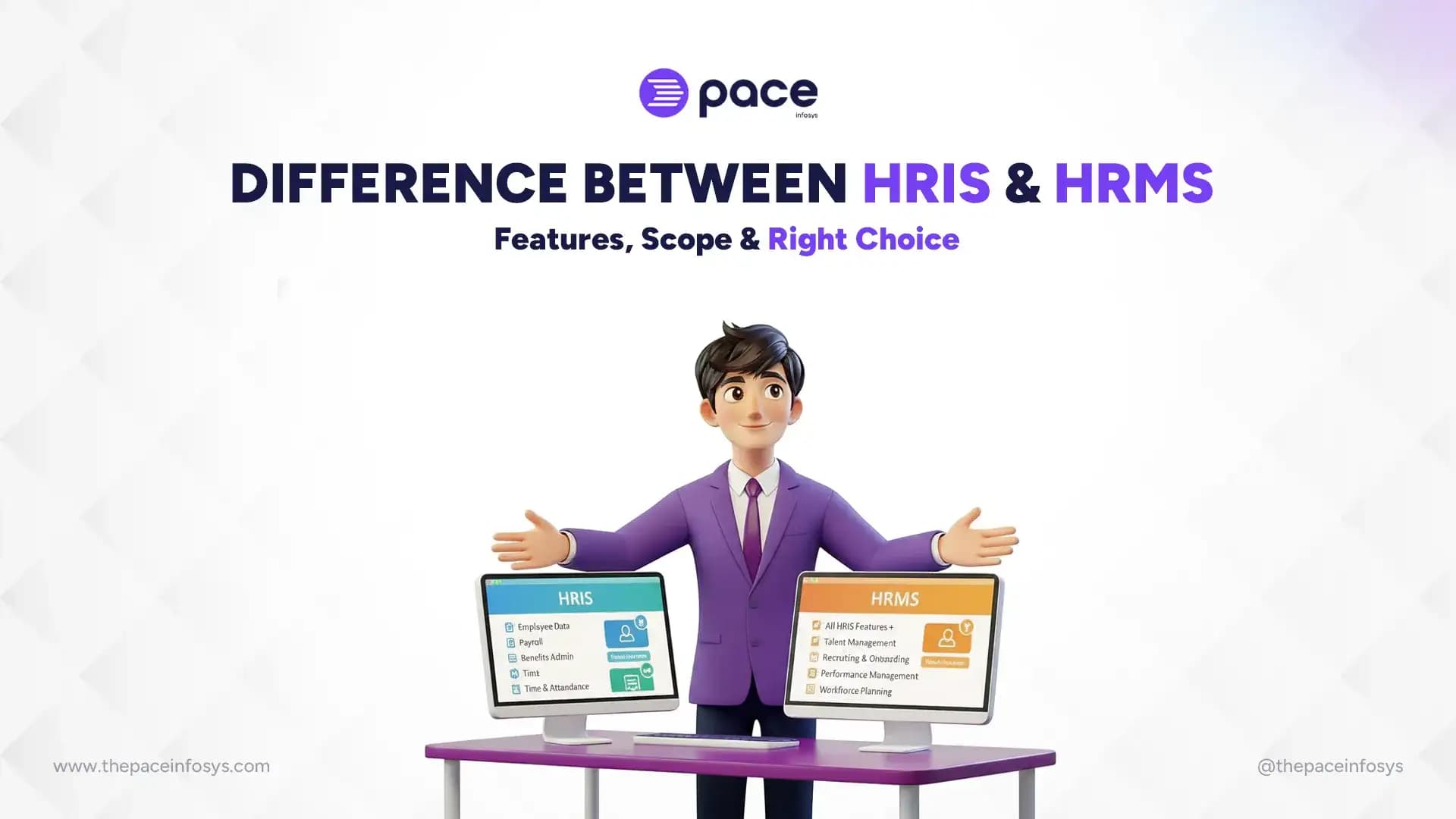
So, what is the difference between HRIS and HRMS? And which one actually fits your business? Let’s break it down in a clear, practical way.
HRIS vs HRMS: Why Understanding the Difference Matters for Growing Businesses
It’s easy to mix up HRIS and HRMS because both handle employee information. Many businesses in Nepal pick a system thinking it’s “just an HR software,” but the reality is more nuanced. The right system can save time, reduce errors, and make your HR team’s life much easier.
Choosing the wrong system, on the other hand, can quietly create problems. Payroll mistakes, compliance headaches, slow reporting, and scattered employee data are just the start. These issues can pile up and cost both time and money, but no growing business wants it.
That’s why understanding the difference between HRIS and HRMS is more than a tech choice. It’s a business decision. Knowing what each system offers helps you invest in the right tools from the start, so your HR processes run smoothly and support your growth goals.
What Is HRIS? (Human Resource Information System)
A HRIS, or Human Resource Information System, is essentially a digital hub for all your employee information. Think of it as the backbone of your HR operations. An HRIS keeps records organized, tracks basic HR processes, and makes sure information is easy to access. Its main focus is managing employee data and supporting administrative tasks, so your HR team spends less time on paperwork and more time on meaningful work.
Core HRIS Features
Employee database management: Keep all employee details in one secure place.
Leave and attendance tracking: Monitor absences, leaves, and attendance easily.
Basic HR reporting: Generate simple reports on workforce trends and data.
Document storage: Store contracts, certificates, and HR documents digitally.
If your business is small and your HR tasks are mostly administrative, a HRIS can cover your needs. It works well when you need basic workforce management, simple reporting, and limited automation. For many startups and growing businesses in Nepal, a HRIS is often a smart, cost-effective starting point.
What Is HRMS? (Human Resource Management System)
A HRMS, or Human Resource Management System, takes everything a HRIS does and adds a whole new layer of HR automation and strategy. It’s not just about storing employee data, it helps manage the entire employee lifecycle, from hiring to performance tracking, payroll, and compliance. Essentially, HRMS is a complete HR toolkit designed to make HR processes smarter, faster, and more connected.
Core HRMS Features
Integrated payroll processing: Automate salaries, deductions, and statutory calculations seamlessly.
Recruitment and onboarding workflows: Streamline hiring, interviews, and new employee onboarding.
Performance management system: Track goals, appraisals, and employee development.
Compliance tracking: Stay updated with labor laws, taxes, and regulations.
Workforce analytics and reporting: Get actionable insights from HR data to support decisions.
HRMS is ideal for scaling businesses that need more than just employee records. If your organization has complex payroll, strict compliance requirements, or a strategic HR vision, a HRMS helps you manage growth efficiently while keeping HR processes smooth and accurate.
What is the Difference Between HRIS and HRMS?
At its core, the main difference between HRIS and HRMS is that HRIS focuses on basic HR record-keeping and administration, while HRMS expands that to include deeper management and automation of HR processes. In other words, HRMS builds on what a HRIS does by adding tools that help HR teams manage talent, performance, compliance, and more in an integrated way. Understanding what does hr software do helps clarify this distinction before we dive into how each part stacks up.
1. Purpose
HRIS is mainly about storing and organising employee data in a central system. It acts like a reliable digital filing cabinet where you can access employee information, payroll details, benefits, and other core HR records quickly and accurately. A HRMS includes all this, but goes further. An HRMS is designed not just to record information, but to drive HR processes like hiring, performance reviews, and workforce planning. While HRIS keeps your HR data structured and compliant, HRMS helps you use that data to manage people more effectively across the employee life cycle.
2. Payroll Management
With a HRIS, payroll features are usually basic and functional. It calculates salaries, deductions, and tax with standard settings, which works well for smaller teams or simple payroll needs. In contrast, HRMS offers advanced payroll management with automation that can tie payroll to benefits, attendance management system, and performance variables, reducing errors and manual effort. In larger companies or those with varied pay structures, this deeper integration makes a noticeable difference in accuracy and efficiency.
3. Talent Acquisition
HRIS typically helps you store candidate information and track basic recruitment data, but doesn’t do much more than keep records. HRMS systems, on the other hand, often include tools for automated job postings, applicant tracking, and onboarding workflows. These features guide a candidate from first contact through to their first day on the job with minimal manual work from HR, which is a real advantage for fast‑growing teams filling many roles.
4. Performance Management
Performance features are limited in a HRIS system. You might be able to record review results, but there’s usually no support for setting goals, running appraisal cycles, or tracking progress over time. HRMS takes performance management seriously by offering built‑in tools for goal setting, feedback collection, and performance reporting. This allows HR leaders to link employee growth with business goals, moving HR from administrative to strategic.
5. Compliance Automation
Both systems help with compliance by keeping accurate records, but the depth varies. A HRIS ensures your core data, like payroll and employee records, meets legal and regulatory requirements. HRMS goes further by automating compliance workflows, sending reminders for deadlines, and generating reports for audits with little manual effort. For businesses operating in multiple regions or strict regulatory environments, this can be a huge time saver and risk reducer.
6. Scalability
HRIS is excellent when your team is small and HR processes are straightforward. It works well up to a point, surely. But, as your company grows, you may find processes start to slow down or require extra manual work. HRMS is built to scale, handling more users, more data, and more workflow automation as your HR needs expand. That means less rework and fewer system upgrades as your business grows.
7. Cost Range
Generally, HRIS systems are lower in cost because they focus on essential HR functions. They’re a good fit for small to mid‑sized companies looking to digitalise HR basics. HRMS solutions usually require a higher investment because they include broader features and automation tools. However, for many organisations the productivity gains and reduced manual work can justify the extra cost over time.
Difference Between HRMS and HRIS: Side-by-Side Comparison
Factor
HRIS
HRMS
Core Purpose
Employee data management and administrative tasks
End-to-end HR management and workforce automation
Payroll Management
Basic payroll functions
Advanced payroll with integration to benefits, attendance, and performance
Automates compliance tasks, reminders, and audit reports
Scalability
Suited for small teams, limited growth
Designed for growing organizations, multiple locations, more users
Cost Range
Lower upfront cost
Higher investment but greater ROI and efficiency
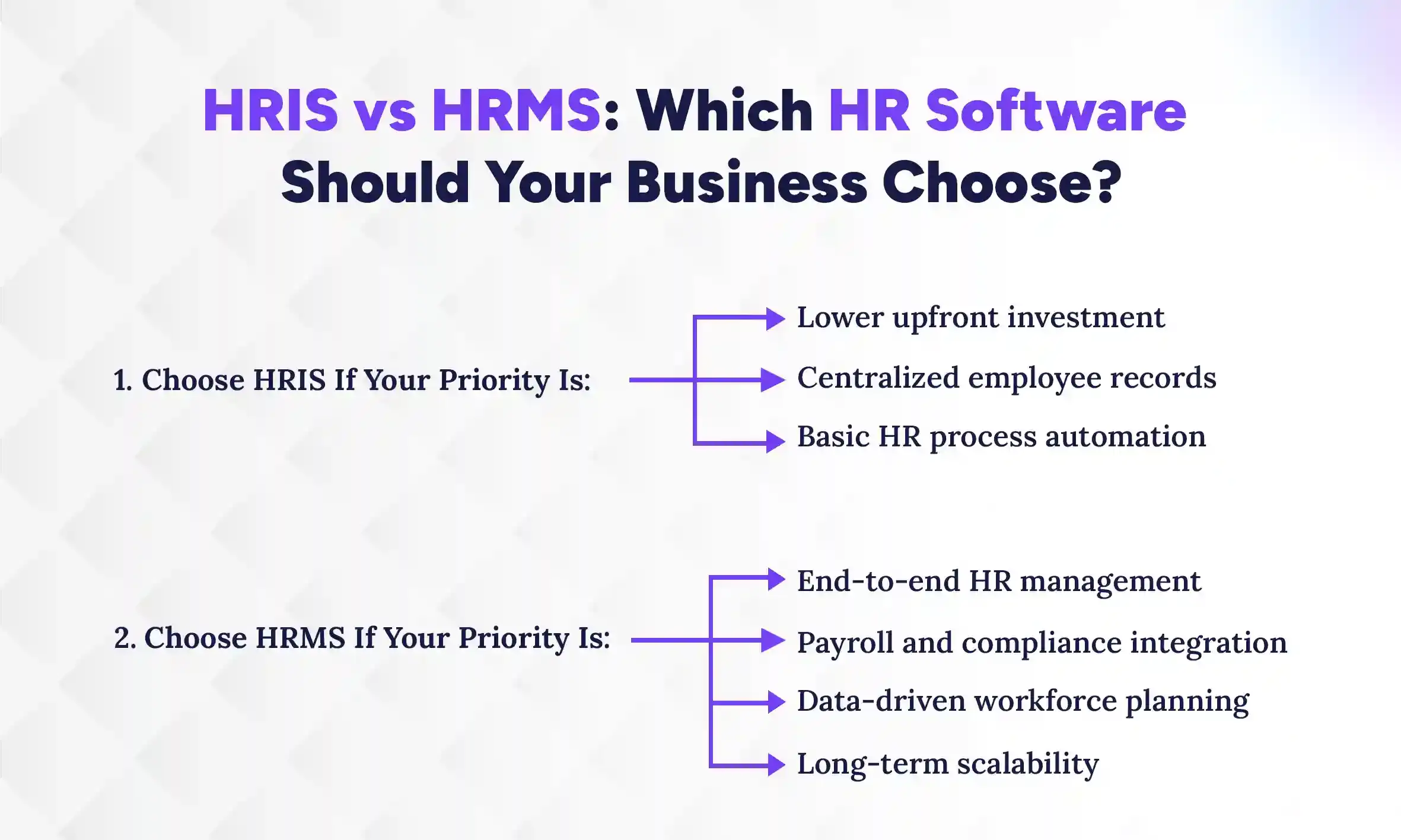
HRIS vs HRMS: Which HR Software Should Your Business Choose?
Choosing the right HR software isn’t just a technical decision, it’s a business decision. The system you pick today will affect how efficiently your HR team works, how accurately payroll runs, and how well you can plan for growth. For small teams, a simple solution might be enough, but for growing companies, a more powerful system can save hours of work and prevent costly mistakes. In this section, we’ll break down what HRIS and HRMS offer, and help you figure out which one fits your business needs and future plans.
1. HRIS is Simple, Efficient, and Cost-Effective
For smaller businesses with straightforward HR tasks, a HRIS is often enough. It centralizes employee records, tracks attendance, and lets you run basic reports without adding unnecessary complexity. Imagine a boutique firm in Kathmandu or a small café in Lalitpur. HRIS helps HR teams in small businesses stay organized and reduces paperwork, without needing a big investment. Its simplicity means your team can focus on core HR tasks rather than navigating complicated workflows. If your HR needs are mainly administrative, and you’re not yet managing complex payroll or compliance, HRIS is a practical, budget-friendly choice.
2. HRMS is Comprehensive, Automated, and Scalable
As your business grows, HR processes become more complex, and that’s where HRMS comes in. It does everything a HRIS can, plus it automates recruitment, onboarding, payroll, performance tracking, and compliance. For example, a mid-sized IT firm hiring dozens of employees each year in Pokhara can use HRMS to streamline recruitment, track performance, and handle payroll automatically, reducing errors and saving hours of manual work. HRMS also provides analytics to guide workforce planning and strategic decisions, making it ideal for companies that are scaling or managing multiple teams across locations.
3. Making the Right Choice: HRIS vs HRMS
Deciding between HRIS and HRMS comes down to your current needs, budget, and growth plans. HRIS works well for small teams with basic HR processes and limited budgets. It keeps operations simple and cost-effective. HRMS, on the other hand, is built for growing organizations that need automation, compliance support, and strategic insights.
If you’re unsure, ask yourself: Do I need advanced payroll, performance analytics, or recruitment automation? Is my business expanding or planning multiple teams? If yes, HRMS is worth the investment. If your HR needs are basic and your team is small, HRIS is the smarter starting point.
Cost, Scalability, and Long-Term HR Strategy Considerations
When choosing between HRIS and HRMS, cost, scalability, and future growth matter just as much as features. A system that fits today might not support your business tomorrow, so it’s important to evaluate implementation, upgrades, total cost of ownership, and workforce expansion.
1. Implementation Complexity
HRIS is generally simple to set up. Most small businesses can get it running quickly with minimal training and basic configuration. HRMS, however, involves a more detailed setup because it connects multiple HR processes like payroll, performance, and recruitment. While the initial effort is higher, a proper HRMS setup ensures automation and smooth workflows that pay off as your company grows.
2. Upgrade Paths
HRIS often comes with limited upgrade options. Adding advanced features later can be tricky or require switching systems entirely. HRMS, by design, allows modular upgrades, so you can start with essential functions and expand to payroll automation, compliance tools, or analytics as your business needs evolve. This flexibility prevents disruption and keeps HR operations consistent.
3. Total Cost of Ownership
HRIS has a lower upfront cost, making it attractive for small businesses. However, if your team grows or you need extra features, hidden costs for add-ons and integrations can pile up. HRMS may require a larger initial investment, but it often reduces manual work, errors, and operational delays, offering better long-term ROI.
4. Future Workforce Expansion
If your company plans to scale by hiring new teams, opening branches, or managing remote employees, HRMS is built to handle it. It supports more users, complex workflows, and multi-location reporting, ensuring HR processes stay efficient as your workforce grows. HRIS can work for small teams, but may struggle to support larger, distributed operations without extra effort.
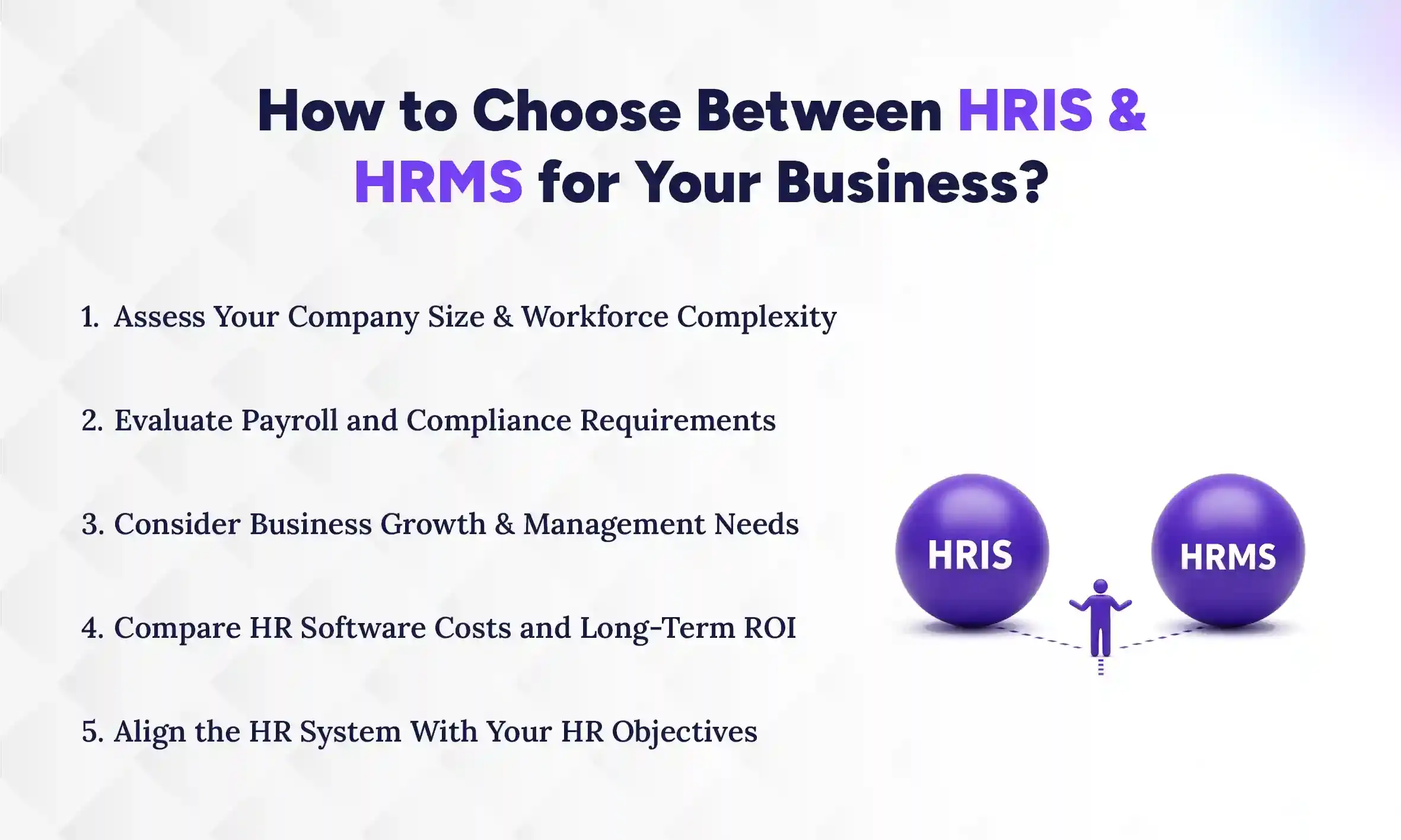
How to Choose Between HRIS and HRMS for Your Business?
Choose an HRIS for small businesses under 100 employees needing to digitize employee records, payroll, and compliance cost-effectively. Opt for an HRMS if you have 100–500+ employees, and need advanced talent management, recruitment, performance analytics, and comprehensive automation. Whatsoever, HRMS are equally great for small businesses too!Here’s how you can approach the decision in a practical, structured way.
1. Assess Your Company Size & Workforce Complexity
Start by looking at your team. Small businesses with fewer than 50 employees and simple HR processes usually benefit from HRIS. It keeps records organized, tracks attendance, and handles basic reporting without overcomplicating things. Larger teams or multi-department organizations, however, often need HRMS to manage multiple workflows, cross-team approvals, and distributed staff, ensuring HR operations run smoothly as the business grows.
2. Evaluate Payroll and Compliance Requirements
Next, consider how complex your payroll and compliance needs are. If you only need straightforward salary calculations, a HRIS can do the job. But if you have variable pay structures, statutory deductions, and tax obligations, HRMS is the safer choice. Automation reduces errors and keeps your business compliant, especially in Nepal where regulations like social security, taxes, and labor laws need careful management.
3. Consider Business Growth & Management Needs
Think about your future plans. Are you hiring rapidly or expanding into new locations? Do you need performance tracking, goal management, or employee development insights? HRMS supports scalable operations and strategic HR management, whereas HRIS is designed more for day-to-day administration and simpler HR oversight.
4. Compare HR Software Costs and Long-Term ROI
Cost is not just about the initial subscription. HRIS is typically cheaper upfront, but adding features or handling growing workloads manually can increase expenses over time. HRMS may cost more initially, but by automating processes, improving compliance, and providing actionable insights, it often delivers a better return on investment in the long run.
5. Align the HR System With Your HR Objectives
Finally, make sure your HR system aligns with your company’s priorities. If efficiency, compliance, and strategic workforce planning are key goals, HRMS is the better fit. If you need simplicity, speed, and low cost for a smaller team, HRIS works well. The right system should not only solve today’s problems but also support your HR strategy as your business grows.
Which is the Best HRMS Software in Nepal?
Pace HRMS is one of the top HRMS Software in Nepal for businesses wanting to simplify HR processes. Pace HRMS centralizes all employee information in one place. From payroll and attendance to recruitment, training, and performance tracking, everything is organized and easy to access.
With Pace HRMS, your HR data is secure and always up to date. Beyond storing records, Pace HRMS automates repetitive HR tasks. Approvals, leave management, payroll calculations, and reporting become faster and more accurate, freeing HR teams to focus on strategy rather than paperwork.
It also scales with your business, supporting more employees and departments as your company grows. For small and medium businesses in Nepal, Pace HRMS offers a reliable, user-friendly solution to manage HR efficiently.
Conclusion
All said and done, the HRIS would be your go to when you need basic HR management, whereas the HRMS is the one-stop solution to the overall management of the workforce and automation. When simplicity and cost efficiency are required to maintain a small team, HRIS helps to keep the things in order and easy. In case your company is expanding, managing a complicated payroll, or developing a strategy for HR activities, HRMS provides you with a set of instruments to do all these things under a roof.
The best HR system allows your HR team to perform their work more efficiently, gives time to do some strategic tasks, and helps the organization grow. Think of your HR operating in an efficient manner, with minimal errors, and informed decisions based on actual insights.
To make the right decision, analyse your existing processes, identify areas of automation, research HR software suppliers, and book a demo with The Pace Infosys. Your HR and your business will then be established in the right system that will lead to future success.
FAQs
Can HRIS or HRMS integrate with payroll software?
+
HRMS usually integrates payroll natively, while HRIS may need third-party tools for salary, tax, and compliance management.
Is HRMS suitable for small businesses?
+
Yes, but HRMS is best for growing companies needing automation, analytics, and multi-department management.
How secure is employee data in HRIS and HRMS?
+
Both use encryption and access controls, but HRMS often provides advanced audit trails and compliance-ready security features.
Can HRIS or HRMS support remote teams?
+
HRMS supports remote teams with cloud access, real-time collaboration, and centralized workflows; HRIS handles basic tracking for small remote teams.
How long does it take to implement HRIS vs HRMS?
+
HRIS setup takes a few days to weeks; HRMS implementation may take several weeks due to workflow configuration and training.
Can HRMS replace traditional HR staff?
+
No, it automates tasks but HR expertise is still needed for strategy, compliance, and employee engagement.
Which is better for compliance in Nepal: HRIS or HRMS?
+
HRMS is better, as it automates statutory compliance, payroll taxes, and generates audit-ready reports.
Ready to get started?
Book a 30-minute consultation call, and let's talk about your goals.